Floor Mounted Air Handling Units (AHU) – Centralised Cooling Units
(Design, Supply, Installation, Commissioning, Service & AMC for Floor Mounted AHUs)
Design, Supply, Installation, Commissioning, Service & AMC for Floor Mounted AHUs
When a building needs large volumes of clean, cooled, and conditioned air, a floor mounted air handling unit is the equipment that delivers it. From shopping malls and corporate offices to hospitals, pharma plants, and hotels, Centralised Cooling Units – (AHU): Floor Mounted Air Handling Units form the backbone of every well-designed central HVAC system.
Compress India is a trusted air handling unit supplier that designs, supplies, installs, commissions, and maintains floor mounted AHUs for commercial, healthcare, and industrial projects. Whether you need a new chilled water air handling unit, a treated fresh air unit, or an upgrade for an ageing AHU system, our HVAC team delivers the right airflow, air quality, and energy performance for your building.
Looking for the right AHU for your project? Share your requirements with Compress India and get a technical proposal and quotation.
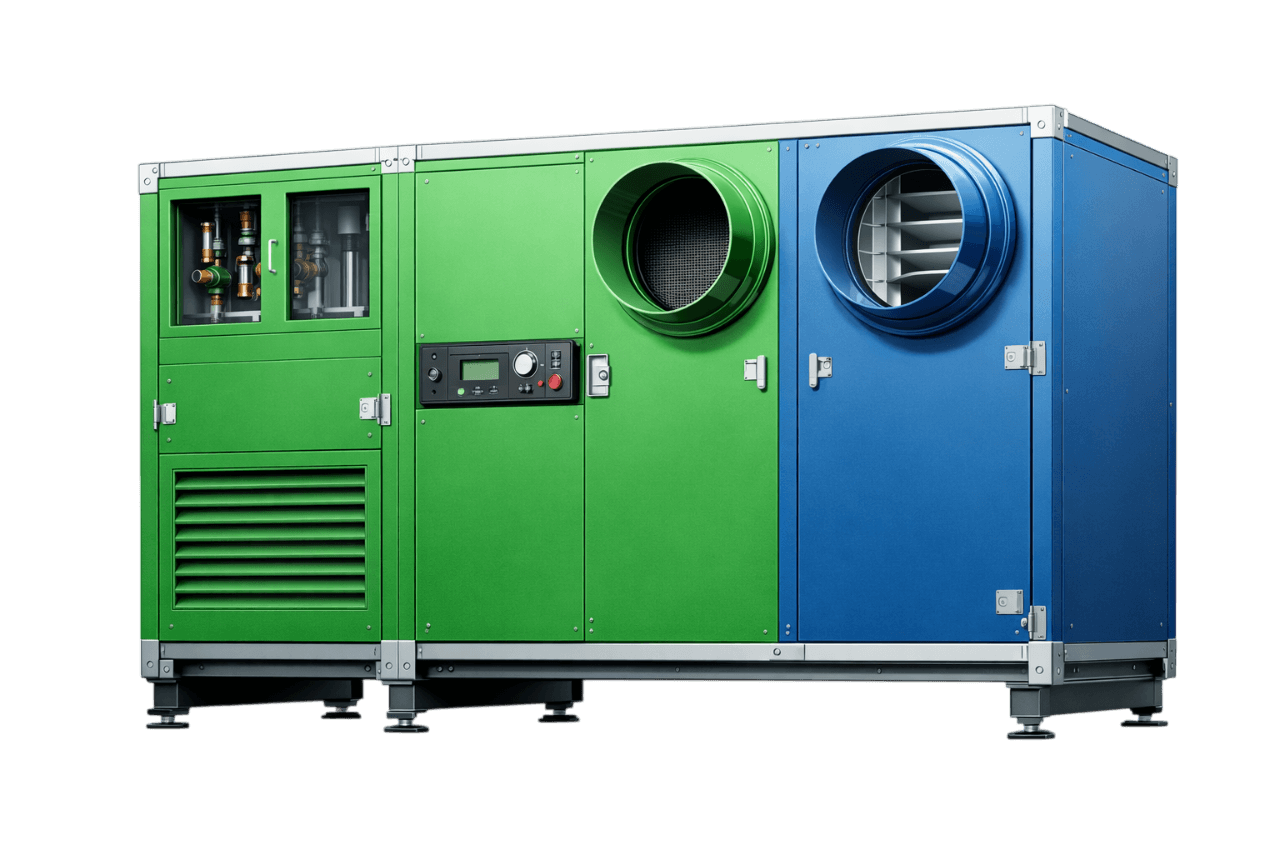
Compress India offers complete, end-to-end solutions for floor mounted air handling units, so you work with a single team from design through to long-term maintenance:
- Design: Heat load calculation, airflow (CFM) estimation, static pressure calculation, and AHU selection.
- Supply: Chilled water AHUs, DX AHUs, double skin AHUs, fresh air handling units, modular air handling units, and custom air handling units from leading manufacturers.
- Installation: AHU room planning, plinth and vibration isolation, ductwork, chilled water piping, condensate drain, and electrical panels.
- Commissioning: Airflow and static pressure measurement, coil performance checks, air balancing, and controls testing.
- Service & AMC: Preventive AHU maintenance, breakdown support, retrofits, and comprehensive or non-comprehensive annual maintenance contracts.
What Is a Floor Mounted Air Handling Unit (AHU)?
A floor mounted air handling unit (AHU) is a large, floor standing air handling unit that draws in return air and fresh air, filters it, cools or heats it, controls its humidity, and supplies it to occupied spaces through a network of ducts. It is usually installed in a dedicated AHU room or plant room at floor level.
Unlike a split AC or a small indoor air handler unit, a floor mounted AHU is built to move thousands to lakhs of CFM of air. It is the main air-side component of a centralised cooling system and works together with a chiller (in a chilled water system) or a condensing unit (in a DX system).
In simple terms, if the chiller is the heart of a central air conditioning system, the AHU is its lungs. It breathes, cleans, and conditions the air your occupants actually feel.
Role of AHUs in Centralised Cooling Systems
In a centralized cooling system, cooling is produced at one central plant and distributed across the building. The centralised air handling unit is the link between that central plant and the people inside the building. This is why AHU air conditioning is the preferred choice for large commercial and institutional buildings.
- The chiller produces chilled water, which is pumped to the AHU cooling coil.
- The AHU passes air over the coil, removing heat and moisture.
- Cooled, filtered AHU supply air is delivered through ducts to offices, wards, halls, or production areas.
- AHU return air comes back to the AHU room to be mixed with fresh air and conditioned again.
The AHU and chiller work as one system. The chiller produces the cooling, and the chiller air handling unit delivers it as comfortable, clean air. Because the central HVAC air handling unit controls airflow, filtration, fresh air, and humidity, it has a direct impact on comfort, indoor air quality (IAQ), and energy consumption. A correctly sized floor mounted AHU for a centralized cooling system keeps the entire plant running efficiently.
How a Floor Mounted AHU Works
Return Air & Fresh Air Intake
Air from the conditioned space returns to the AHU through return air ducts or a return air plenum. At the same time, outdoor air enters through a fresh air intake with louvers and a bird screen. A floor mounted AHU with fresh air intake dilutes indoor CO₂, odours, and pollutants, making the space healthier for occupants.
Mixing Box & Dampers
The return air and fresh air meet in the AHU mixing box. Manual or motorized AHU dampers control how much of each enters the unit. This allows the AHU to maintain minimum fresh air requirements while saving energy by reusing already cooled return air.
Air Filtration
The mixed air passes through the AHU filter section. Pre-filters capture larger dust particles, while fine filters and, where required, HEPA filters capture smaller particles, allergens, and microorganisms. Clean air protects both occupants and the cooling coil.
Cooling Through Chilled Water or DX Coil
Filtered air flows across the cooling coil. In a chilled water AHU, chilled water from the chiller absorbs heat from the air. In a DX AHU, refrigerant evaporates inside the coil to cool the air. The coil also removes moisture, controlling humidity inside the building.
Blower Supplying Air Through Ducts
The AHU supply fan pushes the conditioned air into the AHU duct network. Diffusers and grilles then distribute it evenly across each zone. In larger systems, an AHU return fan helps draw air back from the space. Fan speed can be controlled with a VFD or EC fan to match actual demand.
Condensate Drain Removal
Moisture removed from the air condenses on the cooling coil and collects in the drain pan. A properly designed drain trap carries this water away, preventing overflow, water carryover, and microbial growth inside the AHU.
Main Components of a Floor Mounted AHU
Double Skin Casing & Panels
Modern floor mounted AHUs use double skin panels with insulation sandwiched between an outer and inner sheet. This construction reduces heat gain, prevents condensation on the outer surface, reduces noise, and gives the unit strength and a long service life.
Mixing Box & Motorized Dampers
The mixing box combines return air and fresh air. Motorized dampers with actuators allow automatic control of fresh air, return air, and exhaust air quantities based on temperature, CO₂ levels, or BMS commands.
Pre-Filters, Fine Filters & HEPA Filters
A multi-stage filter section improves indoor air quality. A pre filter AHU stage (G4) protects downstream components, fine filters (F7/F9) remove finer particulates, and a HEPA filter AHU configuration provides very high filtration for hospitals, operation theatres, and cleanrooms.
Cooling Coil (Chilled Water / DX)
The air handling unit cooling coil is typically made of copper tubes with aluminium fins. Coil rows, fin spacing, and circuiting are selected to achieve the required cooling capacity, dehumidification, and pressure drop. Both chilled water cooling coil AHUs and DX cooling coil AHUs are available. A well-selected air handler coil is the key to reliable cooling and humidity control.
Heating Coil & Humidifier (Optional)
Where reheat or winter heating is needed, a hot water or electric heating coil can be added, allowing the same unit to work as an air handler for both heating and cooling. Humidifiers are used in pharma plants, laboratories, and hospitals where relative humidity must be held within tight limits.
Blower, Motor & Drive
The fan section includes the AHU blower, motor, and drive. Options include forward curved, backward curved, plug fans, and EC fans, with belt or direct drive. Air handler fan selection directly affects airflow, static pressure capability, noise, and energy use.
Stainless Steel Drain Pan
A sloped stainless steel drain pan collects condensate below the cooling coil. Stainless steel resists corrosion and makes cleaning and sanitization easier, which is essential for hygiene.
Vibration Isolators & Access Doors
Spring or rubber vibration isolators prevent fan vibration from travelling into the building structure. Hinged access doors with proper sealing provide easy entry for inspection, filter changes, and cleaning.
Types of Floor Mounted AHUs
There are several types of air handlers, and the right choice depends on the application, space, and cooling source. Here are the main air handling unit types used in commercial and industrial buildings:
Horizontal Floor Mounted AHUs
In horizontal AHUs, sections are arranged side by side. They suit AHU rooms with more floor length but limited height and are the most common commercial air handling unit configuration.
Vertical Floor Mounted AHUs
A vertical air handler stacks sections one above the other, saving floor space. This compact air handler design is ideal where the AHU room is small but ceiling height is available.
Chilled Water AHUs
A chilled water air handler uses chilled water from a central chiller plant, making it a true water coil air handler. Chilled water floor mounted air handling units are the preferred choice for large buildings, malls, hospitals, and airports because of their flexibility, efficiency, and capacity range.
DX AHUs
A DX air handling unit uses refrigerant directly in its coil and works with an outdoor condensing unit, so the condenser and air handler operate as a matched pair. When comparing chilled water AHU vs DX AHU, DX units suit medium-sized projects where a chiller plant is not feasible, while chilled water AHUs are better for large, multi-zone buildings.
Treated Fresh Air (TFA / FAHU) Units
A treated fresh air unit, also called a fresh air handling unit (FAHU), handles 100% outdoor air. It filters, cools, and dehumidifies fresh air before supplying it to the building or to other AHUs and FCUs. In the AHU vs FAHU comparison, a standard AHU mainly conditions return air, while a FAHU is dedicated to treating AHU fresh air.
Recirculation AHUs
Recirculation AHUs primarily condition return air with a controlled amount of fresh air. They are energy efficient and widely used in offices, retail, and hospitality spaces.
Hygienic & Pharma-Grade AHUs
Hygienic AHUs feature smooth internal surfaces, stainless steel components, cleanable construction, and HEPA filtration. They are used in hospitals, operation theatres, pharmaceutical plants, food processing units, and cleanrooms.
AHUs with Heat Recovery Wheels
Heat recovery AHUs and energy recovery AHUs use a thermal wheel or plate heat exchanger to recover energy from exhaust air and pre-cool incoming fresh air, significantly lowering cooling load.
Outdoor / Weatherproof AHUs
Outdoor AHUs have weatherproof casings, rain hoods, and protective roofs. They are installed on terraces or open areas when there is no space for an indoor air handling unit room.
AHU Capacity & Sizing – CFM, TR & Static Pressure
Correct AHU sizing is one of the most important decisions in any HVAC project. An undersized unit cannot maintain comfort, while an oversized unit wastes energy and struggles with humidity control.
Airflow (CFM) Calculation
AHU CFM is calculated from the sensible heat load of the space and the desired supply air temperature difference. Room volume, occupancy, and application also influence the required AHU airflow and air volume.
Cooling Capacity (TR) Selection
The cooling capacity in tonnes of refrigeration (TR) depends on sensible and latent loads, fresh air load, and design conditions. Compress India carries out detailed heat load calculations to select the right coil capacity for your building.
Air Changes per Hour
Some applications, such as hospitals, operation theatres, and cleanrooms, specify minimum air changes per hour (ACH). In these cases, airflow is selected to meet the required ACH as well as the cooling load.
External Static Pressure
AHU external static pressure (ESP) is the resistance offered by ducts, diffusers, dampers, and fittings outside the unit. Accurate AHU static pressure calculation ensures the fan delivers the design airflow. Long duct runs and HEPA terminals often require a high static pressure floor mounted AHU.
Coil Face Velocity
Coil face velocity is typically kept within recommended limits to avoid water carryover, excess pressure drop, and noise. Proper face velocity improves dehumidification and coil life.
Double Skin AHU Construction
A double skin air handling unit is the standard for quality central air handling systems. Its construction determines thermal performance, hygiene, and durability.
Panel Thickness (25 mm / 50 mm)
25 mm panels suit many comfort cooling applications, while 50 mm panels provide better insulation, lower heat gain, and improved acoustic performance for demanding and energy-sensitive projects.
PUF vs Rockwool Insulation
PUF (polyurethane foam) insulation offers excellent thermal performance at lower thickness. Rockwool insulation offers superior fire resistance and acoustic performance. The choice depends on fire safety requirements, noise needs, and budget.
Thermal Break Profiles
Thermal break profiles separate the inner and outer frame, preventing heat bridging and external condensation. They are recommended for hygienic AHUs and for humid climates like Mumbai.
Casing Leakage & Thermal Performance
A well-built double skin AHU has low casing air leakage, ensuring that filtered and cooled air reaches the space rather than leaking out. Good sealing improves efficiency, hygiene, and airflow accuracy.
Filtration & Indoor Air Quality
Filter Grades (G4, F7, F9, HEPA)
- G4: Pre-filter for coarse dust and larger particles.
- F7: Fine filter for commercial buildings and offices.
- F9: High-grade fine filter AHU stage for hospitals and sensitive areas.
- HEPA: Very high-efficiency filtration for operation theatres, ICUs, cleanrooms, and pharma areas.
Filter Selection by Application
Offices and malls typically use G4 + F7 filtration. Hospitals use G4 + F9, with HEPA filters for critical areas. Pharma plants and cleanrooms use multi-stage filtration with terminal HEPA filters to meet cleanroom classification requirements.
UV-C Lamps for Coil & Air Disinfection
UV-C lamps installed near the cooling coil and drain pan help control mould and bacterial growth, keep coils cleaner, and support better indoor air quality.
Filter Differential Pressure Monitoring
Differential pressure gauges or sensors across each filter indicate when filters are clogged. This allows timely replacement, maintains airflow, and prevents unnecessary energy consumption.
AHU Fans & Motors
Forward Curved vs Backward Curved Fans
Forward curved fans are compact and suitable for lower static pressure applications. Backward curved fans offer higher efficiency and are better suited to higher static pressure systems and large airflow.
Plug Fans & EC Fans
Plug fans are direct-driven fans without a scroll housing, offering compact installation, easier cleaning, and good efficiency. An EC fan AHU uses electronically commutated motors with built-in speed control, delivering excellent part-load efficiency and low noise.
Belt Drive vs Direct Drive
Belt-driven fans allow speed adjustment through pulleys but need regular belt tensioning and replacement. Direct-drive fans eliminate belt losses and maintenance, improving reliability and efficiency.
VFD Speed Control
A VFD air handling unit uses a variable frequency drive to vary fan speed according to demand. This reduces energy consumption, allows precise airflow control, and extends motor life.
IE3 / IE4 Motors
High-efficiency IE3 and IE4 motors reduce electrical losses and operating costs, especially for AHUs that run long hours every day.
Energy Efficiency in AHUs
AHUs often run for 12 to 24 hours a day, so small efficiency improvements lead to large savings. An energy efficient floor mounted air handling unit lowers electricity bills and supports green building goals.
EC Fans & VFDs
EC fans and VFDs match fan speed to actual load, cutting fan energy significantly during part-load operation.
Heat Recovery Wheels & Energy Recovery
Heat recovery wheels transfer energy between exhaust air and incoming fresh air, reducing the load on the chiller and cooling coil.
Low Pressure Drop Coils & Filters
Selecting coils and filters with lower pressure drop reduces the fan power needed to move the same airflow.
CO₂-Based Demand Controlled Ventilation
CO₂ sensors adjust fresh air quantity based on actual occupancy. This avoids over-ventilation during low occupancy and saves cooling energy.
AHU Controls & BMS Integration
Chilled Water Control Valves (Two-Way / PICV)
Two-way valves and pressure independent control valves (PICV) regulate chilled water flow through the coil according to load, improving temperature control and reducing pumping energy.
Temperature & Humidity Control
Sensors in the supply and return air paths provide accurate AHU temperature control and AHU humidity control, which is critical in hospitals, labs, and pharma areas.
Damper Actuators
Motorized damper actuators control fresh air, return air, and exhaust air automatically based on schedules, CO₂ levels, or economizer logic.
Filter Clog & Fan Status Alarms
Differential pressure switches provide filter clog alarms and fan status indication, helping maintenance teams act before problems affect comfort.
BMS Connectivity
Floor mounted AHUs with BMS integration can be monitored and controlled centrally through BACnet or Modbus protocols. AHU building automation enables scheduling, trend logging, alarm management, and energy optimisation.
Benefits of Floor Mounted AHUs
High Airflow for Large Spaces
Floor mounted AHUs handle very high airflow, making them ideal for malls, auditoriums, airports, and large offices.
Better Air Filtration & IAQ
Multi-stage filtration, UV-C options, and fresh air control deliver superior indoor air quality compared to decentralised systems.
Fresh Air & Humidity Control
AHUs provide controlled fresh air and effective dehumidification, which is especially important in humid coastal cities like Mumbai.
Quiet Occupied Spaces (Equipment in AHU Room)
Since the fan and motor are located in a separate air handler room, occupied spaces stay quiet and free from equipment noise.
Easy Service Access at Floor Level
Floor level installation makes filter changes, coil cleaning, and motor servicing easier and safer than working at ceiling height.
Long Service Life
With double skin construction and proper maintenance, a quality AHU unit can serve reliably for many years.
Limitations of Floor Mounted AHUs
Requires a Dedicated AHU Room
Floor mounted AHUs need an air handling unit room with sufficient space and service clearances. This must be planned early in building design.
Needs Chiller or DX Plant
An AHU does not produce cooling by itself. It requires a chiller plant or DX condensing unit.
Extensive Ductwork
Air distribution through ducts requires ceiling space, proper design, and insulation.
Higher Initial Cost Than Packaged Units
The initial investment is higher than packaged units, but it is offset by better performance, efficiency, and service life in large buildings.
Compress India helps you plan the AHU room, ducting, and plant capacity in advance, so these limitations are managed from day one.
Floor Mounted AHU vs Ceiling Suspended AHU
- Installation: Floor mounted AHUs sit in a dedicated AHU room; ceiling suspended AHUs hang from the slab above false ceilings.
- Capacity: Floor mounted units handle much higher CFM and TR; ceiling suspended AHUs suit smaller zones.
- Space: Ceiling suspended units save floor space; floor mounted units need an AHU room.
- Maintenance: Floor mounted AHUs are easier to service at floor level.
- Noise: Floor mounted AHUs keep noise away from occupied areas more effectively.
- Best For: Floor mounted AHUs for large central systems; ceiling mount air handlers for small offices, shops, or zones without plant room space.
AHU vs FCU (Fan Coil Unit)
- Size: An AHU serves large areas or multiple zones; an FCU serves a single room or small zone.
- Fresh Air: AHUs handle fresh air and filtration; FCUs mainly recirculate room air.
- Filtration: AHUs offer multi-stage filtration up to HEPA; FCUs usually have basic filters.
- Ducting: AHUs use extensive ductwork; FCUs use short duct runs or are ductless.
- Application: Many buildings combine a fan coil unit and air handling unit, with a TFA unit supplying fresh air and FCUs handling local cooling.
AHU vs Packaged AC Unit
- Cooling Source: An AHU uses chilled water or a DX plant; a packaged AC has its own compressor.
- Capacity: AHUs scale to very large capacities; packaged units are limited in size.
- Efficiency: Chilled water AHU systems are more efficient for large buildings.
- Air Quality: AHUs offer better filtration, fresh air control, and humidity control.
- Cost: Packaged units cost less initially, but AHU systems offer lower operating costs and longer life for large facilities.
- AHU vs RTU: A rooftop unit (RTU) is a packaged unit placed on the roof. It is quick to install but offers less flexibility, filtration, and efficiency than a floor mounted AHU connected to a central plant.
Where Floor Mounted AHUs Are Used
Shopping Malls & Commercial Complexes
High footfall areas need large airflow, strong fresh air supply, and reliable cooling. An AHU for a shopping mall or a floor mounted air handling unit for a commercial building delivers all three.
Corporate Offices
AHUs for office buildings maintain comfort, fresh air, and quiet workspaces, supporting productivity.
Hospitals & Operation Theatres
AHUs for hospitals provide HEPA filtration, pressure control, humidity control, and required air changes. A properly designed AHU room in a hospital serves operation theatres, ICUs, and isolation rooms with clean, controlled air.
Pharmaceutical Plants & Cleanrooms
Pharma AHUs and cleanroom AHUs maintain strict temperature, humidity, and particle count requirements for regulated production areas.
Hotels & Banquet Halls
AHUs for hotels keep lobbies, restaurants, and banquet halls comfortable even during peak occupancy.
Airports & Metro Stations
Large public spaces need high-capacity chilled water AHUs with reliable, continuous operation.
Auditoriums & Cinemas
Low-noise AHUs with acoustic treatment ensure comfort without disturbing performances or screenings.
Manufacturing & Food Processing Plants
An industrial air handler controls temperature, humidity, and hygiene in production and processing environments, making it the right AHU for industrial buildings.
Top AHU Manufacturers in India
India has a strong base of air handling unit manufacturers offering double skin, modular, hygienic, and custom air handling units. Compress India supplies and installs AHUs from leading brands based on project needs and specifications.
Zeco
The Zeco air handling unit range is made by an Indian manufacturer known for double skin and hygienic AHUs for commercial, healthcare, and industrial applications.
Edgetech
Edgetech AHU solutions come from an Indian air handling specialist offering AHUs and air-side equipment for comfort and process applications.
Blue Star
Blue Star is a well-known Indian HVAC brand offering a wide range of central air conditioning equipment, including air handling units.
Voltas
Voltas offers air handling units as part of its central air conditioning and HVAC product range.
Daikin
Daikin AHU and Daikin air handling unit solutions are available for chilled water and DX applications across commercial projects.
Carrier
Carrier offers air handling units for commercial and industrial HVAC systems as part of its central cooling range.
Trane
Trane provides air handling units designed for commercial and institutional buildings.
Other AHU Manufacturers
Other options include VTS air handling units and a number of specialised manufacturers of custom and modular AHUs. Compress India recommends the most suitable brand and model based on performance, budget, delivery timelines, and service support.
Floor Mounted AHU Installation Guide
Correct AHU installation is as important as correct selection. Compress India follows proven installation practices to ensure your AHU performs as designed.
AHU Room Planning & Clearances
The AHU room must allow clearance for coil withdrawal, filter removal, fan servicing, and access doors. Good planning also includes lighting, drainage, and ventilation in the AHU room.
Plinth, Foundation & Vibration Isolation
The AHU is installed on a level concrete plinth with vibration isolators to prevent transmission of noise and vibration to the building structure.
Duct Connections & Flexible Connectors
Supply and return ducts are connected using flexible canvas connectors that isolate vibration and allow minor alignment adjustments.
Chilled Water Piping Connections
Chilled water pipes are connected with isolation valves, strainers, control valves, thermometers, and pressure gauges, and are properly insulated to prevent condensation.
Condensate Drain Trap Design
A correctly sized drain trap is essential, especially on the negative pressure side of the unit. It prevents air from being sucked in through the drain and stops drain pan overflow.
Electrical, Starter & VFD Panels
Electrical panels, starters, and VFD panels are installed with proper cabling, earthing, and protection devices for safe and reliable operation.
Noise Control & Acoustic Treatment
Sound attenuators, acoustic lining, and AHU room wall treatment keep noise within acceptable limits for nearby occupied areas.
AHU Testing & Commissioning
Airflow & Static Pressure Measurement
Supply airflow, return airflow, and external static pressure are measured and compared with design values.
Coil Performance Check
Entering and leaving air and water temperatures are recorded to verify cooling capacity and dehumidification.
Air Balancing
Airflow at each diffuser and branch is measured and balanced so every zone receives its design airflow.
Controls & Safety Checks
Temperature control, valve operation, damper actuators, alarms, interlocks, and BMS communication are tested before handover.
AHU Service, Maintenance & AMC
Regular AHU maintenance protects air quality, energy efficiency, and equipment life. Compress India offers scheduled preventive maintenance and AMC plans for floor mounted AHUs.
Filter Cleaning & Replacement
Filters are cleaned or replaced at defined intervals depending on dust levels and filter pressure drop.
Cooling Coil Cleaning
Coil cleaning with suitable chemicals restores heat transfer and airflow and reduces energy consumption.
Drain Pan Cleaning & Sanitization
Regular cleaning and sanitization of the drain pan prevents blockages, odours, and microbial growth.
Belt, Bearing & Motor Checks
Belts are tensioned or replaced, bearings are greased, and motor current and insulation are checked to prevent breakdowns.
Damper & Actuator Checks
Dampers and actuators are inspected to ensure smooth movement and correct fresh air control.
Comprehensive vs Non-Comprehensive AMC
- Comprehensive AMC: Covers scheduled maintenance plus the cost of specified spare parts, offering predictable annual costs.
- Non-Comprehensive AMC: Covers scheduled maintenance and service visits, with spare parts charged separately as needed.
Common AHU Problems & Solutions
Low Airflow
Causes: clogged filters, dirty coil, belt slippage, closed dampers, or duct leakage.
Solution: Clean or replace filters, clean the coil, adjust belts, check dampers, and seal ducts.
AHU Not Cooling Properly
Causes: low chilled water flow, high water temperature, faulty control valve, or dirty coil.
Solution: Check chilled water supply, valve operation, strainers, and coil condition.
Water Carryover & Drain Pan Overflow
Causes: high coil face velocity, blocked drain, or incorrect trap design.
Solution: Clean the drain, correct the trap height, and check airflow across the coil.
High Humidity in the Space
Causes: excess fresh air, oversized unit, or high chilled water temperature.
Solution: Adjust fresh air, review controls, and optimise chilled water temperature or add a TFA unit.
Noise & Vibration
Causes: fan imbalance, worn bearings, loose parts, or failed isolators.
Solution: Balance the fan, replace bearings, tighten components, and repair isolators.
Belt Slippage & Bearing Failure
Causes: poor tensioning, misalignment, or lack of lubrication.
Solution: Align pulleys, tension belts correctly, and follow a lubrication schedule, or convert to direct drive.
Bad Smell & Microbial Growth
Causes: stagnant water, dirty coil, or wet insulation.
Solution: Clean and sanitize the coil and drain pan, fix drainage, and consider UV-C lamps.
AHU Retrofit & Upgrades
Older AHUs can be upgraded to improve efficiency, air quality, and reliability without replacing the entire system.
EC Fan Retrofit
Replacing belt-driven fans with EC fans reduces energy consumption, eliminates belt maintenance, and lowers noise.
Adding VFDs to Existing AHUs
Adding a VFD allows airflow to follow demand and brings quick energy savings.
Coil Replacement
Corroded or leaking coils can be replaced with new high-efficiency coils to restore cooling performance.
Filter & UV-C Upgrades
Upgrading to higher filter grades and adding UV-C lamps improves indoor air quality and coil hygiene.
Complete AHU Refurbishment
Refurbishment may include new panels, insulation, drain pan, fan, motor, and controls to extend the life of an existing AHU.
Floor Mounted AHU Price in India
The floor mounted AHU price in India depends on capacity, construction, filtration, fan type, controls, and installation scope. Air handler prices vary widely from project to project, so Compress India provides a detailed quotation after understanding your requirements.
AHU Price by CFM & TR
AHU unit price is largely driven by airflow (CFM) and cooling capacity (TR). Smaller units for individual zones cost less, while large chilled water AHUs for malls, hospitals, and airports cost more. Higher static pressure requirements also increase the fan and motor size and the overall price.
Construction & Filtration Cost Factors
Panel thickness (25 mm or 50 mm), insulation type (PUF or Rockwool), thermal break profiles, stainless steel components, HEPA filtration, heat recovery wheels, EC fans, and BMS-ready controls all influence the air handler unit cost.
Installation & Ducting Cost
Installation cost includes rigging, plinth work, vibration isolation, chilled water piping, ductwork, insulation, electrical panels, testing, and commissioning. Ducting is often a significant part of the total project cost.
If you are looking for an air handler for sale for a commercial or industrial project, share your building area, application, and drawings with Compress India. Our team will recommend the right unit and provide a transparent quotation.
Floor Mounted AHU Supply, Installation & Service in Mumbai, Navi Mumbai & Thane
As an experienced floor mounted AHU supplier, Compress India provides AHU supply, installation, commissioning, service, and AMC across Mumbai, Navi Mumbai, and Thane. We understand the humid coastal climate of the region and design AHU systems with strong dehumidification, corrosion-resistant construction, and efficient operation.
Whether you are building a new commercial complex, upgrading a hospital AHU room, or maintaining an existing central air conditioning system, our local team offers fast site visits, quick response, and reliable support.
Why Choose Compress India for Floor Mounted AHUs?
Heat Load & Airflow Design
We start with accurate heat load calculation, airflow design, and static pressure calculation, so your AHU is sized correctly for comfort and efficiency.
AHU Selection & Multi-Brand Supply
We work with leading floor mounted AHU manufacturers and recommend the best-fit unit based on performance, budget, and delivery timelines. Our multi-brand approach gives you access to trusted AHU India options for every type of project.
Chilled Water Piping & Ductwork Execution
Our team executes chilled water piping, ductwork, insulation, and drain connections with quality workmanship.
Controls & BMS Integration
We integrate AHU controls with your BMS for monitoring, scheduling, alarms, and energy optimisation.
Testing, Balancing & Commissioning
Every installation is tested, balanced, and commissioned to verify design airflow, cooling, and control performance.
AMC & Retrofit Support
We provide preventive maintenance, breakdown support, AMC plans, and retrofit upgrades to keep your AHU system running efficiently for years.
Commercial, Healthcare & Industrial Projects
Our experience covers offices, malls, hotels, hospitals, pharma plants, cleanrooms, and industrial facilities.
Get a Floor Mounted AHU Solution from Compress India
Planning a new central HVAC system or upgrading an existing AHU? Compress India delivers complete floor mounted air handling unit solutions, from design and supply to installation, commissioning, and long-term service.
Connect with Our HVAC Team
Share your project details, building drawings, or current AHU issues with our team. Call us or fill in the enquiry form to schedule a site visit and receive a detailed technical proposal and quotation.
Related Chiller, Ductwork & Air Conditioning Solutions
Along with AHUs, Compress India offers chillers, chilled water piping, ductwork, fan coil units, treated fresh air units, and complete central air conditioning solutions for commercial and industrial buildings.
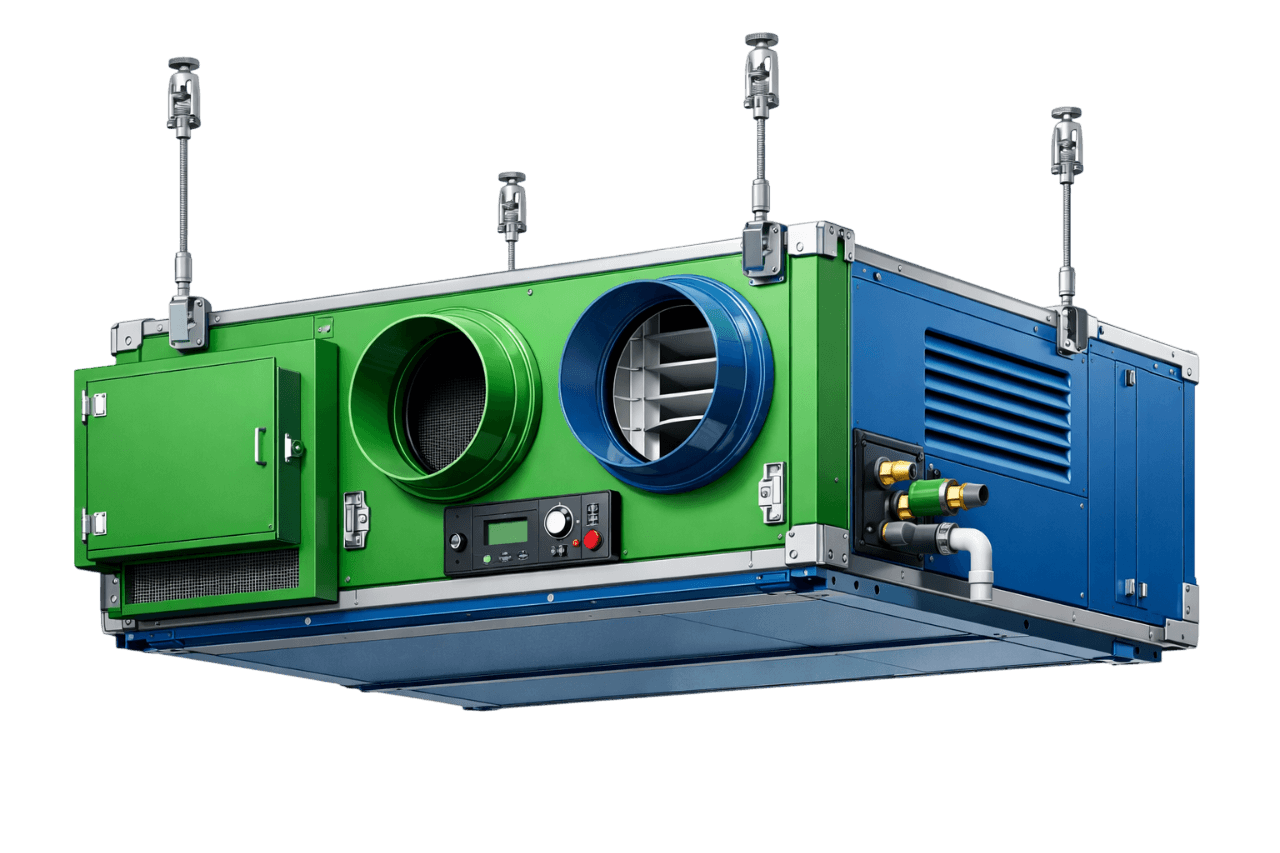
Ceiling Suspended Air Handling Units
Learn More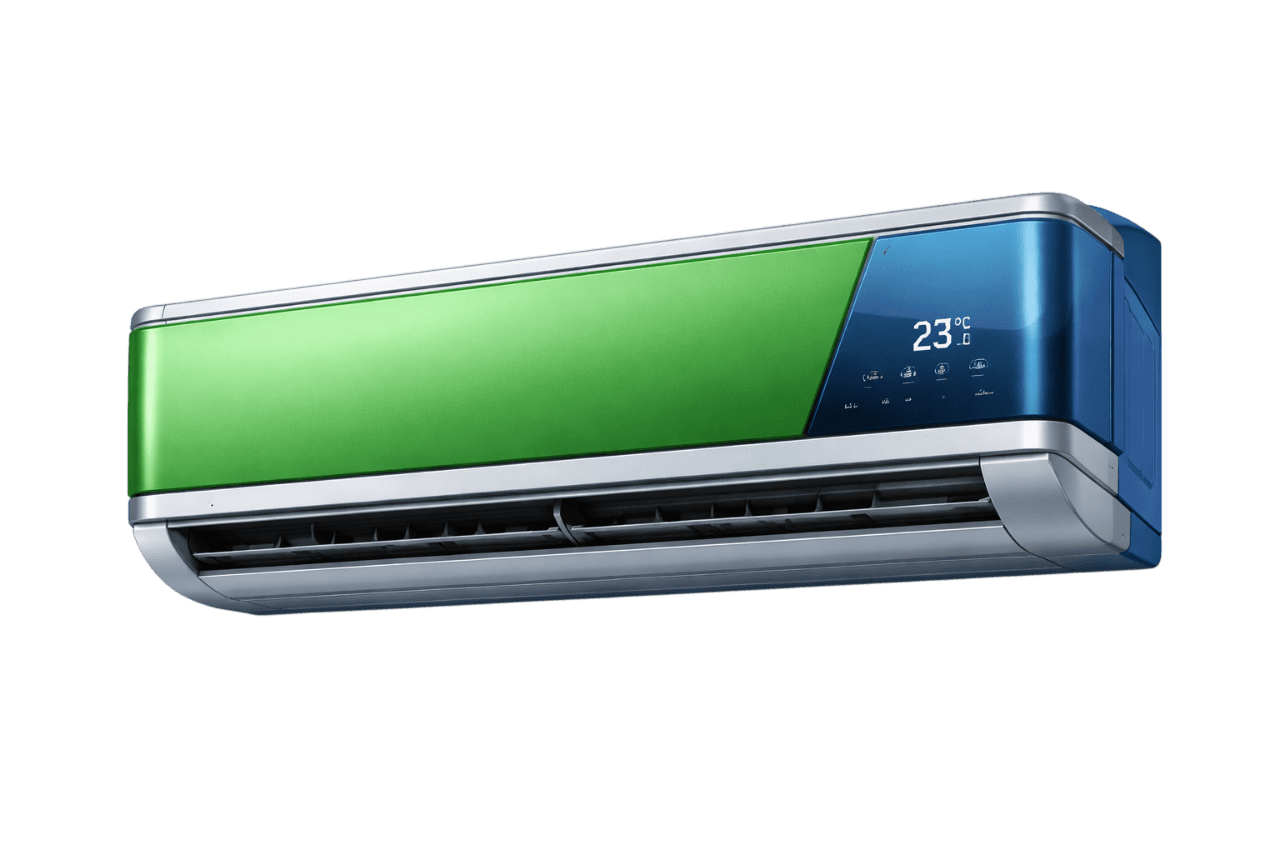
Split / Hi Wall Units
Learn More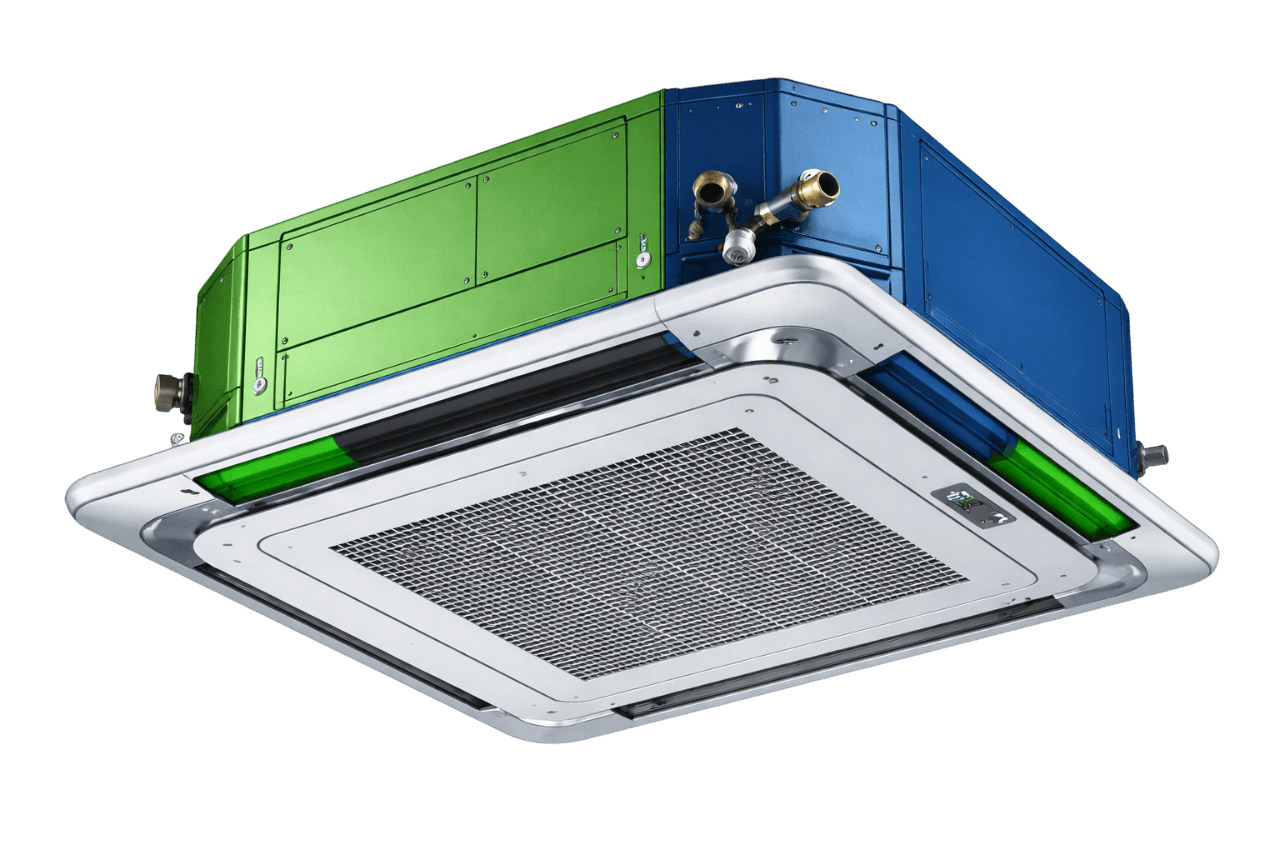
Cassette Units
Learn More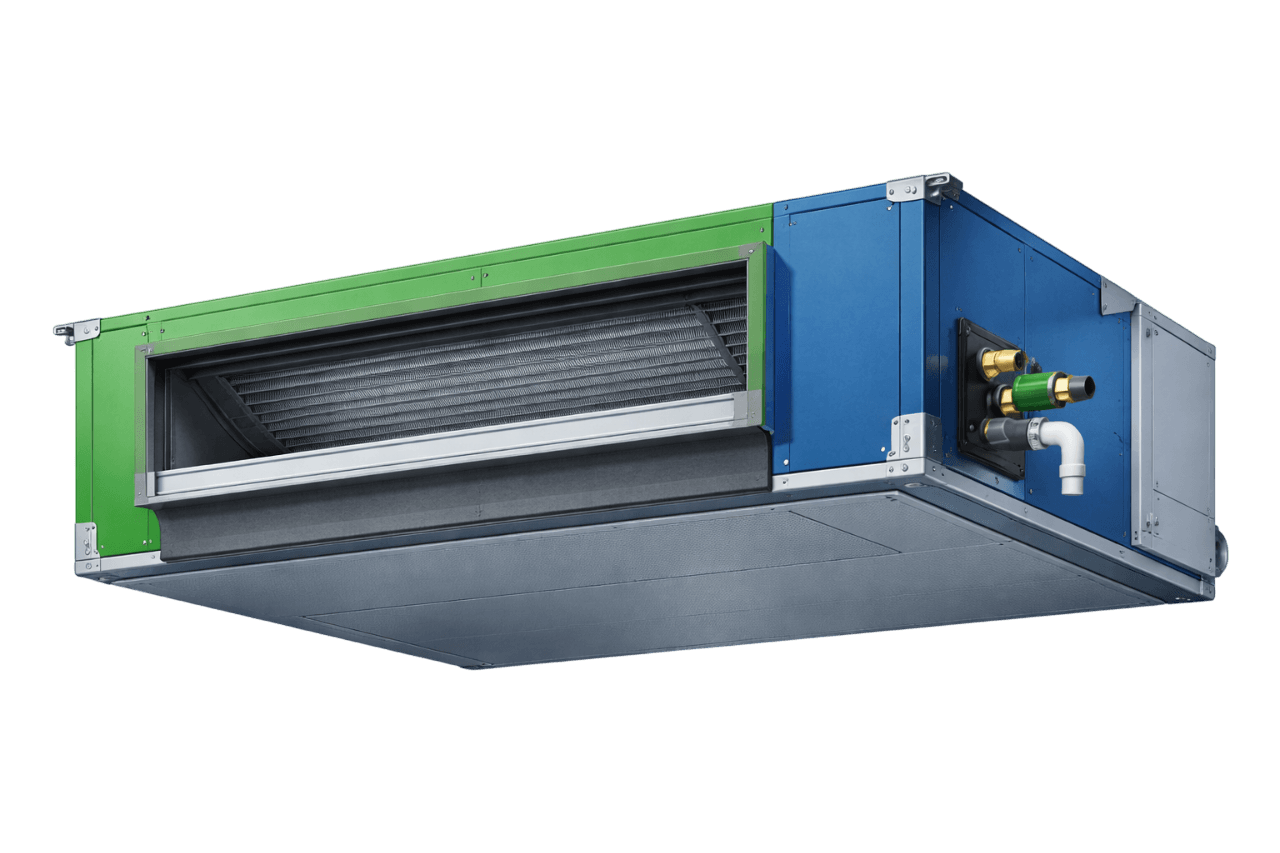
Ducted Units
Learn More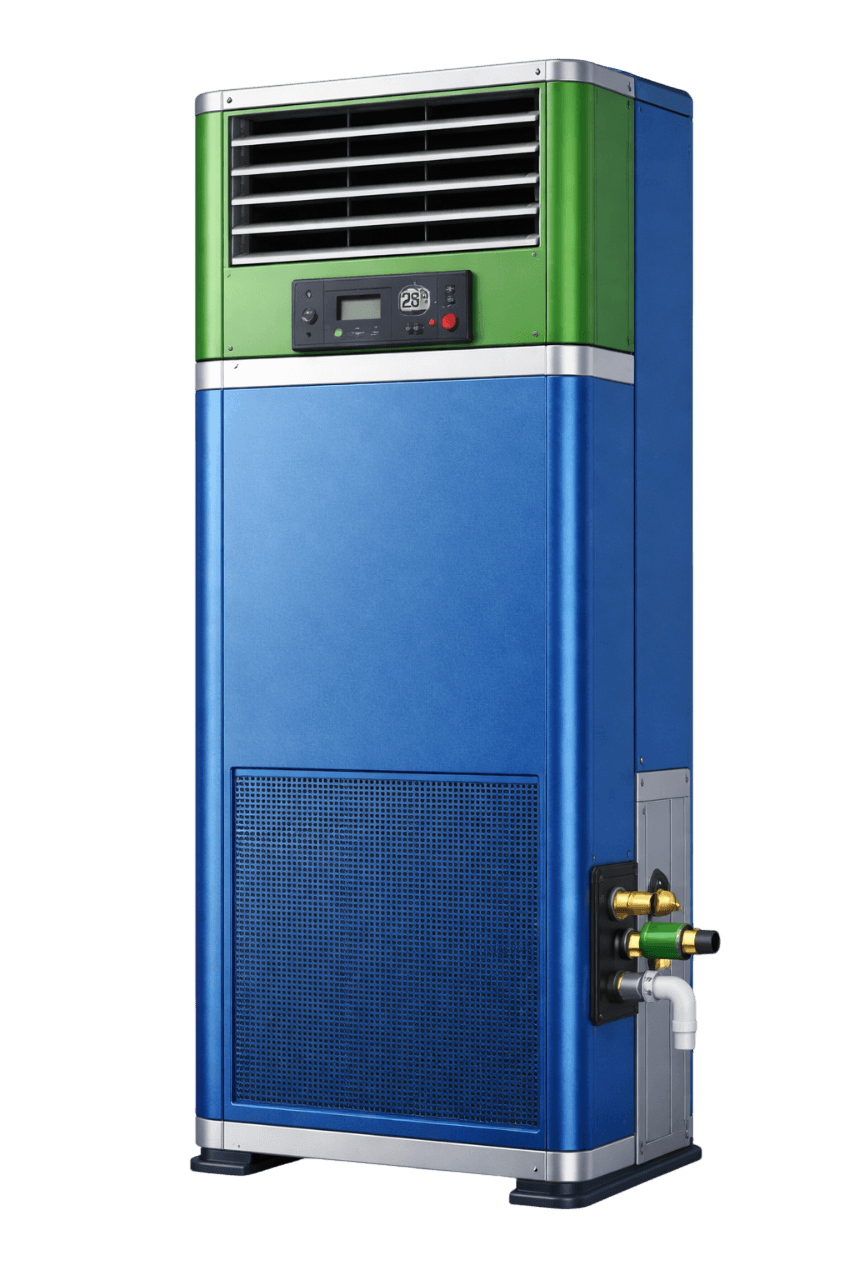
Tower / Vertical Units
Learn More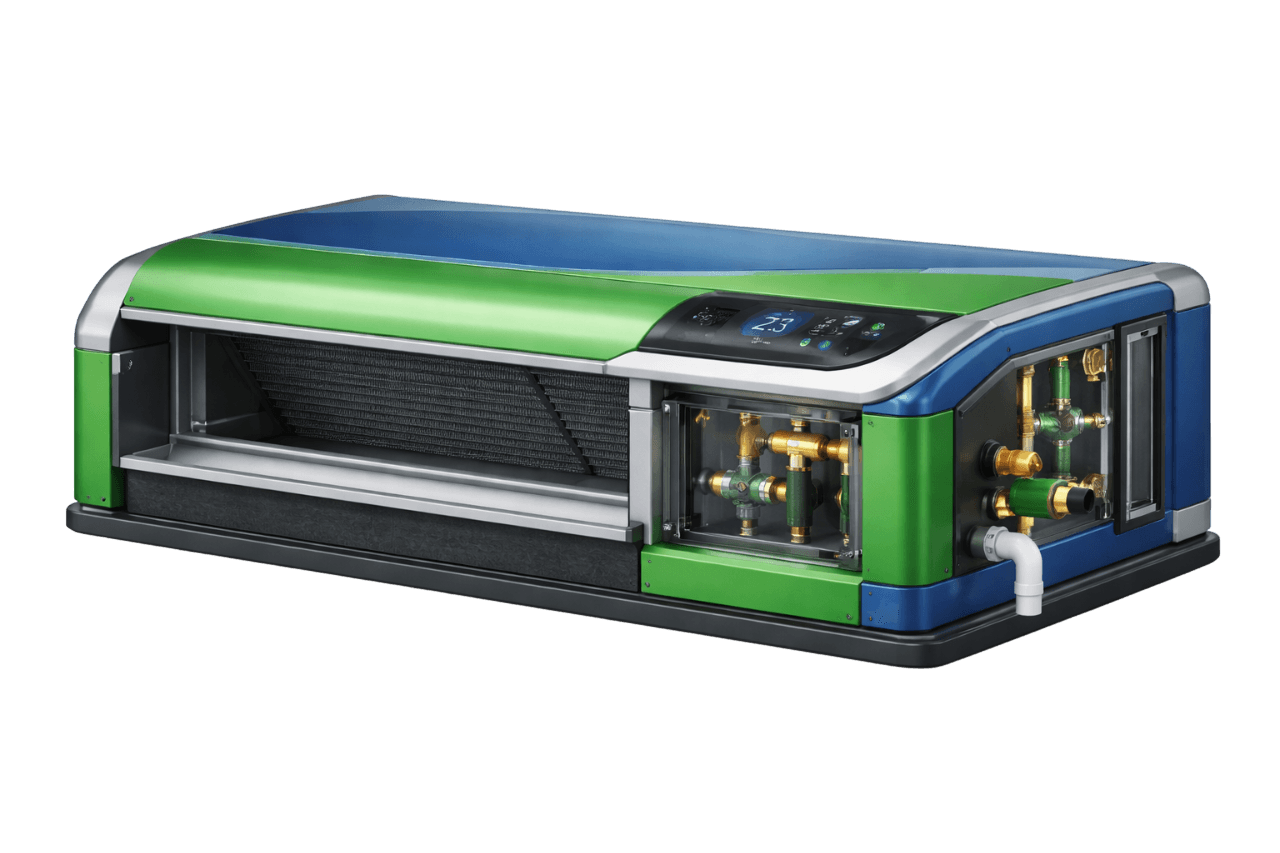
Custom Fan Coil Units
Learn MoreFrequently Asked Questions
Q1: What is a floor mounted air handling unit (AHU)?
A floor mounted AHU is a floor standing HVAC unit installed in an AHU room that filters, cools, dehumidifies, and supplies conditioned air to a building through ducts. It is a key part of centralised cooling systems.
Q2: How does an AHU work in a central cooling system?
The AHU draws in return air and fresh air, filters it, cools it using chilled water or refrigerant in the cooling coil, and supplies it through ducts. The chiller or DX unit provides the cooling, while the AHU distributes conditioned air.
Q3: What is the difference between a floor mounted and a ceiling suspended AHU?
A floor mounted AHU is installed in a dedicated AHU room and handles larger airflow and cooling capacity. A ceiling suspended AHU hangs above the false ceiling, saves floor space, and suits smaller zones.
Q4: What is the difference between an AHU and an FCU?
An AHU serves large areas, handles fresh air, and offers multi-stage filtration. An FCU is a smaller unit that cools a single room or zone, mainly by recirculating room air.
Q5: What is a double skin AHU?
A double skin AHU has casing panels made of two metal sheets with insulation between them. This improves thermal performance, reduces noise, prevents condensation, and increases durability.
Q6: What is the difference between a fresh air AHU (TFA) and a recirculation AHU?
A TFA or fresh air AHU handles 100% outdoor air and treats it before supply. A recirculation AHU mainly conditions return air with a controlled portion of fresh air.
Q7: How is the size (CFM & TR) of an AHU selected?
AHU size is selected based on heat load calculation, required airflow, air changes per hour, fresh air requirements, and external static pressure. Compress India performs detailed calculations before recommending a unit.
Q8: What filters are used in AHUs?
AHUs commonly use G4 pre-filters, F7 or F9 fine filters, and HEPA filters for critical applications like hospitals, operation theatres, and cleanrooms.
Q9: What are EC fans and plug fans in AHUs?
Plug fans are direct-driven fans without a scroll housing. EC fans use electronically commutated motors with built-in speed control. Both offer high efficiency, lower maintenance, and quieter operation.
Q10: How often should an AHU be serviced?
Filters should be checked monthly, with coils, drain pans, belts, and bearings serviced quarterly or as per usage. An AMC with Compress India ensures regular, scheduled maintenance.
Q11: What is the price of a floor mounted AHU in India?
The price depends on CFM, TR, construction, filtration, fan type, controls, and installation scope. Contact Compress India with your requirements for an accurate quotation.
Q12: Does Compress India supply and install AHUs in Mumbai?
Yes. Compress India supplies, installs, commissions, and services floor mounted AHUs across Mumbai, Navi Mumbai, and Thane, along with AMC and retrofit support.