Water Cooled Centrifugal Chiller
(Installation, Commissioning, Repair, Retrofitting & Lifecycle Support Services)
Water-Cooled Centrifugal Chiller Systems – Engineering Execution & Field Services
Compress India provides Water-Cooled Centrifugal Chillers for high-capacity commercial HVAC, industrial cooling, central chilled water systems, data centers, hospitals, pharmaceutical facilities, manufacturing plants, hotels, airports, IT parks and district cooling applications.
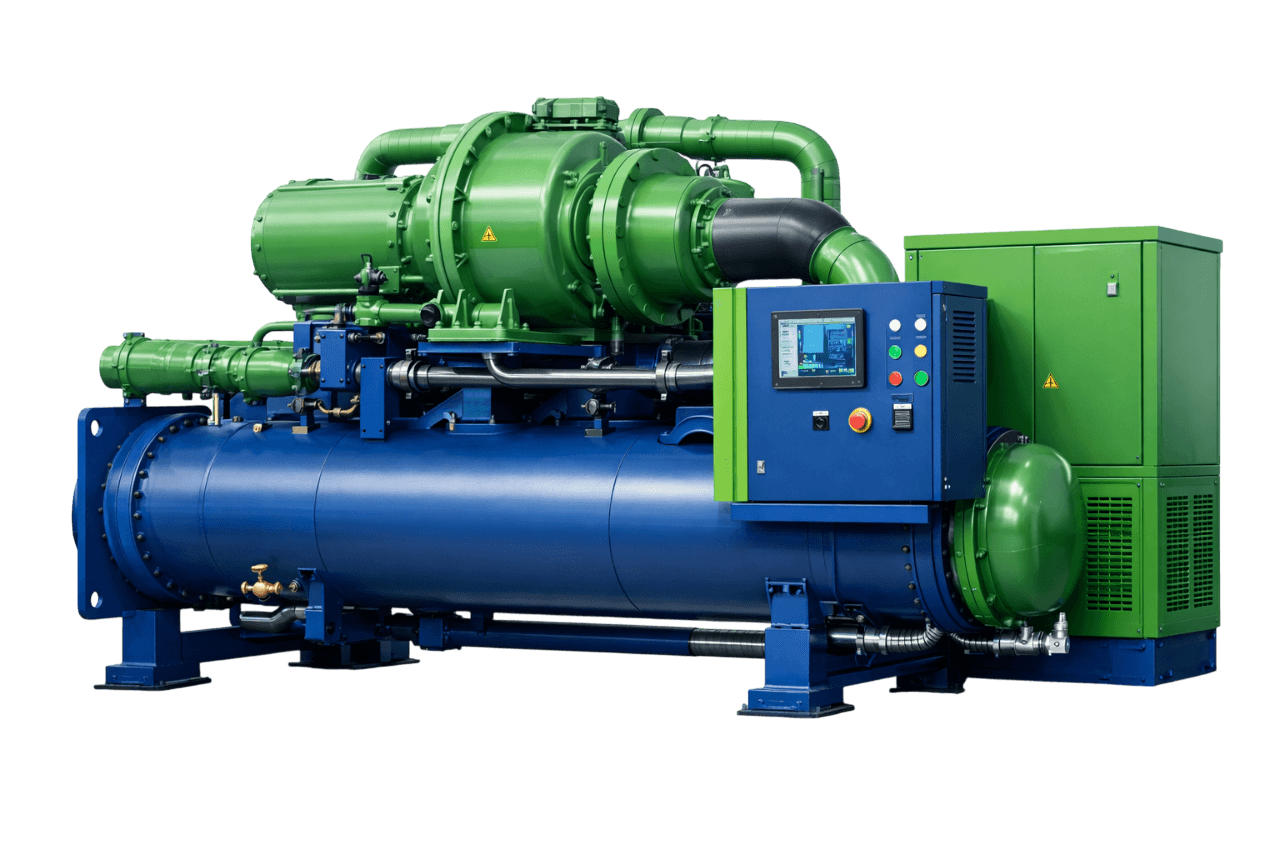
Compress India supports complete centrifugal chiller projects including equipment selection, supply coordination, plant engineering, installation, chilled-water and condenser-water piping, cooling tower integration, pumps, electrical systems, controls, automation, commissioning, repair, overhaul, retrofitting and AMC support.
Whether your project requires a 500 TR Water Cooled Centrifugal Chiller, 1000 TR, 1500 TR, 2000 TR or a multiple-chiller central plant, the correct solution should be selected according to actual cooling demand, operating hours, chilled-water temperatures, condenser-water temperatures, redundancy and efficiency requirements.
Planning a high-capacity chilled-water plant?
Contact Compress India with your required TR capacity, application, design temperatures, project location and operating profile for a technically suitable centrifugal chiller solution.
What Is a Water Cooled Centrifugal Chiller?
A Water Cooled Centrifugal Chiller is a high-capacity refrigeration machine that uses a centrifugal compressor to remove heat from chilled water and transfer that heat to condenser water.
The condenser water then carries the rejected heat to a cooling tower.
A typical Water Cooled Centrifugal Compressor Chiller system consists of:
Centrifugal compressor
Evaporator
Water-cooled condenser
Expansion device
Refrigerant circuit
Chilled-water pumps
Condenser-water pumps
Cooling tower
Electrical starter or VFD
Microprocessor controller
Sensors and safety controls
Central plant automation where required
The complete system forms a Central Chilled Water System capable of serving large buildings, campuses, industrial plants and district cooling networks.
Water Cooled Centrifugal Chiller Working Principle
The Water Cooled Centrifugal Chiller Working Principle is based on the vapour-compression refrigeration cycle combined with dynamic centrifugal compression.
The process continuously removes heat from chilled water and transfers it to the condenser-water circuit.
1. Heat Absorption in the Evaporator
Warm return water from the HVAC or industrial process enters the evaporator.
Low-pressure refrigerant absorbs heat from the water.
As heat is removed, chilled water leaves the evaporator and returns to the building or industrial cooling system.
2. Centrifugal Compression
Refrigerant vapour enters the Water Cooled Centrifugal Chiller Compressor.
The compressor impeller rotates at high speed and accelerates the refrigerant.
Velocity energy is then converted into pressure, increasing refrigerant pressure and temperature before condensation.
3. Heat Rejection in the Water-Cooled Condenser
High-pressure refrigerant enters the condenser.
Condenser water absorbs heat from the refrigerant.
The refrigerant condenses while the condenser water becomes warmer.
4. Cooling Tower Heat Rejection
Warm condenser water is pumped to the cooling tower.
The cooling tower rejects heat to the atmosphere and returns cooler water to the chiller condenser.
5. Refrigerant Expansion
Condensed refrigerant passes through an expansion device.
Its pressure and temperature decrease before it returns to the evaporator.
The cycle then repeats continuously while cooling is required.
Centrifugal Compressor Working Principle
The Centrifugal Compressor Working Principle differs significantly from scroll, reciprocating and screw compression.
A centrifugal compressor uses a rapidly rotating impeller to increase refrigerant velocity.
The compressor then converts this velocity into pressure.
Major components can include:
Impeller
Diffuser
Inlet guide vanes
Motor
Bearings
Compressor housing
Economizer where applicable
Lubrication system on conventional designs
Variable-speed drive on suitable configurations
This dynamic compression method makes a Centrifugal Compressor Chiller particularly suitable for high-capacity chilled-water applications.
Why Choose Water-Cooled Centrifugal Chillers?
Water-Cooled Centrifugal Chillers are widely selected for large cooling plants because of their ability to deliver substantial refrigeration capacity from a centralized machine.
High Cooling Capacity
A High Capacity Centrifugal Chiller can serve applications where cooling requirements extend into hundreds or thousands of refrigeration tons.
This makes centrifugal technology suitable for large:
Commercial complexes
Hospitals
Data centers
Airports
Hotels
Manufacturing facilities
IT parks
Metro facilities
District cooling plants
Strong Part-Load Performance
Large HVAC facilities rarely operate at full cooling load throughout the entire year.
Modern centrifugal chillers can use capacity-control technologies to match compressor operation to actual demand.
Centralized Plant Operation
A Central Chiller Plant can combine multiple chillers, cooling towers and pumps into one coordinated cooling system.
This provides flexibility for staging, redundancy and plant optimization.
Suitable for Long Operating Hours
Facilities with continuous or extended cooling requirements can benefit from selecting chillers based on lifecycle energy performance rather than initial equipment cost alone.
Efficient Heat Rejection
Water-cooled condensers can provide effective heat rejection when integrated with a properly designed cooling tower and condenser-water system.
High Efficiency Centrifugal Chillers
A High Efficiency Centrifugal Chiller should be evaluated as part of the complete chilled-water plant.
Overall efficiency depends on:
Chiller compressor performance
Condenser-water temperature
Chilled-water temperature
Cooling tower efficiency
Pump efficiency
Chiller loading
Heat exchanger cleanliness
Water flow
Controls
Plant sequencing
Maintenance condition
An Energy Efficient Centrifugal Chiller combined with properly optimized pumps and cooling towers can improve overall central-plant performance.
Variable Speed & VFD Centrifugal Chillers
A VFD Centrifugal Chiller uses a Variable Frequency Drive to adjust compressor motor speed according to cooling demand and operating conditions.
A Variable Speed Centrifugal Chiller can potentially improve part-load performance because compressor speed can be adjusted rather than operating continuously at fixed speed.
Benefits of Variable Frequency Drive Centrifugal Chillers
Depending on system configuration and operating conditions, VFD technology can support:
Improved part-load efficiency
Reduced compressor starting current
Better capacity modulation
Lower unnecessary full-speed operation
Improved plant control
Stable chilled-water temperature
Actual energy performance should be evaluated using the anticipated operating profile rather than full-load efficiency alone.
Magnetic Bearing Centrifugal Chillers
A Magnetic Bearing Centrifugal Chiller uses magnetic bearing technology to support the rotating compressor shaft without conventional oil-lubricated mechanical bearings in suitable designs.
This technology is frequently associated with high-speed centrifugal compressors.
Oil Free Magnetic Bearing Chiller
An Oil Free Magnetic Bearing Chiller eliminates the conventional compressor oil-management system associated with many traditional centrifugal compressors.
Potential advantages can include:
Reduced oil-management requirements
Reduced oil-related heat exchanger performance issues
High-speed compressor operation
Variable-speed capability
Reduced mechanical contact within the bearing system
The suitability of an Oil Free Centrifugal Chiller depends on project capacity, operating profile, service infrastructure and lifecycle requirements.
Conventional vs Magnetic Bearing Centrifugal Chillers
Both conventional and magnetic-bearing centrifugal chillers can serve high-capacity cooling applications.
The appropriate solution depends on the individual project.
| Parameter | Conventional Centrifugal Chiller | Magnetic Bearing Centrifugal Chiller |
|---|---|---|
| Bearing System | Conventional mechanical bearings | Magnetic bearings |
| Lubrication | Typically uses oil system | Oil-free designs available |
| Compressor Speed | Conventional/high speed depending on design | Frequently high-speed |
| Capacity Control | Guide vanes, VFD or combination | Variable speed commonly integrated |
| Maintenance Strategy | Includes oil-system maintenance | Different specialized maintenance requirements |
| Application | Large HVAC and industrial systems | High-efficiency commercial and industrial applications |
Single, Dual & Multiple Compressor Centrifugal Chillers
Centrifugal chiller configurations can vary according to capacity and redundancy requirements.
Single Compressor Centrifugal Chiller
A Single Compressor Centrifugal Chiller uses one centrifugal compressor to deliver the designed refrigeration capacity.
Dual Compressor Centrifugal Chiller
A Dual Compressor Centrifugal Chiller or Two Compressor Centrifugal Chiller can provide additional capacity-control flexibility depending on equipment design.
Multiple Compressor Centrifugal Chiller
A Multiple Compressor Centrifugal Chiller can be considered where staged capacity, redundancy or specialized plant operating strategies are required.
Shell and Tube Centrifugal Chillers
Large centrifugal chillers commonly use shell-and-tube heat exchangers.
Shell and Tube Evaporator Chiller
A Shell and Tube Evaporator Chiller transfers heat from circulating chilled water into the refrigerant circuit.
Correct water flow and tube condition are essential for effective heat transfer.
Shell and Tube Condenser Chiller
A Shell and Tube Condenser Chiller transfers refrigerant heat into the condenser-water circuit.
Tube scaling, fouling and water quality can directly affect condenser performance.
Water Cooled Centrifugal Chiller Cooling Tower System
A Water Cooled Centrifugal Chiller Cooling Tower arrangement forms the condenser-water side of the plant.
The typical heat-rejection path is:
Building or Process → Chilled Water → Chiller → Condenser Water → Cooling Tower → Atmosphere
A complete Water Cooled Chiller with Cooling Tower can include:
Centrifugal chiller
Cooling tower
Condenser-water pumps
Chilled-water pumps
Expansion system
Water treatment
Piping
Isolation valves
Strainers
Flow measurement
Temperature sensors
Automation and controls
Correct integration of these components is essential for plant efficiency.
Water Cooled Centrifugal Chiller for HVAC
A Water Cooled Centrifugal Chiller for HVAC can supply chilled water to centralized air-conditioning systems serving large buildings or multiple buildings.
The chilled water can be circulated through:
Air handling units
Fan coil units
Chilled-water coils
Fresh-air systems
Process air systems
A Central HVAC Centrifugal Chiller is particularly suitable where the facility has substantial and continuous cooling demand.
Water Cooled Centrifugal Chiller for Industrial Cooling
A Water Cooled Centrifugal Chiller for Industrial Cooling can support large manufacturing and process facilities where substantial heat must be removed continuously.
Applications can include:
Industrial process cooling
Manufacturing equipment
Production utilities
Heat exchangers
Process liquids
Central plant cooling
High-capacity machine cooling
Water Cooled Centrifugal Chiller for Process Cooling
An Industrial Process Cooling Centrifugal Chiller can serve manufacturing processes requiring high-volume chilled water.
Important engineering parameters include:
Process heat load
Required leaving-water temperature
Return-water temperature
Chilled-water flow
Condenser-water conditions
Operating hours
Process criticality
Redundancy requirements
Minimum and maximum loads
Water Cooled Centrifugal Chiller for Commercial Buildings
A Water Cooled Centrifugal Chiller for Commercial Buildings is commonly considered where centralized air conditioning serves large floor areas.
Suitable applications can include:
Corporate campuses
Large office buildings
Shopping complexes
Convention facilities
Mixed-use developments
Institutional facilities
Water Cooled Centrifugal Chiller for Office Buildings
Large office developments can use centralized centrifugal chiller plants to supply chilled water across multiple floors or buildings.
Water Cooled Centrifugal Chiller for Shopping Mall
Shopping malls experience large and variable cooling loads caused by occupancy, lighting, retail equipment and outdoor conditions.
A central chilled-water plant can stage cooling equipment according to demand.
Centrifugal Chiller for Large Buildings
A Centrifugal Chiller for Large Buildings can provide centralized cooling where smaller decentralized systems would become impractical or inefficient to manage.
Water Cooled Centrifugal Chiller for Data Center
A Water Cooled Centrifugal Chiller for Data Center applications can form part of a mission-critical cooling infrastructure.
Data center cooling systems may require consideration of:
Continuous 24/7 operation
Redundancy
Part-load efficiency
High cooling density
Plant controls
Emergency operating strategies
Cooling tower redundancy
Pump redundancy
Monitoring and alarms
A Data Center Centrifugal Chiller should therefore be selected as part of the complete cooling architecture.
Water Cooled Centrifugal Chiller for Hospital
Hospitals often operate continuously and can contain substantial chilled-water loads from HVAC, medical areas and supporting infrastructure.
A Water Cooled Centrifugal Chiller for Hospital applications should consider:
Critical cooling requirements
Redundancy
Continuous operation
Indoor comfort
Plant maintainability
Backup strategies
Energy consumption
A Hospital Centrifugal Chiller can form part of a multiple-chiller central plant where operational continuity is important.
Water Cooled Centrifugal Chiller for Pharmaceutical Industry
A Water Cooled Centrifugal Chiller for Pharmaceutical Industry applications can serve high-capacity chilled-water requirements involving:
Production facilities
Process areas
Laboratories
Air handling systems
Utility cooling
Manufacturing equipment
Controlled environments
A Pharmaceutical Centrifugal Chiller should be selected according to cooling continuity, required temperatures, redundancy and facility operating conditions.
Water Cooled Centrifugal Chiller for Manufacturing Plants
A Water Cooled Centrifugal Chiller for Manufacturing Plant applications can supply chilled water to large production facilities.
Potential loads include:
Process equipment
Manufacturing lines
Production areas
Heat exchangers
HVAC systems
Utility systems
A large Industrial Water Cooled Centrifugal Chiller can centralize these cooling requirements within one plant.
Water Cooled Centrifugal Chiller for Hotels
Large hotels may require substantial chilled-water capacity for:
Guest rooms
Restaurants
Banquet facilities
Lobbies
Kitchens
Meeting areas
Back-of-house facilities
A centrifugal plant can provide centralized cooling while allowing multiple chillers to be staged according to occupancy and seasonal load.
Water Cooled Centrifugal Chiller for Airport
Airports can have exceptionally large and diversified cooling requirements.
A Water Cooled Centrifugal Chiller for Airport applications may supply chilled water to:
Terminals
Lounges
Retail areas
Offices
Baggage facilities
Operational areas
Multiple high-capacity chillers can be integrated into a central plant depending on total demand and redundancy requirements.
Water Cooled Centrifugal Chiller for Metro Systems
A Water Cooled Centrifugal Chiller for Metro applications can support centralized cooling for stations and associated infrastructure where high HVAC loads are present.
System selection should consider long operating periods, passenger loads and maintainability.
Water Cooled Centrifugal Chiller for IT Parks
Large IT campuses and technology parks may use a Water Cooled Centrifugal Chiller for IT Park applications to centralize cooling across multiple buildings.
This allows chillers, pumps and cooling towers to be sequenced according to total campus cooling demand.
Water Cooled Centrifugal Chiller for District Cooling
A Water Cooled Centrifugal Chiller for District Cooling applications can deliver large quantities of chilled water from a central energy plant to multiple buildings or facilities.
A District Cooling Centrifugal Chiller is typically selected for:
High refrigeration capacity
Long operating hours
Central plant integration
Part-load performance
Multiple-chiller sequencing
Lifecycle efficiency
Water Cooled Centrifugal Chiller Capacity
Water Cooled Centrifugal Chiller Capacity can extend from medium-large commercial applications into several thousand refrigeration tons depending on manufacturer, compressor technology and operating conditions.
Capacity should always be selected using engineering load calculations rather than building area alone.
100 TR Water Cooled Centrifugal Chiller
A 100 TR Water Cooled Centrifugal Chiller may be considered for specialized applications where centrifugal technology is available and technically appropriate.
150 TR Water Cooled Centrifugal Chiller
A 150 TR Water Cooled Centrifugal Chiller can serve medium-to-large chilled-water requirements depending on equipment availability and operating conditions.
200 TR Water Cooled Centrifugal Chiller
A 200 TR Water Cooled Centrifugal Chiller can support commercial or industrial applications requiring centralized chilled water.
250 TR Water Cooled Centrifugal Chiller
A 250 TR Water Cooled Centrifugal Chiller can be evaluated where large cooling capacity and centralized plant operation are required.
300 TR Water Cooled Centrifugal Chiller
A 300 TR Water Cooled Centrifugal Chiller can support large HVAC or industrial installations.
400 TR Water Cooled Centrifugal Chiller
A 400 TR Water Cooled Centrifugal Chiller can be selected for high-capacity commercial and industrial cooling plants.
500 TR Water Cooled Centrifugal Chiller
A 500 TR Water Cooled Centrifugal Chiller is widely representative of the capacity range where centrifugal technology becomes attractive for major central plants.
600 TR Water Cooled Centrifugal Chiller
A 600 TR Water Cooled Centrifugal Chiller can provide substantial cooling capacity for large buildings, manufacturing plants and institutional facilities.
750 TR Water Cooled Centrifugal Chiller
A 750 TR Water Cooled Centrifugal Chiller can be evaluated for high-load commercial and industrial facilities.
800 TR Water Cooled Centrifugal Chiller
An 800 TR Water Cooled Centrifugal Chiller can form part of a centralized multiple-chiller plant.
1000 TR Water Cooled Centrifugal Chiller
A 1000 TR Water Cooled Centrifugal Chiller is suitable for major chilled-water systems where a single machine must deliver very high cooling capacity.
1200 TR Water Cooled Centrifugal Chiller
A 1200 TR Water Cooled Centrifugal Chiller can support very large commercial campuses, data centers, industrial facilities and district cooling applications.
1500 TR Water Cooled Centrifugal Chiller
A 1500 TR Water Cooled Centrifugal Chiller can form part of high-capacity central plants requiring large individual machine capacity.
1800 TR Water Cooled Centrifugal Chiller
An 1800 TR Water Cooled Centrifugal Chiller can be evaluated for very large infrastructure and district-level cooling requirements.
2000 TR Water Cooled Centrifugal Chiller
A 2000 TR Water Cooled Centrifugal Chiller can serve extremely large cooling loads or form part of a multi-chiller district cooling plant.
2500 TR Water Cooled Centrifugal Chiller
A 2500 TR Water Cooled Centrifugal Chiller represents a major central-plant cooling machine requiring detailed engineering of electrical, hydraulic and cooling tower systems.
2700 TR Water Cooled Centrifugal Chiller
A 2700 TR Water Cooled Centrifugal Chiller can be considered for specialized high-capacity projects subject to manufacturer configuration and project conditions.
3000 TR Water Cooled Centrifugal Chiller
A 3000 TR Water Cooled Centrifugal Chiller may be specified for very large district cooling, infrastructure or industrial projects where extremely high individual chiller capacity is required.
Multiple-Chiller Central Plant Configuration
Large projects frequently use several centrifugal chillers instead of relying on one machine.
A multiple-chiller plant can provide:
Capacity staging
Standby capacity
N+1 redundancy
Maintenance flexibility
Better load matching
Future capacity expansion
Improved operational resilience
Compress India can support the wider Centrifugal Chiller Plant design including chilled-water pumps, condenser-water pumps, cooling towers and controls.
Water Cooled Centrifugal Chiller Sizing
Correct Water Cooled Centrifugal Chiller Sizing requires analysis of the building or process cooling profile.
Important parameters include:
Peak cooling load
Normal operating load
Minimum cooling load
Chilled-water supply temperature
Chilled-water return temperature
Chilled-water flow
Condenser-water entering temperature
Condenser-water leaving temperature
Operating hours
Required redundancy
Seasonal load variation
Future expansion
Energy-performance targets
Cooling tower design conditions
Centrifugal Chiller Capacity Calculation
A Centrifugal Chiller Capacity Calculation should use actual thermal load and chilled-water conditions.
Cooling capacity depends primarily on:
Chilled-water flow
Difference between entering and leaving water temperatures
Fluid properties
Building or process heat load
For high-capacity projects, load profiles should also be reviewed across different operating conditions instead of only calculating peak tonnage.
Water Cooled Centrifugal Chiller Technical Specifications
Important Water Cooled Centrifugal Chiller Specifications can include:
Cooling Capacity
Water Cooled Centrifugal Chiller Cooling Capacity is typically expressed in TR or kW.
Compressor Type
Options may include:
Conventional centrifugal compressor
Variable-speed centrifugal compressor
Magnetic-bearing centrifugal compressor
Oil-free centrifugal compressor
Single-compressor configuration
Multiple-compressor configuration
Chilled-Water Temperature
Entering and leaving chilled-water temperatures influence chiller capacity and efficiency.
Chilled-Water Flow
Water Cooled Centrifugal Chiller Chilled Water Flow must match evaporator design conditions.
Condenser-Water Flow
Water Cooled Centrifugal Chiller Condenser Water Flow is selected according to condenser heat rejection and design temperature difference.
Refrigerant
Water Cooled Centrifugal Chiller Refrigerant depends on equipment generation and model.
Existing and new machines may use different refrigerants depending on compressor and heat exchanger design.
Evaporator
The Water Cooled Centrifugal Chiller Evaporator removes heat from circulating chilled water.
Condenser
The Water Cooled Centrifugal Chiller Condenser transfers refrigeration heat into the condenser-water circuit.
Controller
The Water Cooled Centrifugal Chiller Controller can manage:
Compressor operation
Capacity
Safety controls
Temperatures
Pressures
Alarms
Operating hours
VFD commands
BMS communication
Dimensions
Water Cooled Centrifugal Chiller Dimensions vary considerably according to TR capacity, compressor configuration and heat exchanger size.
Plant-room design should consider:
Equipment footprint
Service clearances
Tube-pull clearance
Rigging route
Replacement access
Electrical-panel access
Water Cooled Centrifugal Chiller Water Flow Rate
Correct Water Cooled Centrifugal Chiller Water Flow Rate is essential for efficient heat transfer.
Both the chilled-water and condenser-water circuits should be engineered according to the selected machine.
Incorrect flow can contribute to:
Reduced heat transfer
Unstable operation
Poor temperature control
Increased energy consumption
Chiller safety trips
Water Cooled Centrifugal Chiller Efficiency
Water Cooled Centrifugal Chiller Efficiency depends on both chiller design and plant operating conditions.
Important influences include:
Chilled-water temperature
Condenser-water temperature
Cooling tower approach
Compressor loading
Heat exchanger cleanliness
Water flow
VFD operation
Pump efficiency
Plant sequencing
Refrigerant condition
Maintenance
Water Cooled Centrifugal Chiller COP
Water Cooled Centrifugal Chiller COP represents the relationship between useful cooling output and electrical input.
A higher COP represents more cooling output for the same amount of energy input under the stated operating conditions.
COP should always be evaluated at comparable design conditions.
Water Cooled Centrifugal Chiller IPLV
Water Cooled Centrifugal Chiller IPLV is used to represent efficiency across multiple load conditions rather than only full-load operation.
Part-load performance is particularly important because many central chilled-water plants operate below peak capacity for a large percentage of annual operating hours.
Water Cooled Centrifugal Chiller Power Consumption
Water Cooled Centrifugal Chiller Power Consumption depends on:
Cooling capacity
Compressor efficiency
Cooling load
Chilled-water temperatures
Condenser-water temperature
Cooling tower performance
Pumping energy
Compressor speed
Heat exchanger condition
Plant controls
Centrifugal Chiller Power Consumption Calculation
A proper Centrifugal Chiller Power Consumption Calculation should use actual operating conditions and manufacturer performance data.
Plant energy evaluation should also include:
Chilled-water pumps
Condenser-water pumps
Cooling tower fans
Auxiliary controls
Evaluating only compressor power can give an incomplete picture of total plant energy consumption.
Low Power Consumption Centrifugal Chiller Systems
A Low Power Consumption Centrifugal Chiller solution depends on more than selecting an efficient compressor.
Plant-level improvements can involve:
Optimized chilled-water temperatures
Lower condenser-water temperatures where technically appropriate
Variable-speed pumping
Cooling tower optimization
Chiller sequencing
VFD compressor control
Heat exchanger maintenance
Building automation
Continuous plant monitoring
AHRI Certified Centrifugal Chiller Requirements
Some projects specify an AHRI Certified Centrifugal Chiller or AHRI Certified Water Cooled Centrifugal Chiller as part of consultant or tender requirements.
Where AHRI certification is required, the specific selected equipment model and certified operating conditions should be verified during procurement.
Certification should not be assumed across every chiller or model range.
Centrifugal Chiller Refrigerant Options
Refrigerant selection depends on equipment design, compressor technology, machine generation and applicable environmental requirements.
R134a Water Cooled Centrifugal Chiller
Existing and certain centrifugal chiller designs may use R134a.
Service work should follow the original machine specifications and compatible components.
R513A Water Cooled Centrifugal Chiller
Some modern chiller platforms may use R513A where compatible with the specific compressor and system design.
R1234ze Centrifugal Chiller
Some newer centrifugal technologies may be designed for lower-GWP refrigerants such as R1234ze.
The selected refrigerant should always match the manufacturer's approved equipment configuration.
Low GWP Centrifugal Chiller
A Low GWP Centrifugal Chiller may be considered where environmental performance and future refrigerant strategy are important project criteria.
Existing HCFC-123 Centrifugal Chillers
Older installations may contain centrifugal chillers designed around legacy refrigerants.
When evaluating an older machine, Compress India can assess:
Compressor condition
Refrigerant system
Heat exchanger condition
Controls
Electrical system
Oil system
Service history
Spare availability
Retrofit feasibility
Replacement options
Older equipment should be evaluated carefully before committing to extensive repairs.
Water Cooled Centrifugal Chiller vs Screw Chiller
A Water Cooled Centrifugal Chiller vs Screw Chiller comparison is common when selecting equipment for medium and high-capacity plants.
| Parameter | Centrifugal Chiller | Screw Chiller |
|---|---|---|
| Compressor | Dynamic centrifugal compressor | Rotary screw compressor |
| Typical Application | Large to very large cooling loads | Medium to large cooling loads |
| Large Central Plants | Highly common | Common |
| Part-Load Control | Guide vanes and/or variable speed | Slide valve/unloading/VFD |
| Very High TR Capacity | Strong suitability | Depends on configuration |
| Compressor Design | High-speed impeller | Rotary screw rotors |
| Industrial Cooling | Suitable | Suitable |
Centrifugal Compressor vs Screw Compressor Chiller
A Centrifugal Compressor vs Screw Compressor Chiller decision should consider:
Cooling capacity
Minimum load
Maximum load
Operating hours
Plant redundancy
Required chilled-water temperature
Part-load profile
Electrical infrastructure
Maintenance strategy
Initial investment
Lifecycle operating cost
Centrifugal Chiller vs Scroll Chiller
A Centrifugal Chiller vs Scroll Chiller comparison generally applies to very different cooling capacities.
Scroll technology is commonly used for smaller and modular loads, while centrifugal technology is primarily associated with large central chilled-water plants.
The correct choice depends on actual project scale and operating requirements.
Centrifugal Chiller vs Reciprocating Chiller
A Centrifugal Chiller vs Reciprocating Chiller comparison involves fundamentally different compression technologies.
Reciprocating chillers use piston compressors and are generally associated with smaller capacities compared with modern high-capacity centrifugal machines.
Centrifugal Chiller vs Absorption Chiller
A Centrifugal Chiller vs Absorption Chiller decision involves different energy inputs.
A centrifugal chiller primarily uses electrical compressor power, while absorption chillers use thermal energy as part of the refrigeration process.
Project economics depend on energy availability, plant infrastructure and operating profile.
Water Cooled Centrifugal Chiller vs Air Cooled Chiller
The difference between a Water Cooled Centrifugal Chiller vs Air Cooled Chiller is not limited to compressor technology.
| Parameter | Water Cooled Centrifugal Chiller | Air Cooled Chiller |
|---|---|---|
| Condenser Cooling | Water | Ambient air |
| Cooling Tower | Required in conventional configuration | Normally not required |
| Condenser Pump | Required | Normally not required |
| Typical Capacity | Large to very large | Wide range |
| Plant Infrastructure | More extensive | Simpler |
| Water Requirement | Higher | Lower |
| Large Central Plants | Highly suitable | Application dependent |
Water Cooled Centrifugal Chiller Price in India
Water Cooled Centrifugal Chiller Price in India depends on far more than refrigeration tonnage.
High-capacity centrifugal projects can differ substantially in:
Compressor technology
Efficiency
Heat exchanger design
Refrigerant
VFD configuration
Magnetic-bearing technology
Controls
Electrical requirements
Cooling tower requirements
Pumping systems
Installation conditions
Automation
Commissioning scope
Therefore, equipment price should be evaluated as part of the entire plant.
200 TR Water Cooled Centrifugal Chiller Price
A 200 TR Water Cooled Centrifugal Chiller Price depends on equipment technology, design conditions, efficiency requirements and project scope.
500 TR Water Cooled Centrifugal Chiller Price
A 500 TR Water Cooled Centrifugal Chiller Price varies according to compressor, controls, heat exchangers, refrigerant and required project execution.
1000 TR Water Cooled Centrifugal Chiller Price
A 1000 TR Water Cooled Centrifugal Chiller Price must consider the complete technical specification, including plant-side pumps, cooling towers and controls where included.
1500 TR Centrifugal Chiller Price
A 1500 TR Centrifugal Chiller Price depends on compressor technology, operating efficiency, refrigerant and selected accessories.
2000 TR Centrifugal Chiller Price
A 2000 TR Centrifugal Chiller Price requires detailed project engineering because installation, electrical and condenser-water infrastructure can form a major part of total project cost.
Centrifugal Chiller Cost Per Ton
Centrifugal Chiller Cost Per Ton should not be treated as a fixed universal number.
The effective cost per TR changes with:
Equipment capacity
Compressor technology
Efficiency level
VFD configuration
Magnetic-bearing technology
Heat exchanger design
Refrigerant
Controls
Accessories
Installation
Cooling tower system
Pumps
Piping
Electrical work
Commissioning
For meaningful comparison, systems should be evaluated on equivalent technical specifications.
Water Cooled Centrifugal Chiller Quotation
For an accurate Water Cooled Centrifugal Chiller Quotation, provide:
Required cooling capacity in TR or kW
Application
Project location
Entering chilled-water temperature
Leaving chilled-water temperature
Chilled-water flow
Entering condenser-water temperature
Leaving condenser-water temperature
Condenser-water flow
Operating hours
Required redundancy
Electrical supply
Efficiency requirement
Preferred compressor technology
Existing or new plant
Required installation scope
BMS or automation requirements
Water Cooled Centrifugal Chiller Installation
Professional Water Cooled Centrifugal Chiller Installation requires coordination across mechanical, hydraulic, electrical and controls systems.
Chiller Positioning
Large centrifugal chillers require careful planning for:
Equipment rigging
Foundation
Vibration management
Service clearances
Tube removal
Compressor access
Electrical-panel access
Chilled-Water Piping
The chilled-water system should be engineered for correct:
Pipe size
Flow
Pressure drop
Insulation
Valving
Balancing
Pump operation
Condenser-Water Piping
The condenser-water circuit connects the chiller to the cooling tower.
Correct sizing and hydraulic design are important for effective heat rejection.
Cooling Tower Integration
Cooling tower capacity and operating temperatures should match the chiller condenser requirements.
Electrical Integration
Electrical scope may include:
Power cabling
Protection systems
Starter or VFD integration
Earthing
Control wiring
Interlocks
Automation connections
Water Cooled Centrifugal Chiller Commissioning
Proper commissioning verifies that the complete chiller plant operates according to design.
Commissioning activities can include:
Equipment inspection
Chilled-water flow verification
Condenser-water flow verification
Cooling tower checks
Pump checks
Electrical measurements
Refrigerant pressure checks
Temperature verification
Compressor operation checks
VFD checks
Safety interlock verification
Controller configuration
BMS integration
Performance observation
Water Cooled Centrifugal Chiller Maintenance
Regular Water Cooled Centrifugal Chiller Maintenance is essential for high-capacity equipment.
Maintenance can include:
Operating parameter review
Compressor inspection
Refrigerant checks
Oil-system inspection where applicable
Bearing checks
Motor checks
Electrical inspections
Evaporator inspection
Condenser inspection
Tube cleaning
Pump checks
Cooling tower checks
Sensor verification
Safety-control testing
Controller inspection
Water Cooled Centrifugal Chiller Repair
Compress India can support Water Cooled Centrifugal Chiller Repair requirements depending on equipment make, model, condition and spare availability.
Repair activities can include:
Compressor troubleshooting
Electrical fault diagnosis
Refrigerant leak detection
Control-system repairs
Sensor replacement
Starter or VFD troubleshooting
Heat exchanger inspection
Water-side cleaning
Pump-related troubleshooting
Plant recommissioning
Centrifugal Chiller Overhaul
Older or heavily operated machines may require a comprehensive Centrifugal Chiller Overhaul.
The exact scope depends on compressor design and equipment condition.
A major overhaul can involve inspection of:
Compressor
Bearings
Impeller
Motor
Oil system
Seals
Refrigerant circuit
Electrical systems
Controls
Heat exchangers
The equipment should be inspected before determining whether overhaul, retrofit or replacement provides the more practical long-term solution.
Centrifugal Chiller AMC & Lifecycle Support
A structured AMC can support reliability in mission-critical central plants.
Depending on contract scope, services can include:
Scheduled preventive maintenance
Operating parameter checks
Compressor inspection
Heat exchanger inspection
Electrical checks
Refrigerant checks
VFD inspection
Controls inspection
Pump checks
Cooling tower coordination
Breakdown support
Maintenance reporting
Central Chiller Plant Optimization
A centrifugal chiller should not be evaluated independently from the rest of the plant.
Compress India can assess opportunities involving:
Chiller sequencing
Pump optimization
Variable-speed pumps
Cooling tower controls
Temperature reset strategies
Plant automation
VFD integration
Sensor improvements
BMS integration
Performance monitoring
Plant-level optimization can be particularly important where several chillers operate together.
Carrier Centrifugal Chiller Requirements
Existing plants and project specifications may reference Carrier Centrifugal Chiller equipment.
Common search requirements include:
Carrier 19DV Chiller
Carrier 19DV
Carrier 19XR Chiller
Carrier 19XR Centrifugal Chiller
Carrier 19XRV Chiller
Carrier magnetic bearing chiller
Carrier centrifugal compressor
For an existing Carrier centrifugal chiller, Compress India can evaluate the wider system requirements based on the exact model, capacity, refrigerant, operating condition and service requirement.
Carrier 19XR & 19XRV Chiller Projects
Existing chilled-water plants may contain 19XR Carrier Chiller or 19XRV Carrier Chiller equipment.
Service or replacement evaluation should consider:
Existing TR capacity
Compressor condition
Refrigerant
Heat exchangers
Controls
Electrical systems
Operating efficiency
Cooling tower conditions
Spare availability
Carrier 19DV Chiller Requirements
Projects involving a Carrier 19DV Chiller should be evaluated according to the exact equipment configuration and project specification.
Where magnetic-bearing or oil-free technologies are involved, trained service procedures and manufacturer-compatible components are particularly important.
Trane Centrifugal Chiller Requirements
Existing plants may use a Trane Centrifugal Chiller, Trane CenTraVac Water Chiller, Trane HDWA Chiller or other centrifugal platforms.
Compress India can evaluate:
Existing plant condition
Cooling capacity
Compressor issues
Heat exchanger condition
Electrical faults
Controls
Retrofit opportunities
Replacement requirements
Trane Centrifugal Chiller Overhaul
A Trane Centrifugal Chiller Overhaul requirement should begin with equipment assessment and fault diagnosis.
The exact service scope depends on machine condition and model.
York Centrifugal Chiller Requirements
Existing installations may include a York Centrifugal Chiller, York YZ Chiller, YK Centrifugal Chiller or other York centrifugal platforms.
Project evaluation can include:
Capacity
Compressor condition
Refrigerant
Controls
Electrical system
Heat exchanger condition
Plant efficiency
Repair feasibility
Replacement planning
Daikin Centrifugal Chiller Requirements
Projects may also specify a Daikin Centrifugal Chiller, Daikin Magnetic Bearing Chiller or other high-capacity Daikin chilled-water equipment.
Equipment selection and service requirements should be evaluated using the actual model and design conditions.
Other Existing Centrifugal Chiller Brands
Industrial and commercial plants may also contain centrifugal chillers from manufacturers such as:
Hitachi
LG
McQuay
Midea
Other established HVAC equipment manufacturers
For existing equipment, Compress India can evaluate technical condition and plant integration before recommending repair, retrofit or replacement.
Water Cooled Centrifugal Chiller Supplier in India
For projects requiring a Water Cooled Centrifugal Chiller Supplier in India, Compress India supports equipment selection and supply coordination together with complete plant engineering.
Our scope can include:
Cooling-load evaluation
Equipment selection
Supply coordination
Plant engineering
Chilled-water piping
Condenser-water piping
Pump integration
Cooling tower coordination
Electrical work
Automation
Installation
Testing
Commissioning
Repair
Retrofit
AMC support
Water Cooled Centrifugal Chiller Manufacturer in India – Selecting the Right Equipment
Organizations searching for a Water Cooled Centrifugal Chiller Manufacturer in India, Centrifugal Chiller Manufacturer in India or Industrial Water Cooled Centrifugal Chiller Manufacturer in India should compare equipment using actual technical requirements.
Important evaluation criteria include:
Cooling capacity
Full-load efficiency
Part-load efficiency
IPLV
Compressor technology
VFD capability
Magnetic-bearing technology where required
Refrigerant
Heat exchanger design
Cooling tower requirements
Controls
Serviceability
Spare-part support
Lifecycle cost
Compress India focuses on chiller selection, supply coordination, engineering execution, installation, commissioning, repair, retrofit and lifecycle support rather than manufacturing the centrifugal chiller equipment itself.
Water Cooled Centrifugal Chiller Supplier in Mumbai
For projects requiring a Water Cooled Centrifugal Chiller Supplier in Mumbai, Compress India can support high-capacity commercial and industrial chilled-water requirements.
Project support can include:
New central chiller plants
Existing chiller replacement
Industrial cooling
Commercial HVAC
Data center cooling
Hospital cooling
Chiller repair
Centrifugal compressor service
Plant retrofit
AMC
Water Cooled Centrifugal Chillers in Mumbai, Navi Mumbai, Thane & Maharashtra
Commercial and industrial projects may search for:
Water Cooled Centrifugal Chiller Manufacturer in Mumbai
Water Cooled Centrifugal Chiller Supplier in Mumbai
Water Cooled Centrifugal Chiller Price in Mumbai
Water Cooled Centrifugal Chiller Manufacturer in Navi Mumbai
Water Cooled Centrifugal Chiller Manufacturer in Thane
Water Cooled Centrifugal Chiller Manufacturer in Maharashtra
Water Cooled Centrifugal Chiller Supplier in Maharashtra
Water Cooled Centrifugal Chiller Manufacturer in Pune
Centrifugal Chiller Manufacturer in Mumbai
Centrifugal Chiller Supplier in Mumbai
HVAC Chiller Supplier in Mumbai
Water Cooled Chiller Manufacturer in Mumbai
For these requirements, Compress India can support project engineering, equipment coordination, installation, commissioning and lifecycle service according to the actual site requirement.
Centrifugal Chiller Solutions Across India
Compress India can evaluate project requirements across major industrial and commercial markets including:
Mumbai
Navi Mumbai
Thane
Pune
Maharashtra
Ahmedabad
Gujarat
Delhi
Noida
Bangalore
Bengaluru
Chennai
Hyderabad
Kolkata
Chiller selection should always be based on actual project conditions, cooling demand and plant design rather than location alone.
Why Choose Compress India for Water-Cooled Centrifugal Chillers?
Compress India approaches centrifugal chiller projects as complete chilled-water plants rather than isolated equipment supply.
High-Capacity Chiller Engineering
We evaluate cooling loads, plant configuration and operating conditions before defining the equipment requirement.
Equipment Selection & Supply Coordination
Suitable centrifugal chiller technologies can be evaluated according to capacity, efficiency, application and project specifications.
Complete Plant Integration
Our project scope can include:
Chillers
Chilled-water pumps
Condenser-water pumps
Cooling towers
Piping
Electrical systems
Controls
Automation
Installation & Commissioning
The system can be installed, tested and commissioned as an integrated chilled-water plant.
Existing Chiller Service
Compress India supports troubleshooting, repair and maintenance requirements for existing high-capacity chiller plants.
Retrofit & Modernization
Older plants can be evaluated for:
VFD upgrades
Control modernization
Pump improvements
Cooling tower optimization
Sensor upgrades
Plant sequencing
Automation integration
AMC & Lifecycle Support
Preventive maintenance and lifecycle support help maintain long-term plant reliability.
How to Select a Water Cooled Centrifugal Chiller
When considering How to Select Water Cooled Centrifugal Chiller equipment, define the full project requirement first.
Evaluate:
Required TR capacity
Peak cooling load
Minimum cooling load
Annual operating profile
Chilled-water supply temperature
Chilled-water return temperature
Chilled-water flow
Condenser-water temperatures
Condenser-water flow
Cooling tower capability
Full-load efficiency
Part-load efficiency
IPLV
VFD requirement
Compressor technology
Refrigerant
Redundancy
Electrical infrastructure
Plant-room space
Service access
BMS integration
Future expansion
Maintenance strategy
Lifecycle operating cost
Get a Water-Cooled Centrifugal Chiller Solution from Compress India
For large commercial HVAC, data center cooling, hospital cooling, industrial plants, pharmaceutical facilities, airports, IT parks and district cooling systems, Compress India provides engineering-focused Water-Cooled Centrifugal Chiller solutions based on actual plant requirements.
Our team can support requirements for:
200 TR Centrifugal Chiller
300 TR Centrifugal Chiller
400 TR Centrifugal Chiller
500 TR Centrifugal Chiller
600 TR Centrifugal Chiller
800 TR Centrifugal Chiller
1000 TR Centrifugal Chiller
1200 TR Centrifugal Chiller
1500 TR Centrifugal Chiller
2000 TR Centrifugal Chiller
2500 TR Centrifugal Chiller
3000 TR Centrifugal Chiller
High Capacity Centrifugal Chiller
VFD Centrifugal Chiller
Magnetic Bearing Centrifugal Chiller
Oil Free Centrifugal Chiller
Commercial HVAC Centrifugal Chiller
Industrial Centrifugal Chiller
Data Center Centrifugal Chiller
Hospital Centrifugal Chiller
Pharmaceutical Centrifugal Chiller
District Cooling Centrifugal Chiller
Central Chiller Plant
Existing Centrifugal Chiller Replacement
Centrifugal Chiller Repair
Centrifugal Chiller Overhaul
Central Plant Retrofit
Preventive Maintenance
AMC Support
Contact Compress India with your cooling capacity, chilled-water and condenser-water conditions, project location, operating profile and plant requirements to discuss the right Water-Cooled Centrifugal Chiller solution for your project.
Connect with Our HVAC Execution Team
Need help with your cooling project? Connect with our team for technical support, project coordination, installation, service and lifecycle assistance.
Related Water-Cooled Chillers
Explore other water-cooled chiller systems available within our cooling solutions range.
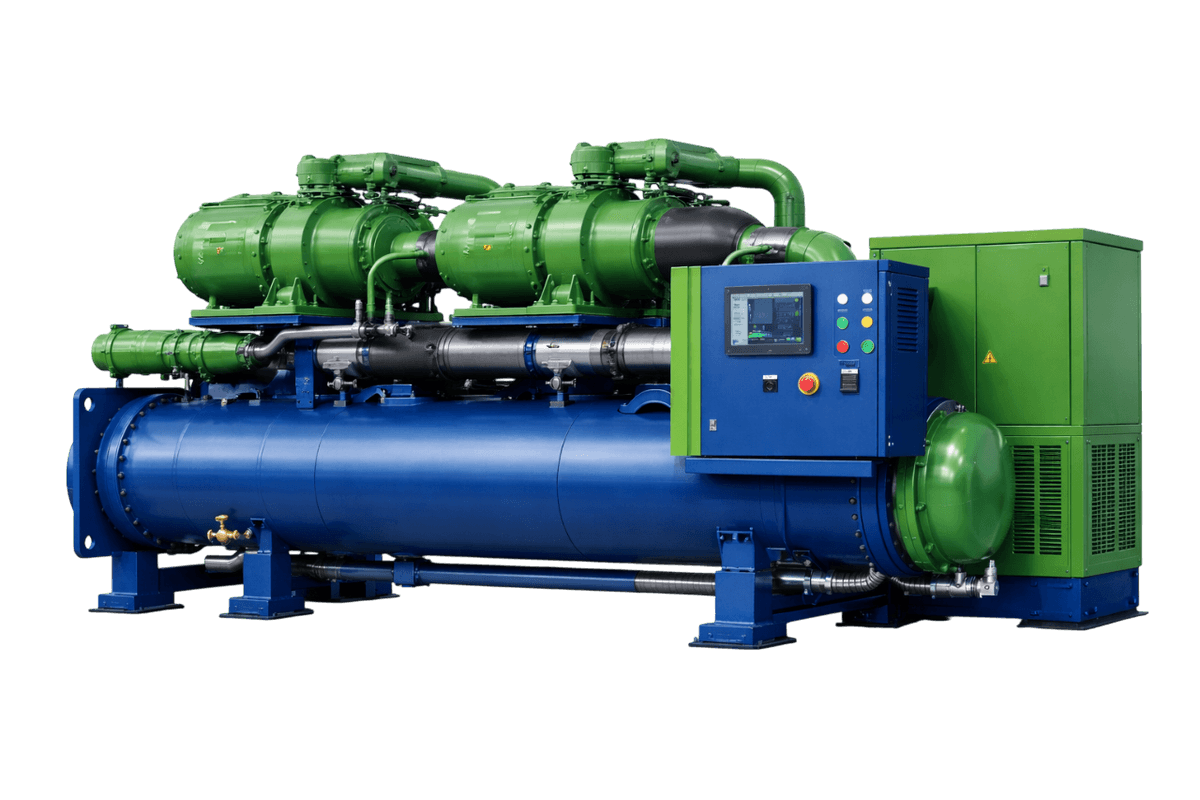
Water-Cooled Screw Chillers
Learn More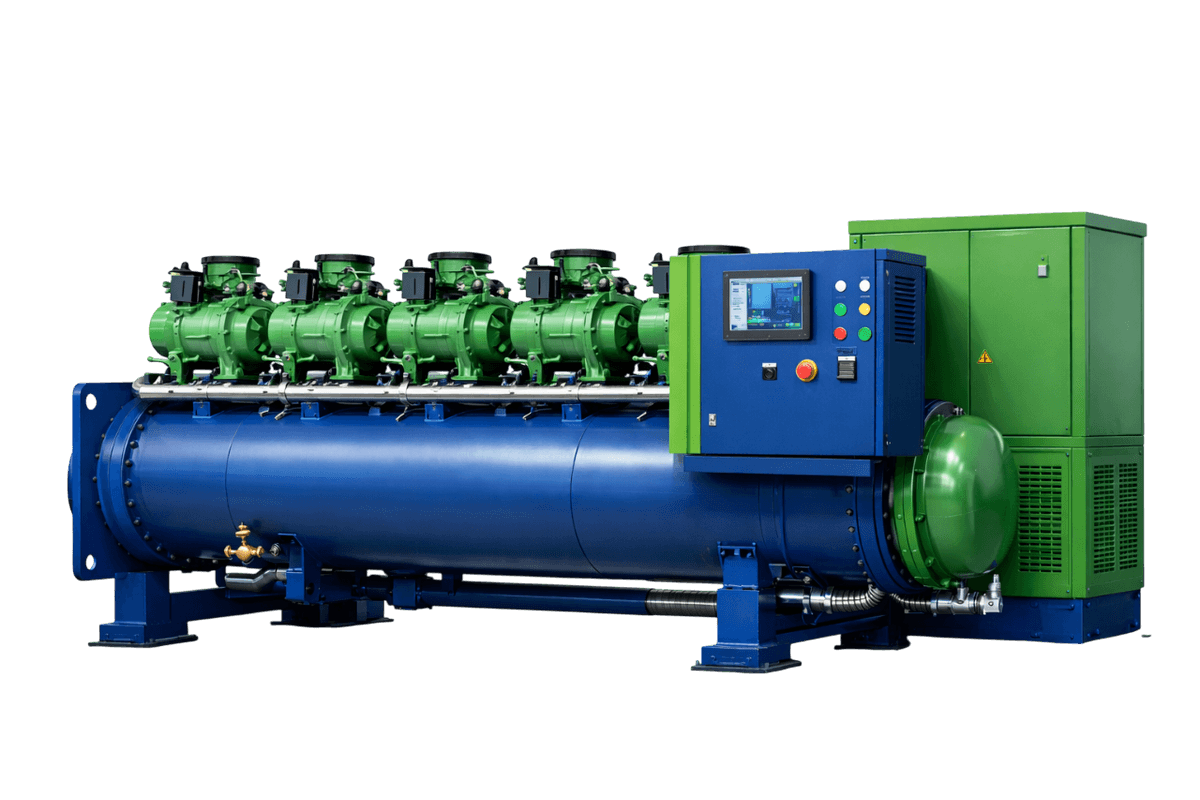
Water-Cooled Reciprocating Chillers
Learn More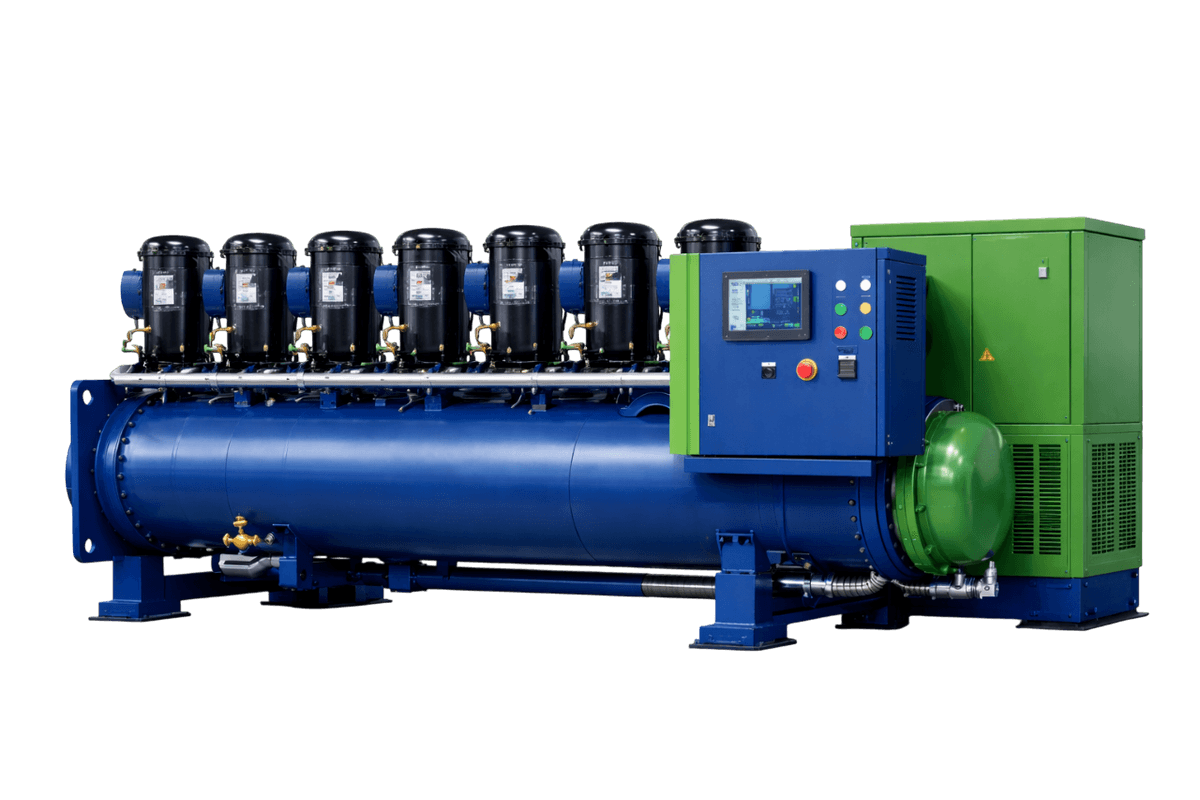
Water Cooled Scroll Chiller
Learn MoreFrequently Asked Questions
What is a Water Cooled Centrifugal Chiller?
A Water Cooled Centrifugal Chiller is a high-capacity refrigeration machine that uses a centrifugal compressor to produce chilled water and a water-cooled condenser to reject heat through a condenser-water and cooling-tower circuit.
How does a Centrifugal Chiller work?
Refrigerant absorbs heat from chilled water in the evaporator. The centrifugal compressor increases refrigerant pressure, the condenser transfers heat into condenser water, and the cooling tower rejects that heat to atmosphere.
What is a Centrifugal Compressor Chiller?
A Centrifugal Compressor Chiller uses a high-speed rotating impeller to accelerate refrigerant and convert velocity into pressure. It is primarily used for high-capacity chilled-water applications.
What capacities are available for Water-Cooled Centrifugal Chillers?
Depending on manufacturer and technology, centrifugal chillers can cover capacities ranging from several hundred TR to 1000 TR, 1500 TR, 2000 TR, 2500 TR, 3000 TR or higher specialized capacities.
Where are Water-Cooled Centrifugal Chillers used?
Typical applications include large commercial buildings, hospitals, data centers, hotels, airports, pharmaceutical facilities, manufacturing plants, IT parks and district cooling systems.
What is the Water Cooled Centrifugal Chiller Price in India?
Water Cooled Centrifugal Chiller Price in India depends on TR capacity, compressor technology, efficiency, refrigerant, VFD, magnetic-bearing configuration, heat exchangers, controls and complete project scope.
Does a Water Cooled Centrifugal Chiller need a cooling tower?
A conventional water-cooled centrifugal chiller normally uses a cooling tower to reject heat from the condenser-water circuit.
What is a VFD Centrifugal Chiller?
A VFD Centrifugal Chiller uses variable-frequency drive technology to adjust compressor speed according to operating conditions and cooling demand.
What is a Magnetic Bearing Centrifugal Chiller?
A Magnetic Bearing Centrifugal Chiller uses magnetic forces to support the compressor rotor instead of conventional mechanical bearing contact in compatible designs.
What is an Oil Free Centrifugal Chiller?
An Oil Free Centrifugal Chiller uses compressor technology that does not require the traditional oil-lubrication circuit associated with conventional centrifugal compressors.
What is IPLV in a Centrifugal Chiller?
IPLV is a measure used to represent chiller efficiency across several part-load operating conditions rather than only full-load performance.
What is the difference between a Centrifugal Chiller and Screw Chiller?
A centrifugal chiller uses high-speed dynamic compression, while a screw chiller uses rotary screw compression. Centrifugal technology is particularly common in very large central plants, while screw chillers serve medium-to-large cooling requirements.
Is a Centrifugal Chiller suitable for a data center?
Yes. Centrifugal chillers can be used for large data centers where cooling capacity, redundancy, continuous operation and part-load efficiency are important.
Are Centrifugal Chillers suitable for district cooling?
Yes. Their high individual cooling capacity makes centrifugal chillers highly relevant to large central and district cooling plants when project requirements support the technology.
Can an existing Centrifugal Chiller be repaired or overhauled?
Depending on equipment condition, age, model and spare availability, existing centrifugal chillers may be repaired, overhauled or modernized. A technical inspection should determine the appropriate scope.
What information is required for a Centrifugal Chiller quotation?
Provide required TR, chilled-water temperatures, chilled-water flow, condenser-water temperatures, condenser-water flow, operating hours, project location, electrical supply, redundancy, efficiency requirements and installation scope.
Does Compress India manufacture Water-Cooled Centrifugal Chillers?
Compress India focuses on centrifugal chiller selection, supply coordination, engineering, installation, commissioning, repair, retrofit and lifecycle support rather than manufacturing the chiller equipment itself.