Boiler-Based Constant Flow Heating Systems
(Design, Installation, Commissioning, Retrofit & Lifecycle Support for Hot Water Heating Systems)
Boiler-Based Constant Flow Heating Systems – Heating Plant Engineering & Execution
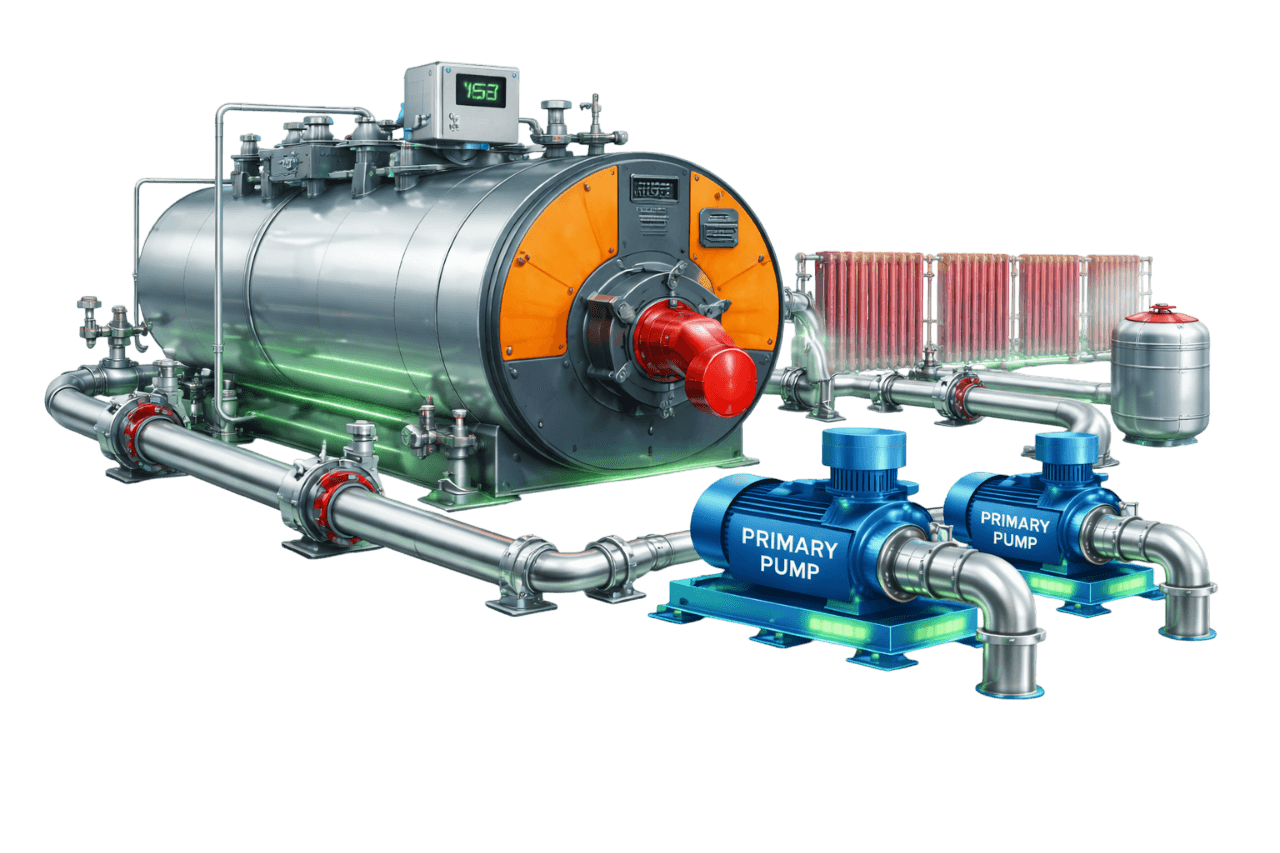
Hospitals, hotels, pharma plants and buildings in India's colder regions all depend on reliable hot water, for comfort and for process. A boiler-based constant flow heating system delivers it simply:
- A hot water boiler heats the water.
- Constant speed pumps circulate it at a steady rate.
- Three-way valves at each coil take exactly the heat they need.
Compress India designs, installs, commissions and maintains boiler-based constant flow heating systems for commercial and industrial facilities across India. Projects range from a single hot water boiler serving AHU reheat coils to multi-boiler plants for large campuses. In each case we deliver the complete hydronic boiler heating system: boilers, pumps, piping, controls, safety devices and water treatment.
What we deliver:
- Heating load calculation, boiler selection and constant flow hydronic heating system design
- Boiler, pump, expansion tank and accessory selection, with supply coordination
- Hydronic boiler piping, headers, insulation and boiler room works
- Flue, fuel supply and combustion air arrangements
- Boiler sequencing, outdoor reset controls and BMS integration
- Commissioning, water treatment and AMC
- Retrofits to condensing boilers, variable flow or hybrid heat pump systems
Share your heating requirements with Compress India for a boiler system proposal.
A heating plant must be safe first, efficient second and simple to run. That takes more than picking a boiler: boiler protection, water treatment, flue design and controls all have to be right. Compress India handles every project end to end:
- 1. Heating load assessment: we quantify space heating, reheat, fresh air preheat, process and hot water loads.
- 2. System design: we set boiler capacity, supply and return temperatures, flows, pump head and pipe sizes.
- 3. Equipment selection: we select boilers, burners, pumps, valves, expansion tanks and safety devices.
- 4. Boiler room engineering: we plan the layout, flue, fuel supply, ventilation and access.
- 5. Installation: we install boilers, pumps, headers, piping, insulation, electrical works and controls.
- 6. Testing and commissioning: we carry out hydrostatic testing, flushing, burner setup, safety tests and balancing.
- 7. Lifecycle support: we provide water treatment, AMC, performance reviews and upgrades.
What Is a Boiler-Based Constant Flow Heating System?
A boiler-based constant flow heating system is a hydronic heating system with three working parts:
- one or more hot water boilers that heat the water
- constant speed pumps that circulate it at a fixed rate through a distribution loop
- three-way valves at each heating coil that divide flow between the coil and a bypass
Each coil receives the heat it needs, while total system flow stays constant.
It is also known as a constant flow boiler heating system, a constant flow hot water heating system or a boiler constant flow system. It is one of the simplest and most dependable forms of hot water boiler heating system. It remains widely used for AHU heating coils, reheat coils, radiators and process heating.
What Is a Hydronic (Hot Water) Heating System?
A hydronic heating system uses water to carry heat from a central source to the spaces or processes that need it. Water holds about 3,500 times more heat per unit volume than air, so hydronic systems move large amounts of heat through small pipes using little energy.
In a boiler hydronic heating system, the boiler is the heat source. A hydronic heating distribution system of pumps, pipes and valves delivers hot water to AHU coils, fan coils, radiators, underfloor circuits or process heat exchangers.
Hydronic heating differs from forced air flow heating, which delivers heat by blowing warm air through ducts. In most commercial buildings the two work together: boiler hot water feeds AHU heating coils, and the AHU fans distribute the warm air.
Why Constant Flow Is Used in Boiler Heating Systems
Constant flow remains popular in boiler heating for practical reasons:
- Boiler protection: many boilers need a steady minimum flow through their heat exchangers, and constant flow provides it without extra controls.
- Stable temperatures: steady flow keeps supply temperatures and burner firing stable.
- Simplicity: constant speed circulators, three-way valves and basic controls are easy to install and operate.
- Lower first cost: there are no VFDs, differential pressure sensors or complex sequences.
- Reliable delivery: in a properly balanced system, every coil receives its design flow.
- Legacy compatibility: many existing heating plants were designed this way and still rely on it.
How a Boiler-Based Constant Flow Heating System Works
1. Hot Water Generation in the Boiler
The burner fires, or electric elements heat, and the boiler's heat exchanger transfers heat to the circulating water. Conventional systems commonly supply water at around 70–82 °C. Condensing and radiant systems use lower temperatures.
2. Constant Speed Pumps Circulating Hot Water
Constant speed circulators move a fixed flow of hot water from the boiler, through the supply header, into the distribution loop. Each constant flow circulation pump runs at a single duty point, set during design and confirmed during balancing.
3. Three-Way Valves Controlling Heating Coils
At each AHU coil, reheat coil or heat exchanger, a three-way valve modulates to hold the required air or process temperature. It sends more hot water through the coil when more heat is needed, and more through the bypass when less is needed.
4. Return Water Flowing Back to the Boiler
Water from the coils and bypasses flows back through the return header to the boiler. Because bypassed water returns hot, boiler return water temperature stays high at part load.
5. Boiler Firing Control Based on Supply / Return Temperature
The boiler controller modulates or stages the burner to hold boiler supply water temperature, while boiler return water temperature reflects system load. In multi-boiler plants, boilers are sequenced on and off as the load changes.
Main Components of a Boiler-Based Constant Flow Heating System
| Component | Role in the System |
|---|---|
| Hot water boilers | Heat the circulating water |
| Burners and fuel trains | Supply and control fuel combustion in fuel-fired boilers |
| Constant speed circulation pumps | Circulate a fixed flow of hot water |
| Standby pump | Takes over on duty pump failure or during maintenance |
| Supply and return headers | Distribute flow between boilers, pumps and circuits |
| Three-way valves | Control heat output at each coil |
| Balancing valves | Set design flow in each circuit and bypass |
| Expansion tank | Absorbs water expansion and maintains system pressure |
| Air separator and automatic air vents | Remove air from the system |
| Safety relief valves | Protect against overpressure |
| Low water cut-off and high limit controls | Shut down the boiler under unsafe conditions |
| Dirt separator and strainers | Keep debris out of boilers, pumps and valves |
| Hydraulic separator or low loss header, where used | Separates boiler flow from distribution flow |
| Flue or chimney | Removes combustion products safely |
| Water treatment equipment | Protects the system against scale and corrosion |
| Controls and BMS | Handle sequencing, temperature control, alarms and monitoring |
Types of Boilers Used in Constant Flow Heating Systems
Hot Water Boilers / Hot Water Generators
Hot water boilers, often called hot water generators, heat water without producing steam. They are the standard heat source for hydronic HVAC heating and reheat, and for domestic hot water through calorifiers and storage cylinders.
Condensing Boilers
A condensing boiler heating system recovers extra heat by cooling flue gases until their water vapour condenses. These boilers reach peak efficiency only when return water is cool enough, below roughly 55 °C for natural gas. Low return temperatures are therefore essential.
Non-Condensing Boilers
Conventional non-condensing boilers are designed to keep flue gases above their dew point. They need return water warm enough to prevent condensation inside the boiler, and they tolerate the higher return temperatures typical of constant flow systems.
Fire-Tube Boilers
In a fire-tube boiler, hot combustion gases pass through tubes surrounded by water. These boilers hold a large water volume, respond steadily to load changes and suit medium-capacity commercial and industrial heating.
Water-Tube Boilers
In a water-tube boiler, water flows inside tubes surrounded by hot gases. These boilers suit higher capacities and heat up quickly, but usually need close attention to minimum flow.
Cast Iron Sectional Boilers
Cast iron sectional boilers are built from sections joined together on site. They are durable and can be assembled in plant rooms with limited access, but they are sensitive to thermal shock, so return temperature and flow must be controlled.
Comparison Table – Condensing vs Non-Condensing Boilers
| Parameter | Condensing Boiler | Non-Condensing Boiler |
|---|---|---|
| Seasonal efficiency | Highest, when return water is cool | Lower |
| Return water temperature | Best below about 55 °C (natural gas) | Must stay above a minimum to avoid condensation |
| Flue gas temperature | Low | Higher |
| Flue material | Corrosion-resistant, handles condensate | Conventional flue materials |
| Condensate drain | Required, often with neutralization | Not required |
| Typical fuels | Natural gas / PNG or LPG | Gas, LPG or diesel |
| Fit with constant flow three-way systems | Limited, because return water stays hot | Good |
| Capital cost | Higher | Lower |
Boiler Fuel Options
Natural Gas / PNG Fired Boilers
Piped natural gas is clean and convenient, and it reaches a growing number of Indian cities. PNG-fired boilers need no on-site fuel storage and pair well with condensing technology.
LPG Fired Boilers
LPG suits sites without piped gas. It burns cleanly and supports condensing boilers, but it needs a bulk storage or cylinder manifold installation with the appropriate statutory approvals.
Diesel / HSD Fired Boilers
Diesel (HSD) boilers are common where gas is not available. They provide reliable, high-output heating, but fuel cost is usually higher, and they need a storage tank, a day tank and regular burner maintenance.
Biomass Fired Boilers
Biomass boilers burn briquettes, pellets or agricultural residue. They can cut fuel cost and carbon emissions for industrial sites, but they need fuel handling, storage and ash management, and they respond more slowly to load changes.
Electric Boilers
Electric boilers are compact, clean at the point of use and simple to install, with no flue and no fuel storage. Running cost depends heavily on the electricity tariff, so they suit smaller loads, backup duty or sites with renewable power.
Constant Flow Heating System Configurations
Single Boiler with Single Pump
This is the simplest arrangement: one boiler and one pump serving the heating loop. It suits small loads where a short outage for maintenance is acceptable.
Single Boiler with Duty–Standby Pumps
One boiler is served by a duty boiler circulator pump and a standby pump. If the duty pump fails, the standby starts automatically. This is the minimum we recommend for hospitals, hotels and occupied buildings.
Multiple Boilers with Dedicated Pumps
Each boiler has its own primary boiler pump, which starts and stops with it. Controls are simple and each boiler gets its design flow. However, stopping a boiler and its pump also reduces total system flow.
Multiple Boilers with Headered Pumps
Pumps discharge into a common header serving all boilers, with isolation valves on each boiler. Any pump can serve any boiler, and one standby pump covers all duty pumps.
Constant Primary – Constant Secondary Heating Loop
The boilers circulate constant flow through a boiler primary loop. Constant speed secondary pumps then serve the building through a hydraulic separator, low loss header or closely spaced tees. The boiler heating loop is protected from building-side disturbances, while the distribution side remains a constant flow hydronic distribution.
Comparison Table – Dedicated vs Headered Boiler Pumps
| Parameter | Dedicated Pumps | Headered Pumps |
|---|---|---|
| Pump-to-boiler relationship | One pump per boiler | Any pump serves any boiler |
| Controls | Simple | Needs isolation valves and sequencing |
| Boilers of different sizes | Easy to accommodate | Harder to balance |
| Standby provision | One per pump, or crossover piping | One shared standby |
| Flow through idle boilers | Stops with the pump | Stopped by isolation valves |
| Best suited for | Most small and medium plants | Identical boilers with a shared standby |
Role of Three-Way Valves in Constant Flow Heating Systems
Mixing Valves for Supply Temperature Control
A three-way mixing valve blends boiler water with cooler return water to supply a circuit at a lower, controlled temperature. Underfloor heating and weather-compensated radiator loops are typical examples. A constant flow heating system with three-way mixing valves can serve circuits at several temperatures from one boiler plant.
Diverting Valves at Heating Coils
At AHU and reheat coils, three-way control valves send hot water through the coil or around it to hold air temperature. A diverting valve does this on the supply side; a three-way mixing valve on the return does the same job from the other end. Both keep circuit flow constant.
Bypass Balancing
Each coil bypass needs a balancing valve set to match the coil's pressure drop. Without one, a circuit overflows when its valve moves to full bypass. Other circuits are starved, and even more hot water returns straight to the boiler.
Boiler Protection in Constant Flow Systems
Minimum Boiler Flow Requirements
Many boilers, especially water-tube and low-water-content designs, need a minimum flow through the heat exchanger to avoid overheating and localized boiling. Flow switches confirm flow before the burner is allowed to fire.
Minimum Return Water Temperature Protection
Non-condensing boilers need return water above a minimum temperature, set by the manufacturer, to stop flue gases condensing inside the boiler. Mixing valves, shunt pumps or return temperature controls keep it there.
Preventing Flue Gas Condensation in Non-Condensing Boilers
Cold return water can chill heat exchanger surfaces below the flue gas dew point. Acidic condensate then forms and corrodes the boiler. The risk is highest during cold start-up and in systems holding large volumes of cold water. Return temperature protection prevents it.
Thermal Shock Prevention
Sudden large temperature differences stress boiler materials, for example when cold water rushes into a hot boiler. Cast iron sectional boilers are especially sensitive. Controlled start-up, mixing and limits on supply–return differences protect the boiler.
Boiler Shunt / Recirculation Pumps
A boiler shunt pump recirculates hot water from the boiler outlet back to its inlet. This raises the return temperature, keeps water moving through the boiler and prevents stratification, particularly in fire-tube boilers.
Boiler Sequencing & Temperature Control
Lead–Lag Boiler Sequencing
In multi-boiler plants, a lead boiler runs first and lag boilers start as the load rises. The lead role rotates by run hours to spread wear evenly.
Boiler Modulation & Burner Turndown
A modulating burner adjusts its gas flow, heating output and combustion air together to match the load. A wide turndown ratio lets the boiler run steadily at low load instead of cycling on and off.
Supply Water Temperature Control
The boiler controller holds the heating flow (supply) temperature at setpoint by modulating or staging the burners. A stable supply temperature keeps coil control predictable.
Outdoor Temperature Reset (Weather Compensation)
Outdoor reset lowers the supply temperature as the outdoor temperature rises. Mild days need less heat, so cooler water reduces standing losses and improves boiler efficiency. With condensing boilers, it also increases the hours spent condensing.
Safety Devices & Accessories
Expansion Tanks
Water expands as it heats, by roughly 3% between cold fill and 80 °C. A diaphragm or bladder expansion tank absorbs this expansion and keeps system pressure within safe limits.
Air Separators & Automatic Air Vents
Air in hot water systems causes noise, corrosion and poor heat transfer. Air separators remove air carried in the circulating water, and automatic air vents release it at high points.
Safety Relief Valves
Relief valves protect the boilers and the system from overpressure. They are sized for the boiler's output and set at or below the maximum allowable working pressure.
Pressure & Temperature Gauges
Gauges at boilers, pumps and headers give operators an instant check on system health. They are also essential for commissioning and troubleshooting.
Low Water Cut-Off & High Limit Controls
A low water cut-off stops the burner if the water level falls too low. A high limit control, usually manual reset, stops the burner if water temperature exceeds a safe limit.
Dirt Separators & Strainers
Dirt separators capture fine particles and magnetite from the circulating water, while strainers protect pumps and valves from larger debris.
Heating Terminal Units in Constant Flow Systems
AHU Heating Coils
An AHU hot water heating coil warms supply air for space heating. Coil capacity depends on air handler air flow as well as water flow and temperature, so the air and water sides are designed together.
Reheat Coils for Humidity Control
In humid climates, air is overcooled to remove moisture, then reheated to a comfortable temperature. Hot water reheat coils are common in hospitals, pharma cleanrooms and laboratories where humidity control is critical, which makes them the most frequent boiler heating coil application in Indian cities.
Fresh Air Preheat Coils
In cold regions, preheat coils warm incoming fresh air before it reaches other coils. This prevents cold drafts and protects equipment downstream.
Radiators & Fan Coil Heating
Hot water radiator heating and fan coil heating deliver heat directly to rooms. A boiler radiator heating system suits hotels, hostels, residential buildings and offices in colder regions.
Underfloor / Radiant Heating
Underfloor and radiant systems use low-temperature water, often around 35–45 °C, supplied through a mixing circuit. They give even, comfortable heat and pair naturally with condensing boilers and heat pumps.
Benefits of Boiler-Based Constant Flow Heating Systems
Simple Design & Operation
Constant speed pumps, three-way valves and straightforward controls mean fewer components and fewer settings. Operators understand the system quickly.
Stable Boiler Flow & Protection
Boilers always see steady flow, which protects heat exchangers and keeps burner control stable.
Reliable Heating at All Terminal Units
With balanced circuits, every coil receives its design flow, from the plant room to the farthest AHU.
Lower Initial Cost
With no VFDs, differential pressure controls or secondary pump sets, capital cost stays down. That matters on small and medium projects.
Minimal Controls & Instrumentation
Temperature controllers, flow switches and basic safety controls are all the system needs. There are no pressure control loops to tune.
Easy Maintenance
Constant speed pumps, standard valves and simple controls are easy to service, and spares are widely available across India.
Planning a new heating plant or replacing an old one? Talk to Compress India about the right boiler-based heating system for your facility.
Limitations & Design Challenges
Constant Pumping Energy at Part Load
Pumps draw full power at every load. Pumping energy is modest compared with fuel energy in most heating plants, but it still adds up over a long heating season.
High Return Water Temperature & Reduced Condensing Efficiency
Bypassed hot water keeps return temperatures high. That suits non-condensing boilers, but it stops condensing boilers from reaching their rated efficiency.
Boiler Short Cycling at Low Load
When the load is much smaller than boiler capacity, burners switch on and off frequently. This wastes fuel, wears components and raises emissions. It is worst with oversized boilers, on/off burners and low system water volume.
Low Delta-T at Part Load
Because flow stays constant, the supply-return temperature difference shrinks as load falls. The heating system delta-T at part load is only a fraction of design.
Limited Scalability for Large Buildings
In large buildings and campuses, constant flow pumping, balancing effort and high return temperatures become increasingly costly. Variable flow designs usually serve them better.
Energy Code Compliance Concerns
For larger heating systems, energy codes generally expect features such as supply temperature reset and variable flow. Constant flow designs with three-way valves may need review against the applicable code.
Constant Flow vs Variable Flow Heating Systems
| Parameter | Constant Flow Heating | Variable Flow Heating |
|---|---|---|
| Terminal valves | Three-way | Two-way or PICVs |
| Pumps | Constant speed | VFD-controlled |
| Pumping energy at part load | Full | Reduced sharply |
| Return water temperature | High | Lower, which favours condensing boilers |
| Boiler flow protection | Inherent | Needs a hydraulic separator, bypass or minimum flow control |
| Controls | Simple | More complex |
| Capital cost | Lower | Higher |
| Best suited for | Small and medium plants, non-condensing boilers | Larger buildings, condensing boilers |
Constant Flow Heating vs Primary–Secondary Heating Systems
A primary secondary boiler system uses a hydraulic separator, low loss header or closely spaced tees to split the plant into two loops. The boilers keep their own steady flow, and the distribution side runs independently.
| Parameter | Constant Flow (Single Loop) | Primary–Secondary Heating |
|---|---|---|
| Pump sets | One | Boiler loop pumps plus distribution pumps |
| Boiler flow | Tied to system flow | Protected by the separator |
| Distribution flow | Constant | Constant or variable |
| Multiple circuit temperatures | Via mixing valves | Easier, with separate secondary circuits |
| Condensing performance | Limited | Better, if boiler loop flow doesn't exceed system flow |
| Capital cost | Lower | Higher |
One caution: with a hydraulic separator, boiler loop flow should not exceed system flow. If it does, hot supply water short-circuits into the return and raises boiler return temperature, which works against condensing boilers.
Boiler Heating vs Heat Pump Heating Systems
| Parameter | Boiler Heating | Heat Pump Heating |
|---|---|---|
| Energy source | Gas, LPG, diesel, biomass or electricity | Electricity |
| Efficiency | Up to about 100% of fuel energy, depending on type | Typically delivers 2.5 to 4 units of heat per unit of electricity |
| Supply temperature | High, easily 70–82 °C | Usually lower, which suits radiant and reheat duties |
| Performance in very cold weather | Unaffected | Air-source output falls |
| Capital cost | Lower | Higher |
| On-site emissions | Combustion products (fuel-fired boilers) | None at the point of use |
| Best suited for | High temperatures, peak loads, backup | Base loads, domestic hot water preheat, moderate climates |
Heat pumps, including VRF heating systems for direct space heating, are increasingly attractive in India's moderate climates. Hybrid designs often work best: heat pumps or chiller heat recovery carry the base load, and boilers cover peaks and backup.
When Is a Boiler-Based Constant Flow Heating System the Right Choice?
Small & Medium Heating Loads
For small and medium plants, a constant flow system delivers dependable heat at the lowest cost and complexity.
Single-Boiler Heating Plants
A single boiler with duty-standby pumps needs steady flow, and constant flow provides it without extra controls.
Constant Process Heating Loads
Where process loads run steadily, constant flow matches demand naturally and keeps process temperatures stable.
Existing Legacy Heating Systems
Many older plants run well on constant flow. Optimizing them with rebalancing, outdoor reset and burner tuning is often more cost-effective than replacing them.
IBR, ECBC & Safety Compliance Considerations
Every boiler project must satisfy safety and energy regulations. Compress India checks each of these at the design stage:
- IBR and boiler law: steam boilers, and pressure vessels that meet the legal definition of a boiler, require registration and inspection by the state boiler directorate under the Boilers Act and Indian Boiler Regulations (IBR). Hot water generators that heat water below 100 °C are generally outside that definition. Systems operating at or above 100 °C need specific review with the directorate. We confirm the position for your exact equipment.
- ECBC and ASHRAE 90.1: energy codes set minimum boiler efficiencies. For larger heating systems, ASHRAE 90.1 also expects hot water supply temperature reset and, above certain sizes, variable flow.
- Fuel safety: gas installations need proper gas trains, safety shut-off valves and leak detection. LPG and diesel storage may require licensing from PESO, depending on quantities.
- Emissions and chimney: chimney height and emission norms set by the pollution control board may apply, depending on fuel and capacity.
- Fire and building safety: boiler room fire safety, ventilation and access must meet local requirements.
Boiler-Based Constant Flow Heating for HVAC & Space Heating
In HVAC applications, a boiler heating coil system serves AHU heating coils, reheat coils, fresh air preheat coils, fan coils and radiators. In most commercial buildings, air flow, heating and air conditioning are designed as one system, with boiler hot water providing the heating side. Compress India delivers each constant flow boiler heating system for commercial buildings with correctly sized boilers, balanced three-way circuits and reliable controls. This covers buildings in cold regions that need full space heating, as well as hospitals and labs that mainly need reheat for humidity control.
Boiler-Based Constant Flow Heating for Industrial & Process Heating
An industrial boiler heating system supplies hot water for processes such as washing, cleaning-in-place, jacketed vessels, pretreatment tanks and product heating. Where boiler water must stay separate from process fluids, a plate heat exchanger arranged as a counterflow exchanger transfers heat efficiently between the two circuits.
Compress India designs process heating plants with standby capacity, water treatment, stable temperature control and interlocks with production equipment, so processes get consistent heat every shift.
Applications of Boiler-Based Constant Flow Heating Systems
Hospitals & Healthcare Facilities
Hospitals use boiler hot water for AHU reheat in operating theatres and ICUs, and for domestic hot water through calorifiers. In colder regions they also use it for space heating. Duty-standby boilers and pumps keep supply reliable.
Hotels & Resorts
Hotels need hot water for guest rooms, kitchens, laundries and pools, plus space heating in hill resorts. Constant flow boiler plants with well-controlled supply temperatures deliver consistent comfort.
Pharmaceutical Facilities
Cleanroom AHUs rely on hot water reheat for tight humidity control, and process areas need controlled hot water. Stable boiler plants with documented controls support consistent, auditable operation.
Commercial Buildings in Cold Regions
Offices, malls and institutions in North India and hill regions need reliable winter heating. Boiler plants serving AHU coils and radiators deliver it efficiently.
Educational Institutions & Hostels
Schools, colleges and hostels in cold regions need space heating and large volumes of hot water at predictable times. Constant flow systems with properly sized storage handle these peaks well.
Manufacturing & Process Heating
Factories use hot water for washing, pretreatment, curing and equipment heating. Constant flow boiler loops deliver steady temperatures to every process user.
Food Processing Plants
Food plants need hot water for cleaning, sanitation and product processes. Reliable boiler plants with heat exchangers keep process water separate and temperatures controlled.
Laboratories
Laboratories use hot water reheat for precise humidity control and heating for equipment. Stable supply temperatures support sensitive work.
Residential Complexes & Villas
Premium residential complexes and villas in cold regions use central boilers for space heating and domestic hot water. Simple constant flow systems keep operation easy for facility teams.
System Design & Sizing
Heating Load Calculation
The heating load includes several parts:
- fabric heat losses through walls, roofs and glazing
- heating of ventilation and fresh air
- reheat and process loads
- domestic hot water where combined
For example, heating 5 m³/s of fresh air from 5 °C to 20 °C needs about 90 kW.
Boiler Capacity Selection (kW / kcal/hr)
Boiler capacity covers the peak load plus piping losses and a warm-up allowance. One kW is about 860 kcal/h, so a 500 kW plant is roughly 4.3 lakh kcal/h. Splitting capacity across two or three boilers improves redundancy and low-load operation.
Hot Water Flow Calculation
Hot water flow is calculated as:
Flow (m³/h) = Heat load (kW) ÷ (1.163 × ΔT in °C)
A 500 kW load at 80/60 °C (20 °C ΔT) needs about 21.5 m³/h. At an 11 °C ΔT, the same load needs about 39 m³/h.
Supply & Return Temperature Selection
Typical design temperatures depend on the system:
- conventional systems: 80/60 °C or 82/71 °C
- condensing designs: 70/50 °C or lower
- radiant systems: around 45/35 °C
A wider delta-T reduces flow, pipe sizes and pump power, while lower return temperatures unlock condensing efficiency.
Pump Head Calculation
Pump head is the sum of losses around the index circuit at design flow:
- the boiler heat exchanger
- supply and return piping and fittings
- the index coil with its three-way valve and balancing valve
- strainers, check valves and separators
Margins are kept realistic, because an oversized constant speed pump wastes energy every hour it runs.
Expansion Tank Sizing
The tank is sized from four inputs: system water volume, water expansion, fill pressure and maximum working pressure.
Take a 5,000-litre system heated to 80 °C, which expands by about 144 litres. With a 2.5 bar fill pressure and a 5.5 bar maximum, the tank needs roughly 310 litres of total volume, so the next standard size up is selected.
Pipe Sizing for Hot Water Circuits
Pipes are sized for design flow using sensible velocity and friction limits, balancing pump head against pipe cost. Consistent sizing makes balancing easier and keeps flow noise low in occupied areas.
Pump Selection Criteria for Hot Water Systems
End-Suction vs Inline Pumps
End-suction pumps suit medium and large flows with easy access for maintenance. Inline pumps save floor space and mount directly in the pipework, which suits compact boiler rooms and smaller circuits.
High-Temperature Pump Seals & Materials
Mechanical seals, elastomers and gaskets must be rated above the maximum water temperature, typically with high-temperature seal faces and EPDM elastomers. Because water vapour pressure rises with temperature, NPSH must be checked at operating temperature. Pumps are generally located to pump away from the expansion tank connection.
Pump Efficiency and Best Efficiency Point (BEP)
A constant speed boiler pump runs at one operating point for its entire life, so we select it at or very close to its BEP. This keeps energy use and wear to a minimum.
IE3 / IE4 Motor Selection
High-efficiency IE3 and IE4 motors reduce losses on pumps that run through the whole heating season. They pay back quickly on long running hours.
Piping Layout & Boiler Room Arrangement
Boiler Room Layout & Clearances
Boiler rooms are planned for burner withdrawal, tube cleaning, flue connections, gas trains and safe access around every boiler, following the manufacturer's clearances. Drainage, lifting arrangements and ventilation openings are designed in from the start.
Supply & Return Header Design
Headers are sized for low velocities, so boilers and pumps connected to them see nearly equal pressures and flow divides evenly. Connections are arranged for easy isolation of each boiler and pump.
Direct Return vs Reverse Return Piping
Direct return piping is simpler and cheaper, but it needs balancing to prevent near circuits overflowing. Reverse return equalizes path lengths and reduces balancing effort, at the cost of extra pipe.
Pipe Expansion & Thermal Movement
Steel pipe grows about 1.2 mm per metre for every 100 °C rise. A 50 m run heated from 20 °C to 80 °C therefore grows by about 36 mm. Expansion loops, offsets or bellows, with properly placed anchors and guides, absorb this movement safely.
Valves, Strainers, Check Valves & Flexible Connections
Isolation valves allow each boiler and pump to be serviced. Strainers protect equipment, check valves prevent reverse flow through idle pumps, and flexible connections isolate vibration.
Hot Water Pipe Insulation
Insulation rated for the water temperature cuts heat loss, protects people from hot surfaces and keeps boiler room temperatures down. Outdoor piping is protected with metal cladding.
Flue, Fuel & Combustion Air Arrangement
Flue / Chimney Design
Flues are sized to the boiler manufacturer's requirements for draught and back-pressure. Condensing boilers need corrosion-resistant flues that handle condensate. Chimney height also follows applicable emission norms.
Fuel Supply Piping
Gas trains include pressure regulators, safety shut-off valves, pressure switches and leak detection. Diesel systems include storage tanks, day tanks, transfer pumps and filters. Every fuel system is designed for safe isolation and maintenance.
Combustion Air & Boiler Room Ventilation
Boilers need a steady supply of combustion air, and boiler rooms need ventilation to remove heat. Openings or fans are sized for both, with interlocks where mechanical ventilation is used.
Water Treatment for Boiler Heating Systems
Water Quality Requirements
Hot water systems need clean, low-hardness fill water with controlled pH and dissolved solids, as specified by the boiler manufacturer. Poor water quality is one of the most common causes of boiler failure.
Scale & Corrosion Prevention
Scale insulates heat transfer surfaces and wastes fuel, while corrosion damages boilers, pipes and valves. Softened fill water, corrosion inhibitors and minimal fresh make-up water keep both under control.
Chemical Dosing Systems
Dosing pots or dosing pumps add inhibitors and pH conditioners to the closed loop. Regular sampling confirms treatment levels stay within range.
Side-Stream Filtration
A side-stream filter continuously cleans a portion of the circulating water, removing particles and magnetite before they reach boilers and valves.
Controls, Automation & BMS Integration
Boiler–Pump Interlocking
The pump must start and prove flow before the burner fires. After the burner stops, the pump runs on for a set time to carry residual heat away from the boiler.
Boiler Sequencing Logic
Sequencing logic starts and stops boilers based on supply temperature and load, with lead-lag rotation, time delays and minimum run times to prevent short cycling.
Three-Way Valve Control at Heating Coils
Each coil's valve is modulated by its own controller to hold supply air, room or process temperature. Correct valve sizing and tuning prevent hunting.
Temperature & Pressure Monitoring
Supply and return temperatures, system pressure, boiler status and pump status are monitored continuously. This gives early warning of problems.
Safety Alarms & BMS Integration
Burner lockouts, low water, high limit, low pressure and pump failure alarms are integrated with the BMS over BACnet, Modbus or hardwired points. This supports fast response and remote monitoring.
Energy Efficiency & Fuel Consumption
Boiler Efficiency Calculation
Boiler efficiency can be measured two ways:
- Direct method: useful heat output divided by fuel heat input.
- Indirect method: 100% minus measured losses, including flue gas, moisture, unburnt fuel and radiation.
Combustion analysis of flue gas oxygen, carbon monoxide and temperature shows how well the burner is tuned.
Fuel Consumption Calculation
Fuel use is calculated as:
Fuel (kg/h) = Heat output (kcal/h) ÷ (Boiler efficiency × Fuel calorific value in kcal/kg)
A 500 kW (4.3 lakh kcal/h) boiler at 85% efficiency burning diesel of about 10,800 kcal/kg uses roughly 47 kg, or about 55 litres, per hour at full load. The same method applies to PNG, LPG or biomass using their calorific values. Efficiency and calorific value must be on the same gross or net basis.
Pumping Energy Calculation
Pump power is estimated as:
Pump power (kW) = Flow (m³/h) × Head (m) ÷ (367 × pump-motor efficiency)
Pumping 21.5 m³/h at 20 m head with 60% efficiency takes about 2 kW, or roughly 4,900 kWh over a 2,500-hour season. That is small next to fuel use. In most boiler heating plants, the bigger savings come from lower return temperatures, fewer burner cycles and better combustion.
Energy Improvement Opportunities
- Add outdoor temperature reset
- Tune burners and fit oxygen trim on larger boilers
- Stop short cycling with modulating burners, buffer volume or correctly sized boilers
- Insulate bare pipes, valves and flanges
- Balance bypasses so hot water isn't short-circuited back to the boiler
- Convert to variable flow and condensing boilers where the load profile justifies it
- Add heat pumps or chiller heat recovery for base loads
Installation of Boiler-Based Constant Flow Heating Systems
Compress India installs heating plants in a planned, safety-first sequence:
- 1. Boiler room preparation: we complete foundations, drainage, ventilation openings, lifting arrangements and access routes.
- 2. Boiler and burner installation: we set boilers on plinths, level them and fit burners and gas trains or fuel lines.
- 3. Pumps and headers: we install pumps on bases, then connect headers, isolation valves, strainers and check valves.
- 4. Hydronic boiler piping: we install boiler supply and return piping, expansion loops, anchors and guides.
- 5. Safety devices and accessories: we fit relief valves, the expansion tank, air separators, dirt separators and gauges.
- 6. Flue and chimney: we install the flue with correct supports, joints and condensate drainage where needed.
- 7. Electrical and controls: we install panels, burner controls, sensors, interlocks and BMS connections.
- 8. Testing and insulation: we pressure test, flush and treat the system, then insulate.
Testing, Balancing & Commissioning
Hydrostatic Pressure Testing
Piping and equipment are pressure tested before insulation, typically at 1.5 times the design working pressure for piping or as specified, to confirm strength and leak-tightness.
Flushing & Water Treatment
The system is flushed to remove construction debris, then filled with treated water. Inhibitor levels are confirmed by sampling.
Burner Setup & Combustion Analysis
Each burner is set up across its firing range. Flue gas oxygen, carbon monoxide, temperature and draught are measured and adjusted for safe, efficient combustion.
Safety Device Testing
We test every safety device before handover:
- low water cut-offs and high limits
- flame failure protection and gas pressure switches
- pump flow interlocks
- relief valve arrangements
Results are recorded in the commissioning report.
Water Balancing & Flow Verification
Coil and bypass flows are balanced to design, and pump flow and head are verified against the pump curve. All readings are recorded for handover.
Maintenance & AMC for Boiler Heating Systems
A boiler plant stays safe and efficient only with regular care. Compress India's AMC covers the complete heating system and can be comprehensive or non-comprehensive.
Boiler Cleaning & Descaling
Fireside cleaning removes soot that raises flue temperatures and wastes fuel. Waterside inspection and descaling keep heat transfer surfaces clean.
Burner Servicing
Nozzles, electrodes, filters, fans and linkages are serviced, and combustion is re-tuned using flue gas analysis to hold efficiency and safety.
Safety Valve & Control Testing
Relief valves, low water cut-offs, high limits, flame safeguards and interlocks are tested at defined intervals, with results logged.
Pump & Valve Maintenance
Pumps are checked for seal leakage, bearing condition, vibration and alignment. Three-way valves and actuators are exercised and checked for leakage, and strainers are cleaned.
Common Problems & Troubleshooting
Boiler Short Cycling
Causes include oversized boilers, on/off burners, low system water volume and tight control differentials. Modulating burners, wider differentials, buffer volume or better boiler sizing fix it.
Low Return Water Temperature & Flue Condensation
In non-condensing boilers, cold return water causes corrosive condensation. Shunt pumps, mixing valves and controlled start-up keep the return temperature above the manufacturer's minimum.
Insufficient Heating at Terminal Units
Common causes are unbalanced circuits, air locks, blocked strainers, faulty three-way valves, low supply temperatures or undersized coils. Balancing checks, venting and valve inspection pinpoint the fault.
Air Locks & Noise in Piping
Air trapped at high points causes gurgling, poor circulation and corrosion. Air separators, automatic vents at high points and correct system pressure prevent it.
Scale Formation & Corrosion
Scale and corrosion come from hard make-up water, frequent refilling or poor treatment. Water analysis, softening, inhibitor dosing and leak repair control both.
Expansion Tank & System Pressure Problems
Pressure swings and relief valve discharges usually point to an undersized or waterlogged expansion tank, or the wrong pre-charge pressure. Checking and re-charging the tank, or resizing it, restores stable pressure.
Pump Seal Leakage & Cavitation
Seal leaks can come from high temperature, dirty water or dry running. Cavitation comes from low suction pressure at high water temperature. Correct seal materials, system pressure and pump location resolve both.
Retrofitting & Upgrading Boiler Heating Systems
Older heating plants can often be upgraded for lower fuel bills and better reliability without starting from scratch.
Replacing Non-Condensing Boilers with Condensing Boilers
Condensing boilers save fuel only when return water is cool enough. The upgrade usually combines the new boilers with lower design temperatures, outdoor reset and fewer bypasses. It also needs a corrosion-resistant flue and condensate neutralization.
Converting Constant Flow to Variable Flow Heating
Replacing three-way valves with two-way valves or PICVs and adding VFD pumps makes the system variable flow. Boiler minimum flow is then protected by a hydraulic separator, bypass or boiler-mounted pumps.
Adding VFDs to Heating Pumps
VFDs let pumps follow demand once the system can vary flow. On constant flow systems, they can also set pumps to the exact design flow instead of throttling.
Replacing Three-Way Valves with Two-Way Valves / PICVs
Converting terminal valves lowers return temperatures, cuts pumping energy and prepares the system for condensing boilers.
Fuel Conversion (Diesel to Gas / PNG)
Where PNG is available, converting diesel boilers to gas can cut running costs and emissions. Conversion involves a gas or dual-fuel burner, a gas train, a PNG connection and the necessary approvals.
Heat Pump Integration & Hybrid Heating
Heat pumps, or heat recovery from chillers running year-round, can carry base heating and domestic hot water preheat, with boilers covering peaks and backup. This hybrid approach is well suited to Indian hotels and hospitals.
Running an older boiler plant? Ask Compress India for a heating system upgrade assessment.
Boiler-Based Heating System Cost in India
The cost of a boiler-based heating system depends on heating capacity, boiler type, fuel, the number of boilers and pumps, the extent of piping and the controls scope. A single electric or LPG boiler serving reheat coils is a very different investment from a multi-boiler plant for a hospital campus.
Compress India provides itemized proposals covering boilers, burners, pumps, piping, flue, fuel systems, controls and commissioning. Where it makes sense, we also compare fuels and technologies, including gas vs diesel and boilers vs hybrid heat pumps, over their lifecycle cost.
Factors Affecting Project Cost
- Heating capacity and number of boilers
- Boiler type (condensing or non-condensing, fire-tube, water-tube or sectional)
- Fuel type, and fuel storage or gas connection works
- Pumps, standby arrangement and motor efficiency class
- Piping length and size, headers and insulation
- Flue and chimney requirements
- Safety devices, expansion tanks and water treatment
- Controls, sequencing and BMS integration
- Boiler room civil works, ventilation and access
- Approvals, testing and commissioning
- AMC requirements
Information Required for a Quotation
To prepare an accurate proposal, please share:
- Type of facility and the heating applications (space heating, reheat, preheat, process, domestic hot water)
- Heating loads, or AHU and terminal unit schedules with heating capacities
- Preferred fuel and availability of PNG, LPG or diesel
- Required supply and return temperatures
- Existing boiler and pump details for retrofits
- Boiler room location, space and access details
- Piping layout or building drawings
- Controls and BMS requirements
- Operating hours and heating season duration
- Project timeline
Missing some details? Our engineers can collect them during a site visit.
Boiler Heating System Contractor in Mumbai
Looking for a boiler heating system contractor in Mumbai? In Mumbai, most boiler hot water serves three purposes:
- domestic hot water for hotels, hospitals and residential towers
- AHU reheat for humidity control in hospitals, pharma plants and laboratories
- process heating for industrial users
Space heating demand is small in Mumbai's climate, but the need for reliable hot water is constant. Compress India designs and installs compact, safe boiler rooms suited to Mumbai's space-constrained sites. PNG is available in many parts of the city, which makes gas-fired and condensing boilers an attractive option. We also upgrade existing diesel plants and integrate heat recovery wherever chillers run year-round.
Book a site visit with Compress India for your boiler heating system.
Hot Water Heating Solutions in Mumbai, Navi Mumbai, Thane & Maharashtra
Compress India supports hot water heating projects across the region:
- Mumbai, Navi Mumbai and Thane: hotels, hospitals and commercial buildings
- Industrial belts: Taloja, Tarapur and Chakan
- Hill destinations: Lonavala, Mahabaleshwar and Panchgani, where resorts and schools need winter heating
- Cities with cooler winters: Pune and Nashik
Our solutions include:
- Hot water boiler plants: for domestic hot water, reheat and space heating
- Hydronic boiler piping and insulation: complete boiler supply return piping and distribution
- Process heating systems: boilers and heat exchangers for industrial hot water
- Fuel conversions: diesel to PNG or LPG, with burner and gas train upgrades
- Hybrid heating: heat pumps and chiller heat recovery integrated with boilers
- AMC: burner servicing, safety testing, water treatment and pump maintenance
Boiler-Based Heating System Solutions Across India
Space heating demand in India is concentrated in the north and in hill regions: Delhi NCR, Chandigarh, Punjab, Haryana, Uttarakhand, Himachal Pradesh, Jammu & Kashmir, Ladakh, Sikkim and the Northeast. Compress India takes up boiler heating projects for commercial buildings, hospitals, hotels, schools and hostels across these regions. We also take up process heating projects in industrial states such as Gujarat, Tamil Nadu and Karnataka.
Every plant follows the same design checks, safety standards and commissioning procedures, adapted to local climate, fuel availability and regulations.
Why Choose Compress India for Boiler-Based Heating Systems?
Heating System Design Expertise
We calculate real heating loads and design boilers, flows and temperatures around your applications, whether space heating, reheat, process or domestic hot water.
Boiler & Pump Selection Support
We help you choose the right boiler type, fuel, capacity split and pumps, balancing capital cost, running cost and reliability.
Complete Hydronic Piping & Insulation
Our team delivers boiler rooms, headers, distribution piping, expansion provisions and insulation as one coordinated package.
Controls & BMS Integration
We set up boiler sequencing, outdoor reset, safety interlocks and BMS monitoring, so your plant runs safely and efficiently.
Installation & Commissioning
From hydrostatic testing to combustion analysis and safety device tests, we commission every plant thoroughly before handover.
Retrofit & Energy Optimization
We upgrade older plants with condensing boilers, fuel conversions, variable flow and hybrid heat pump systems, and we measure the results.
AMC & Lifecycle Support
Burner servicing, safety testing, water treatment and pump care keep your heating plant dependable for decades.
How to Select the Right Boiler-Based Heating System
Every facility is different, but these guidelines are a good starting point:
- Small or single-boiler plants with steady loads: a constant flow system with duty-standby pumps
- Several heating circuits at different temperatures: a boiler heating system with a hydraulic separator and mixing circuits
- Gas available and low-temperature terminals: condensing boilers with variable flow and outdoor reset
- Large buildings and campuses: variable flow with VFD pumps and two-way valves or PICVs
- Hotels and hospitals with year-round cooling: chiller heat recovery or heat pumps for base loads, with boilers for peaks
- Diesel-fired plants in PNG-served areas: a fuel conversion assessment
- Process heating: boilers with heat exchangers and steady constant flow loops
Not sure which fits your site? A short site assessment will show the right heating system and its lifecycle cost.
Get a Boiler-Based Heating Solution from Compress India
Whether you need a new heating plant, a safer and more efficient boiler room, or an upgrade to condensing or hybrid heating, Compress India delivers it with one accountable team.
Connect with Our HVAC Execution Team
Call our team or send an enquiry through this page with your heating requirements and site details. Our engineers will review your needs and recommend a site visit where required. You will then receive a clear proposal covering design, equipment, installation and commissioning.
Related Systems Types & Components
Primary Constant Flow Systems
Learn More
Constant Flow with Three-Way Valve Control
Learn More
Decoupled Constant Primary Systems
Learn More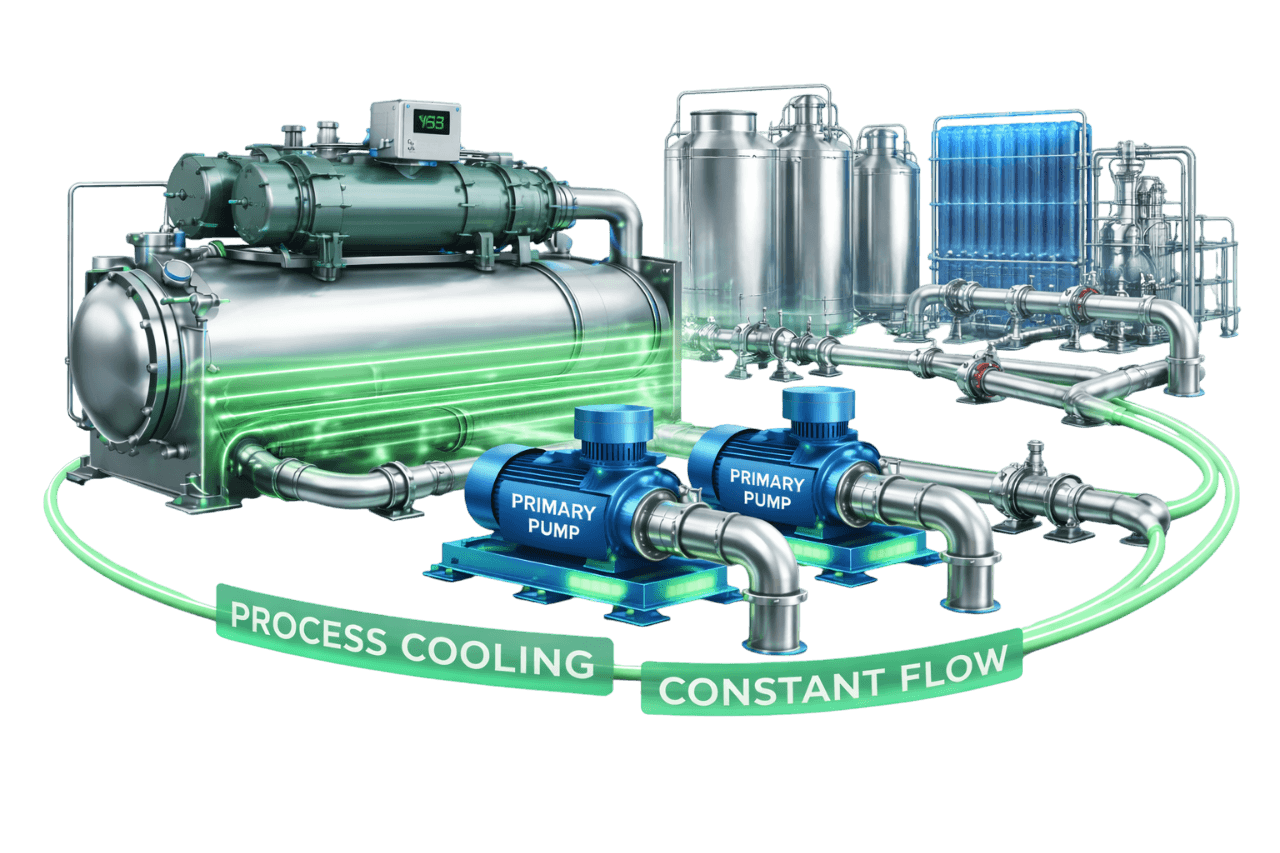
Process Cooling Constant Flow Loops
Learn MoreFrequently Asked Questions
Q1. What is a boiler-based constant flow heating system?
It is a hydronic heating system in which boilers heat water and constant speed pumps circulate it at a fixed rate to heating coils. Three-way valves at the coils control heat output while total flow stays constant.
Q2. How does a constant flow hot water heating system work?
The boiler heats water to a set supply temperature, and constant speed pumps circulate it through the distribution loop. Three-way valves divide flow between each coil and its bypass. Water returns to the boiler, which fires to hold the supply temperature.
Q3. What types of boilers are used in hot water heating systems?
The main types are hot water generators, condensing and non-condensing boilers, fire-tube boilers, water-tube boilers and cast iron sectional boilers. They can be fired by PNG, LPG, diesel or biomass, or heated electrically.
Q4. What is the difference between condensing and non-condensing boilers?
Condensing boilers recover extra heat by condensing flue gas moisture, which gives higher efficiency when return water is cool. Non-condensing boilers keep flue gases above their dew point and need return water above a minimum temperature.
Q5. Why is constant flow used in boiler heating systems?
It protects boilers with steady flow, keeps temperatures stable, and keeps design, controls and operation simple, all at a lower first cost.
Q6. Why are three-way valves used in constant flow heating systems?
They control each coil's heat output while keeping circuit flow constant. This protects the boiler and keeps pump operation stable.
Q7. What is minimum return water temperature protection?
It keeps the water returning to a non-condensing boiler above the manufacturer's minimum, using shunt pumps, mixing valves or controls. This prevents corrosive flue gas condensation inside the boiler.
Q8. What is a boiler shunt pump?
It is a pump that recirculates hot water from the boiler outlet back to its inlet. It raises the return temperature, maintains flow through the boiler and prevents stratification.
Q9. What is outdoor temperature reset in heating systems?
Outdoor reset, or weather compensation, automatically lowers the supply water temperature as outdoor temperature rises. It saves fuel and improves comfort control.
Q10. Why is an expansion tank required in a hot water heating system?
Water expands by roughly 3% when heated from cold to 80 °C. The expansion tank absorbs this extra volume and keeps system pressure within safe limits.
Q11. What is the difference between constant flow and variable flow heating systems?
Constant flow systems use constant speed pumps and three-way valves, so flow never changes. Variable flow systems use VFD pumps with two-way valves or PICVs. This cuts pumping energy and lowers return temperatures, which suits condensing boilers.
Q12. Which is better: boiler heating or heat pump heating?
It depends on the application. Boilers deliver high temperatures and high output at a lower capital cost. Heat pumps deliver several units of heat per unit of electricity at moderate temperatures. Hybrid systems often give the best balance.
Q13. Where are boiler-based heating systems used in India?
They serve three main groups:
- hospitals, hotels, pharma plants and laboratories needing domestic hot water and AHU reheat
- buildings in North India and hill regions needing space heating
- factories and food plants needing process hot water
Q14. Are boiler heating systems used for AHU reheat and humidity control?
Yes. In humid climates, air is overcooled to remove moisture and then reheated. Boiler hot water is a common reheat source in hospitals, pharma cleanrooms and laboratories.
Q15. Do hot water boilers require IBR approval?
Hot water generators that heat water below 100 °C are generally outside the legal definition of a boiler and do not need IBR registration. Steam boilers, and systems operating at or above 100 °C, may fall under the Boilers Act and IBR. Confirm with the state boiler directorate for your specific equipment.
Q16. How is boiler capacity calculated?
Boiler capacity is the peak heating load, covering space heating, ventilation, reheat, process and domestic hot water, plus piping losses and a warm-up allowance. One kW equals about 860 kcal/h.
Q17. What water treatment is required for boiler heating systems?
The system needs:
- soft, clean fill water
- corrosion inhibitors and pH control
- minimal make-up water
- regular sampling
- dirt separation or side-stream filtration
Q18. What are common problems in boiler heating systems?
The most common problems are:
- short cycling
- flue condensation from low return temperatures
- poor heating at terminal units
- air locks
- scale and corrosion
- expansion tank faults
- pump seal leaks
Q19. Can an existing constant flow heating system be converted to variable flow?
Yes. Three-way valves are replaced with two-way valves or PICVs, and VFD pumps are added. Boiler minimum flow is then protected with a hydraulic separator, bypass or boiler pumps. This often prepares the plant for condensing boilers.
Q20. What maintenance does a boiler heating system need?
It needs:
- fireside and waterside cleaning
- burner servicing and combustion tuning
- safety device testing
- water treatment checks
- pump and valve maintenance
- expansion tank checks
Q21. What information is needed for a boiler heating system quotation?
We need:
- facility type and heating applications
- heating loads or terminal schedules
- preferred fuel
- design temperatures
- boiler room details and drawings
- controls requirements
- for retrofits, existing equipment details
Q22. Does Compress India design and install boiler-based heating systems?
Yes. Compress India delivers complete boiler-based heating systems across Mumbai, Maharashtra and India:
- design and boiler selection
- piping, flue and fuel systems
- controls and BMS integration
- commissioning and AMC
- retrofits to condensing, variable flow and hybrid heating