Chemical Exhaust Systems
(Design, Supply, Installation, Testing, Commissioning & AMC for Corrosive, Toxic & Flammable Chemical Exhaust)
Design, Supply, Installation, Testing, Commissioning & AMC for Corrosive, Toxic & Flammable Chemical Exhaust
Acid mists, solvent vapours and toxic gases do not just harm people; they corrode ducts, destroy ordinary fans and create fire and explosion risks. Compress India designs and installs chemical exhaust systems built from chemical-compatible materials, engineered to capture hazardous fumes at the source, treat them and discharge clean air safely.
From a single laboratory fume hood to a complete acid fume exhaust system with FRP ductwork and scrubbers for a process plant, we engineer every system around your chemicals, your process and your site. Share your requirement for a free site survey and detailed quotation.
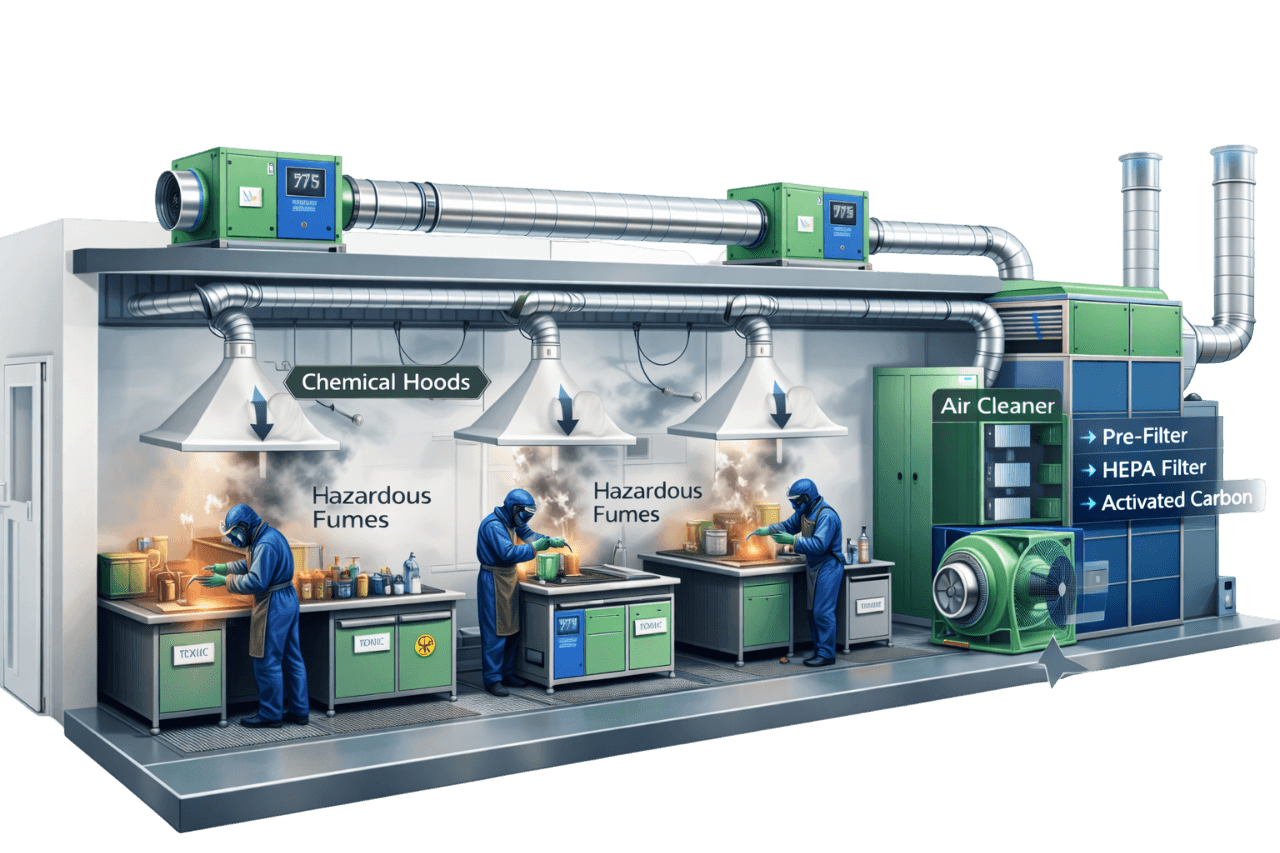
Compress India is a specialist chemical exhaust contractor serving Mumbai, Navi Mumbai, Thane and industries across India. We take full responsibility for your project from concept to long-term maintenance.
- Design: Chemical inventory review, hazard assessment, stream segregation, airflow calculation, material selection and stack design.
- Supply: Hoods, enclosures, PP, PVC, FRP and SS ductwork, chemical exhaust fans, scrubbers, carbon adsorbers, gas detectors and controls.
- Installation: In-house duct fabrication and plastic welding, equipment erection, electrical work and interlocks.
- Testing & Commissioning: Leakage, airflow, face velocity, scrubber performance and alarm tests with a full commissioning report.
- AMC: Planned maintenance, scrubber dosing checks, carbon replacement, gas detector calibration and emergency support.
Whether you need a chemical exhaust system for an industrial process, a laboratory chemical exhaust system with negative pressure or a chemical fume exhaust system with a scrubber, we deliver a safe, compliant and durable solution.
What Is a Chemical Exhaust System?
A chemical exhaust system is a specialised ventilation system that captures corrosive, toxic or flammable fumes, vapours and gases at their source and removes them from the workplace. It uses corrosion-resistant hoods, ducts and fans, and often a scrubber or activated carbon adsorber to treat the exhaust before it is discharged through a stack.
Unlike general exhaust systems built from galvanised steel, a chemical exhaust system is designed around the chemistry of what it carries. Every component, from the hood and exhaust piping to the fan impeller and stack, is selected to resist attack from the specific chemicals involved.
A typical industrial chemical exhaust system includes:
- Fume hoods, capture hoods, slot hoods or enclosures at the source
- Chemical resistant ductwork in PP, PVC, FRP, stainless steel or coated materials
- A fume scrubber, carbon adsorber or oxidiser for treatment
- A chemical-resistant exhaust fan that maintains negative pressure
- A stack that discharges treated air safely above the building
- Dampers, airflow monitors, gas detectors and controls
These systems are also known as chemical exhaust ventilation, chemical ventilation systems, chemical extraction systems or corrosive exhaust systems.
Why Chemical Exhaust Systems Are Critical
In chemical handling areas, ventilation is not a comfort feature; it is a primary safety system. A properly engineered chemical exhaust system protects your people, your building, your neighbours and your licence to operate.
Protecting People from Toxic Vapours & Gases
Chemical vapours and gases can cause immediate irritation, burns, dizziness and loss of consciousness, as well as long-term damage to the lungs, nervous system, liver and kidneys. Source capture chemical exhaust removes these contaminants before they reach the breathing zone, keeping exposure within safe limits.
Preventing Corrosion Damage to Buildings & Equipment
Acid and alkali fumes that escape into a building attack steel structures, roofing sheets, cable trays, electrical panels and machinery. Uncontrolled corrosion leads to costly repairs, electrical faults and shortened equipment life. A chemical exhaust system keeps these fumes contained and away from your assets.
Reducing Fire & Explosion Risks
Solvent vapours and hydrogen can form flammable mixtures in poorly ventilated rooms and ducts. A flammable vapor exhaust system keeps concentrations well below the lower explosive limit, while spark-resistant and flameproof equipment removes ignition sources from the airstream.
Emission Control & Regulatory Compliance
Indian occupational safety law, hazardous chemical rules and pollution control boards all expect hazardous emissions to be captured, treated and discharged responsibly. Scrubbers, carbon adsorbers and correctly designed stacks help you meet consent conditions, pass inspections and avoid complaints from neighbours.
Types of Chemical Contaminants Handled
The right chemical exhaust system depends entirely on what it has to carry. Compress India designs hazardous chemical exhaust for the full range of contaminants found in Indian industry and laboratories.
Acid Fumes (Sulphuric, Hydrochloric, Nitric & Hydrofluoric)
Pickling, plating, etching, digestion and chemical processing release acid mists and fumes that rapidly corrode steel. Hydrochloric and nitric acids are highly volatile, sulphuric acid forms dense mists, and hydrofluoric acid attacks glass and silica-based materials. An acid exhaust system uses PP, PVC or specially lined FRP components with a neutralising scrubber.
Alkali & Caustic Vapours
Caustic soda, potassium hydroxide and other alkalis are used in cleaning, degreasing, etching and chemical manufacturing. Their mists damage aluminium, galvanised surfaces and some plastics. They are typically captured with tank hoods and treated in an acid-dosed scrubber.
Organic Solvent Vapours (VOCs)
Toluene, xylene, acetone, alcohols, MEK and other solvents are used in paints, coatings, inks, adhesives, pharmaceuticals and cleaning. A solvent or VOC exhaust system must handle both toxicity and flammability, often using activated carbon or oxidisers and spark-resistant fans. An exhaust fan for paint fumes, for example, must never be an ordinary ventilation fan.
Toxic Gases (Ammonia, Chlorine & Others)
Chlorine in water treatment, ammonia in refrigeration and fertilisers, and gases such as hydrogen sulphide, sulphur dioxide and phosphine in process and semiconductor plants are acutely toxic. They need reliable local exhaust, gas detection and, in many cases, an emergency scrubber to neutralise a leak.
Flammable Vapours & Hydrogen
Solvent storage rooms, dispensing areas and battery charging rooms can accumulate flammable vapours or hydrogen. Hydrogen is lighter than air and collects at ceiling level, while most solvent vapours are heavier and settle low. Exhaust points, fans and electrical equipment are designed for the specific hazard.
Perchloric Acid Fumes
Hot perchloric acid digestion can deposit perchlorate salts inside hoods and ducts, which may become shock-sensitive and explosive. Perchloric acid work needs a dedicated wash-down exhaust system with no shared ductwork and regular wash cycles to keep internal surfaces clean.
How a Chemical Exhaust System Works
Every chemical exhaust system follows a simple principle: capture at the source, carry safely, treat effectively and discharge responsibly. Each stage is engineered for the specific chemicals involved.
1. Fumes Captured at Hoods, Cabinets or Enclosures
Fumes are captured where they are generated by a fume hood, slot hood, tank lip hood, ventilated cabinet or process enclosure. The hood is designed to create enough capture velocity or face velocity to contain the fumes without disturbing the process.
2. Corrosion-Resistant Ducts Carry Contaminated Air
Chemical resistant ductwork in PP, PVC, FRP, stainless steel or coated materials carries the contaminated air to the treatment unit. Ducts are kept under negative pressure so any leak draws air in rather than letting fumes out, and they are sloped to drain condensate.
3. Scrubber or Adsorber Treats the Exhaust
A packed bed scrubber neutralises acid and alkali fumes, while an activated carbon adsorber captures solvent vapours and odours. For large VOC loads, thermal or catalytic oxidisers destroy the vapours. A mist eliminator removes droplets before the air moves on.
4. Chemical-Resistant Fan Maintains Negative Pressure
An FRP, PP or coated chemical centrifugal exhaust fan provides the airflow and static pressure for the whole system. It is usually located at the end of the system, on the roof or at the scrubber outlet, so that the ducts inside the building stay under negative pressure.
5. High-Velocity Stack Discharges Treated Air Safely
The treated air leaves through a stack at a height and velocity that carries it well above the roofline. Good chemical exhaust dispersion prevents fumes from re-entering the building through fresh air intakes, windows or neighbouring buildings.
Main Components of a Chemical Exhaust System
A chemical exhaust system is only as reliable as its most vulnerable component. Compress India selects every part for chemical compatibility, temperature, fire rating and service life.
Fume Hoods, Capture Hoods & Enclosures
Laboratory fume hoods, chemical exhaust hoods, canopy hoods, chemical slot hoods along tank edges and ventilated enclosures form the first line of defence. Chemical tank exhaust typically uses lateral slot or push-pull hoods that capture fumes across the tank surface without obstructing work.
Corrosion-Resistant Ductwork
Chemical exhaust duct systems are built from PP, PVC, CPVC, FRP, stainless steel or PVDF and PTFE-coated steel, depending on the chemicals and temperature. Joints are welded, flanged or bonded to remain leak-tight under constant chemical attack.
Fume Scrubbers
A chemical exhaust scrubber removes acid, alkali and water-soluble gases by contacting the airstream with a scrubbing liquid. Packed bed scrubbers are the most common chemical gas scrubber for process and laboratory exhaust, with automatic pH control and chemical dosing.
Activated Carbon Adsorbers
Activated carbon chemical exhaust units adsorb solvent vapours, VOCs and odours. Impregnated carbons target specific gases such as ammonia, hydrogen sulphide or mercury vapour. Carbon beds are sized for adequate contact time and replaced before breakthrough.
FRP, PP & Coated Exhaust Fans
Chemical resistant exhaust fans are built with FRP, PP or coated casings and impellers. An FRP chemical exhaust fan or corrosion resistant exhaust fan handles acid fumes for years where a standard steel fan would fail in months. For flammable vapours, spark-resistant construction and flameproof motors are used.
Dampers & Airflow Controls
PP, PVC and FRP dampers balance airflow between branches and isolate hoods when not in use. In laboratories, VAV valves and airflow controllers adjust exhaust to sash position, maintaining face velocity while saving energy.
Exhaust Stacks
The chemical exhaust stack discharges treated air at a safe height and velocity. Stacks include sampling ports and platforms for emission monitoring and are designed to avoid rain entry without using rain caps that push air downward.
Gas Detectors & Alarms
Fixed gas detectors monitor for toxic or flammable gases in rooms and near equipment. On alarm, they can start emergency exhaust fans, trigger scrubbers, shut off gas supplies and alert staff, forming a critical part of chemical exhaust gas detection.
Types of Chemical Exhaust Systems
Compress India designs chemical exhaust systems for laboratories, process plants, storage areas and emergency applications. Each type has its own design rules.
Laboratory Fume Hood Exhaust Systems
Laboratory fume hood exhaust systems connect one or more hoods to chemical-resistant ducts and roof-mounted fans. Laboratories are kept under negative pressure relative to corridors, so fumes cannot escape into offices or other areas.
Process Chemical Exhaust Systems
Chemical process exhaust systems capture fumes from reactors, charging points, mixing vessels, dryers, filling lines and tank farms. They are often combined with scrubbers or carbon adsorbers to meet emission norms.
Acid Fume Scrubber Systems
Acid fume extraction systems for pickling, plating, etching and digestion combine tank hoods, PP or FRP ductwork, a packed bed scrubber and an FRP chemical exhaust fan. These are among the most common chemical fume exhaust systems with scrubbers in Indian industry.
Solvent & VOC Exhaust Systems
Solvent exhaust systems serve paint booths, coating lines, printing, pharmaceutical processing and solvent storage. They use spark-resistant fans, earthed ductwork and carbon adsorption or oxidation to control VOC emissions.
Perchloric Acid Wash-Down Exhaust Systems
Perchloric acid hoods are connected to dedicated, straight-run ductwork with built-in water spray nozzles. Regular wash-down cycles remove perchlorate deposits from the hood, duct and fan, preventing the build-up of explosive residues.
Chemical Storage Room & Cabinet Exhaust
Chemical storage rooms and ventilated safety cabinets need continuous exhaust to remove vapours released from containers. Exhaust points are placed at high or low level based on vapour density, and fans are selected for corrosive or flammable duty.
Battery Room & Hydrogen Exhaust
Battery charging and UPS rooms release hydrogen, which must be removed from ceiling level to prevent an explosive build-up. We design continuous or detector-triggered exhaust with spark-resistant fans and suitable electrical equipment.
Gas Cabinet & Toxic Gas Exhaust
Gas cabinets for toxic, corrosive or pyrophoric gases in semiconductor, electronics and research facilities are continuously exhausted. Exhaust flow is monitored, and any failure alarms and shuts off the gas supply.
Emergency Leak Exhaust & Scrubbers (Chlorine / Ammonia)
Chlorine tonner rooms and ammonia plants require emergency exhaust connected to a leak absorption scrubber. When gas detectors sense a leak, the exhaust fan and scrubber start automatically to neutralise the gas before it reaches the atmosphere. A chlorine room exhaust fan is always selected for corrosive, wet-gas duty.
Materials of Construction for Chemical Exhaust
Material selection is the single biggest factor in the life of a chemical exhaust system. The wrong material can fail within months; the right one can last decades. Compress India selects materials based on chemical type, concentration, temperature, fire rating and budget.
Polypropylene (PP) Ducts
PP chemical exhaust ducts offer excellent resistance to most acids, alkalis and salt solutions at moderate temperatures. They are lightweight, easy to weld and cost-effective, making them the most popular choice for acid fume extraction in plating and pickling plants. Flame-retardant PP grades are available where fire performance matters.
PVC & CPVC Ducts
PVC chemical exhaust ducts resist a wide range of acids, alkalis and chlorine, and are inherently self-extinguishing. They are widely used in laboratories and water treatment plants. CPVC extends the temperature range for warmer exhaust streams.
FRP (Fibre Reinforced Plastic) Ducts
FRP chemical exhaust ducts combine chemical resistance with high structural strength, making them ideal for large-diameter ducts, outdoor runs, stacks and scrubbers. Resin and liner selection, such as vinyl ester resin with a synthetic veil, is matched to the chemical service. Acid fume exhaust systems with FRP ductwork are a proven choice for heavy industrial duty.
Stainless Steel (SS 304 / 316) Ducts
Stainless steel is suited to solvent vapours, many alkalis, nitric acid and high-temperature exhaust. It is non-combustible and conductive, which suits flammable vapour systems. However, it is attacked by chlorides and hydrochloric acid, so SS 316 or alternative materials are chosen where chlorides are present.
PVDF & PTFE-Coated Ducts
PVDF and PTFE-coated ducts are premium options for aggressive or mixed chemical streams, higher temperatures and cleanroom or semiconductor applications. They offer broad chemical resistance and, in coated steel form, the fire performance of a metal duct.
Material Selection Chart by Chemical Type
| Chemical Stream | Recommended Materials | Also Used | Avoid |
|---|---|---|---|
| Sulphuric acid mist | PP, FRP (vinyl ester) | PVC, PVDF | GI, mild steel |
| Hydrochloric acid | PP, PVC, FRP | PVDF | GI, stainless steel |
| Nitric acid | SS 304 / 316, PVDF | PVC or PP for dilute fumes | GI, mild steel |
| Hydrofluoric acid | PP, PVDF | PVC, FRP with synthetic (non-glass) veil | Glass-reinforced surfaces without a synthetic veil, stainless steel, GI |
| Caustic and alkali mist | PP, SS 304 / 316 | PVC, FRP with synthetic veil | GI, aluminium |
| Wet chlorine | PVC, FRP | PP, PVDF | Stainless steel, GI |
| Ammonia | SS 304 / 316, PP | PVC, FRP | Copper and brass fittings |
| Organic solvents and VOCs | SS 304, GI for non-corrosive streams | Coated steel | PP and PVC (solvent attack and static risk) |
| Perchloric acid | SS 316L with wash-down | Other materials only as specifically designed | Shared ductwork, organic sealants |
*This chart is a general guide. Final material selection depends on concentration, temperature, moisture, fire requirements and a chemical compatibility check by our engineers.*
Chemical Exhaust Treatment Technologies
Capturing fumes is only half the job; treating them before discharge protects the environment and keeps you compliant. Compress India selects the treatment technology that matches your chemical load and emission targets.
Packed Bed Wet Scrubbers
A packed bed scrubber passes contaminated air upward through a bed of random or structured plastic packing while scrubbing liquid flows downward. The large wetted surface area gives high removal efficiency for acid gases, alkali mists and water-soluble vapours. It is the workhorse of chemical exhaust treatment.
Venturi Scrubbers
Venturi scrubbers accelerate the gas through a narrow throat where the scrubbing liquid is atomised into fine droplets. They are effective for fine particulate, mists and sticky fumes, and are often followed by a packed section or cyclonic separator.
Acid & Alkali Neutralising Scrubbers
For acid fumes, a caustic solution neutralises the gas; for ammonia and alkaline vapours, a dilute acid is used. Automatic pH control and chemical dosing keep the scrubbing liquid at the right strength, while blowdown removes spent solution to the effluent treatment plant.
Activated Carbon Adsorption
Activated carbon captures organic vapours, odours and some inorganic gases on its internal surface. It is ideal for low to moderate VOC concentrations, laboratory exhaust with mixed organics and odour control. Carbon replacement is planned based on the solvent load.
Thermal & Catalytic Oxidisers
For large or concentrated VOC streams, thermal oxidisers destroy solvent vapours at high temperatures, while catalytic oxidisers do the same at lower temperatures. Regenerative designs recover heat to cut fuel consumption significantly.
Mist Eliminators
Mist eliminators, such as chevron blades or mesh pads, remove entrained droplets from the air leaving a scrubber. They prevent chemical carryover into fans, ducts and the surrounding environment, and are also used to capture acid mist directly from process tanks.
Chemical Exhaust vs General Exhaust Systems
General exhaust systems are built to move air; chemical exhaust systems are built to move hazardous air safely. Using ordinary exhaust systems for chemical fumes is one of the most common and costly mistakes in industry.
| Factor | Chemical Exhaust System | General Exhaust System |
|---|---|---|
| Purpose | Capture and treat corrosive, toxic or flammable fumes | Remove heat, odour or stale air |
| Capture method | Hoods and enclosures at the source | Wall or roof fans, room-wide |
| Duct material | PP, PVC, FRP, SS, PVDF or coated | GI or mild steel |
| Fan construction | FRP, PP, coated or spark-resistant | Standard steel or aluminium |
| Treatment | Scrubbers, carbon, oxidisers | Usually none |
| Discharge | High-velocity stack above the roofline | Local discharge |
| Pressure strategy | Negative pressure throughout the building | Not controlled |
This also explains chemical exhaust vs dilution ventilation: dilution simply lowers average concentrations, while chemical exhaust removes contaminants before they spread. Chemical exhaust is a specialised form of local exhaust ventilation (LEV) and a subset of fume extraction dedicated to corrosive and hazardous chemicals.
Wet Scrubber vs Carbon Adsorption
Wet scrubbers are best for acids, alkalis and water-soluble gases; carbon adsorbers are best for organic solvents, VOCs and odours. Many plants need both.
| Factor | Wet Scrubber | Activated Carbon Adsorber |
|---|---|---|
| Best for | Acid and alkali fumes, chlorine, ammonia, soluble gases | VOCs, solvents, odours, low-concentration organics |
| How it works | Absorption and chemical neutralisation in liquid | Adsorption onto a porous carbon surface |
| Consumables | Water, neutralising chemicals, power for pumps | Replacement carbon |
| Effluent | Blowdown liquid to ETP | Spent carbon for disposal or regeneration |
| Humidity tolerance | Handles wet, humid gas | Performance drops with high humidity |
| Typical footprint | Larger, with pumps and tank | Compact |
Ducted Fume Hoods vs Ductless Fume Hoods
Ducted fume hoods send air outdoors and handle almost any chemical; ductless fume hoods filter and return air to the room and are limited to known, low-volume chemicals.
| Factor | Ducted Fume Hood | Ductless Fume Hood |
|---|---|---|
| Air path | Exhausted outdoors through ducts and a fan | Filtered through carbon or HEPA and returned to the room |
| Chemical range | Broad, including acids, solvents and unknown mixtures | Limited to specific, compatible chemicals in small quantities |
| Installation | Needs ductwork, roof fan and make-up air | Plug-and-play, easily relocated |
| Running cost | Higher energy for conditioned make-up air | Lower energy, but regular filter replacement |
| Safety margin | High | Depends on filter saturation monitoring |
For most industrial, pharmaceutical and research laboratories, a ducted laboratory fume hood exhaust system is the safer and more versatile choice.
Chemical Exhaust Standards & Regulations
A compliant chemical exhaust system is designed with Indian regulations and recognised international standards in mind. Compress India applies these references in design, documentation and commissioning.
MSIHC Rules & Factories Act (India)
The Manufacture, Storage and Import of Hazardous Chemical (MSIHC) Rules, 1989 require sites handling listed hazardous chemicals to identify major accident hazards, take preventive measures and maintain emergency plans. Occupational safety law, carried forward from the Factories Act, 1948 into the Occupational Safety, Health and Working Conditions Code, 2020 (operative since 21 November 2025), requires fumes to be removed at source and exposure kept within permissible limits. Effective chemical exhaust ventilation is a core control measure under both.
CPCB & SPCB Emission Norms
Chemical exhaust discharged to atmosphere falls under the Air (Prevention and Control of Pollution) Act, 1981. State Pollution Control Boards, such as the Maharashtra Pollution Control Board, set emission limits, stack requirements and monitoring conditions through your Consent to Establish and Consent to Operate. Scrubbers, carbon adsorbers and properly designed stacks with sampling ports help meet these conditions.
PESO Requirements for Flammable Storage
The Petroleum and Explosives Safety Organisation (PESO) licenses the storage of petroleum products and flammable liquids above specified quantities. Electrical equipment such as fan motors and controls installed in hazardous areas must be of an approved flameproof or explosion-protected type. We design solvent exhaust systems to align with these requirements.
NFPA 45 & NFPA 91
NFPA 45 covers fire protection for laboratories using chemicals, including fume hood and laboratory exhaust requirements. NFPA 91 addresses exhaust systems for conveying vapours, gases, mists and particulates, including duct materials, construction and fire protection. These standards are widely referenced by multinational, pharmaceutical and research facilities in India.
ANSI/ASSP Z9.5 Laboratory Ventilation
ANSI/ASSP Z9.5 is a leading standard for laboratory ventilation. It sets requirements for fume hood performance, laboratory pressurisation, airflow monitoring, exhaust stack discharge and routine performance testing. We use it as a reference for laboratory chemical exhaust system design.
ASHRAE 110 Fume Hood Testing
ASHRAE 110 is the recognised method for testing laboratory fume hood containment. It combines face velocity measurement, smoke visualisation and tracer gas testing to confirm that a hood contains fumes under realistic conditions.
Chemical Exhaust System Design & Sizing
Chemical exhaust system design demands more than airflow calculations; it requires a clear understanding of chemistry, fire safety and dispersion. Compress India's engineering-led approach ensures your system is safe, compliant and correctly sized from the start.
Chemical Inventory & Hazard Assessment
We begin with a review of every chemical used, its quantity, concentration, temperature, vapour pressure and hazard classification using safety data sheets. This determines materials of construction, treatment needs, fire protection and whether hazardous area classification applies.
Segregating Incompatible Exhaust Streams
Some chemical streams must never share a duct. Acids and cyanides, oxidisers and organics, and perchloric acid and anything else can react dangerously or form explosive deposits. We group compatible streams and design dedicated systems where needed, which also simplifies treatment.
Hood Face Velocity & Airflow Calculation
Chemical fume hood face velocity is commonly designed at around 0.4 to 0.6 m/s at the working sash opening. Chemical exhaust airflow is calculated as face velocity multiplied by open area; for example, a sash opening of 0.75 m² at 0.5 m/s needs about 1,350 m³/h. Tank and slot hoods are sized based on tank dimensions, liquid temperature and hazard level.
Duct Sizing & Transport Velocity
Chemical exhaust duct velocity is typically kept around 5 to 10 m/s for gases and vapours, balancing noise, pressure loss and duct size. Higher velocities are used where mists or particulates are present. Ducts are sized branch by branch and balanced for correct airflow at every hood.
Scrubber Sizing & Removal Efficiency
Scrubber diameter is set by the gas velocity through the packing, while packing height is set by the required removal efficiency and the solubility of the gas. Well-designed packed bed scrubbers commonly achieve 95% to 99% removal for soluble acid gases, with recirculation rate, pH and dosing sized accordingly.
Fan Selection & Static Pressure
The chemical centrifugal exhaust fan is selected for total airflow and chemical exhaust static pressure, including losses through hoods, ducts, scrubbers, carbon beds, mist eliminators and the stack. Fan material, seals and motor protection are matched to the chemical and hazardous area requirements.
Stack Height, Discharge Velocity & Re-Entrainment Prevention
The chemical exhaust stack must carry treated air clear of the building wake. Common laboratory design references call for a discharge velocity of around 15 m/s and a stack height at least 3 m above the adjacent roof line, adjusted for nearby air intakes, taller buildings and wind conditions. High plume chemical exhaust fans achieve effective dispersion without very tall stacks.
Make-Up Air & Room Pressure Control
Exhausted air must be replaced with conditioned make-up air. Laboratories and chemical rooms are kept at negative pressure relative to surrounding areas by supplying slightly less air than is exhausted, so fumes always flow inward. Chemical exhaust make-up air is balanced to maintain this pressure without drafts that disturb hood performance.
Condensate Drainage in Ducts
Humid or wet chemical exhaust, especially downstream of scrubbers, can condense inside ducts and form corrosive liquid. Ducts are sloped toward drain points at low spots, with drains connected to suitable collection or effluent systems.
Fire, Explosion & Safety Protection
Where flammable solvents, hydrogen or reactive chemicals are involved, the chemical exhaust system itself must be designed to prevent ignition and contain fire. Safety is engineered in from the first drawing.
Spark-Resistant & Flameproof Fans
For flammable vapour exhaust, fans are built with spark-resistant construction, such as non-ferrous impellers or rub rings, following recognised spark-resistance classes. Combined with flameproof motors, they remove the fan as an ignition source.
ATEX & Hazardous Area Classification
Areas where flammable atmospheres may occur are classified into zones based on how often and how long they are present. India follows the IS/IEC 60079 series for area classification and equipment protection, aligned with international ATEX and IECEx practice. Hazardous area chemical exhaust equipment is then selected to suit each zone.
Explosion-Proof Motors & Controls
Motors, starters, sensors, damper actuators and lighting in classified areas must be of certified explosion-protected types. Where practical, we locate motors and panels outside the hazardous zone or outside the airstream to simplify compliance and maintenance.
Fire Suppression in Exhaust Ducts
Combustible plastic ducts and solvent-laden exhaust can carry fire through a building. Depending on the risk, we use flame-retardant or non-combustible duct materials, fire-rated enclosures and, where required, sprinkler or suppression systems inside ducts and hoods.
Emergency Power for Critical Exhaust
Toxic gas cabinets, chlorine and ammonia rooms, perchloric hoods and critical laboratory exhaust must keep running during a power failure. We connect these fans and controls to DG or UPS-backed supplies, with automatic restart and alarm signals.
Energy Efficiency & Controls
Chemical exhaust systems often run 24 hours a day and exhaust expensive conditioned air. Smart controls make an energy efficient chemical exhaust system possible without compromising safety.
VAV Fume Hood Controls
VAV chemical exhaust controls adjust the exhaust flow of each fume hood as the sash is raised or lowered, keeping face velocity constant. When sashes are closed, exhaust and make-up air both reduce, delivering large savings in fan and air conditioning energy.
VFD Fans & Stack Velocity Control
A chemical exhaust VFD adjusts fan speed to match demand. Because the stack still needs enough discharge velocity for safe dispersion, bypass air dampers or variable-geometry nozzles maintain stack velocity even at low exhaust flow.
High-Plume Laboratory Exhaust Fans
High-plume or induced-flow exhaust fans entrain outdoor air into the discharge and project the plume high above the roof. They improve dispersion, reduce the need for tall stacks and help prevent re-entrainment into fresh air intakes.
Gas Detection–Based Emergency Exhaust
For rooms with toxic or flammable gas risks, gas detectors can boost exhaust from normal to emergency flow only when a leak is detected. This avoids running high airflow continuously while keeping the room safe.
Airflow Monitors & Alarms
Fume hood airflow monitors display face velocity and alarm when it falls below the safe level. Chemical exhaust airflow monitors and chemical exhaust differential pressure sensors on ducts, scrubbers and filters give early warning of blockages, fan problems or filter loading.
BMS & SCADA Integration
A chemical exhaust system with BMS integration brings fan status, airflow, room pressure, scrubber pH, gas alarms and energy data onto your building management or SCADA platform. Facility teams gain real-time visibility and faster response to faults.
Benefits of Chemical Exhaust Systems
A professionally engineered chemical exhaust system protects everything that matters in a chemical facility.
Safe Removal of Hazardous Chemicals
Source capture removes toxic, corrosive and flammable fumes before they reach workers, keeping exposure within safe limits and preventing both acute incidents and long-term illness.
Corrosion-Resistant, Long-Life Construction
Chemical-compatible ducts, fans and scrubbers last many years in service where ordinary GI systems fail quickly. Fewer replacements mean lower lifecycle cost and less production downtime.
Compliance with Safety & Emission Norms
Captured, treated and properly discharged emissions support compliance with occupational safety law, hazardous chemical rules and pollution control consent conditions. Commissioning records provide documented proof for audits.
Protection of Neighbouring Areas & Air Intakes
Negative pressure design keeps fumes inside controlled areas, while correctly designed stacks disperse treated exhaust away from fresh air intakes, neighbouring buildings and communities.
Reduced Fire & Explosion Risk
Keeping flammable vapours below explosive limits and using spark-resistant, flameproof equipment dramatically reduces the risk of fire or explosion in solvent and hydrogen areas.
Limitations of Chemical Exhaust Systems
Chemical exhaust systems are specialised, and an honest plan accounts for their limitations. Here is what to expect and how Compress India helps you manage each point.
Higher Cost of Special Materials
PP, FRP, PVDF, stainless steel and chemical-resistant fans cost more than standard GI and steel. However, they last far longer in corrosive service, making them cheaper over the system's life.
Scrubber Water & Chemical Handling
Wet scrubbers consume water and neutralising chemicals and produce blowdown that must go to effluent treatment. We design dosing and blowdown systems that minimise consumption and simplify handling.
Specialised Design Required
Incompatible streams, perchloric acid, hazardous areas and stack dispersion all require specialist knowledge. Generic ventilation contractors often miss these details, which is why an experienced chemical exhaust contractor matters.
Energy Use for 24/7 Operation & Make-Up Air
Many chemical exhaust systems run continuously and exhaust conditioned air that must be replaced. VAV controls, VFDs and demand-based emergency exhaust significantly reduce this energy use.
Regular Inspection & Maintenance Needed
Scrubbers, carbon beds, gas detectors, airflow monitors and fans need routine inspection and calibration. An AMC ensures these tasks are done on schedule and performance stays within design.
Where Chemical Exhaust Systems Are Used
Compress India designs chemical exhaust systems for a wide range of industries, laboratories and utilities.
Chemical Plants
Chemical plant exhaust systems serve reactors, vessels, filling stations, drum handling and tank farms. They combine process hoods with scrubbers, carbon adsorbers or oxidisers to control both workplace exposure and stack emissions.
Pharmaceutical & API Plants
Pharmaceutical chemical exhaust handles solvent vapours from reactors, centrifuges, dryers and dispensing booths in API and formulation plants. Systems often need flameproof equipment, solvent recovery or carbon adsorption, and integration with cleanroom HVAC.
Research & Testing Laboratories
QC, R&D and testing laboratories depend on reliable fume hood exhaust, safe room pressurisation and good stack dispersion. We design laboratory chemical exhaust systems with negative pressure, VAV controls and airflow monitoring.
Educational & Hospital Laboratories
School, college, university and hospital laboratories need safe, simple and low-maintenance fume hood exhaust. Correctly sized systems protect students, staff and patients in adjoining areas.
Electroplating & Metal Finishing Units
Electroplating exhaust systems capture acid, alkali, cyanide and chromic acid fumes from process tanks using slot or push-pull hoods. PP or FRP ductwork, mist eliminators and packed bed scrubbers make up a complete wet process exhaust system.
Semiconductor & Electronics Manufacturing
Semiconductor chemical exhaust handles acid, alkali, solvent and toxic gas streams from wet benches, etching and gas cabinets. These streams are segregated and treated separately, with high reliability and continuous monitoring.
Battery Manufacturing Plants
Battery plants require acid fume exhaust from formation and charging areas, as well as hydrogen ventilation. Corrosion-resistant ducts, scrubbers and spark-resistant fans are standard.
Water Treatment Plants (Chlorine Rooms)
Chlorine rooms in water and sewage treatment plants need continuous ventilation, chlorine gas detection and emergency exhaust to a chlorine neutralisation scrubber. Chlorine room exhaust fans are always of corrosion-resistant construction.
Paint, Ink & Solvent Industries
Paint, ink, adhesive and solvent manufacturers need exhaust for mixing, grinding, filling and storage areas. Every exhaust fan for paint fumes or solvent vapours must be spark-resistant with a flameproof motor, with VOC treatment where emission norms require it.
Fertiliser & Agrochemical Plants
Fertiliser and agrochemical plants handle ammonia, acids and pesticide intermediates. Scrubbers, corrosion-resistant ducts and gas detection protect workers and control emissions to atmosphere.
Top Chemical Exhaust Equipment Brands in India
Chemical exhaust projects in India draw on a mix of international and domestic equipment brands. Compress India takes a brand-neutral, application-first approach: we help you compare fans, hoods and treatment equipment on chemical compatibility, performance, spares support and lifecycle cost, then engineer the complete system around the equipment that fits best.
Greenheck (Laboratory Exhaust Fans)
Greenheck is a US-based manufacturer of air movement and control equipment. It is well known in laboratory projects for high-plume and induced-flow laboratory exhaust fans designed for safe dispersion from roof-mounted systems.
Thermax
Thermax is an Indian engineering company with a strong presence in energy and environmental solutions. Its air pollution control offerings include scrubbers and other emission control equipment for industrial process exhaust.
Nederman
Nederman is a Swedish industrial air filtration company. Its range includes extraction arms and snorkels for laboratory and light chemical applications, along with filtration systems for industrial processes.
Esco (Fume Hoods)
Esco is a laboratory equipment manufacturer headquartered in Singapore. It offers ducted and ductless fume hoods, along with a wide range of other laboratory safety cabinets.
Other FRP / PP Fan & Scrubber Manufacturers
India has a large base of specialist fabricators producing FRP and PP chemical exhaust fans, packed bed scrubbers, ducts and stacks. Selecting a supplier with proven resin systems, quality welding and balanced impellers is essential for long service life, and our engineers help you evaluate these options.
*Brand names are trademarks of their respective owners and are mentioned for reference only.*
Chemical Exhaust Installation Guide
Chemical exhaust system installation requires specialist fabrication skills and strict attention to safety. Compress India's teams follow a structured sequence that delivers a leak-tight, durable system with minimal disruption.
Site Survey & Chemical Process Study
Our engineers study each process, chemical, hood location, room layout, roof structure, fresh air intakes and utility connections. We review safety data sheets and existing ventilation to form the basis of a safe, compliant design and accurate quotation.
Hood & Enclosure Installation
Fume hoods, tank slot hoods, canopy hoods and enclosures are positioned for effective capture and fixed securely. Connections are made with chemical-compatible flexible or rigid joints to avoid leakage and vibration transfer.
Fabrication & Welding of PP / FRP / SS Ducts
PP and PVC ducts are hot-air or extrusion welded, FRP ducts are hand lay-up or filament wound and joined with resin laminates, and stainless steel is TIG welded. Our in-house fabrication ensures consistent quality, correct wall thickness and leak-tight joints.
Duct Supports, Slopes & Drain Points
Plastic ducts need closer support spacing than steel to prevent sagging, and allowance for thermal expansion. Ducts are sloped toward drain points at low spots so condensate can be safely removed.
Scrubber & Adsorber Installation
Scrubbers and carbon adsorbers are installed on level foundations with access for maintenance. Recirculation pumps, dosing systems, pH controllers, level controls, make-up water and drain connections are completed and tested.
Fan Mounting on Roof or Plinth
Chemical exhaust fans are mounted on the roof or a plinth at the end of the system, keeping ducts inside the building under negative pressure. Anti-vibration mounts, flexible connectors and drain points are provided, along with safe access for maintenance.
Stack Erection & Sampling Ports
FRP, PP or stainless steel stacks are erected at the designed height with guy wires or structural support. Sampling ports and access platforms are included where pollution control consent requires stack monitoring.
Gas Detectors, Electrical & Controls
Gas detectors, airflow monitors, VFDs, control panels, alarms and interlocks are installed and wired. Equipment in hazardous areas is installed to the required protection standards, and emergency exhaust is linked to detectors and backup power.
Testing & Commissioning
A chemical exhaust system must be proven safe before it goes into service. Compress India's chemical exhaust commissioning process verifies every critical function and documents the results.
Duct Leakage Testing
Ductwork is pressure tested and inspected for leaks, especially at welded and flanged joints. Positive-pressure sections downstream of the fan receive particular attention, since any leak there would release fumes.
Hood Face Velocity & Containment Testing
Fume hood face velocity is measured across a grid at the working sash height, and smoke tests confirm containment. Where specified, testing follows ASHRAE 110 methods. Tank and slot hoods are checked for capture with smoke visualisation.
Scrubber Performance & Emission Testing
Scrubber recirculation flow, pressure drop, pH control and dosing are verified. Stack emission testing can be arranged through accredited laboratories to confirm compliance with consent limits.
Airflow & Static Pressure Measurement
Airflow at every hood and branch, fan duty, static pressure and stack discharge velocity are measured and compared with design. Dampers and VAV controls are balanced and set.
Alarm & Emergency Exhaust Testing
Airflow alarms, gas detector responses, emergency exhaust start-up, interlocks and backup power changeover are tested in real conditions to confirm the system responds correctly.
Commissioning Reports
You receive a detailed commissioning report with measured airflows, velocities, pressures, test results and control settings, together with as-built drawings and operation and maintenance manuals.
Chemical Exhaust Service, Maintenance & AMC
Chemical exhaust maintenance is essential because corrosive and hazardous service is hard on equipment. Compress India's AMC keeps your system safe, compliant and running at design performance.
Scrubber Packing, Nozzle & Pump Checks
We inspect scrubber packing for fouling or damage, clean spray nozzles, check recirculation pump performance and inspect mist eliminators to maintain removal efficiency.
Chemical Dosing & pH Monitoring
pH sensors are calibrated, dosing pumps checked and chemical strength verified. Blowdown and make-up water rates are adjusted to keep neutralisation effective.
Carbon Bed Replacement
Carbon beds are monitored for saturation and replaced before breakthrough. Spent carbon is handled and disposed of according to its hazard classification.
Fan, Motor & Belt Checks
Fans are checked for vibration, impeller corrosion or build-up, bearing condition, belt tension and drain function. Motors are checked for insulation and current draw.
Duct Corrosion & Leak Inspection
Ducts, joints, supports and stacks are inspected for corrosion, cracking, sagging and leaks. Early repairs prevent fume leakage and costly structural failures.
Gas Detector Calibration
Toxic and flammable gas detectors are bump-tested and calibrated at recommended intervals so they respond reliably when it matters.
Airflow Monitor Checks
Fume hood airflow monitors and duct pressure sensors are verified against measured values and alarms are tested, ensuring users can trust what they see.
Common Chemical Exhaust Problems & Solutions
If your existing chemical exhaust system is underperforming, the cause is usually one of these common issues. Compress India diagnoses and corrects problems in systems of any make.
Low Hood Face Velocity
Cause: Undersized fan, leaking or corroded ducts, clogged scrubber packing, closed dampers or too many hoods added over time. Solution: Measure airflow and pressure through the system, repair leaks, clean or replace packing, rebalance dampers and upgrade the fan or add VAV control where needed.
Fumes Escaping into Work Areas
Cause: Poor hood design, cross-drafts from doors or supply diffusers, positive room pressure or leaks in positive-pressure ducts. Solution: Improve hood design, relocate supply outlets, restore negative room pressure and ensure the fan is at the end of the system.
Duct & Fan Corrosion
Cause: GI or mild steel components in corrosive service, or the wrong plastic or resin for the chemical. Solution: Replace with PP, FRP, PVC, PVDF or suitable stainless steel based on a proper compatibility review.
Scrubber Carryover & Low Efficiency
Cause: Excessive gas velocity, damaged mist eliminator, blocked nozzles, wrong pH or fouled packing. Solution: Correct airflow, repair or upgrade the mist eliminator, clean nozzles and packing, and recalibrate pH control and dosing.
Condensate Accumulation in Ducts
Cause: Ducts laid flat or sagging, no drain points, or saturated air from scrubbers cooling in the duct. Solution: Re-slope and re-support ducts, add drains at low points and insulate where necessary.
Re-Entrainment into Fresh Air Intakes
Cause: Short stacks, low discharge velocity, rain caps or stacks placed close to air intakes. Solution: Raise stacks, increase discharge velocity, remove rain caps, relocate intakes or install high-plume exhaust fans.
Odour Complaints from Neighbours
Cause: Untreated VOC or acid emissions, saturated carbon or poor dispersion. Solution: Add or upgrade scrubbers and carbon adsorbers, replace saturated carbon and improve stack design.
Fan Failures in Corrosive Service
Cause: Wrong fan material, impeller build-up, no casing drain or bearing damage from vapour ingress. Solution: Upgrade to an FRP or PP chemical exhaust fan, add casing drains, improve shaft seals and include the fan in regular AMC checks.
Chemical Exhaust Retrofit & Upgrades
Many existing systems can be made safer, compliant and more efficient without a complete replacement. Compress India specialises in targeted exhaust system replacement and upgrade projects.
Replacing Corroded GI Ducts with PP / FRP
We replace corroded GI or mild steel exhaust piping and ducts with PP or FRP, often section by section during planned shutdowns to minimise downtime.
Adding Scrubbers for Emission Compliance
Where pollution control boards require emission reduction, we add packed bed scrubbers, mist eliminators or carbon adsorbers to existing exhaust systems, with stacks and sampling ports to match.
Upgrading to VAV Fume Hood Controls
Converting constant-volume laboratory hoods to VAV control reduces exhaust and make-up air when sashes are closed, delivering significant energy savings while improving safety monitoring.
Installing High-Plume Exhaust Fans
Replacing short-stack fans with high-plume laboratory exhaust fans improves dispersion and solves re-entrainment problems without building taller stacks.
Adding Gas Detection & Emergency Exhaust
We retrofit toxic and flammable gas detectors, emergency exhaust fans and leak scrubbers to chlorine, ammonia, solvent and battery rooms, linked to alarms and backup power.
Chemical Exhaust System Cost in India
Chemical exhaust system price in India depends mainly on airflow, number of hoods, materials of construction and the treatment required. The ranges below are indicative, excluding GST, and help you plan a budget before a site survey.
| System Scope | Typical Indicative Range (INR) | Main Price Drivers |
|---|---|---|
| Single fume hood exhaust (duct, fan, stack) | ₹2,00,000 to ₹6,00,000 | Duct length, fan material, stack height |
| PP / FRP packed bed scrubber unit only | ₹1,00,000 to ₹5,00,000 for small to medium units | Airflow, number of stages, dosing and controls |
| Acid fume exhaust for a plating or pickling line, with scrubber | ₹5,00,000 to ₹20,00,000 | Number of tanks, hood type, airflow, duct material |
| Multi-hood laboratory or large process exhaust | ₹20,00,000 and above | Hoods, VAV controls, scrubbers or carbon, BMS integration |
*Indicative ranges only. Your exact chemical exhaust system price depends on the survey, chemicals and specification. Request a free quotation from Compress India for an accurate figure.*
Cost by Airflow & Number of Hoods
Airflow is the biggest cost driver because it sets the size of ducts, fans, scrubbers and stacks. Each additional fume hood or tank hood adds airflow, ductwork and controls, while VAV and diversity can reduce total design airflow in laboratories with many hoods.
PP, FRP & SS Ductwork Cost
Ductwork is priced by size, length, wall thickness and fittings. As a general guide, PP and PVC are the most economical corrosion-resistant options, FRP costs more but offers greater strength for large sizes and outdoor runs, stainless steel is higher again, and PVDF or PTFE-coated ducts are premium choices for the most aggressive service.
Scrubber & Carbon Adsorber Cost
Scrubber cost depends on airflow, gas load, required removal efficiency, number of stages, material and instrumentation such as pH control and automatic dosing. Carbon adsorber cost depends on the volume of carbon needed for adequate contact time and the carbon grade, with impregnated carbons costing more.
Factors Affecting Total Project Cost
- Chemicals handled, concentration and temperature
- Number and type of hoods, tanks and enclosures
- Total airflow and static pressure
- Materials of construction for ducts, fans and stacks
- Treatment: scrubber, carbon adsorber, oxidiser or mist eliminator
- Hazardous area requirements and flameproof equipment
- Stack height, supports and sampling platforms
- Controls: VAV, VFD, gas detection, airflow monitors and BMS integration
- Make-up air and room pressure control
- AMC, consumables and chemical dosing over the system's life
A cheaper system in the wrong material usually costs far more in replacements, downtime and compliance issues. A correctly engineered chemical exhaust system delivers the lowest lifecycle cost.
Chemical Exhaust System Design & Installation in Mumbai, Navi Mumbai & Thane
Compress India provides complete chemical exhaust system design and installation across Mumbai, Navi Mumbai, Thane and the wider Maharashtra industrial belt. Being local means faster site surveys, quicker fabrication and installation, and responsive support when you need it.
The region is home to a dense concentration of chemical, pharmaceutical, specialty chemical and research facilities, and we understand the corrosive, hazardous and compliance-driven environments they operate in. Whether you need a single laboratory fume hood exhaust, an acid fume scrubber for a plating line or a complete chemical plant exhaust system, our team can survey your site at short notice.
For clients beyond the Mumbai region, we undertake chemical exhaust projects across India with the same engineering, fabrication and commissioning standards.
Why Choose Compress India for Chemical Exhaust Systems?
Among exhaust companies, Compress India stands out as a dedicated chemical exhaust system supplier and contractor that combines hazardous-exhaust engineering, in-house fabrication and long-term support.
Hazardous Exhaust Design Expertise
Our team understands corrosive, toxic and flammable exhaust, including stream segregation, hazardous area requirements, perchloric acid systems and stack dispersion. We design chemical exhaust systems that are safe by design, not just adequate on paper.
Chemical-Compatible Material Selection
We select duct, fan, scrubber and stack materials based on your actual chemicals, concentrations and temperatures, so your system resists attack and delivers a long service life.
PP, FRP & SS Duct Fabrication
Our in-house fabrication of PP, FRP and stainless steel ductwork gives us full control over quality, welding standards, lead times and fit on site.
Scrubber & Fan Integration
We integrate scrubbers, carbon adsorbers, mist eliminators and chemical-resistant fans into one balanced system, with controls that keep treatment and airflow working together.
Safety & Compliance Focus
Negative pressure design, gas detection, emergency exhaust, flameproof equipment and correct stack design are built into every project. Our documentation supports your safety audits and pollution control consent requirements.
Testing & Commissioning
Every system is tested for leakage, airflow, face velocity, scrubber performance and alarms, then handed over with a complete commissioning report.
AMC & Emergency Support
Our Annual Maintenance Contracts cover scrubber checks, dosing, carbon replacement, fan maintenance, gas detector calibration and airflow monitor checks, with emergency support for critical exhaust systems.
Get a Chemical Exhaust Solution from Compress India
The safety of your people, your facility and your neighbours depends on getting chemical exhaust right. Tell us about your chemicals and process, and we will recommend a safe, compliant and cost-effective solution.
Connect with Our HVAC Team
Share your requirement with Compress India's HVAC team today. Send us your process details, chemical list, number of hoods or tanks and any existing equipment, and we will arrange a site survey and a detailed technical proposal with quotation.
Call us, email us or fill out the enquiry form to request a free site survey and quotation for your chemical exhaust system.
Related Industrial HVAC, Fume Extraction & LEV Solutions
Chemical exhaust is often part of a wider ventilation and air quality plan. Compress India also designs and installs:
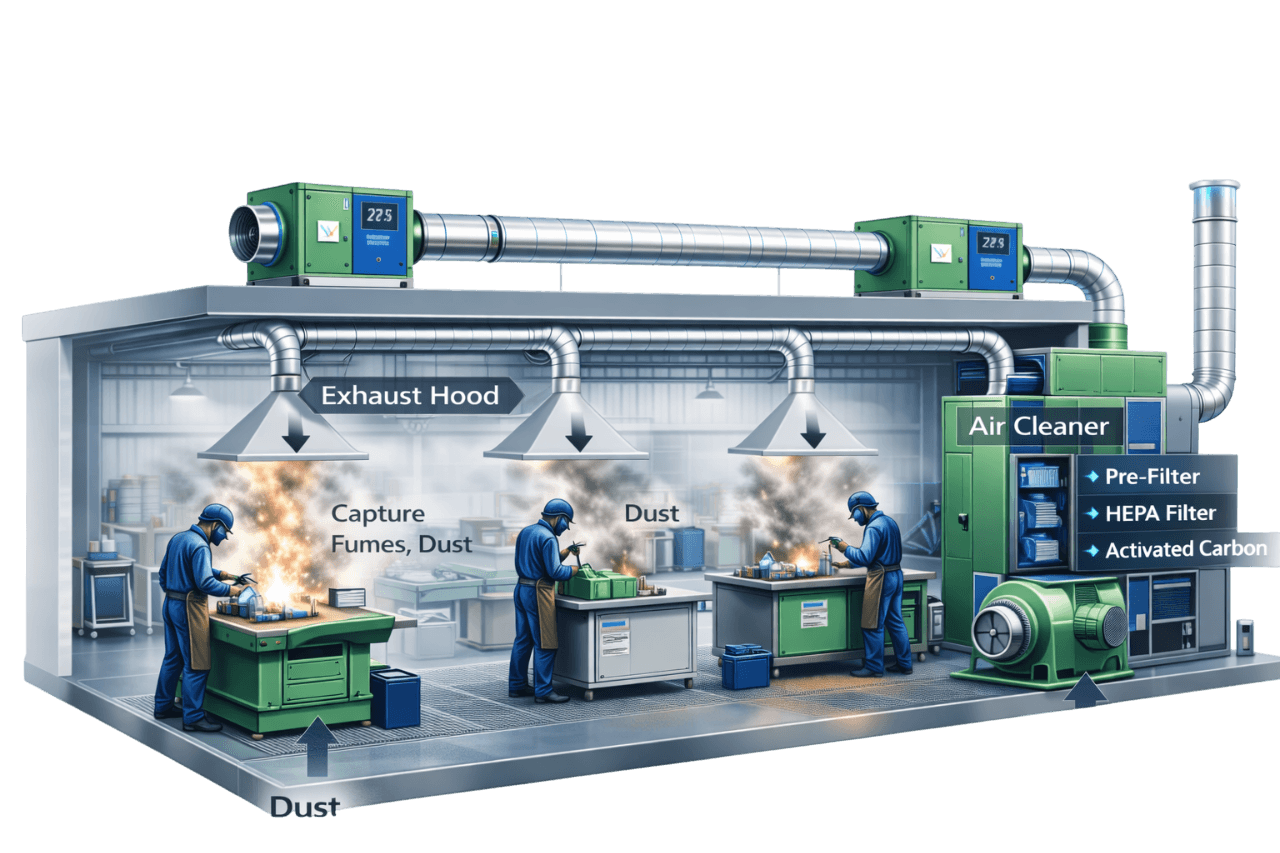
Local Exhaust Ventilation (LEV) Systems
Learn More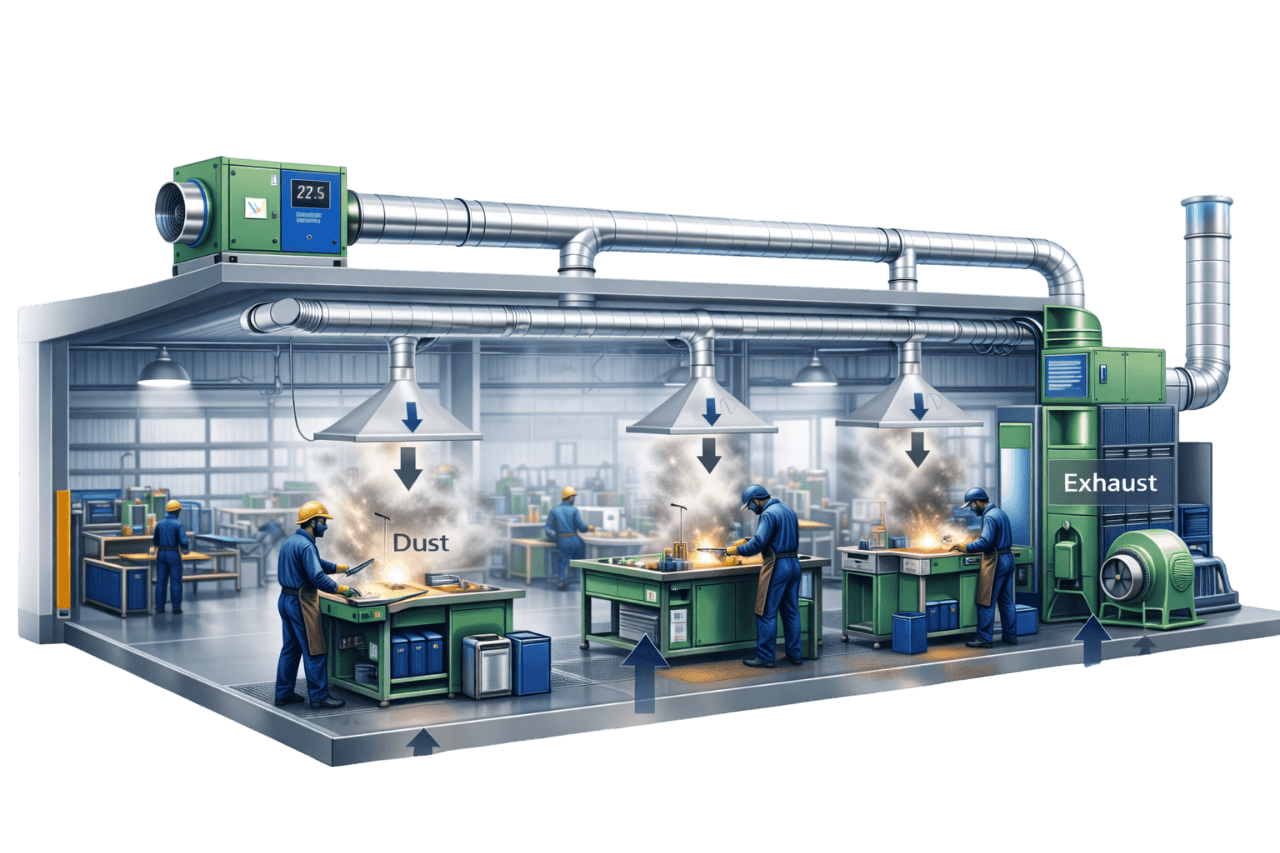
General Dilution Ventilation Systems
Learn More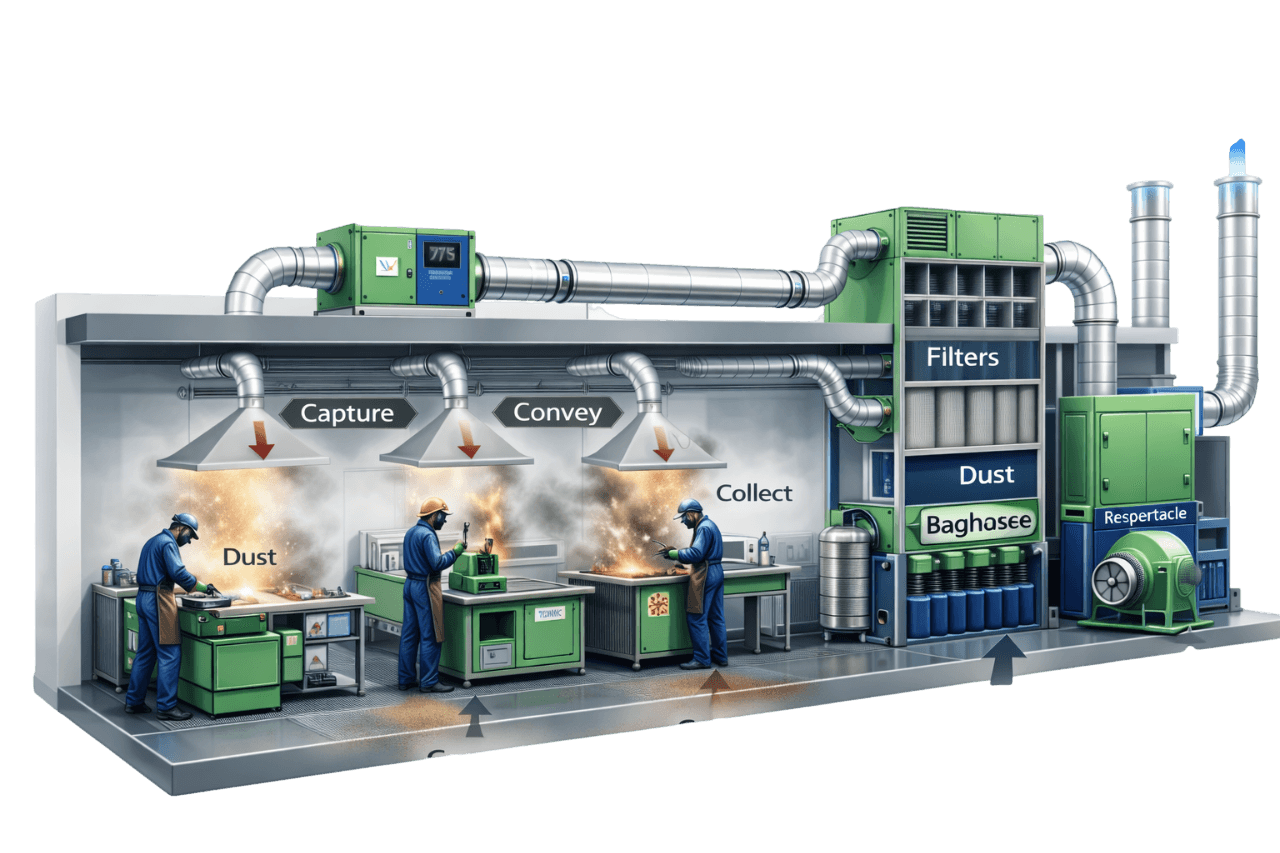
Dust Collection Systems
Learn More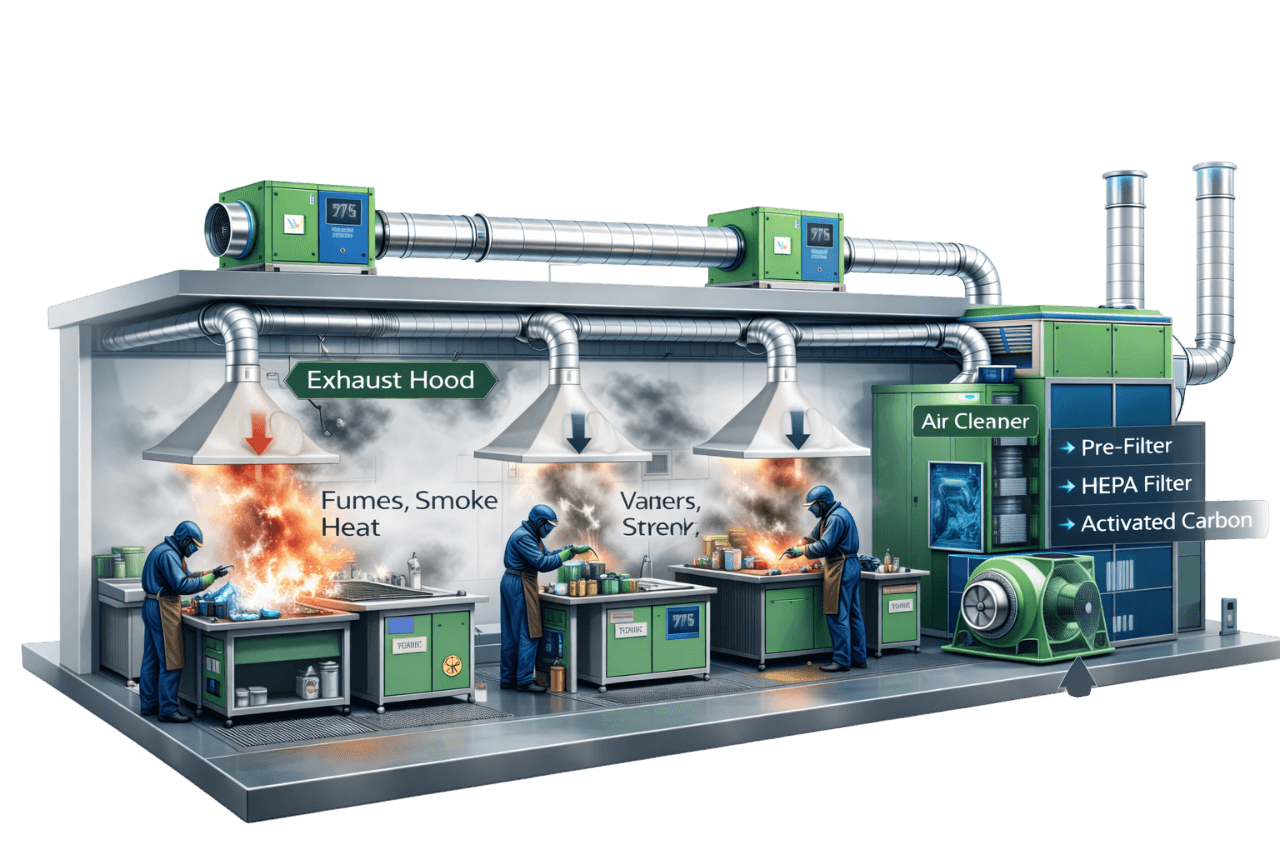
Fume Extraction Systems
Learn More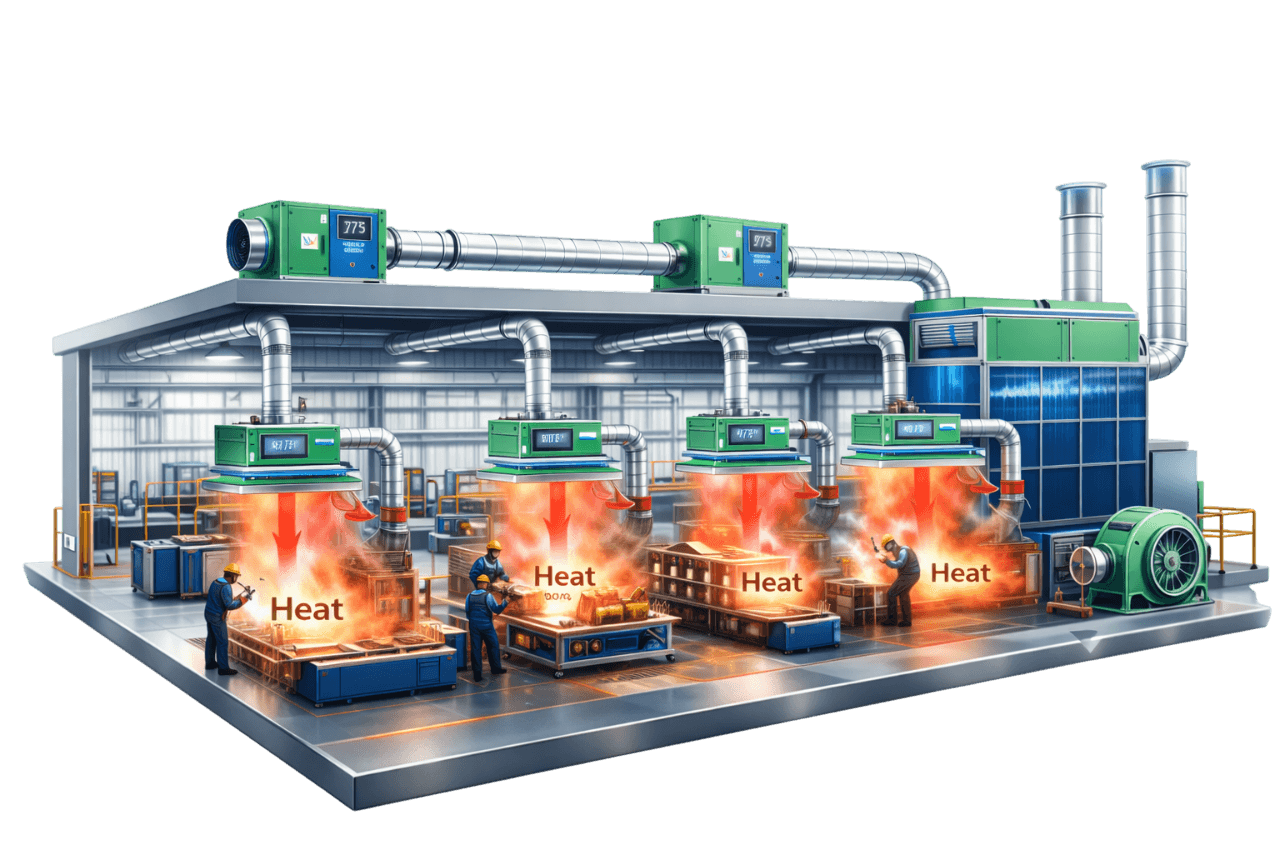
Heat Exhaust Ventilation Systems
Learn More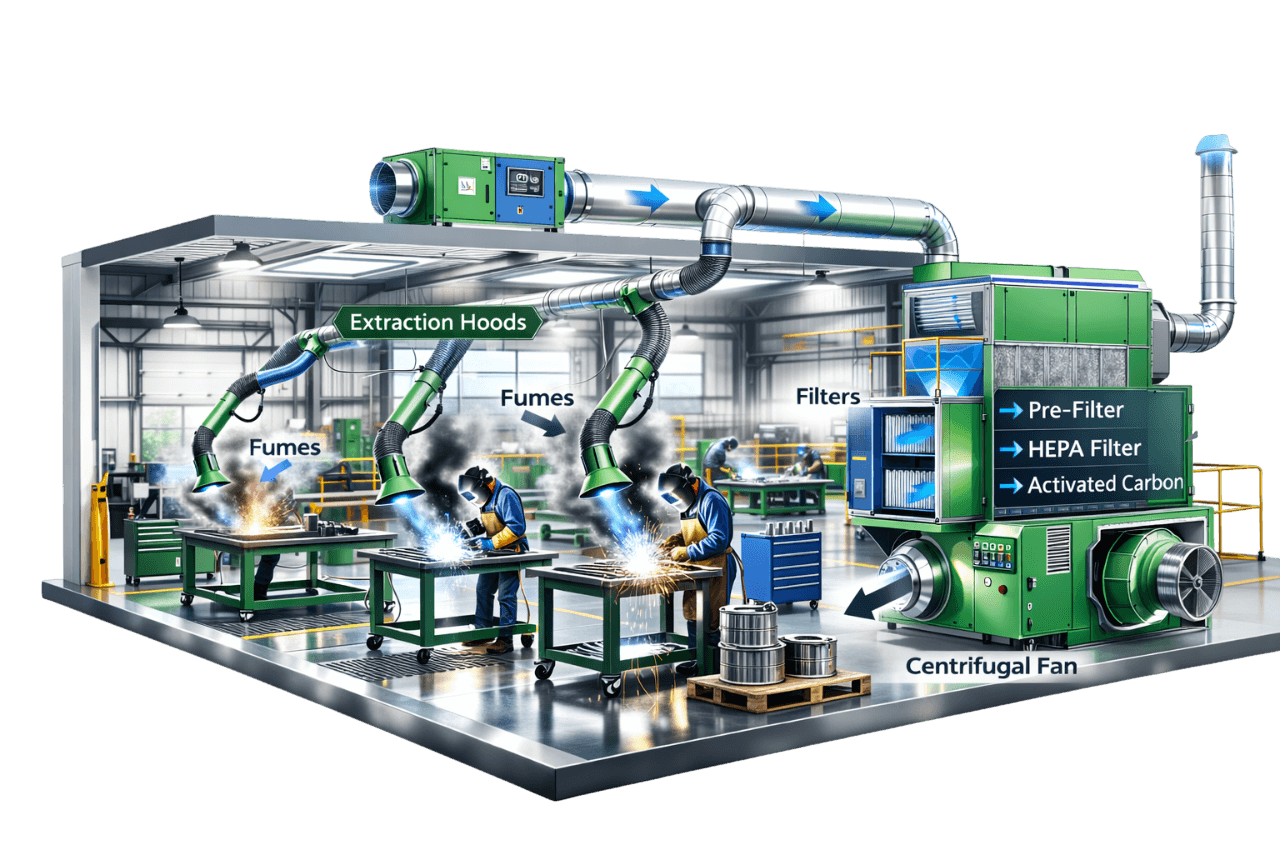
Welding Fume Extraction Systems
Learn More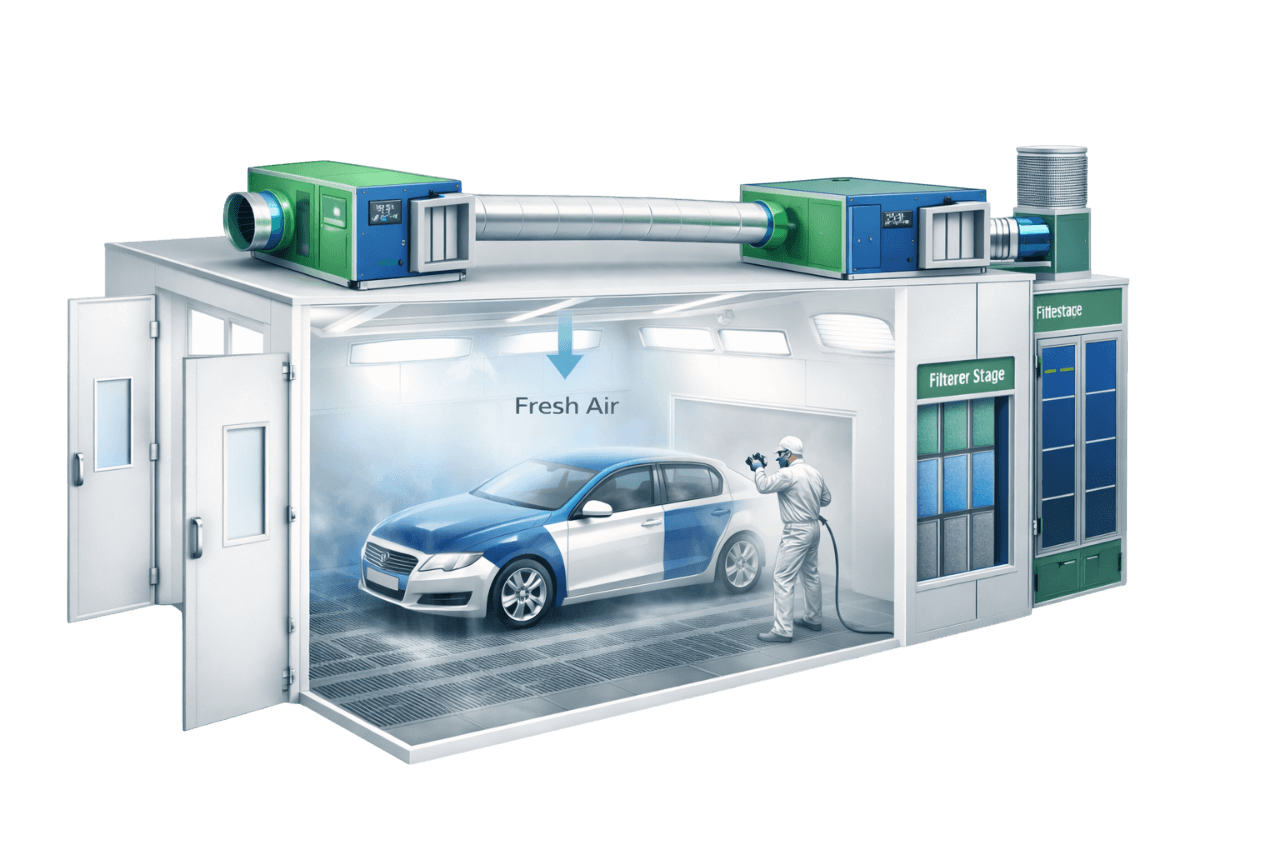
Paint Booth Ventilation Systems
Learn More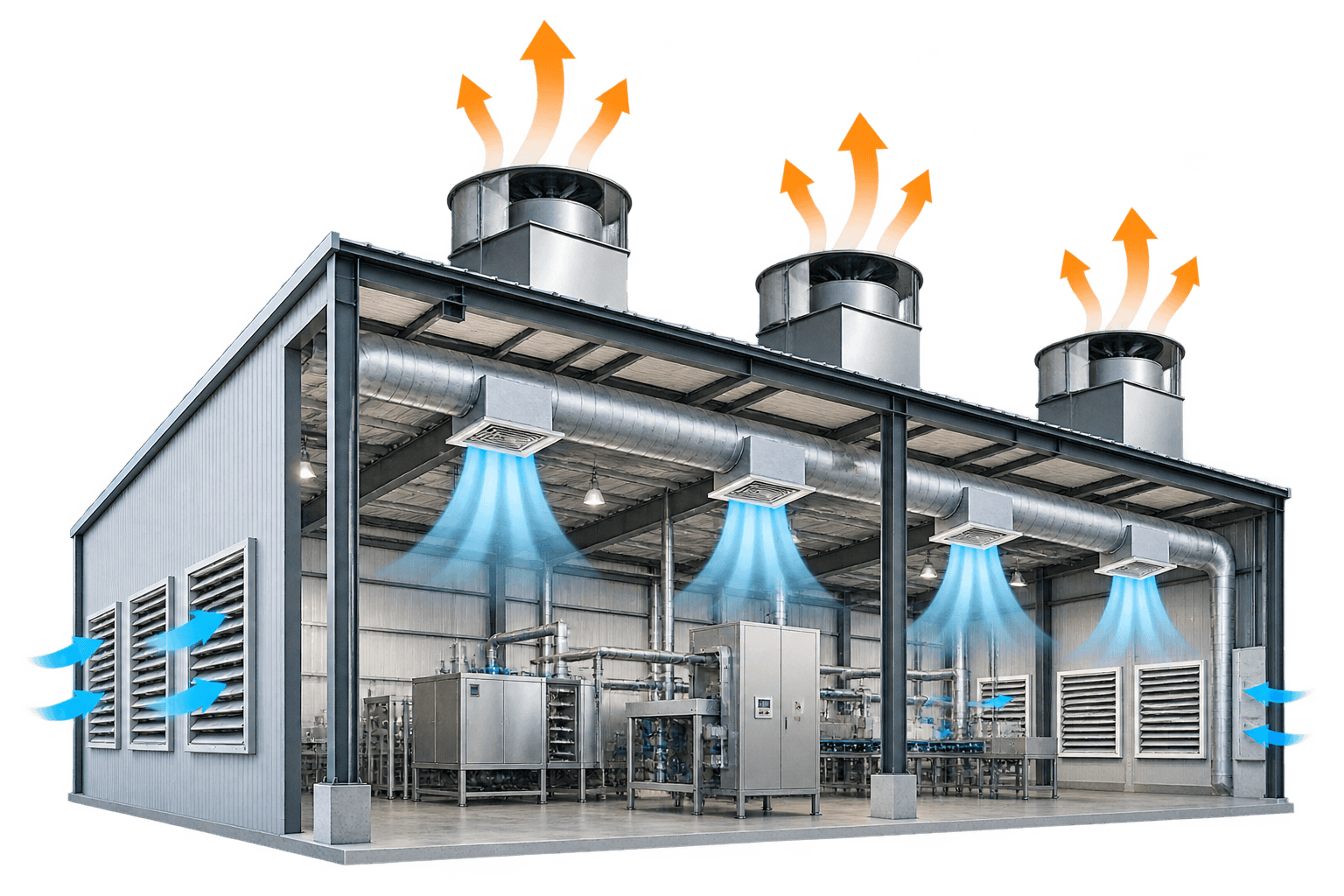
Industrial Dilution Ventilation Systems
Learn MoreFrequently Asked Questions
Q1. What is a chemical exhaust system?
A chemical exhaust system is a specialised ventilation system that captures corrosive, toxic or flammable fumes at the source and removes them through chemical-resistant ducts and fans. It often includes a scrubber or carbon adsorber to treat the exhaust before it is discharged through a stack.
Q2. How does a chemical exhaust system work?
Fumes are captured at hoods, cabinets or enclosures, carried through corrosion-resistant ducts under negative pressure, treated in a scrubber, adsorber or oxidiser, and discharged through a high-velocity stack. A chemical-resistant fan at the end of the system maintains the airflow.
Q3. Which duct material is best for chemical exhaust?
It depends on the chemicals. PP and PVC suit most acids and alkalis, FRP suits large or outdoor corrosive duty, stainless steel suits solvents and high temperatures, and PVDF or PTFE-coated ducts handle the most aggressive or mixed streams. Our engineers select the material after a chemical compatibility review.
Q4. Why can't GI ducts be used for acid fumes?
The zinc coating on galvanised iron is quickly attacked by acid fumes, exposing the steel underneath, which then corrodes rapidly. This leads to leaks, fume escape and structural failure, often within months. Plastic, FRP or suitable alloy ducts are required.
Q5. What is a fume scrubber and how does it work?
A fume scrubber cleans exhaust air by bringing it into close contact with a scrubbing liquid. In a packed bed scrubber, air rises through wetted packing while water or a neutralising solution flows down, absorbing and neutralising acid or alkali gases before the air leaves through a mist eliminator.
Q6. What is the difference between a wet scrubber and a carbon adsorber?
A wet scrubber uses liquid to absorb and neutralise acids, alkalis and water-soluble gases. A carbon adsorber uses activated carbon to capture organic solvent vapours, VOCs and odours. Many facilities need one or both depending on their chemicals.
Q7. Why should incompatible chemical exhaust streams be kept separate?
Some chemicals react dangerously when mixed, producing heat, toxic gases or explosive deposits. Separating streams such as oxidisers and organics, acids and cyanides, or perchloric acid from everything else prevents these reactions and makes treatment simpler and more effective.
Q8. What is a perchloric acid wash-down exhaust system?
It is a dedicated exhaust system for perchloric acid hoods, with its own ductwork and fan and built-in water spray nozzles. Regular wash-down cycles remove perchlorate salts from internal surfaces, preventing the build-up of shock-sensitive, explosive residues.
Q9. How high should a chemical exhaust stack be?
Stack height depends on the building, nearby air intakes, surrounding structures and pollution control requirements. Common laboratory design references call for at least 3 m above the adjacent roof line with a discharge velocity of around 15 m/s, while industrial stacks may need to be taller to meet consent conditions.
Q10. How often should chemical exhaust systems be inspected?
Critical items such as airflow monitors, scrubber pH and dosing should be checked routinely, often daily or weekly by site staff. A professional inspection covering fans, ducts, scrubbers, carbon and gas detectors is typically carried out every quarter, with fume hood performance tested at least once a year.
Q11. What is the cost of a chemical exhaust system in India?
Indicative costs start from around ₹2,00,000 for a single fume hood exhaust, ₹1,00,000 to ₹5,00,000 for a small PP or FRP scrubber unit and ₹5,00,000 to ₹20,00,000 for an acid fume exhaust line with scrubber. The final price depends on airflow, materials, treatment and controls. Contact Compress India for an accurate quotation.
Q12. Does Compress India design and install chemical exhaust systems in Mumbai?
Yes. Compress India designs, supplies, installs, tests, commissions and maintains chemical exhaust systems across Mumbai, Navi Mumbai, Thane and the rest of Maharashtra, and undertakes projects across India. Contact our HVAC team to schedule a site survey.