Dust Collection Systems
(Design, Supply, Installation, Testing, Commissioning & AMC for Industrial Dust Collection)
Design, Supply, Installation, Testing, Commissioning & AMC for Industrial Dust Collection
Dust on the shop floor is more than a housekeeping problem. It damages lungs, wears out machines, spoils products, attracts pollution control notices and, in the wrong conditions, can explode. Compress India designs and installs Dust Collection Systems that capture dust at the source, separate it from the air and discharge clean air within emission limits.
From a single grinding booth to a central dust collection system for an entire factory, we engineer every project around your dust, your process and your compliance requirements. Hoods, ductwork, dust collectors, fans, filter media, explosion protection and controls are all sized to work together, so you get strong suction at every pick-up point and a system that stays efficient for years.
If you are planning a new line, facing a pollution board deadline or struggling with an under-performing dust collector, our team can help. Request a site survey and quotation today.
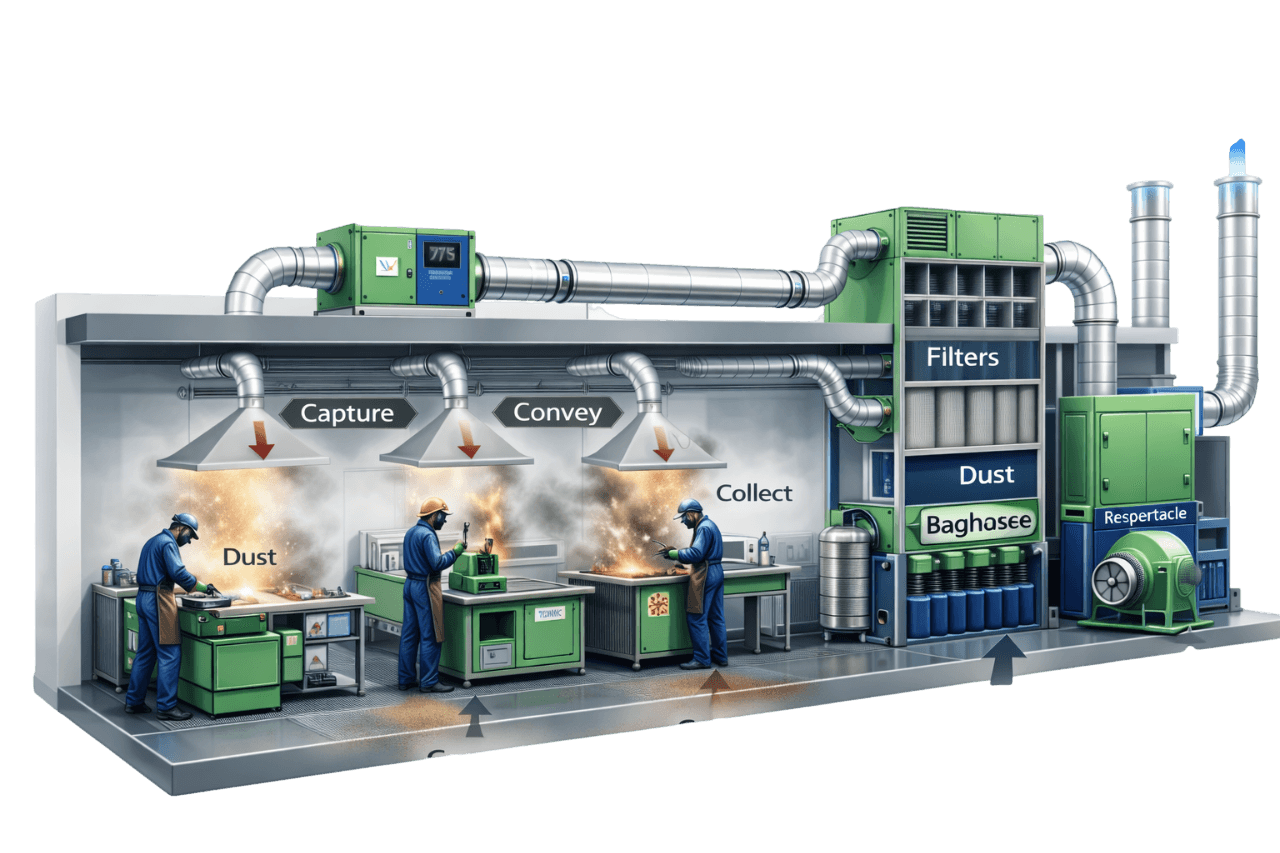
Compress India delivers turnkey industrial dust collection systems under one contract, with a single team accountable for performance from process study to long-term maintenance.
- Design: Dust characterisation, pick-up point airflow, capture and conveying velocities, air-to-cloth ratio, duct balancing, fan selection and explosion protection planning.
- Supply: Pulse-jet bag filters, cartridge dust collectors, cyclones, wet scrubbers, fans, filter bags and cartridges, rotary airlocks, explosion vents, isolation valves and control panels.
- Installation: In-house fabricated dust collection ductwork, collector erection, fan mounting, compressed air piping, stack erection and electrical works.
- Testing & Commissioning: Hood velocity and airflow measurement, static pressure profiling, filter differential pressure checks and stack emission monitoring, documented in a full performance report.
- AMC: Filter inspection and replacement, pulse valve servicing, leak detection testing and breakdown support.
One partner, one set of drawings and one team that stands behind the result.
What Is a Dust Collection System?
A dust collection system is an engineered network of hoods, ductwork, a dust collector and an exhaust fan that captures airborne dust where it is generated, carries it away and separates it from the air. The collected dust is discharged into bins or returned to the process, while cleaned air is released through a stack or, in some cases, returned to the building.
Dust collection systems range widely in size. At the small end are a portable dust collector machine beside a woodworking saw or a drill dust collector attachment on site. At the industrial end are centralised baghouse dust collectors handling hundreds of thousands of cubic metres of air per hour in cement, steel and chemical plants. Between them sit cartridge dust collectors for grinding and laser cutting, cyclone separators for coarse dust, and wet scrubbers for sticky or hazardous dust.
Whatever the scale, the goal is the same: capture dust before it reaches workers' lungs, the plant atmosphere or the environment.
Why Industries Need Dust Collection
For most manufacturing plants, industrial dust collection is not optional. It protects people, assets, products and your licence to operate.
Protecting Worker Health from Harmful Dust
Fine and respirable dust, including silica, metal, wood, flour and chemical dust, can cause lung disease, allergies and long-term health damage. Capturing dust at the source keeps exposure below occupational limits and protects your workforce.
Preventing Combustible Dust Fires & Explosions
Wood, flour, sugar, spice, pharmaceutical, plastic and many metal dusts are combustible. Dust that settles on beams and machines can fuel devastating secondary explosions. Proper combustible dust collection with explosion protection removes the fuel and controls the risk.
Pollution Control & Emission Compliance
State Pollution Control Boards set particulate emission limits for industrial stacks and make them conditions of your Consent to Operate. An efficient dust collector keeps stack emissions within limits, helping you avoid notices, penalties and closure orders.
Product Recovery & Reduced Material Loss
In pharmaceutical, food, chemical, cement and powder processing, collected dust is often valuable product. Bag filters and cyclones recover it for reuse, reducing raw material losses and improving yield.
Protecting Machines & Improving Product Quality
Abrasive dust wears bearings, slides, motors and electronics. Dust settling on products causes rejects in painting, packaging and assembly. Effective dust extraction keeps machines running longer and products cleaner.
Cleaner Workplace & Less Housekeeping
A well-designed dust extraction system keeps floors, walls and equipment clean, reduces cleaning labour and creates a more professional, pleasant working environment for employees and visiting clients.
How a Dust Collection System Works
Every dust collection system follows the same six-stage path, from the point where dust is created to the stack where clean air leaves.
1. Hoods Capture Dust at the Source
Hoods, enclosures, pick-up points and downdraft tables are placed as close as possible to where dust is released. The fan creates enough air velocity at the hood face to pull dust in before it escapes into the workspace.
2. Ductwork Conveys Dust-Laden Air
Dust collection ductwork carries the air and dust to the collector. Duct sizes are chosen to keep air moving above the minimum conveying velocity, so dust stays suspended and does not settle and block the ducts.
3. Dust Collector Separates Dust from Air
Inside the dust collector, dust is separated from the airstream by filter bags, pleated cartridges, cyclonic action, water sprays or electrostatic charge, depending on the collector type. Heavier particles often drop out first in an inlet baffle or pre-separator.
4. Filters Are Cleaned Automatically
As dust builds up on the filters, resistance rises. In a pulse jet dust collector, short bursts of compressed air knock the dust cake off bags or cartridges, keeping pressure drop stable without stopping production.
5. Collected Dust Is Discharged to Bins
Dislodged dust falls into the hopper and is discharged through a rotary airlock, slide gate or screw conveyor into bins, bags or back into the process. The airlock keeps the collector sealed while dust leaves.
6. Clean Air Exits Through the Stack
Filtered air passes through the exhaust fan and leaves through a stack designed for good dispersion, with sampling ports for emission monitoring. Where permitted, filtered air can be recirculated to save heating or cooling energy.
Main Components of a Dust Collection System
A dust collection system performs only as well as its weakest component. Compress India designs every part as one integrated system.
Hoods & Pick-Up Points
Hoods are the most important and most overlooked part of the system. Enclosing hoods, capture hoods, slot hoods and booth-type enclosures are shaped to each machine or transfer point, because a poorly designed hood wastes airflow and lets dust escape.
Ductwork, Bends & Blast Gates
Dust collection system piping uses long-radius bends, 30–45° branch entries and smooth transitions to reduce pressure loss and abrasion. Blast gates isolate unused branches and balance airflow between pick-up points. Heavier gauge or wear-resistant sections protect areas exposed to abrasive dust.
Dust Collector Housing
The housing encloses the filters and separation chamber. It is designed for the system's negative pressure, dust properties, temperature and corrosion conditions, and for explosion protection where the dust is combustible.
Filter Bags or Cartridges
Filter bags suit high dust loads, high temperatures and large airflows, while pleated filter cartridges pack more media into a smaller space and suit fine, dry dusts. Filter media selection determines emission levels, pressure drop and filter life.
Pulse-Jet Cleaning System
A compressed air header, diaphragm pulse valves, solenoids, blowpipes and a controller deliver cleaning pulses to each row of filters in turn. A well-tuned pulse-jet system keeps pressure drop low and maximises filter life.
Exhaust Fan & Motor
A centrifugal dust collector fan provides the airflow and static pressure the system needs. It is usually placed on the clean-air side so the impeller handles filtered air, reducing wear and imbalance.
Hopper, Rotary Airlock & Dust Bins
Hoppers with steep walls funnel dust to the outlet. A dust collector rotary airlock discharges dust while maintaining the seal, and dust bins, bags or conveyors form the dust disposal system.
Stack with Sampling Ports
The stack discharges clean air at the required height and velocity. Sampling ports and a working platform allow stack emission monitoring as required by the Pollution Control Board.
Explosion Protection Devices
For combustible dust, explosion vents, flameless vents, isolation valves, spark arrestors and suppression systems protect the collector, the ductwork and the people nearby.
Controls & Differential Pressure Gauges
A pulse controller, differential pressure gauge or transmitter, fan starter or VFD, and alarms show how the dust collector is performing and let you act before problems become breakdowns.
Types of Dust Collectors
The right dust collector depends on particle size, dust load, temperature, moisture, combustibility and emission targets. Compress India supplies and integrates all major types.
Pulse-Jet Bag Filters (Baghouses)
A pulse jet baghouse uses rows of fabric filter bags cleaned online by compressed air pulses. It handles high dust loads, large airflows and elevated temperatures, and routinely achieves very low outlet emissions. Baghouse dust collectors are the workhorse of cement, steel, chemical, food and power applications.
Reverse Air & Shaker Bag Filters
These older fabric filter designs clean bags by reversing airflow or mechanically shaking them, usually with the compartment taken offline. They are gentler on bags and suit very large, low-pressure installations, but need more space and cloth area than pulse-jet designs.
Cartridge Dust Collectors
A cartridge dust collector uses pleated filter cartridges that pack large media areas into a compact housing. Industrial cartridge dust collectors excel with fine, dry, non-sticky dust from grinding, laser and plasma cutting, welding, powder handling and pharmaceutical processes, and cartridges are quick to change.
Cyclone Separators & Multi-Cyclones
A cyclone dust collector spins the airstream so centrifugal force throws heavier particles to the wall, where they drop into a hopper. Cyclones are simple, robust and have no filters, but efficiency falls sharply for fine particles. A multi cyclone dust collector uses many small cyclones in parallel for better efficiency. Cyclones are often used as a cyclone pre-separator ahead of a bag filter.
Wet Scrubbers
A wet scrubber dust collector captures particles in water through sprays, venturi throats or wetted surfaces. It handles hot, sticky, moist or explosive dust and can remove some gases at the same time, but produces slurry that needs treatment and disposal.
Electrostatic Precipitators (ESP)
An electrostatic dust collector charges particles and collects them on plates. ESPs treat very large gas volumes with low pressure drop and are common in power plants, boilers and cement kilns. Performance depends on dust resistivity, and capital cost is high.
Downdraft Tables
A downdraft dust collector pulls air down through a perforated work surface, capturing dust from grinding, sanding, deburring and polishing right at the bench. Integrated units have built-in filters and fans; others connect to a central system.
Portable Dust Collectors
A portable dust collector or mobile dust extraction unit serves one or two machines and can be moved as layouts change. Options range from a small wall mount dust collector or a 3 HP single-stage unit in a small woodshop to 5 HP two-stage cyclone units and industrial portable cartridge collectors for welding and grinding.
Centralised Dust Collection Systems
A central dust collection system for a factory connects many machines to one large collector through a ducted network. It keeps noise, dust handling and filter maintenance outside the production area and is usually the most economical option for multiple machines.
Central Vacuum Cleaning Systems
A central vacuum system uses a high-vacuum unit and fixed piping with hose points around the plant. Instead of sweeping or compressed-air blowing, which spread dust, operators vacuum floors, machines and beams safely. It complements, rather than replaces, source capture.
Filter Media for Dust Collectors
The dust collector filter media decides how clean your stack is, how much energy the fan uses and how often filters are replaced. We match media to dust type, temperature, moisture and chemistry.
Polyester Filter Bags
Polyester needle felt is the most widely used dust collector filter bag material. It offers good strength and dust release at an economical price, for continuous temperatures up to about 130 °C. It is not suited to hot, moist or alkaline conditions, where it can degrade.
PPS & Aramid (Nomex) for High Temperature
PPS handles continuous temperatures up to about 190 °C and resists acids and moisture, making it common on boiler and dryer exhausts. Aramid (Nomex) handles about 200 °C and resists abrasion well, suiting asphalt, cement and metal processes. Both are used where polyester would fail.
PTFE Membrane Filters
A thin expanded PTFE membrane laminated to the filter surface captures dust on the surface instead of inside the felt. This surface filtration gives very low emissions, easy cake release, lower pressure drop and longer life, especially for fine, sticky or valuable dust.
Fibreglass Filters
Woven fibreglass withstands continuous temperatures of about 260 °C and is used in high-temperature applications such as furnaces and kilns. It needs gentle cleaning and careful handling, as the fibres are sensitive to flexing and abrasion.
Anti-Static Filter Media
Anti-static media includes conductive fibres or coatings that drain static charge to earth. It is essential for combustible dust collection, where a static spark from a filter could ignite a dust cloud.
Oil & Water Repellent Treatments
Fluorocarbon treatments help filters shed oily or damp dust, reducing blinding in humid conditions or where oil mist is present. This is particularly useful in Mumbai's humid climate and in machining or food applications.
Nanofibre Cartridge Media
Nanofibre cartridge filter media carries an ultra-fine fibre layer on a cellulose or synthetic base. Dust is held on the surface and pulses off easily, giving high efficiency on fine particles with low pressure drop and longer filter cartridge life.
| Filter media | Approx. continuous temperature | Best suited for |
|---|---|---|
| Polyester | 130 °C | General industrial dust, woodworking, food, cement mills |
| Polypropylene | 90 °C | Acidic or chemical dust at low temperature |
| PPS | 190 °C | Boilers, dryers, acidic flue gas |
| Aramid (Nomex) | 200 °C | Asphalt, cement, metal processes |
| PTFE membrane (on various bases) | Depends on base felt | Fine, sticky or valuable dust, very low emissions |
| Fibreglass | 260 °C | Furnaces, kilns, high-temperature gas |
| Nanofibre cartridge | Depends on base media | Fine dry dust, welding, laser and plasma cutting |
Bag Filter vs Cartridge Dust Collector
Both are fabric filters cleaned by pulse jets, but they suit different dusts. Choosing correctly between a cartridge dust collector vs baghouse affects filter life, emissions and running cost.
| Factor | Bag Filter (Baghouse) | Cartridge Dust Collector |
|---|---|---|
| Filter form | Long cylindrical felt bags | Pleated cartridges |
| Footprint | Larger | Compact, more media per m³ |
| Dust load | High to very high | Low to moderate |
| Dust type | Coarse to fine, abrasive, fibrous, sticky with right media | Fine, dry, free-flowing |
| Temperature | Up to about 260 °C with suitable media | Usually below about 80–90 °C |
| Filter change | Slower, more filters | Faster, fewer larger elements |
| Typical applications | Cement, steel, chemicals, food, woodworking | Welding, laser cutting, grinding, powder coating, pharma |
For heavy, hot or fibrous dust, a bag filter dust collector is usually the safer choice. For fine, dry dust in compact spaces, a cartridge collector often wins.
Cyclone Separator vs Bag Filter
A cyclone separator removes coarse particles cheaply with no filters, while a bag filter captures fine dust to meet emission limits. The baghouse vs cyclone dust collector choice often ends in using both.
| Factor | Cyclone Separator | Bag Filter |
|---|---|---|
| Separation method | Centrifugal force | Filtration through fabric |
| Efficiency on fine dust | Low, particularly below about 5–10 microns | Very high, including sub-micron dust |
| Emission compliance on its own | Rarely sufficient | Usually meets limits |
| Pressure drop | Moderate and constant | Moderate, rises with dust cake |
| Maintenance | Very low, no filters | Filter inspection and replacement |
| Temperature and abrasion | Very tolerant | Depends on media |
| Best role | Pre-separator, product recovery, coarse dust | Final filtration and compliance |
A cyclone ahead of a bag filter removes the coarse and abrasive fraction, protecting bags and extending their life.
Wet vs Dry Dust Collection
Dry collectors such as bag filters and cartridges are the default for most industries. Wet collectors are chosen where dust is hot, sticky, moist or highly explosive.
| Factor | Dry Dust Collection | Wet Dust Collection |
|---|---|---|
| Collected dust | Dry, often reusable | Slurry needing treatment |
| Efficiency on fine dust | Very high | Moderate to high, depends on energy input |
| Sticky or moist dust | Can blind filters | Handles well |
| Explosion risk | Needs explosion protection for combustible dust | Water greatly reduces ignition risk |
| Gas removal | No | Can absorb some gases |
| Running considerations | Filters and compressed air | Water, pumps, effluent treatment, corrosion |
Centralised vs Portable Dust Collectors
A centralised system serves many machines from one collector; a portable dust collection system serves one or two machines where they stand.
| Factor | Centralised System | Portable Dust Collector |
|---|---|---|
| Machines served | Many | One or two |
| Initial cost | Higher | Lower per unit |
| Cost per machine at scale | Lower | Higher |
| Noise and dust handling | Outside the work area | Inside the work area |
| Layout flexibility | Needs duct changes | Easy to move |
| Maintenance | One point | Many small units |
| Best for | Factories, multi-machine lines | Small shops, maintenance areas, occasional tasks |
For growing plants, we often start with a central system sized for expansion and use portable units for isolated or occasional tasks.
Combustible Dust Safety
A dust collector concentrates fine, dry dust inside an enclosure, which is exactly the condition a dust explosion needs. For any combustible dust, a dust collection system for combustible dust must be designed with prevention, protection and isolation built in from day one.
Combustible Dust Hazards
A dust explosion needs five elements: combustible dust, oxygen, an ignition source, dispersion into a cloud and confinement. Many common materials, including wood, flour, sugar, starch, spices, pharmaceuticals, plastics, coal, aluminium and magnesium, can explode. Laboratory tests for Kst (explosion severity), Pmax, minimum ignition energy and minimum explosible concentration tell us how dangerous a dust is and what protection is needed.
Explosion Vents & Flameless Venting
A dust collector explosion vent is a panel that bursts at a set pressure, releasing the explosion safely before the housing ruptures. Vents must discharge to a safe outdoor area. For collectors located indoors, flameless venting devices quench the flame and dust while still relieving pressure.
Isolation Valves & Flap Valves
An explosion can travel back through the ductwork into the plant. A passive flap valve on the inlet closes under explosion pressure, while active explosion isolation valves or chemical barriers are triggered by detectors. On the outlet side and on dust discharge, rotary airlocks rated for explosion isolation stop flame propagation.
Spark Detection & Extinguishing Systems
In woodworking, grinding and dryer exhausts, sparks and embers can travel down ducts into the collector. Infrared spark detectors trigger a fine water mist or an abort gate within milliseconds, extinguishing sparks before they reach the filters. A dust collector spark arrestor or drop-out box adds a mechanical layer of protection.
Grounding & Bonding
Static electricity is a common ignition source. Ducts, flexible connections, filter cages, hoppers and bins are bonded and earthed, and anti-static filter media is used, so no component can build up a dangerous charge.
Flameproof Motors & ATEX Equipment
The inside of a collector handling combustible dust is typically classified as a hazardous zone. Fans, motors, rotary airlocks, sensors and valves in these areas must be certified for the zone, such as ATEX or IS/IEC 60079 rated equipment, so they cannot become an ignition source. An ATEX dust collector design addresses every one of these components.
Combustible Dust Standards (NFPA & ATEX)
NFPA 660, the consolidated Standard for Combustible Dusts and Particulate Solids, now brings together the former NFPA 652, 654, 61, 664, 484 and 655, including the requirement for a documented Dust Hazard Analysis (DHA). NFPA 68 covers explosion venting and NFPA 69 covers explosion prevention and isolation systems. In Europe, the ATEX directives govern equipment and workplace zoning. In India, these internationally recognised standards are widely followed as good engineering practice, and Compress India applies them alongside the Factories Act and Indian electrical standards.
Dust Control Standards & Regulations in India
Industrial dust collection in India is regulated for both the environment and the workplace. A compliant dust collection system protects your consent to operate and your workers at the same time.
CPCB & SPCB Particulate Emission Norms
Under the Environment (Protection) Rules, 1986, the general emission standard for particulate matter from industrial stacks is 150 mg/Nm³, unless a stricter limit is prescribed for a specific industry. Many sectors, such as cement, steel and thermal power, have much tighter industry-specific limits, and State Pollution Control Boards, including the Maharashtra Pollution Control Board, can set stricter values in your consent. A properly designed bag filter typically achieves outlet emissions well below these limits.
Consent to Establish & Operate (CTE / CTO)
Most industries need a Consent to Establish before building and a Consent to Operate before starting production, under the Air and Water Acts. The consent specifies the air pollution control devices, stacks and emission limits you must maintain. We design dust collectors to meet these conditions and provide the technical details needed for applications and renewals.
Stack Monitoring Requirements
Stacks must have correctly located sampling ports, typically several duct diameters away from bends and disturbances, plus a safe platform and ladder for isokinetic sampling. Periodic monitoring by a recognised laboratory is a common consent condition, and industries in the highly polluting categories identified by CPCB must also install online continuous emission monitoring systems (OCEMS).
Factories Act Dust Control Provisions
Section 14 of the Factories Act, 1948 requires effective measures to prevent inhalation and accumulation of dust, including exhaust appliances as near as possible to the point of origin. Section 37 addresses explosive or inflammable dust. The Second Schedule sets permissible exposure levels for hazardous substances, and state rules such as the Maharashtra Factories Rules add detail.
ACGIH Industrial Ventilation Guidelines
The ACGIH manual, Industrial Ventilation: A Manual of Recommended Practice for Design, is the global reference for hood design, capture velocities, minimum duct conveying velocities and system balancing. Compress India uses it as the engineering basis for every dust extraction system we design.
Dust Collection System Design & Sizing
Most dust collection problems, such as weak suction, blocked ducts, short filter life and stack emissions, trace back to design. Compress India's dust collection system design follows a structured engineering process for every project.
Dust Characterisation (Particle Size, Type & Moisture)
We start by understanding the dust itself: particle size distribution, density, shape, abrasiveness, stickiness, moisture, temperature, chemistry and combustibility. These properties decide the collector type, filter media, conveying velocity and explosion protection. Where needed, samples are tested in a laboratory.
Airflow (CFM) per Pick-Up Point
Each hood is sized for the airflow needed to capture dust reliably. For an enclosing hood, Q = V × A (capture velocity × open face area). For an exterior hood, the classic relationship is Q = V × (10X² + A), where X is the distance from the hood to the source.
*Worked example:* A 0.1 m² hood capturing at 1.0 m/s from 0.3 m away needs about 1.0 m³/s (3,600 m³/h). Moving the same hood to 0.15 m cuts the requirement to about 0.33 m³/s (1,170 m³/h). Good hood placement is the cheapest energy saving in any dust collector CFM calculation.
Capture & Conveying Velocity
Capture velocity is the air speed needed at the source to pull dust into the hood. Conveying velocity is the minimum duct velocity that keeps dust airborne. Typical design values, based on ACGIH guidance, are shown below.
| How dust is released | Typical capture velocity |
|---|---|
| Very low velocity into still air (evaporation, gentle handling) | 0.25–0.5 m/s |
| Low velocity into moderately still air (container filling, welding) | 0.5–1.0 m/s |
| Active generation (conveyor transfer, crushers, bag filling) | 1.0–2.5 m/s |
| High initial velocity (grinding, abrasive blasting) | 2.5–10 m/s |
| Dust type | Typical minimum conveying velocity |
| -------------------------------------------------------- | -------------------------------------- |
| Very fine, light dust (flour, lint, fine powders) | 13–15 m/s |
| Dry dusts and powders | 15–20 m/s |
| Average industrial dust (sawdust, grinding dust, cement) | 18–20 m/s |
| Heavy dust (metal turnings, foundry sand, blast media) | 20–23 m/s |
| Heavy or moist dust | 23 m/s and above |
Air-to-Cloth Ratio
The dust collector air to cloth ratio is the airflow divided by total filter area, and it is the most important sizing parameter for bag and cartridge collectors. A/C ratio = airflow (m³/min) ÷ filter area (m²). Typical pulse-jet bag filters run at about 0.9–1.8 m/min (3–6 ft/min), with lower ratios for fine or difficult dust, while cartridge collectors run lower still.
*Worked example:* 10,000 m³/h (167 m³/min) at 1.2 m/min needs about 139 m² of cloth. Using 160 mm × 3 m bags (about 1.5 m² each), that is roughly 93 bags, rounded up to suit the tube-sheet layout. Undersized cloth area is the most common cause of high pressure drop and short bag life.
Duct Design & System Balancing
Duct sizes are selected branch by branch to hold conveying velocity, then the system is balanced so every hood receives its design airflow. We use long-radius bends, 30–45° branch entries, gradual expansions and minimal flexible hose, and balance by design or with blast gates. Inspection and clean-out doors are provided at key points.
Static Pressure & Fan Selection
Total static pressure is the sum of hood entry losses, duct and fitting losses, collector and filter pressure drop, and stack losses, plus a margin for filter loading. The dust extraction fan, usually a backward-curved or radial-blade centrifugal fan on the clean side, is selected to deliver the design airflow at that pressure, close to its peak efficiency.
Hopper & Dust Discharge Design
Hopper walls are steep enough, typically 60° or more, for dust to flow freely. Sticky or hygroscopic dust may need steeper walls, vibrators, air pads or hopper heaters. The rotary airlock and dust disposal system are sized for peak discharge, not average, so dust never backs up into the filters.
Compressed Air Requirements
Most pulse-jet collectors need clean, dry, oil-free compressed air, typically at 5–7 bar. We size the air header, receiver, dryer and drains so pulse pressure stays stable, since wet or oily air is a leading cause of filter blinding.
Stack Height & Discharge Design
The stack is sized for good exit velocity and dispersion, with height as prescribed in your consent conditions. Sampling ports, a platform and a ladder are included, and rain protection is designed so it does not deflect the plume back towards the roof.
Recirculation vs Exhaust to Atmosphere
Returning filtered air to the building can save significant heating or cooling energy. It is only appropriate for non-toxic dust, with a secondary high-efficiency after-filter, continuous leak monitoring and, for combustible dust, suitable explosion isolation. For silica, lead, carcinogenic or highly toxic dust, exhausting to atmosphere is the safe choice.
Energy Efficiency in Dust Collection
The fan and the compressed air system are the two biggest running costs of any dust collector. An energy efficient industrial dust collection system can cut both substantially without compromising capture.
VFD Fan Control
A dust collector VFD adjusts fan speed to actual demand, for example when machines are idle or blast gates are closed, and holds constant suction as filters load up. Because fan power varies with the cube of speed, even a modest speed reduction produces large savings.
Differential Pressure–Based Pulse Cleaning
Timer-only cleaning pulses filters whether they need it or not, wasting compressed air and wearing out media. Pulse cleaning triggered by filter differential pressure cleans only when needed, saving air and extending filter life.
Automatic Blast Gates
Automatic blast gates open only when a machine is running, so the fan serves active pick-up points instead of the whole network. Combined with a VFD, this can reduce airflow and fan energy dramatically in multi-machine plants and woodshops.
Low Pressure-Drop Filter Media
PTFE membrane and nanofibre media release dust easily and run at lower pressure drop than conventional felts. Lower resistance means lower fan power, less frequent pulsing and longer filter life.
Reducing Compressed Air Consumption
Fixing leaks, using correctly sized receivers and pulse valves, optimising pulse duration and pressure, and cleaning on demand all cut compressed air use. Since compressed air is one of the most expensive utilities in any plant, these small changes add up quickly.
Controls & Monitoring
Good dust collector monitoring turns a black box into a system you can see, trust and maintain proactively.
Differential Pressure Gauges & Transmitters
Filter differential pressure is the single most useful health indicator. A local gauge shows operators the reading at a glance, while a transmitter sends it to the controller, PLC or BMS for trending and alarms.
Sequential Timer & DP Pulse Controllers
Pulse controllers fire each valve in sequence. Advanced controllers start and stop cleaning based on differential pressure, run an off-line clean-down cycle after shutdown, and log cleaning activity.
Broken Bag Detectors
Triboelectric or similar particulate sensors in the outlet duct detect a rise in dust emission the moment a bag or cartridge fails. Some systems can pinpoint which row is leaking, speeding up repairs and protecting compliance.
PLC & SCADA Integration
Dust collector BMS integration or PLC and SCADA connectivity brings fan status, differential pressure, emission readings, airlock status and alarms onto your plant control screens for remote monitoring and data logging.
Alarms & Interlocks
Interlocks ensure the fan starts before the process, the airlock runs whenever the collector is on, and the system responds safely to spark detection, high temperature, high differential pressure or explosion protection signals.
Benefits of Dust Collection Systems
A properly engineered dust collection system pays back in health, safety, compliance and productivity.
Cleaner, Safer Workplace
Dust captured at the source never reaches workers' lungs, floors or machines. The result is a healthier, more comfortable and more productive workplace.
Compliance with Emission Norms
A well-designed bag filter or cartridge collector keeps stack emissions within CPCB and SPCB limits, protecting your Consent to Operate and your reputation with regulators and neighbours.
Recovery of Valuable Material
In pharmaceutical, food, chemical and powder processing, recovered dust goes straight back into production, often paying for a significant part of the system over its life.
Lower Fire & Explosion Risk
Removing combustible dust from the air and from surfaces, combined with proper explosion protection, greatly reduces the risk of fires and dust explosions.
Longer Equipment Life
Less abrasive dust in bearings, motors, panels and HVAC equipment means fewer breakdowns, lower maintenance costs and longer machine life.
Better Product Quality
Clean air reduces contamination, surface defects and rejects in painting, coating, packaging, electronics, food and pharmaceutical production.
Limitations of Dust Collection Systems
Understanding the costs and constraints helps you plan correctly. Compress India designs to minimise each of them.
Capital & Operating Cost
Collectors, ducts, fans, explosion protection and controls need investment, and fans and filters cost money to run. Correct sizing avoids paying for capacity you do not need, while under-sizing costs more in the long run.
Compressed Air & Energy Use
Pulse-jet cleaning consumes compressed air and fans consume power continuously. VFDs, DP-based cleaning and low pressure-drop media keep these costs under control.
Periodic Filter Replacement
Filter bags and cartridges wear out and must be replaced. Choosing the right media and running at the right air-to-cloth ratio extends life significantly.
Space Requirement
Large collectors, hoppers, stacks and ductwork need floor, roof or yard space and structural support. Compact cartridge designs and careful layout help where space is tight.
Explosion Protection Needs for Combustible Dust
Combustible dust adds vents, isolation devices, spark detection, certified equipment and safe collector locations to the design, which increases cost but is essential for safety.
Where Dust Collection Systems Are Used
Compress India designs dust collection systems for a wide range of industries, each with its own dust, process and compliance challenges.
Cement Plants
Crushers, raw mills, cement mills, packers, silos and transfer points all generate fine, abrasive dust. Pulse-jet bag filters, bin vent dust collectors on silos and cyclone pre-separators keep emissions within the strict limits applied to the cement sector.
Pharmaceutical Plants
Pharmaceutical dust collection protects operators from potent compounds, prevents cross-contamination and recovers valuable product from granulation, blending, compression, coating and dispensing. Cartridge collectors with containment features and high-efficiency after-filters are common.
Food, Flour & Spice Mills
Flour, sugar, starch, spice and grain dust is both a hygiene issue and a combustible dust hazard. A food dust collection system uses food-grade materials, easy-clean designs and explosion protection. From a large roller flour mill dust collector to a compact atta chakki dust collector, we size systems for every scale.
Woodworking & Furniture Units
Saws, planers, routers, sanders and CNC machines produce large volumes of combustible chips and fine dust. A wood dust collection system, often a central cyclone and bag filter with spark detection, keeps furniture factories clean and safe. For a small shop, a compact woodworking dust collector or two-stage cyclone unit can be the right starting point.
Metal Grinding & Foundries
Grinding, fettling, shot blasting, sand handling and knock-out generate abrasive and sometimes combustible metal dust. Metal dust collection systems use abrasion-resistant ducts, spark arrestors and cartridge or bag collectors. Grinder dust collectors, including units for tool sharpening machines, capture dust right at the wheel.
Steel Plants
Steel plants rely on large dedusting systems for raw material handling, sinter plants, blast furnace cast houses, steel melt shops and rolling mills. High-temperature media, spark arrestors and very large bag filters are typical.
Chemical & Fertiliser Plants
A chemical dust collection system must handle corrosive, hygroscopic or toxic powders during grinding, drying, bagging and conveying. Material selection, sealed designs and sometimes wet scrubbers are used to control both dust and gases.
Plastics & Rubber Industries
Compounding, mixing, grinding and pellet handling create fine, often combustible dust. Powder dust collection systems with anti-static media and explosion protection keep these plants clean and safe.
Textile Mills
Blow rooms, carding and spinning generate lint and fibre fly that clog machines and create fire risk. Rotary drum filters, bag filters and fibre collection systems remove fibre and return clean air to the conditioned space.
Paper & Packaging Units
Slitting, cutting, corrugating and trimming release paper dust and trim waste. Dust extraction systems with cyclones and bag filters keep printing and converting lines clean and reduce fire risk.
Mining & Minerals Processing
A mining dust collection system controls silica and mineral dust from crushing, screening, conveying and loading. Silica dust collection requires high-efficiency filtration to protect workers from serious lung disease.
Recycling Plants
Shredding, granulating and sorting of plastics, paper, metals and e-waste generate mixed, abrasive and sometimes combustible dust. Robust cyclones, bag filters and spark detection handle these demanding conditions.
Top Dust Collector Brands in India
Compress India is brand-neutral. We recommend collectors, filters and components based on your dust, performance requirements, budget and local service support, and we design complete systems around the collector that fits best.
Donaldson
Donaldson is one of the best-known names in industrial filtration. Its Torit dust collector range includes widely used cartridge collectors for welding, cutting, grinding and powder handling, and Donaldson dust collector filters and cartridges are used as replacements across many collector brands.
Nederman
Swedish group Nederman is known for source capture solutions such as extraction arms and fume extractors, along with filter units, bag filters and complete industrial air filtration systems for metalworking, woodworking and process industries.
Camfil
Camfil, a global air filtration specialist, offers cartridge dust collectors and replacement filter cartridges for demanding applications such as thermal cutting, welding, powder and pharmaceutical processes, with a strong focus on combustible dust safety.
Thermax
Indian engineering company Thermax supplies large air pollution control equipment, including bag filters, electrostatic precipitators and wet scrubbers, for power, cement, steel and process industries.
Other Dust Collector Manufacturers
India also has many capable fabricators of pulse-jet bag filters, cyclones and scrubbers, and filter media makers for bags and cartridges. For small shops, woodworking brands such as JET and Harvey offer compact cyclone and two-stage units. Compress India selects from this full market, so your dust collection system is never limited by a single supplier's range.
Dust Collection System Installation Guide
Correct dust collection system installation protects the performance you paid for. Compress India manages the full installation with our own engineers and fabrication teams.
Site Survey & Process Study
We study each dust source, machine layout, operating hours, dust properties, existing ducts and collectors, and space, structural and utility constraints. Where a system is under-performing, we measure airflow and pressure to find the real cause.
Foundation & Support Structure
Collectors, fans and stacks need foundations and steel structures designed for dead load, dust load, wind and seismic forces, and, for combustible dust, explosion vent reaction forces.
Dust Collector Erection
The collector housing, tube sheet, hopper, filter cages and access platforms are erected, levelled and sealed. Airtight construction matters, since leaks reduce suction at the hoods and let dust bypass the filters.
Ductwork with Long-Radius Bends & Inspection Doors
Our in-house team fabricates dust extraction ducting with long-radius bends, angled branch entries, flanged or clamped joints and inspection doors at bends and junctions. Wear-resistant sections are fitted where abrasive dust impacts.
Blast Gate Installation
Manual or automatic blast gates are fitted on each branch, close to the main, for isolation and balancing. Automatic gates are wired to machine signals for on-demand extraction.
Fan & Motor Installation
The dust collector fan is mounted on an inertia base or anti-vibration mounts, aligned and fitted with flexible connections, guards and access for maintenance.
Compressed Air Piping
We run clean air piping from the compressor or a dedicated receiver to the collector header, with filters, a regulator, a dryer where needed and automatic drains to keep the air clean and dry.
Rotary Airlock & Hopper Installation
Rotary airlocks, slide gates, level sensors, vibrators and bin connections are installed and sealed so dust discharges reliably without air leakage.
Explosion Vents & Isolation Devices
Explosion vents, flameless vents, isolation valves and spark detection are installed to the manufacturer's requirements, with safe discharge areas, clear zones and warning signage.
Stack Erection with Sampling Ports
The stack is erected to the consented height with sampling ports at the correct location, a working platform, a ladder and lightning protection where required.
Electrical & Control Wiring
We complete power and control wiring, starters or VFDs, pulse controllers, DP transmitters, interlocks, and earthing and bonding of every component, using certified equipment in hazardous zones.
Testing & Commissioning
Our dust collector commissioning process proves the system meets its design airflow, capture and emission targets before handover.
Airflow & Velocity Measurement at Hoods
We measure airflow and face or capture velocity at every hood, and duct velocity in every branch, confirming each pick-up point meets its design value and conveying velocities are maintained.
Static Pressure Profile
Static pressure readings at hoods, branches, the collector inlet and outlet and the fan create a baseline profile. This baseline makes future troubleshooting fast and accurate.
Filter Differential Pressure Checks
We confirm clean-filter differential pressure, set pulse cleaning start and stop points, and verify the pulse sequence and compressed air pressure.
Stack Emission Monitoring
Stack emission monitoring by a recognised laboratory confirms outlet dust concentration is within consent limits, giving you documentation ready for your Pollution Control Board.
Explosion Protection Device Checks
Vents, isolation valves, spark detection and suppression systems are inspected, function-tested where possible and documented against the manufacturer's requirements.
Performance Report
You receive a complete performance report with measured airflows, velocities, pressures, emission results, device checks, as-built drawings and operation and maintenance manuals.
Dust Collector Service, Maintenance & AMC
A dust collector slowly loses suction and efficiency without regular care. Compress India's dust collector maintenance AMC keeps your system compliant, efficient and safe.
Filter Bag & Cartridge Inspection
We inspect bags and cartridges for wear, holes, abrasion, blinding, chemical attack and seal condition, and check cages and tube-sheet seals for leaks.
Filter Replacement
Filters are replaced based on differential pressure trends, emission readings and physical condition, with correctly specified media and proper installation to avoid bypass leaks.
Pulse Valve & Diaphragm Checks
Diaphragms, solenoids and pulse valves are tested and serviced. A single failed valve leaves an entire row of filters uncleaned and drives pressure drop up.
Compressed Air Quality Checks
We check air pressure, moisture and oil content, dryer performance, drains and leaks, because poor-quality compressed air blinds filters and damages valves.
Hopper & Rotary Airlock Checks
Hoppers are checked for build-up and bridging, and rotary airlocks for wear, clearance, seal condition and drive health, to keep dust discharge reliable.
Duct Wear & Cleaning
Ducts are inspected for abrasion, holes, leaks and settled dust. Worn bends are replaced and settled dust is cleaned out, restoring airflow and reducing fire risk.
Fan & Motor Checks
We check fan vibration, bearing condition, belt tension, impeller build-up and wear, motor current and alignment, preventing unplanned breakdowns.
Leak Detection Testing
Fluorescent powder leak testing and emission monitoring locate leaking bags, cartridges and seals quickly, so they can be fixed before they affect compliance.
Common Dust Collection Problems & Solutions
Most dust collector troubleshooting comes down to a handful of recurring problems. Here is how we diagnose and fix them.
Low Suction at Hoods
Cause: Blocked ducts, open blast gates on idle machines, leaks, high filter pressure drop, a worn fan or machines added without redesign.
Solution: Measure static pressure and airflow, clear blockages, seal leaks, rebalance the system and restore filter and fan performance.
High Filter Pressure Drop
Cause: Undersized cloth area, poor pulse cleaning, low compressed air pressure, moisture or wrong filter media.
Solution: Check pulse valves and air supply, tune cleaning, fix moisture sources and, if needed, upgrade to low pressure-drop media or add filter area.
Filter Blinding
Cause: Moist, oily or sticky dust, condensation, or wet compressed air sealing the filter surface.
Solution: Insulate or heat the collector, use pre-coating, dry the compressed air and switch to PTFE membrane or oleophobic media.
Dust Emission from the Stack
Cause: Torn or poorly fitted filters, tube-sheet leaks or media unsuitable for fine dust.
Solution: Leak-test and replace failed filters, fix seals, upgrade media and install a broken bag detector.
Hopper Bridging & Plugging
Cause: Hygroscopic or sticky dust, shallow hopper angles or an undersized or stopped airlock.
Solution: Add hopper vibrators, air pads or heaters, increase airlock capacity and interlock the airlock with the collector.
Duct Plugging & Abrasion
Cause: Duct velocity below conveying velocity, poor branch entries or abrasive dust hitting short-radius bends.
Solution: Resize ducts, fix fittings, fit wear-resistant bends and maintain correct airflow in every branch.
Condensation & Sticky Dust
Cause: Warm, moist gas cooling below its dew point inside the collector, common in Mumbai's humid climate.
Solution: Insulate the housing and ducts, add hopper heaters, preheat before start-up and run a purge cycle after shutdown.
Pulse Valve Failure
Cause: Worn diaphragms, wet or dirty air, or failed solenoids and controllers.
Solution: Replace diaphragms, clean the air supply and test the controller and every valve.
Fan Imbalance from Dust Build-Up
Cause: Dust bypassing the filters or a fan placed on the dirty-air side, building up on the impeller.
Solution: Clean and rebalance the impeller, fix filter leaks and, where possible, relocate the fan to the clean side.
Fire & Explosion Incidents
Cause: Sparks entering ducts, static discharge, hot surfaces or combustible dust without protection.
Solution: Carry out a dust hazard analysis, then add spark detection, grounding, anti-static media, explosion vents and isolation as required.
Dust Collection Retrofit & Upgrades
Many existing dust collectors can be brought up to today's performance and compliance standards without full replacement. Compress India assesses your system and recommends the most cost-effective upgrade.
Upgrading Cyclones to Bag Filters for Compliance
Cyclones alone rarely meet modern emission limits on fine dust. Adding a pulse-jet bag filter after an existing cyclone, or replacing it, brings stack emissions into compliance while the cyclone continues as a pre-separator.
Upgrading Filter Media
Switching to PTFE membrane, anti-static, oil-repellent or nanofibre media can cut emissions, lower pressure drop and extend filter life in the same housing.
Adding Explosion Protection
Older collectors handling combustible dust often lack vents, isolation or spark detection. We carry out a hazard review and retrofit the protection required to bring the system in line with recognised combustible dust standards.
VFD & DP-Based Cleaning Upgrades
Retrofitting a VFD, a DP-based pulse controller and automatic blast gates reduces power and compressed air consumption with a short payback period.
Replacing Worn Ducts & Components
Abraded bends, leaking joints, worn airlocks and tired fans rob a system of suction. Targeted replacement restores airflow at the hoods and reduces leakage.
Capacity Expansion
When new machines are added, we recalculate the airflow and pressure for the whole system, then extend ducts, add filter area or upgrade the fan so every pick-up point still performs.
Dust Collection System Cost in India
The dust collector price for your project depends on airflow, dust type, collector type, filter media, ductwork, explosion protection and site conditions. The figures below are indicative 2026 ranges excluding GST; your exact price is confirmed after a site survey and design.
Cost by Airflow (CFM)
The table shows indicative budgets for complete systems, including collector, fan, ductwork, stack, controls and installation.
| System scope | Typical airflow | Indicative budget |
|---|---|---|
| Portable or single-machine unit | Up to 2,000 CFM | ₹40,000 – ₹3 lakh |
| Small shop or single line with ducting | 2,000 – 10,000 CFM | ₹3 lakh – ₹15 lakh |
| Multi-machine central dust collection system | 10,000 – 30,000 CFM | ₹12 lakh – ₹45 lakh |
| Large process or plant-wide system, high temperature or explosion-protected | 30,000 CFM and above | ₹40 lakh and above |
Bag Filter vs Cartridge vs Cyclone Cost
Cyclones are usually the lowest-cost collectors, with simple units starting from around ₹1 lakh. Small pulse-jet bag filters and cartridge collectors commonly cost about ₹1 lakh to ₹5 lakh for the collector alone, while large, high-temperature or special-material units can run well beyond ₹15 lakh. Cartridge collectors are often cheaper at small airflows; bag filters become more economical at large airflows and high dust loads.
Filter Media Cost
Standard polyester filter bags typically cost around ₹200 to ₹550 each, while PTFE membrane, PPS and fibreglass bags generally range from about ₹450 to ₹1,600 depending on size and construction. Replacement filter cartridges commonly cost around ₹4,000 to ₹5,500 each. Premium media costs more upfront but often lowers total cost through longer life and lower energy use.
Ductwork, Fan & Stack Cost
Dust collection ductwork uses heavier gauge material than standard HVAC ducts, plus wear-resistant bends where needed, so in a central system with long runs it can be a large share of the total cost. Fan cost depends on airflow, static pressure, material and motor rating, and stack cost on height, diameter and platform requirements.
Explosion Protection Cost
For combustible dust, explosion vents are the most economical protection. Flameless vents for indoor collectors, active isolation valves, spark detection and certified electrical equipment add further cost, which varies widely with collector size and dust properties.
Factors Affecting Total Project Cost
- Total airflow and number of pick-up points
- Dust properties, including fineness, abrasiveness, stickiness, temperature and combustibility
- Collector type, material of construction and filter media
- Duct length, gauge and complexity
- Explosion protection and hazardous-area requirements
- Emission limits in your consent
- Structural, civil, electrical and compressed air works
- Controls, monitoring and automation
A used dust collector for sale or a DIY dust collector may look cheaper upfront, but if it is not sized for your airflow, dust and emission limits, it usually costs more in poor suction, filter failures and compliance risk. Share your process details or book a site survey for a detailed, itemised quotation.
Dust Collection System Design & Installation in Mumbai, Navi Mumbai & Thane
Compress India designs, installs, commissions and maintains dust collection systems across Mumbai, Navi Mumbai and Thane, serving plants in industrial areas such as MIDC Andheri, the Thane-Belapur (TTC) industrial area, Taloja, Wagle Estate and the Bhiwandi belt.
The region's high humidity and heavy monsoon make condensation, sticky dust and filter blinding common problems. We design for these conditions with insulated housings, hopper heaters, dry compressed air and moisture-resistant filter media. We also understand the consent and emission requirements of the Maharashtra Pollution Control Board, helping you install equipment that meets your consent conditions from day one.
From pharmaceutical and chemical plants to food processing units, furniture workshops and engineering shops, our local team offers fast site surveys, responsive installation and reliable AMC support.
Why Choose Compress India for Dust Collection Systems?
As an industrial dust collector supplier and turnkey installer, Compress India combines process understanding, ventilation engineering and in-house fabrication to deliver systems that work.
Industrial Ventilation & Dust Control Expertise
Our engineers apply ACGIH-based design principles to hoods, ducts, collectors and fans, treating dust control as a complete ventilation system rather than a collector in isolation.
Process-Specific System Design
Every system is designed around your dust, process, shift pattern and plant layout, so capture is effective where it matters and you do not pay for capacity you will not use.
In-House Ductwork Fabrication
Our in-house fabrication gives you dust collection ductwork built to the right gauge, with long-radius bends, wear protection and precise fit, delivered on schedule.
Dust Collector & Filter Media Selection
As a brand-neutral partner, we select the collector type and filter media that best suit your dust, temperature, moisture and emission targets.
Safety & Emission Compliance Focus
From explosion protection for combustible dust to stacks and sampling ports that meet Pollution Control Board requirements, safety and compliance are designed in from the start.
Testing & Commissioning
We measure and document hood velocities, airflows, pressures and emissions, handing over a system that is proven to perform.
AMC & Filter Replacement Support
Our AMC keeps filters, pulse valves, airlocks and fans in top condition, with planned filter replacement and quick breakdown response.
Get a Dust Collection Solution from Compress India
Whether you need a new industrial dust collection system for a manufacturing plant, a compliance upgrade or help with an under-performing collector, Compress India is ready to help.
Connect with Our HVAC Team
Tell us about your dust and process, and we will recommend the most effective solution. To help us respond quickly, share:
- Process description and machine list
- Dust type, and a safety data sheet or sample if available
- Plant layout or photographs
- Current problems, such as poor suction, visible dust, stack emission notices or high filter costs
- Your Pollution Control Board consent conditions, if applicable
Call: [Phone Number] | Email: [Email Address] | Visit: [Office Address]
Request a site survey and quotation today.
Related Industrial HVAC, LEV & Ductwork Solutions
Dust Collection Systems work alongside these industrial ventilation solutions to control airborne contaminants, protect workers and support cleaner production environments.
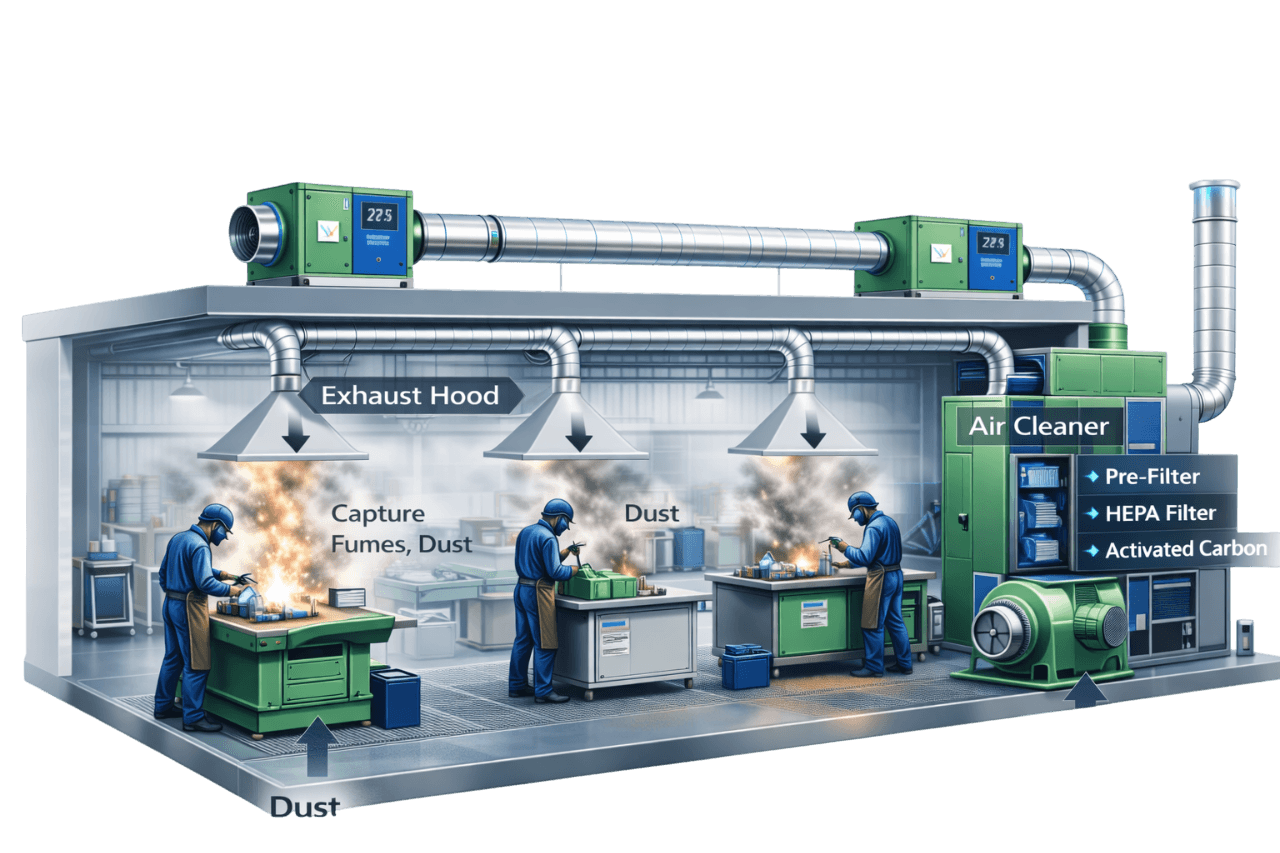
Local Exhaust Ventilation (LEV) Systems
Learn More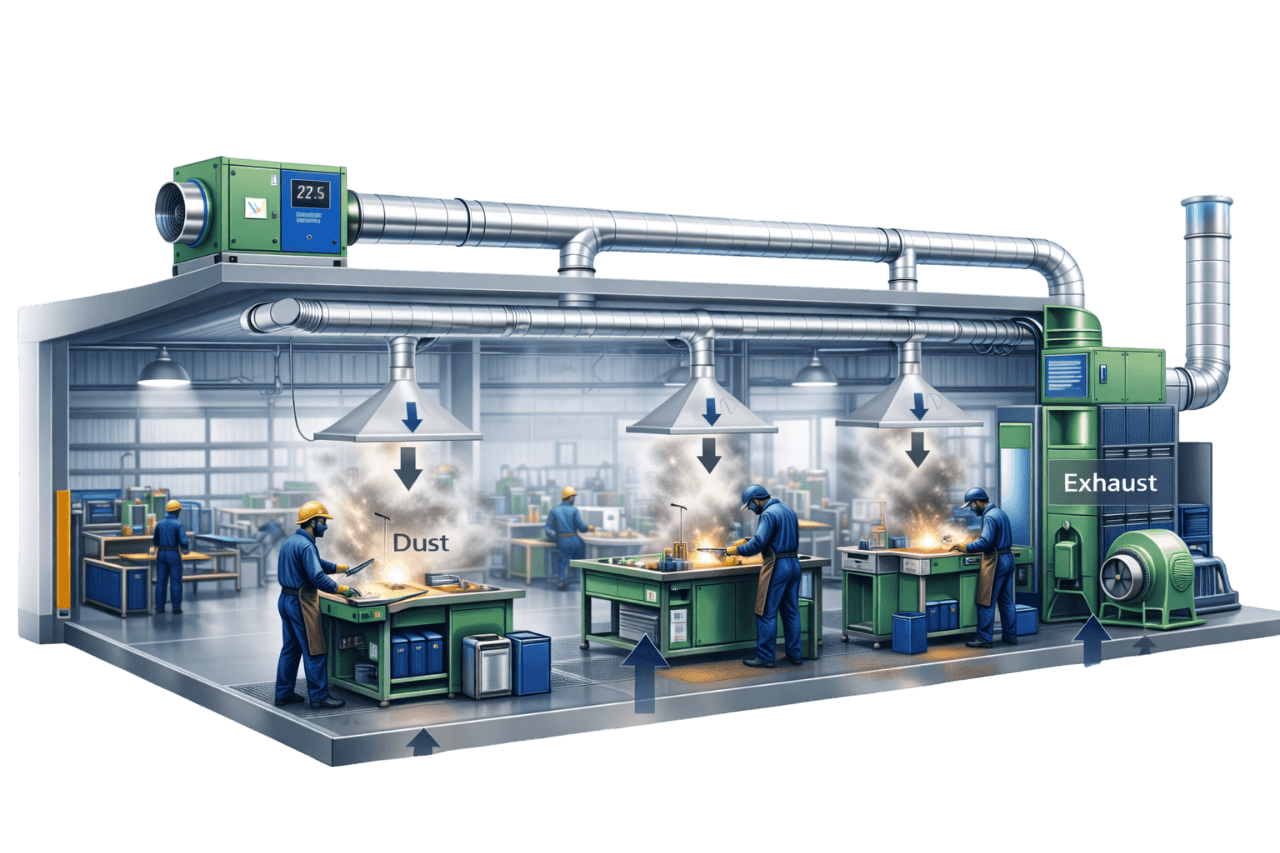
General Dilution Ventilation Systems
Learn More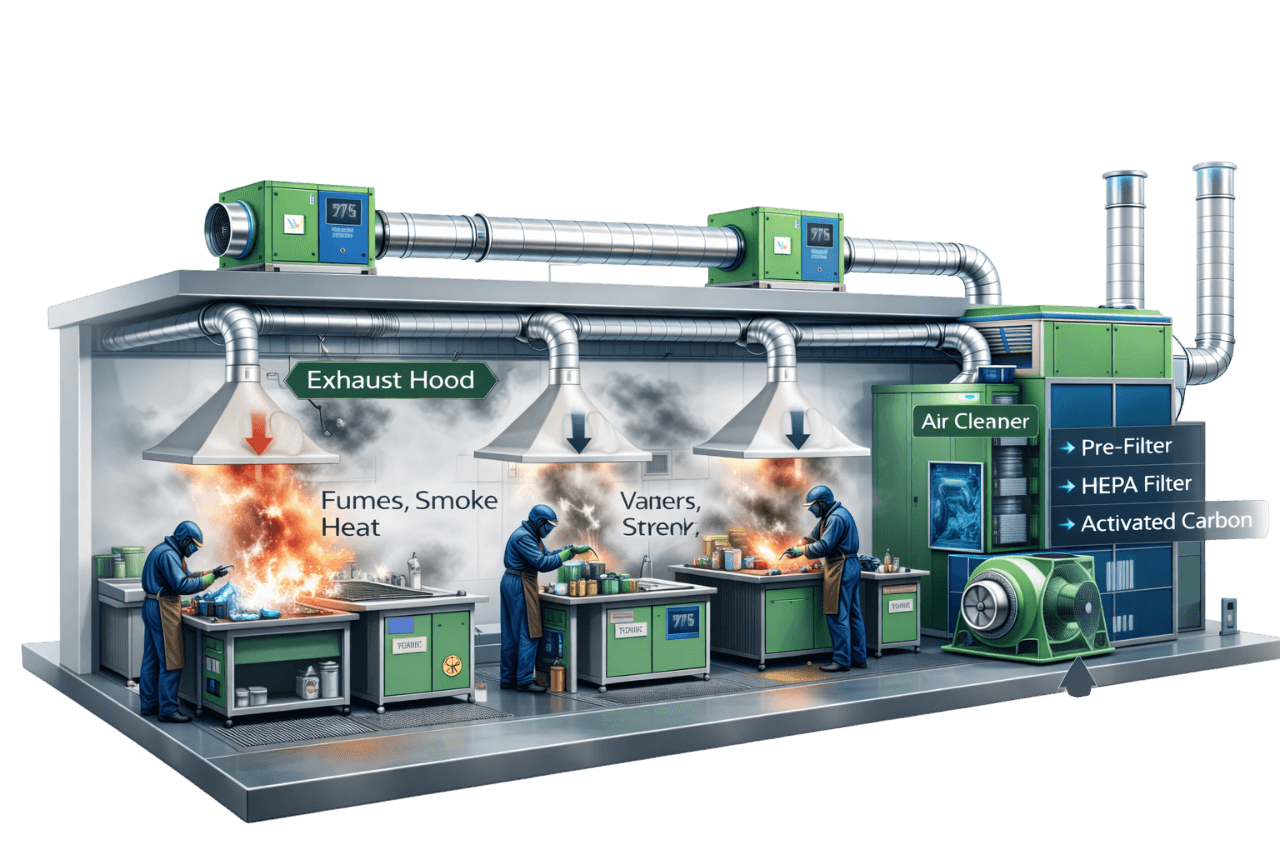
Fume Extraction Systems
Learn More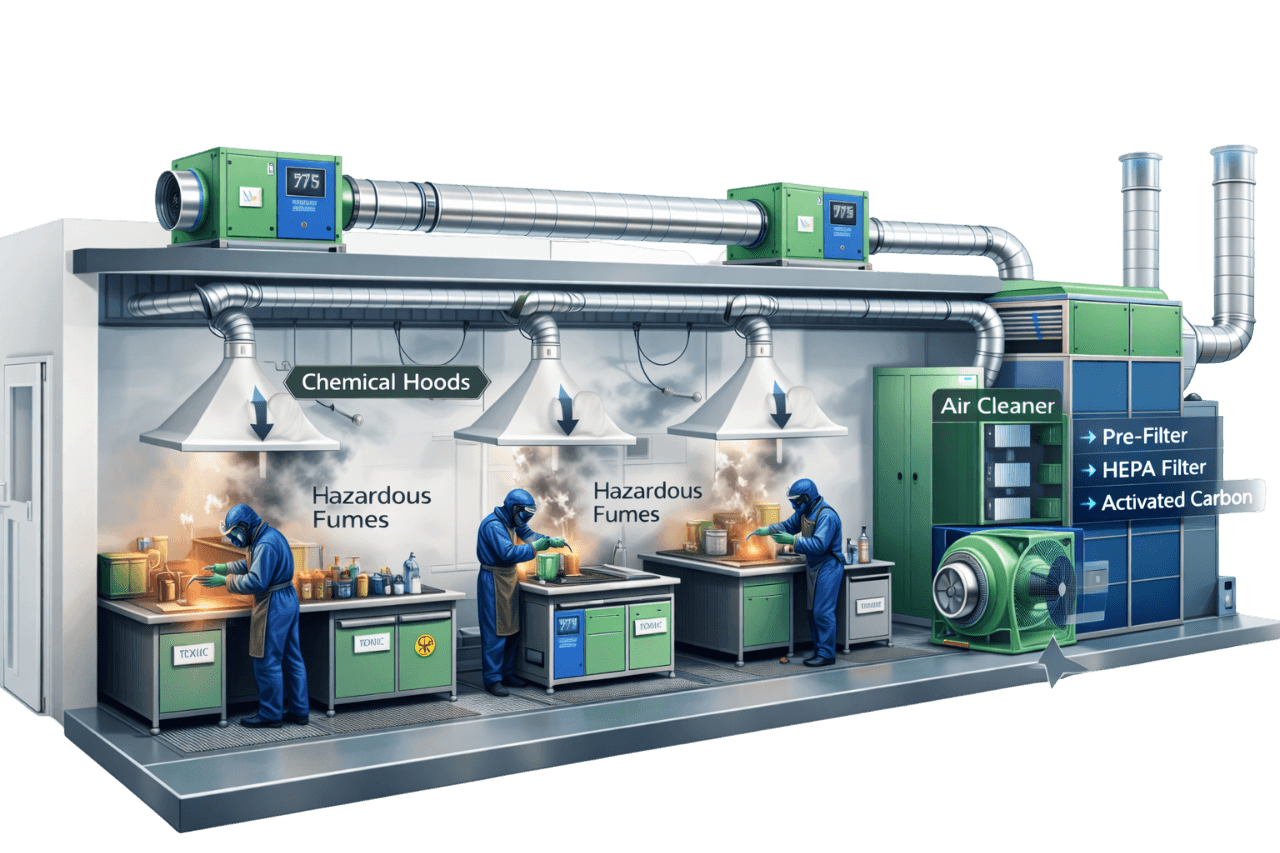
Chemical Exhaust Systems
Learn More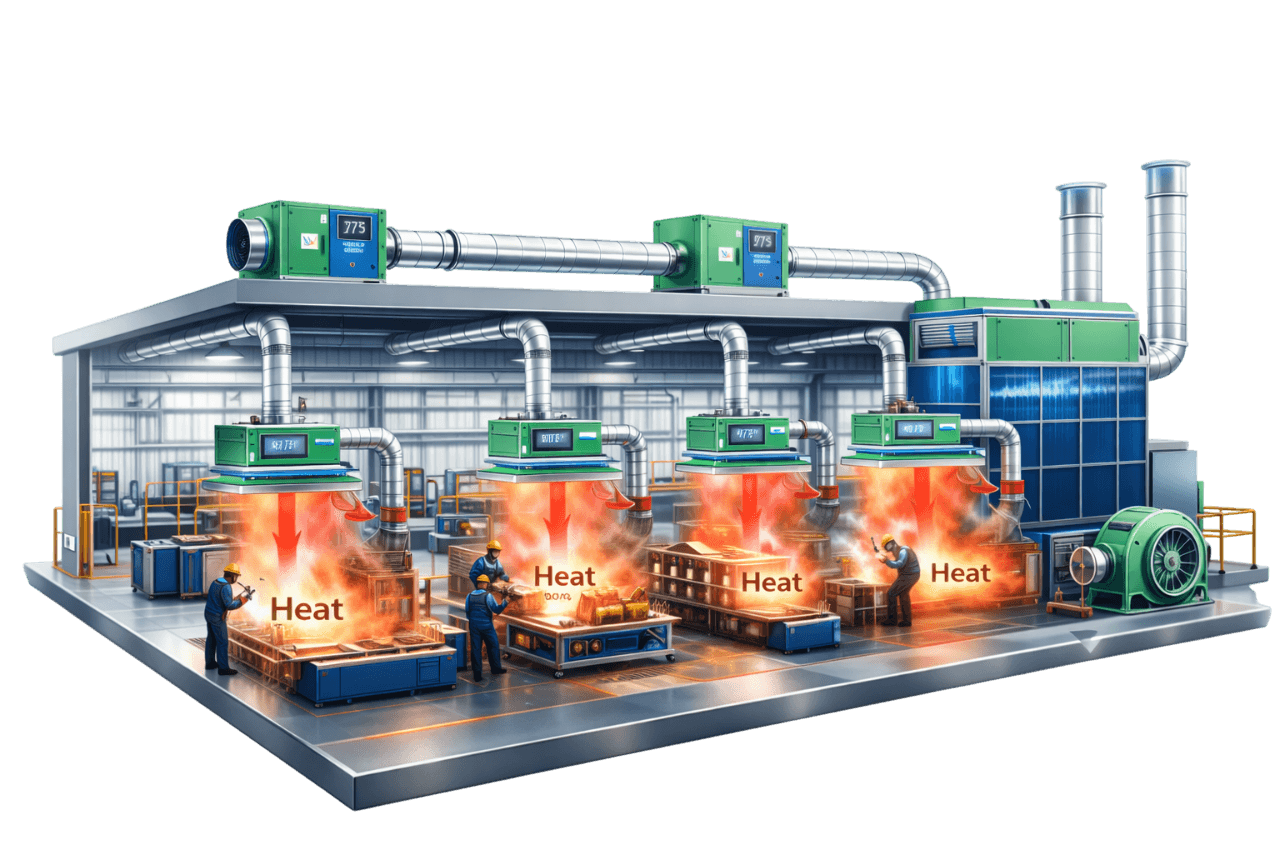
Heat Exhaust Ventilation Systems
Learn More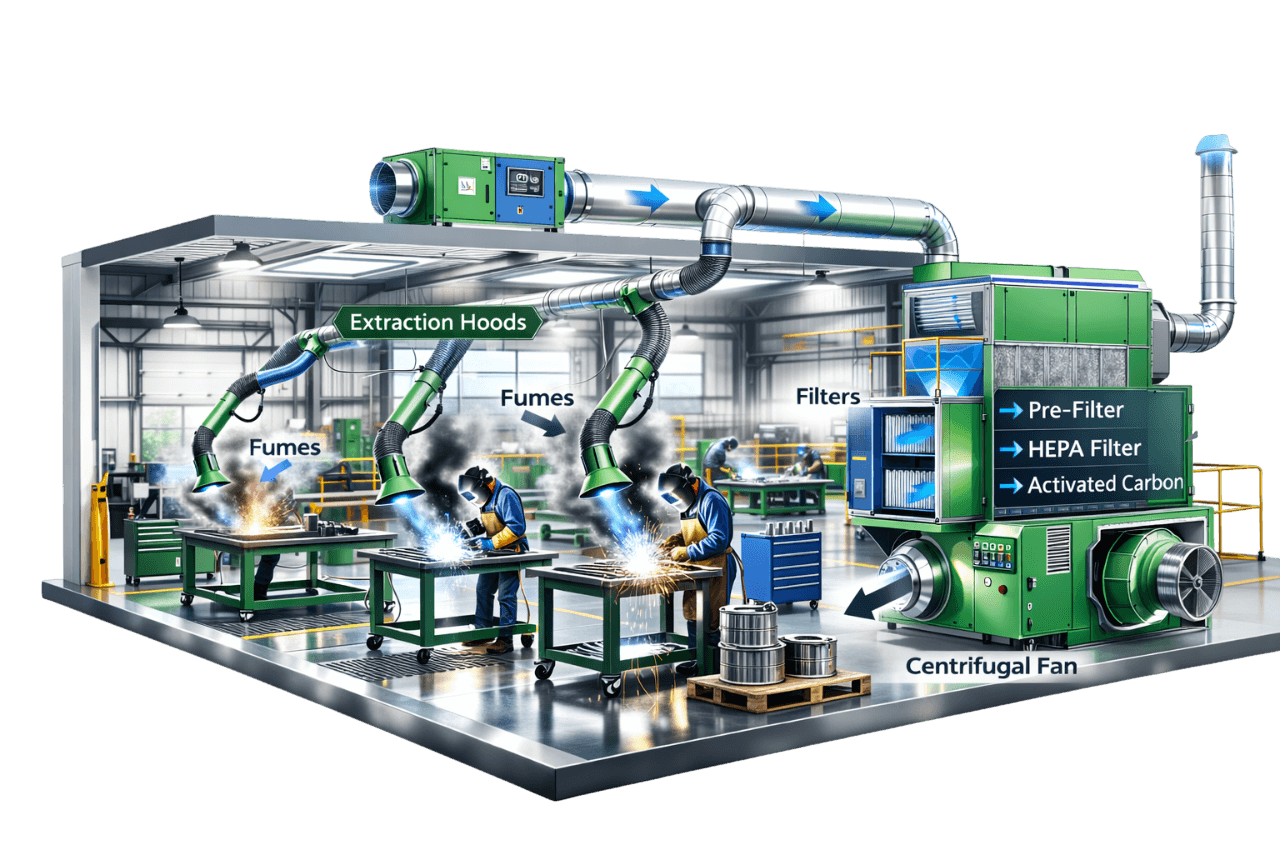
Welding Fume Extraction Systems
Learn More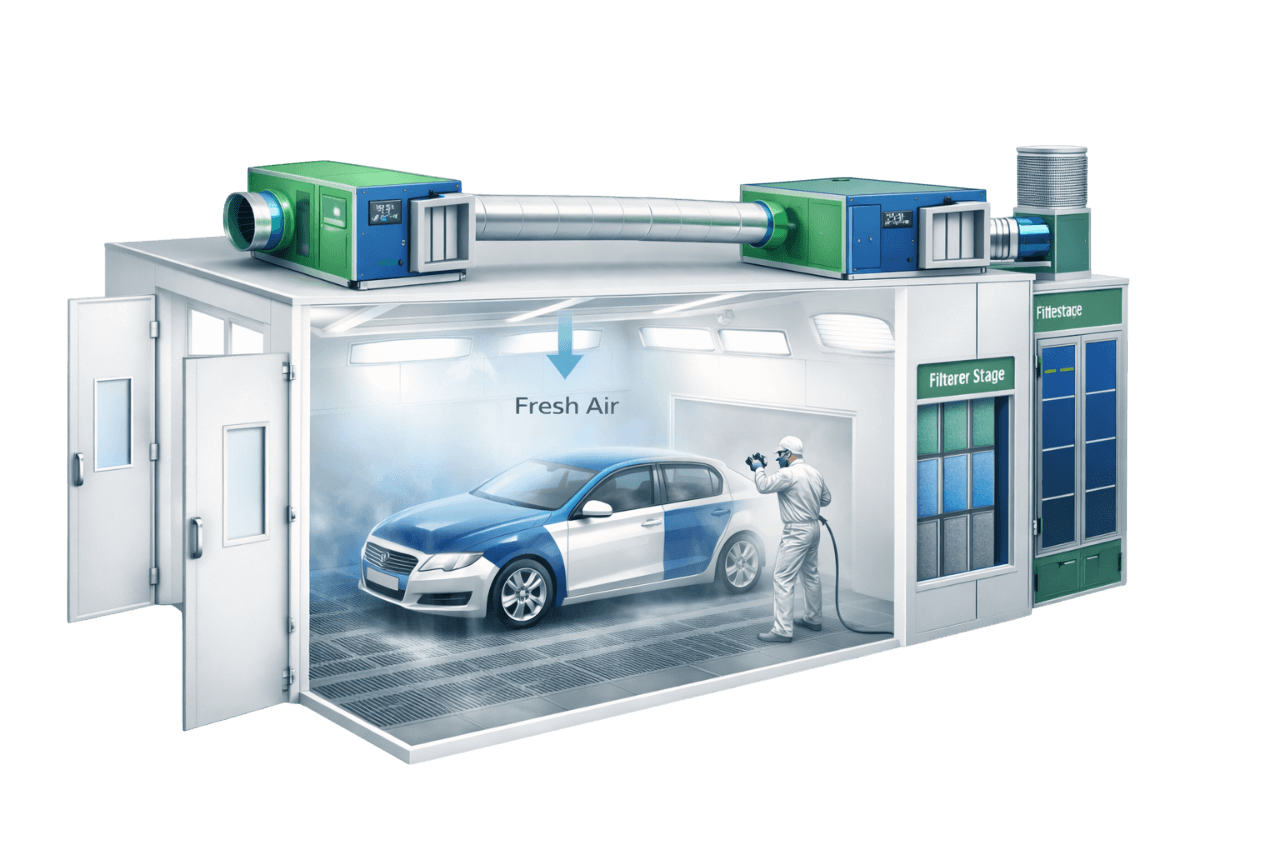
Paint Booth Ventilation Systems
Learn More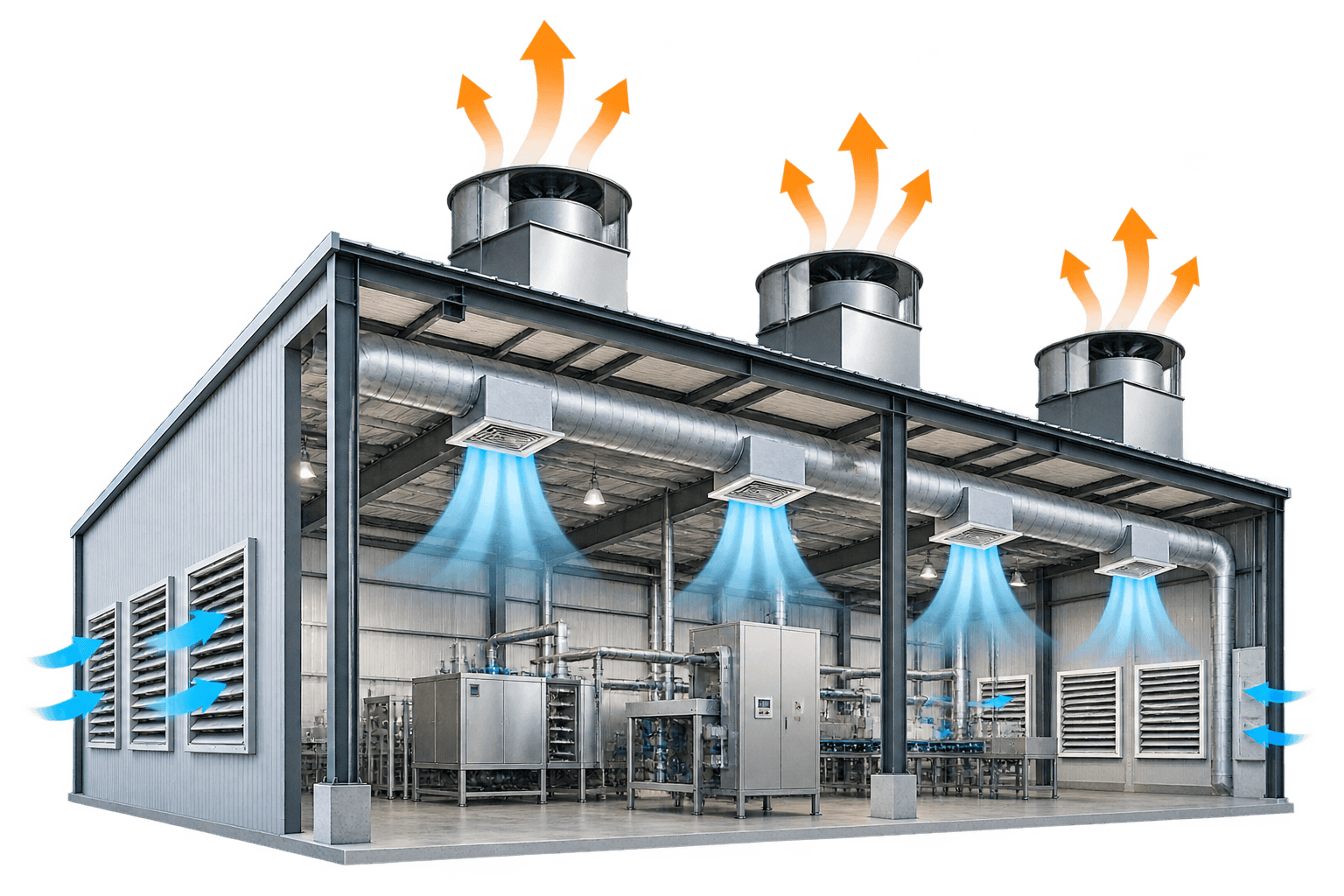
Industrial Dilution Ventilation Systems
Learn MoreFrequently Asked Questions
Q1. What is a dust collection system?
A dust collection system captures airborne dust at the source through hoods, carries it through ductwork to a dust collector, separates the dust from the air and discharges clean air through a stack. It protects workers, equipment, product quality and emission compliance.
Q2. How does a dust collection system work?
A fan draws dust-laden air into hoods and through ducts at a velocity high enough to keep dust airborne. In the collector, filters, cyclonic action or water separate the dust. Filters are cleaned automatically, collected dust drops into a hopper and is discharged, and clean air leaves through the stack.
Q3. What are the main types of dust collectors?
The main types are pulse-jet bag filters, reverse air and shaker bag filters, cartridge dust collectors, cyclones and multi-cyclones, wet scrubbers, electrostatic precipitators, downdraft tables, portable dust collectors and centralised systems. The right choice depends on your dust, airflow, temperature and emission targets.
Q4. What is the difference between a bag filter and a cartridge dust collector?
Bag filters use long felt bags and suit high dust loads, large airflows, high temperatures and abrasive or fibrous dust. Cartridge collectors use pleated cartridges with more media in a compact housing and suit fine, dry dust at lower loads, such as welding, cutting and powder handling.
Q5. When should a cyclone separator be used?
Use a cyclone for coarse, heavy or abrasive dust, for product recovery, for hot gases, or as a pre-separator ahead of a bag filter. On its own, a cyclone rarely meets emission limits for fine dust.
Q6. What is air-to-cloth ratio in dust collectors?
Air-to-cloth ratio is the airflow divided by the total filter area, usually expressed in m/min or ft/min. A lower ratio means more filter area per unit of airflow, which gives lower pressure drop, better emissions and longer filter life. Pulse-jet bag filters typically operate at about 0.9–1.8 m/min.
Q7. Which filter media is best for my type of dust?
Polyester suits most general dust up to about 130 °C. PPS, aramid and fibreglass handle higher temperatures. PTFE membrane gives the lowest emissions and best release for fine or sticky dust, anti-static media is used for combustible dust, and nanofibre cartridges suit fine, dry dust. We recommend media after reviewing your dust and process conditions.
Q8. How are combustible dust explosions prevented in dust collectors?
Through a dust hazard analysis followed by layered protection: good housekeeping, grounding and bonding, anti-static media, spark detection, explosion vents or flameless vents, isolation valves, certified electrical equipment and safe collector location, in line with standards such as NFPA 660, NFPA 68, NFPA 69 and ATEX.
Q9. What pollution control norms apply to dust collectors in India?
The Environment (Protection) Rules, 1986 set a general particulate emission standard of 150 mg/Nm³, with stricter industry-specific limits for many sectors. Your State Pollution Control Board's Consent to Operate specifies the actual limits, stacks and monitoring. The Factories Act also requires dust control at the source to protect workers.
Q10. How often should dust collector filters be replaced?
Filter life depends on dust, temperature, moisture, air-to-cloth ratio and maintenance. Filter bags in general industrial service often last one to three years, and cartridges somewhat less, but some harsh applications need more frequent changes. Replace filters based on differential pressure trends, emission readings and inspection rather than a fixed calendar.
Q11. What is the cost of a dust collection system in India?
Indicative budgets range from about ₹40,000 for a small portable unit to ₹3–15 lakh for a small ducted system, ₹12–45 lakh for a multi-machine central system, and ₹40 lakh or more for large process or explosion-protected systems. The exact cost depends on airflow, dust type, collector, media, ductwork and safety requirements.
Q12. Does Compress India design and install dust collection systems in Mumbai?
Yes. Compress India designs, supplies, installs, commissions and maintains dust collection systems across Mumbai, Navi Mumbai and Thane. Contact our HVAC team to book a site survey and receive a detailed quotation.