Heat Exhaust Ventilation Systems
(Design, Supply, Installation, Testing, Commissioning & AMC for Industrial & Utility Heat Removal)
Design, Supply, Installation, Testing, Commissioning & AMC for Industrial & Utility Heat Removal
Furnaces, machines, DG sets and a hot roof can push factory temperatures well above outdoor levels, draining productivity and putting workers and equipment at risk. Compress India designs and installs heat exhaust ventilation systems that remove trapped hot air, bring in fresh outdoor air and bring indoor conditions back under control, at a fraction of the cost of air conditioning.
From roof exhaust fans for a single workshop to a complete industrial heat exhaust system for a large manufacturing plant, every Compress India system is engineered around your actual heat load, building and process. Share your requirement for a free site survey and detailed quotation.
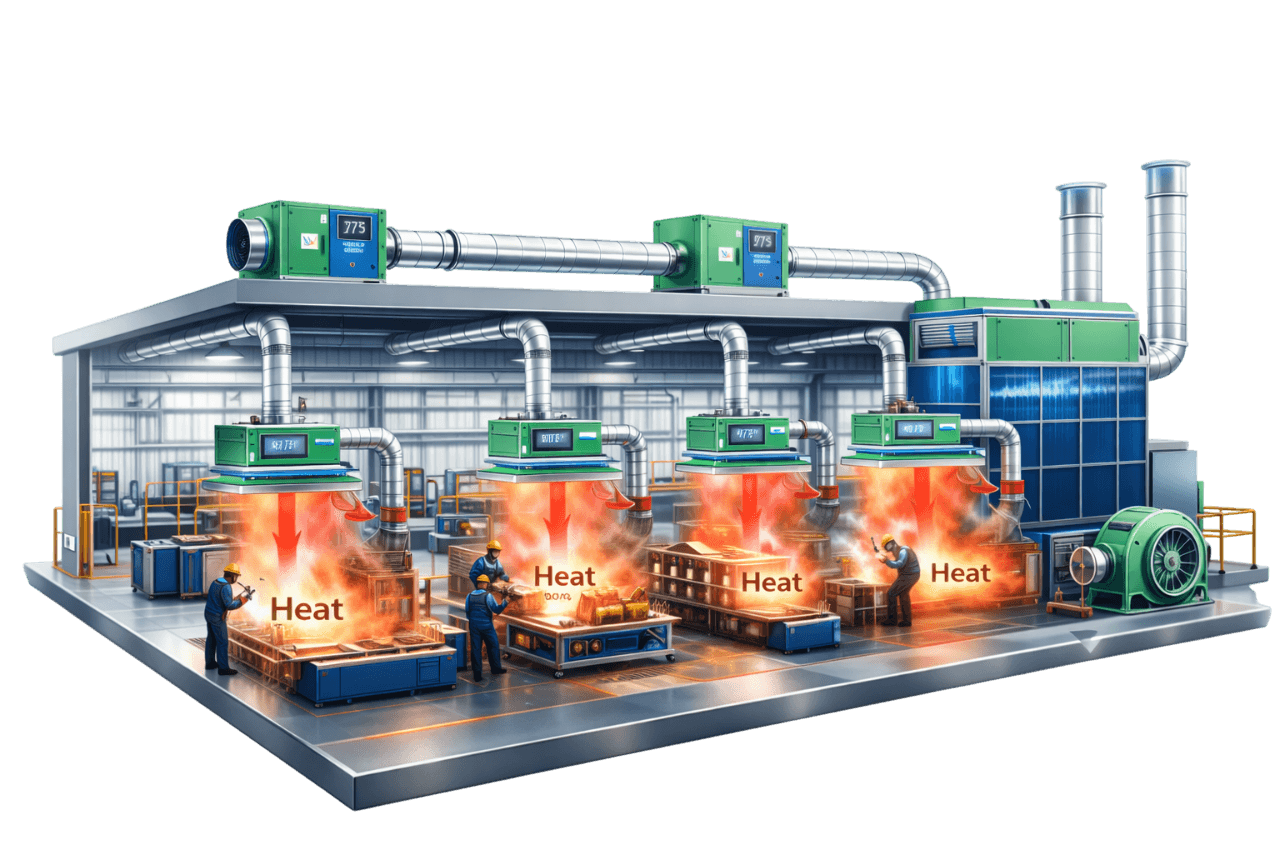
Compress India is a single-point partner for heat exhaust ventilation in Mumbai, Navi Mumbai, Thane and across India. We handle the complete lifecycle so you get one accountable team from survey to long-term support.
- Design: Heat source mapping, heat load calculation, airflow and air change rate calculation, inlet and outlet planning and CFD analysis where required.
- Supply: Industrial roof exhaust fans, wall-mounted axial fans, centrifugal and inline fans, turbine ventilators, louvres, canopy hoods, evaporative make-up air units and controls.
- Installation: Roof openings and curbs, fan and ventilator erection, ductwork and hood fabrication, weatherproofing and electrical work.
- Testing & Commissioning: Temperature mapping, airflow measurement, thermal imaging and control testing with a documented performance report.
- AMC: Planned maintenance for fans, ventilators, evaporative coolers and controls to keep the system performing season after season.
Whether you need a heat exhaust ventilation system for an industrial building, a hot air exhaust system for a manufacturing plant or dedicated ventilation for DG and transformer rooms, we deliver a solution that works.
What Is a Heat Exhaust Ventilation System?
A heat exhaust ventilation system is a mechanical or natural ventilation system that removes excess heat from a building by exhausting hot air, usually from the upper zone, and replacing it with cooler outdoor air at a lower level. It controls indoor temperature by providing enough air changes to carry away the heat generated by processes, equipment, people and solar gain.
Unlike air conditioning, which cools air by refrigeration, heat exhaust ventilation works with air that is already available outdoors. It cannot cool below outdoor temperature, but it can bring a hot factory much closer to outdoor conditions at a far lower capital and running cost. Combined with evaporative make-up air, it can deliver noticeably cooler air at low level.
A typical industrial heat exhaust system includes:
- Roof exhaust fans, wall-mounted axial fans or turbine ventilators to remove hot air
- Canopy hoods or local heat exhaust over high-heat equipment
- Intake louvres, dampers or make-up air units for fresh air supply
- Evaporative coolers where extra cooling is needed
- Heat exhaust ductwork where hot air must be ducted to outside
- Thermostats, VFDs and controls for automatic operation
These systems are also known as hot air extraction systems, heat removal ventilation, factory heat ventilation or industrial heat removal systems.
Why Heat Exhaust Ventilation Is Needed
In Indian summers, an unventilated factory or warehouse can run far hotter than outdoors. Effective heat exhaust ventilation is one of the most cost-effective upgrades a plant can make.
Reducing Indoor Temperatures
Heat from machines, processes and the roof accumulates under the ceiling and gradually warms the whole space. Removing this hot air continuously, and replacing it with outdoor air, lowers indoor temperatures and prevents heat from building up through the day.
Preventing Heat Stress in Workers
High temperatures combined with physical work can cause heat exhaustion, dehydration, cramps and, in severe cases, heat stroke. Industrial heat stress control through good ventilation, air movement and spot cooling keeps workers safer and more alert.
Protecting Machines & Electrical Equipment from Overheating
Motors, drives, PLC panels, transformers and DG sets lose efficiency and life when operated in hot rooms. Heat exhaust keeps equipment rooms within their rated operating temperatures and reduces nuisance tripping and breakdowns.
Improving Productivity & Comfort
Comfortable workers make fewer mistakes, take fewer breaks and maintain output through the shift. Industrial thermal comfort ventilation also improves morale and helps retain skilled staff.
Lower Cost Than Full Air Conditioning
Air conditioning large, high-roofed factories with high internal heat loads is extremely expensive to install and run. A heat exhaust ventilation system with evaporative make-up air typically costs a fraction of AC to install and uses far less electricity.
Common Sources of Heat in Buildings & Plants
Identifying where heat comes from is the first step in removing it efficiently. Compress India maps every major heat source before designing your system.
Furnaces, Ovens & Kilns
Furnaces, heat treatment ovens, kilns and dryers release large amounts of convective and radiant heat. Furnace heat exhaust and industrial oven exhaust often need canopy hoods to capture the rising thermal plume before it spreads into the building.
Injection Moulding & Process Machines
Injection moulding machines, extruders, presses, hydraulic power packs and CNC machines each add continuous heat through motors, heaters and hydraulic oil. In a plant with dozens of machines, this adds up to a very large heat load.
DG Sets, Transformers & Electrical Panels
DG sets reject significant heat through their radiators and engine surfaces, transformers lose energy as heat, and electrical panels and drives generate heat continuously. These rooms need dedicated ventilation to keep equipment within safe limits.
Boilers & Air Compressors
Boilers lose heat through their casings and flue connections, while air compressors convert most of their input power into heat. Boiler room heat exhaust and compressor room ventilation are essential for safe, efficient operation.
Commercial Kitchen Equipment
Cooking ranges, tandoors, fryers, ovens and dishwashers release heat, steam, smoke and grease. Commercial kitchen exhaust fans and hoods remove this heat and contaminants to keep kitchens workable.
Solar Heat Gain Through Roofs
Uninsulated metal roofs in Indian conditions absorb intense solar radiation and radiate heat down into the building. Roof heat gain is often one of the largest heat sources in warehouses and light industrial buildings, and it is best tackled with a combination of roof ventilation and insulation.
How a Heat Exhaust Ventilation System Works
A heat exhaust ventilation system works with the natural behaviour of hot air, then adds fans and controls to make the process faster, stronger and more reliable.
1. Hot Air Rises to the Upper Zone
Hot air is lighter than cool air, so heat from machines, people and the roof rises and collects under the ceiling. This creates a hot upper layer, often several degrees warmer than the working zone below.
2. Exhaust Fans or Roof Vents Remove Hot Air
Roof exhaust fans, turbine ventilators, ridge vents or high-level wall fans remove this hot layer from the building. Removing air from the highest, hottest point gives the greatest heat removal for every unit of airflow.
3. Cooler Outdoor Air Enters at Low Level
As hot air leaves, fresh outdoor air is drawn in through low-level louvres, doors or make-up air units. Where evaporative cooling is used, this incoming air is cooled before it reaches the workers.
4. Continuous Air Changes Carry Away Heat
The continuous flow of air, measured as heat exhaust airflow or air changes per hour (ACH), carries heat out as fast as it is generated. The higher the heat load, the more airflow is needed to hold indoor temperature close to outdoor conditions.
5. Temperature Controls Adjust Fan Operation
Thermostats and temperature sensors switch fans on or adjust their speed as indoor temperature changes. Temperature controlled heat exhaust ventilation runs harder on hot afternoons and slows down at night or in cooler seasons, saving energy automatically.
Main Components of a Heat Exhaust Ventilation System
Compress India selects and integrates each component to suit your building structure, heat load and budget.
Roof Exhaust Fans & Powered Roof Ventilators
Industrial roof exhaust fans and powered roof ventilators are mounted on the roof to remove hot air from the highest point. Roof mounted exhaust fans are available as axial, mixed-flow or centrifugal designs, with weatherproof cowls and backdraft dampers. They are the backbone of most factory heat exhaust systems.
Wall-Mounted Axial Exhaust Fans
Wall mount exhaust fans and louvered exhaust fans installed high on side walls are a simple, cost-effective way to exhaust hot air, especially in sheds with low roof pitch. Heavy duty industrial exhaust fans in 18-inch, 24-inch and larger sizes are common in workshops, warehouses and shop floors.
Turbine (Wind-Driven) Ventilators
Turbine ventilators use wind and thermal buoyancy to spin a vaned head, drawing hot air out of the roof without electricity. They provide low-cost, zero-power ventilation and are widely used on industrial sheds and warehouses.
Ridge Vents & Monitor Roofs
Continuous ridge vents and raised monitor roofs create permanent openings at the highest point of the building. They allow large volumes of hot air to escape naturally and work well with low-level inlets to drive stack ventilation.
Canopy Hoods over Hot Processes
Canopy hoods capture the rising thermal plume from furnaces, ovens and hot tanks before it spreads. A canopy hood heat exhaust system with a high temperature exhaust fan removes concentrated heat and fumes directly at the source.
Intake Louvres & Dampers
Weather louvres, sand trap louvres and motorised dampers allow fresh air in while keeping rain and dust out. Correctly sized inlets are just as important as exhaust fans for effective heat removal.
Make-Up Air Units & Evaporative Coolers
Make-up air units supply filtered fresh air, and evaporative air coolers cool that air before it enters the building. A heat exhaust system with make-up air ensures balanced airflow and better cooling at worker level.
Thermostats & Controls
Thermostats, temperature sensors, timers, VFDs and control panels automate fan operation based on indoor temperature, process status or time of day, keeping the system efficient and hands-free.
Types of Heat Exhaust Ventilation Systems
The right system depends on your building, heat sources, budget and how much cooling you need at worker level. Compress India designs and installs every major type.
Mechanical Roof Exhaust Systems
Powered roof exhaust fans provide reliable, controllable heat removal regardless of wind or weather. They are ideal for factories with high internal heat loads and are easily combined with thermostats and VFDs for automatic control.
Wall Exhaust Systems
High-level wall exhaust fans work well in buildings where roof access is limited or roof penetrations are undesirable. Paired with low-level inlets on the opposite wall, they create cross-ventilation across the working area.
Canopy Hood Heat Extraction
For concentrated heat sources, canopy hood heat extraction captures the thermal plume directly above the equipment. This local heat exhaust, or source capture heat exhaust, removes heat before it mixes with room air and is far more efficient than trying to dilute it.
Natural Stack Ventilation
Natural stack ventilation uses the height difference between low-level inlets and high-level outlets to drive airflow through thermal buoyancy. With correctly sized openings, it can remove substantial heat with no running cost.
Turbine Ventilator Systems
Multiple turbine ventilators spaced across the roof provide continuous, zero-energy ventilation. They are popular for warehouses, storage sheds and light industrial buildings with moderate heat loads.
Hybrid Natural & Mechanical Ventilation
Hybrid systems use natural ventilation or turbine ventilators for everyday operation and powered fans for peak heat conditions. This combination balances energy savings with dependable performance on the hottest days.
Evaporative Make-Up Air Systems
Evaporative make-up air units pass outdoor air through wetted pads, cooling it before supplying it to the working area. Combined with roof exhaust, they can deliver cooler air at worker level, especially in dry and moderately humid conditions.
Spot Cooling & Man Coolers
Where cooling the whole building is not practical, spot cooling for industrial heat directs cool or high-velocity air at specific workstations. Man coolers and air circulators are widely used near furnaces, presses and heavy work areas.
HVLS Fans for Air Movement
High-volume, low-speed (HVLS) ceiling fans move large volumes of air gently across big floor areas. The air movement increases perceived cooling for workers and helps destratify hot air toward roof exhaust points.
Heat Exhaust Ventilation vs Air Conditioning
Heat exhaust ventilation removes heat at low cost but cannot cool below outdoor temperature; air conditioning can reach any set point but costs far more to install and run in large industrial spaces. For most factories and warehouses, heat exhaust with evaporative make-up air delivers the best value.
| Factor | Heat Exhaust Ventilation | Air Conditioning |
|---|---|---|
| Indoor temperature | Close to outdoor; lower at worker level with evaporative cooling | Any set point, independent of outdoor conditions |
| Capital cost | Low | High, especially for large volumes and high heat loads |
| Running cost | Low fan power; zero for natural ventilation | High compressor power, running all day |
| Fresh air | 100% fresh outdoor air | Mostly recirculated air |
| Removes smoke & fumes | Yes, along with heat | No, unless separate exhaust is added |
| Best for | Factories, warehouses, workshops, utility rooms | Control rooms, labs, offices, precision processes |
Many plants use both: heat exhaust ventilation for the shop floor and air conditioning only for control rooms or temperature-critical areas.
Natural vs Mechanical Heat Exhaust
Natural ventilation costs nothing to run but depends on wind, temperature difference and building height; mechanical heat exhaust delivers a guaranteed airflow whenever it is needed.
| Factor | Natural Ventilation | Mechanical Heat Exhaust |
|---|---|---|
| Driving force | Stack effect and wind | Fans |
| Running cost | Zero | Fan electricity |
| Airflow control | Limited, varies with weather | Precise, adjustable with VFDs and thermostats |
| Performance on still, hot days | Reduced | Consistent |
| Best for | Tall buildings with moderate heat loads and large openings | High heat loads, deep plans and critical temperature control |
Hybrid systems combine both, using natural ventilation most of the time and mechanical fans when heat or weather demands it.
Turbine Ventilators vs Powered Roof Exhaust Fans
Turbine ventilators are a low-cost, zero-energy option for moderate heat loads; powered roof exhaust fans are the choice where heat loads are high or airflow must be guaranteed.
| Factor | Turbine Ventilator | Powered Roof Exhaust Fan |
|---|---|---|
| Power required | None | Electric motor |
| Airflow per unit | Low, varies with wind and temperature difference | High and consistent |
| Units needed | Many for a given airflow | Fewer |
| Controllability | None | Thermostat, timer and VFD control |
| Capital cost per unit | Low | Higher |
| Best for | Warehouses, storage sheds, light industrial buildings | Factories with furnaces, machines and high process heat |
Compress India often combines both on the same roof, with turbines providing base ventilation and powered fans handling peak heat.
Heat Exhaust for Utility & Equipment Rooms
Utility rooms pack a lot of heat-producing equipment into small, often enclosed spaces. Without dedicated ventilation, temperatures rise quickly, equipment derates and failures follow. Compress India designs heat exhaust for every type of plant room.
DG Room Ventilation
DG sets need large volumes of air for combustion and for removing heat rejected by the engine and radiator. We design DG room ventilation with correctly sized inlet louvres, exhaust fans or radiator discharge ducts and acoustic treatment, following the airflow and temperature limits specified by the DG manufacturer.
Transformer Room Ventilation
Transformers lose part of their rated power as heat. Transformer rooms are ventilated with low-level inlets and high-level outlets, supplemented by exhaust fans where natural ventilation cannot keep the room within the transformer's rated ambient temperature.
Electrical & Panel Room Ventilation
LT panels, VFDs, UPS systems and control panels generate continuous heat. Electrical room ventilation with filtered supply air and exhaust fans keeps panels cool and dust-free, extending component life and reducing nuisance trips.
Boiler Room Ventilation
Boiler rooms need air for combustion and ventilation to remove radiant and convective heat from boilers, pipework and flues. A boiler room exhaust fan with properly sized fresh air inlets keeps the room safe for operators and ensures clean combustion.
Compressor Room Ventilation
Air compressors convert most of their input energy into heat. Compressor room ventilation ducts hot cooling air directly outside and supplies cool air at the compressor intake, improving compressor efficiency and reliability.
Lift Machine Room Ventilation
Lift machine rooms house motors, drives and controllers that must operate within the temperature range specified by the lift manufacturer. Wall or roof exhaust fans with thermostatic control maintain safe conditions.
UPS & Battery Room Ventilation
UPS rooms produce heat from inverters, while battery rooms can release hydrogen during charging. Ventilation removes both heat and hydrogen, with exhaust points at high level and spark-resistant fans where required.
Heat Stress Standards & Regulations
Heat exhaust ventilation is not only about comfort; Indian law and international guidelines expect employers to control workplace heat. Compress India designs with these references in mind.
Factories Act Ventilation & Temperature Provisions
For decades, the Factories Act, 1948 required adequate ventilation by the circulation of fresh air, and temperatures that secure reasonable comfort and prevent injury to health, including measures to protect workers from excessive heat. These duties have been carried into the Occupational Safety, Health and Working Conditions Code, 2020, operative since 21 November 2025, with State Factory Rules such as the Maharashtra Factories Rules continuing to guide practical expectations.
Heat Stress Index (WBGT)
The Wet Bulb Globe Temperature (WBGT) index combines air temperature, humidity, radiant heat and air movement into a single measure of heat stress. It is widely used to decide safe work-rest cycles and to assess whether ventilation and cooling measures are effective.
NBC 2016 Ventilation Requirements
The National Building Code of India 2016, in its building services provisions, sets out requirements and recommended air change rates for natural and mechanical ventilation in different building types and spaces. We use it as a key reference for heat exhaust ACH and ventilation design.
ACGIH Heat Stress Guidelines
ACGIH publishes heat stress threshold limit values based on WBGT, workload and work-rest patterns, along with action limits for unacclimatised workers. These guidelines help plants set safe working conditions and demonstrate responsible heat exposure control.
Heat Exhaust Ventilation Design & Sizing
A heat exhaust system that is sized by guesswork either fails on the hottest days or wastes money on oversized fans. Compress India's heat exhaust ventilation design process is based on calculated heat loads and measured site conditions.
Heat Load Calculation (Equipment, Process, Roof & People)
We calculate the total heat entering the space from machines, motors, furnaces, ovens, lighting, people and solar gain through the roof and walls. Where possible, we use nameplate ratings, operating hours and site temperature readings. This ventilation heat load calculation is the foundation for every other design decision.
Airflow Calculation for Heat Removal
The heat exhaust airflow needed is calculated from the heat load and the allowable temperature rise. As a working rule, airflow in m³/h is roughly 3,000 × heat load in kW ÷ allowable temperature rise in °C. For example, removing 100 kW of heat with a 5 °C rise needs about 60,000 m³/h. We then convert this into heat exhaust CFM, air changes per hour (ACH) and the number and size of fans required.
Allowable Temperature Rise
The allowable temperature rise is the difference between indoor and outdoor temperature that the design accepts. Occupied production areas are typically designed for a small rise of a few degrees, while utility rooms may accept a larger rise within equipment limits. A smaller rise gives cooler conditions but needs more airflow.
Stack Effect & Thermal Buoyancy
Warm indoor air is lighter than cooler outdoor air, creating a natural upward flow known as the stack effect. The taller the building and the greater the temperature difference, the stronger the flow. We design inlet and outlet heights to make the most of this thermal plume exhaust effect.
Inlet & Outlet Opening Sizing & Placement
Inlets are placed low and on the cooler, windward side where possible, and outlets high at the roof or ridge. Inlet free area is generally at least equal to the outlet area, sized for low velocities to limit noise, pressure loss and drafts.
Make-Up Air Requirements
Every cubic metre exhausted must be replaced. Without adequate heat exhaust make-up air, fans cannot deliver their rated airflow, doors become hard to open and hot air may be pulled in from unwanted areas. We plan fresh air heat removal through louvres, openings or evaporative make-up air units.
High-Temperature Rated Fan Selection
For exhaust above furnaces, ovens and kilns, we select high temperature exhaust fans and heat resistant exhaust fans rated for the actual air temperature. Designs with motors outside the hot airstream, such as belt-driven centrifugal or bifurcated axial fans, protect the motor and extend its life.
Avoiding Hot Air Short-Circuiting
If exhaust outlets are too close to fresh air inlets, hot air is simply drawn back into the building. We separate intakes and discharges, consider prevailing winds and use discharge direction and height to prevent short-circuiting.
CFD Airflow Analysis
For large, complex or critical buildings, computational fluid dynamics (CFD) simulations predict airflow patterns and temperature distribution before installation. CFD helps us test fan locations, inlet sizes and hood designs virtually, avoiding costly changes on site.
Energy Efficiency in Heat Exhaust Ventilation
An energy efficient industrial heat exhaust system removes heat at the lowest possible running cost. Compress India combines smart equipment choices with passive measures to cut electricity bills.
Thermostat-Controlled Fans
Thermostats switch fans on only when indoor temperature rises above a set point, and can stage multiple fans as heat increases. This prevents fans from running unnecessarily during cool mornings, nights and winter months.
VFD & EC Fan Control
A heat exhaust fan VFD varies fan speed to match the actual heat load. EC heat exhaust fans and BLDC exhaust fans use electronically commutated motors that are highly efficient and inherently speed-controllable. Because fan power falls sharply at reduced speed, even modest speed reductions produce large energy savings.
Zero-Power Turbine & Natural Ventilation
Turbine ventilators, ridge vents and natural stack ventilation remove heat without any electricity. Where the heat load and building allow, they form the base of a low-energy system, with powered fans added only for peak conditions. Solar powered ventilation fans are another option for remote or off-grid areas.
Evaporative Cooling Instead of AC
Evaporative air coolers use a fraction of the power of refrigerated air conditioning to deliver cooler supply air. In many Indian climates, evaporative make-up air combined with roof exhaust provides comfortable working conditions at a much lower cost.
Roof Insulation & Cool Roof Coatings
Reducing heat entering through the roof lowers the heat load the ventilation system has to remove. Under-deck insulation, insulated roofing and reflective cool roof coatings can significantly reduce roof heat gain, allowing smaller fans and lower running costs.
Heat Recovery from Compressor & Process Exhaust
Hot air from compressors and some process exhausts can be recovered for useful purposes, such as drying, space heating or preheating process air, instead of being wasted. Where there is a suitable heat demand, recovery improves overall plant efficiency.
Controls & Automation
Smart controls make heat exhaust ventilation responsive, safe and easy to manage.
Thermostats & Temperature Sensors
Temperature sensors placed at working level and near the roof give an accurate picture of heat conditions. They drive fan staging, speed control and alarms for high temperatures.
VFD Speed Control
VFDs provide smooth, stepless fan speed control linked to temperature, reducing energy use and noise while extending motor and belt life through soft starting.
DG Set Interlocks
DG room ventilation fans can be interlocked with the DG set so they start automatically when the engine runs, and continue for a set time after shutdown to remove residual heat.
Fire Alarm Interface
In the event of a fire, heat exhaust fans may need to stop to avoid feeding the fire or switch to a smoke exhaust mode, depending on the building's fire strategy. We interface fan controls with the fire alarm panel to follow the approved fire safety plan.
BMS Integration
Heat exhaust BMS integration brings fan status, temperatures, alarms and energy data onto your building management system for central monitoring and scheduling, enabling demand controlled heat exhaust across the facility.
Benefits of Heat Exhaust Ventilation Systems
A well-engineered heat exhaust ventilation system is one of the highest-return investments a plant can make.
Lower Indoor Temperatures
Continuous removal of hot air brings indoor temperatures much closer to outdoor levels and prevents heat from building up through the day.
Reduced Heat Stress & Better Productivity
Cooler, fresher air reduces fatigue, dehydration and heat-related illness. Workers stay more alert and productive, and absenteeism falls during the hottest months.
Protects Equipment from Overheating
Motors, drives, panels, transformers and DG sets run cooler, more efficiently and with fewer failures when their surroundings are properly ventilated.
Much Lower Cost Than Air Conditioning
Heat exhaust ventilation costs a fraction of air conditioning to install and run in large industrial spaces, making it the practical choice for factories and warehouses.
Removes Smoke & Fumes Along with Heat
The same airflow that carries away heat also removes smoke, fumes, odours and airborne moisture, improving overall indoor air quality.
Energy Savings with Natural Ventilation
Turbine ventilators, ridge vents and natural stack ventilation remove heat with zero running cost, and thermostatic and VFD controls minimise fan energy when mechanical exhaust is needed.
Limitations of Heat Exhaust Ventilation Systems
Understanding the limitations helps you set the right expectations and choose the right combination of solutions.
Cannot Cool Below Outdoor Temperature
Ventilation alone can only bring indoor temperature close to outdoor levels. Where lower temperatures are required, evaporative cooling, spot cooling or air conditioning for specific areas is added.
Dust & Rain Ingress Through Openings
Large inlets and outlets can admit dust and monsoon rain. Weather louvres, sand trap louvres, filters, cowls and backdraft dampers keep ingress under control.
Fan Noise
Large exhaust fans can be noisy, particularly at full speed. Correct fan selection, lower-speed operation with VFDs, anti-vibration mounts and silencers keep noise within acceptable limits.
Higher Humidity with Evaporative Cooling
Evaporative cooling adds moisture to the air, which reduces its effectiveness in very humid weather and may not suit humidity-sensitive processes. Adequate exhaust rates and correct sizing keep humidity manageable.
Needs Large Inlet & Outlet Openings
Effective heat removal needs substantial openings for air to enter and leave. In existing buildings, creating these openings may require structural and roofing work, which we plan carefully with you.
Where Heat Exhaust Ventilation Systems Are Used
Compress India designs heat exhaust ventilation for a wide range of Indian industries and utility applications.
Factories & Manufacturing Plants
An industrial heat exhaust system for a factory removes heat from machines, processes and the roof, keeping shop floors workable through the summer. Industrial roof exhaust fans, wall fans and evaporative make-up air are the most common combination.
Foundries & Forging Units
Foundry heat exhaust handles intense radiant and convective heat from melting furnaces, pouring and forging. Monitor roofs, canopy hoods, high temperature exhaust fans and man coolers work together to protect workers.
Steel & Glass Plants
Metal processing heat exhaust in rolling mills, reheating furnaces and glass furnaces requires very high airflows and heat-resistant equipment. Natural stack ventilation through large roof monitors is often combined with powered exhaust.
Plastic & Injection Moulding Units
Injection moulding machines, extruders and chillers generate continuous heat. Roof exhaust and evaporative make-up air keep production halls cooler and help stabilise product quality.
Textile Mills
Textile processing and spinning areas generate heat from machines and lighting and often need controlled humidity. Heat exhaust is designed alongside humidification and air washer systems.
Warehouses & Logistics Centres
Warehouse exhaust fans, turbine ventilators and HVLS fans reduce roof heat build-up, protect stored goods and improve comfort for staff in large, high-roofed buildings.
Commercial Kitchens
Commercial kitchen exhaust fans and hoods remove heat, smoke, steam and grease from cooking areas, with fresh air supply to balance the exhaust and keep kitchens comfortable.
DG, Transformer & Electrical Rooms
Dedicated ventilation keeps DG sets, transformers and electrical panels within their rated operating temperatures, protecting critical power infrastructure.
Boiler & Compressor Rooms
Boiler and compressor rooms need combustion air, cooling air and heat exhaust to operate safely and efficiently. We design ducted discharge and fresh air supply for these high-heat rooms.
Bakeries & Food Processing Units
Ovens, fryers, steam cookers and packaging lines release heat and moisture. Heat exhaust with hygienic design and appropriate filtration keeps food processing areas comfortable and compliant.
Printing Presses & Laundries
Printing presses, dryers, ironers and industrial washers produce heat, humidity and sometimes solvent vapours. Heat exhaust ventilation removes these, improving comfort and protecting equipment.
Top Ventilation Equipment Brands in India
Heat exhaust projects in India can draw on a wide range of international and domestic fan and ventilator brands. Compress India follows a multi-brand, application-first approach: we compare options on airflow, efficiency, temperature rating, noise, service support and lifecycle cost, then design and install the system around the equipment that suits you best.
Kruger
Kruger is a Singapore-headquartered fan manufacturer with a strong presence in India. It is known for centrifugal, inline and axial fans widely used in HVAC and industrial ventilation projects.
Systemair
Systemair is a Swedish ventilation company offering a broad range of fans, air handling units and air distribution products. Its axial, roof and inline fans are used in commercial and industrial buildings.
Nicotra Gebhardt
Nicotra Gebhardt is a fan brand with Italian and German roots, known for centrifugal fans, plug fans and fan modules for air handling and industrial applications.
Greenheck
Greenheck is a US-based manufacturer of air movement and control equipment. Its roof exhaust fans, industrial fans, louvres and dampers are used in commercial and industrial ventilation worldwide.
Almonard
Almonard is an Indian manufacturer of industrial fans, including exhaust fans, air circulators and ventilation fans for factories and commercial spaces.
Other Industrial Ventilation Brands
Several leading Indian electrical brands offer heavy duty industrial exhaust fans, while specialist manufacturers supply turbine ventilators, HVLS fans, evaporative air coolers and louvres. Our team helps you compare these options for quality, performance and value.
*Brand names are trademarks of their respective owners and are mentioned for reference only.*
Heat Exhaust Ventilation Installation Guide
Correct heat exhaust ventilation installation, especially on roofs, is critical for performance, weatherproofing and safety. Compress India's teams follow a structured sequence with minimal disruption to your operations.
Site Survey & Heat Source Mapping
Our engineers survey the building structure, roof type, heat sources, existing openings, prevailing wind and surrounding buildings. We record temperatures at different heights and locations to map hot zones and establish a baseline.
Roof Opening & Curb Installation
Roof openings are cut precisely, and fan curbs or mounting bases are fabricated to suit the roof profile, whether metal sheet, concrete or tiled. Curbs are sealed and flashed to keep water out.
Roof Fan & Turbine Ventilator Installation
Roof exhaust fans and turbine ventilators are lifted, positioned and fixed securely to resist wind loads. Backdraft dampers, bird screens and weather cowls are fitted as specified.
Wall Fan & Louvre Installation
Wall-mounted exhaust fans, fan shutters and intake louvres are installed in prepared openings at the designed heights, with frames, sealing and rain protection.
Canopy Hood & Duct Installation
Canopy hoods over furnaces and ovens are fabricated and hung at the correct height and overhang. Heat exhaust ductwork is routed to high temperature exhaust fans, with supports, expansion allowance and insulation where needed.
Make-Up Air & Evaporative Cooler Installation
Make-up air units and evaporative air coolers are installed on walls, roofs or plinths, with supply ducts, water connections, drains and bleed-off lines.
Weatherproofing & Rain Protection
Every penetration is sealed and flashed, and rain hoods, cowls and louvres are checked to withstand monsoon conditions. We pay particular attention to preventing leaks on metal roofs.
Electrical & Control Wiring
Starters, VFDs, thermostats, sensors and control panels are installed and wired, with interlocks to DG sets, fire alarm systems or BMS as required.
Testing & Commissioning
Heat exhaust ventilation commissioning proves the system delivers the promised improvement. Compress India measures performance and documents the results.
Temperature Mapping Before & After
We record temperatures at working level and near the roof at multiple points before installation and again after commissioning under similar conditions. This shows the real reduction in indoor temperature and the difference between indoor and outdoor conditions.
Airflow Measurement
Airflow is measured at fans, louvres and hoods using anemometers and flow hoods, and compared with design values. Fan speed and damper settings are adjusted to achieve the designed air changes.
Thermal Imaging of Hot Zones
Thermal imaging cameras reveal hot spots on roofs, walls, equipment and ceilings, helping confirm that heat is being removed where it matters most and identifying any areas that need fine-tuning.
Control & Interlock Testing
Thermostats, VFDs, timers, DG interlocks, fire alarm interfaces and BMS signals are tested to confirm the system responds correctly in every operating mode.
Performance Report
You receive a performance report covering temperature readings, airflow measurements, thermal images, control settings and recommendations, along with operation and maintenance manuals.
Heat Exhaust Ventilation Service, Maintenance & AMC
Fans and ventilators work hard through the hottest months. Compress India's heat exhaust ventilation maintenance and AMC keep them running reliably and efficiently.
Fan Blade & Motor Cleaning
Dust, oil mist and debris on fan blades and motors reduce airflow and cause overheating. Regular cleaning restores performance and extends motor life.
Bearing & Belt Checks
Bearings are checked for noise, temperature and lubrication, and belts for wear and tension. Timely replacement prevents unexpected breakdowns during peak summer.
Turbine Ventilator Lubrication & Inspection
Turbine ventilators are inspected for smooth rotation, bearing wear, vane damage and secure fixing, and serviced to keep them spinning freely.
Louvre & Damper Cleaning
Intake louvres, bird screens and backdraft dampers are cleaned and checked so fresh air can enter freely and dampers open and close properly.
Evaporative Pad & Water System Maintenance
Cooling pads are cleaned or replaced, water tanks flushed, pumps and distribution checked and bleed-off adjusted to prevent scaling, odour and bacterial growth.
Thermostat & Sensor Checks
Thermostats and temperature sensors are verified and recalibrated, and control sequences reviewed so fans start, stage and stop at the right temperatures.
Common Heat Exhaust Problems & Solutions
If your building is still too hot despite having exhaust fans, one of these issues is usually the cause. Compress India diagnoses and fixes problems in existing systems of any make.
Hot Spots Near Machines
Cause: Concentrated heat sources with no local capture, or fans placed far from the heat. Solution: Add canopy hoods or local heat exhaust above hot equipment, relocate or add fans, and provide spot cooling at affected workstations.
Insufficient Airflow
Cause: Undersized or too few fans, worn belts, dirty blades, or inadequate inlet openings starving the fans. Solution: Recalculate the heat load and airflow, service or upgrade fans and enlarge or add inlet louvres.
Hot Air Recirculation & Short-Circuiting
Cause: Exhaust discharges close to fresh air inlets, or inlets placed high where hot air collects. Solution: Relocate inlets to low level and away from discharges, redirect fan outlets and use prevailing wind to advantage.
Dust & Rain Ingress
Cause: Open inlets without louvres, damaged cowls or poorly sealed roof penetrations. Solution: Fit weather or sand trap louvres, filters, rain cowls and backdraft dampers, and re-seal roof curbs and flashings.
Fan Motor Overheating & Failure
Cause: Motors in hot airstreams, dust build-up, overloading or poor maintenance. Solution: Use high temperature rated fans with motors outside the airstream, clean regularly, correct fan duty and add VFD soft starting.
Excessive Noise
Cause: Fans running at high speed, unbalanced impellers, loose mountings or undersized openings creating high air velocity. Solution: Add VFDs, balance impellers, fit anti-vibration mounts and silencers, and enlarge openings.
High Humidity from Evaporative Cooling
Cause: Too little exhaust relative to evaporative supply, or operation during very humid weather. Solution: Increase exhaust airflow, add humidity-based controls and switch to ventilation-only mode when outdoor humidity is high.
Heat Exhaust Ventilation Retrofit & Upgrades
Most existing buildings can be made significantly cooler without major reconstruction. Compress India specialises in practical retrofit upgrades.
Adding Roof Extractors or Turbine Ventilators
Adding powered roof extractors or turbine ventilators to an existing roof is often the fastest way to reduce heat build-up. We handle roof cutting, curbs, installation and weatherproofing.
Adding Evaporative Make-Up Air
Retrofitting evaporative air coolers or make-up air units supplies cooler fresh air to working areas and improves the performance of existing exhaust fans.
Thermostat & VFD Control Upgrades
Upgrading manual fans to thermostatic and VFD control reduces energy use and keeps conditions consistent without operator intervention.
Installing HVLS Fans
HVLS fans improve air movement and perceived cooling over large floor areas, and help push hot air toward roof exhaust points.
Roof Insulation Upgrades
Adding under-deck insulation, insulated roofing or cool roof coatings reduces roof heat gain at the source, making the entire ventilation system more effective.
Heat Exhaust Ventilation System Cost in India
Heat exhaust system price in India depends on the heat load, required airflow, fan type and whether evaporative cooling is included. The equipment ranges below are indicative supply prices, excluding GST and installation, to help you plan a budget before a site survey.
| Equipment | Typical Indicative Price per Unit (INR) | Main Price Drivers |
|---|---|---|
| Turbine (wind-driven) ventilator, about 600 mm | ₹1,500 to ₹5,000 | Material (aluminium, SS), size, bearing quality |
| Heavy duty wall exhaust fan, 18 to 24 inch | ₹5,000 to ₹25,000 | Size, motor rating, construction |
| Powered roof exhaust fan, 600 mm and above | ₹25,000 to ₹1,50,000 | Size, airflow, direct or belt drive, temperature rating |
| Industrial evaporative air cooler or make-up air unit | ₹50,000 to ₹3,00,000 | Airflow, pad type, construction, controls |
*Indicative ranges only. Your exact heat exhaust ventilation system price depends on the survey, heat load and specification. Request a free quotation from Compress India for an accurate figure.*
Cost by Airflow & Fan Type
Total airflow, set by the heat load and allowable temperature rise, determines the number and size of fans. Axial heat exhaust fans are the most economical per unit of airflow, while centrifugal heat exhaust fans and high temperature rated fans cost more but handle ducted systems, higher static pressure and hot air.
Turbine Ventilator vs Powered Fan Cost
Turbine ventilators cost far less per unit and have no running cost, but each moves much less air, so many units are needed. Powered roof exhaust fans cost more per unit and use electricity, but deliver high, guaranteed airflow from fewer roof openings. The best value often comes from combining both.
Evaporative Cooling & Make-Up Air Cost
Evaporative make-up air adds equipment, ductwork, water supply and drainage costs, but delivers noticeably cooler air at worker level. It is typically far cheaper to install and run than refrigerated air conditioning for the same floor area.
Factors Affecting Total Project Cost
- Total heat load and required airflow
- Fan type, size, drive and temperature rating
- Mix of powered fans, turbine ventilators and natural openings
- Roof type, height, access and structural work for openings
- Canopy hoods and heat exhaust ductwork for hot processes
- Evaporative cooling, make-up air and supply ducting
- Louvres, dampers, weatherproofing and bird protection
- Controls: thermostats, VFDs, DG interlocks and BMS integration
- CFD analysis for complex buildings
- AMC and maintenance over the system's life
A correctly designed system avoids both underperformance on the hottest days and the cost of oversized equipment, giving you the best long-term value.
Heat Exhaust Ventilation Design & Installation in Mumbai, Navi Mumbai & Thane
Compress India provides complete heat exhaust ventilation design and installation across Mumbai, Navi Mumbai, Thane and the wider Maharashtra industrial belt. Our local teams offer quick site surveys, efficient installation and dependable after-sales support.
The region's hot, humid summers and heavy monsoons demand ventilation systems that remove heat effectively while keeping rain and dust out. We design with these conditions in mind for factories, warehouses, workshops, commercial kitchens and utility rooms of every size.
For clients beyond the Mumbai region, we undertake heat exhaust ventilation projects across India with the same design, installation and commissioning standards.
Why Choose Compress India for Heat Exhaust Ventilation?
As a heat exhaust system supplier and installation partner, Compress India combines engineering-led design with practical site experience and long-term support.
Industrial Heat Load & Ventilation Design
We calculate heat loads from equipment, processes, people and roofs, then size airflow, fans and openings accordingly. Your system is designed to perform on the hottest days, not just on paper.
CFD-Based Airflow Planning
For complex or large buildings, CFD analysis lets us test fan positions, inlet sizes and hood designs before installation, reducing risk and optimising performance.
Multi-Brand Fan & Ventilator Supply
We supply industrial roof exhaust fans, wall fans, centrifugal and inline fans, turbine ventilators, HVLS fans and evaporative coolers from multiple brands, selecting the best fit for your application and budget.
In-House Ductwork & Hood Fabrication
Our in-house fabrication of heat exhaust ductwork, canopy hoods, curbs and louvres ensures quality, correct fit and faster project delivery.
Evaporative Cooling Integration
We integrate evaporative make-up air with roof and wall exhaust so airflow is balanced and cooling reaches the working zone where it is needed most.
Testing & Commissioning
Every project includes temperature mapping, airflow measurement, thermal imaging and control testing, with a clear performance report showing the results.
AMC & Retrofit Support
Our AMC keeps fans, ventilators, coolers and controls running reliably, and our retrofit team can upgrade existing systems with additional fans, controls or insulation as your needs grow.
Get a Heat Exhaust Ventilation Solution from Compress India
A cooler, safer and more productive workplace starts with a site survey. Tell us about your building and heat sources, and we will recommend the most effective, energy-efficient solution for your budget.
Connect with Our HVAC Team
Share your requirement with Compress India's HVAC team today. Send us your building size, roof type, main heat sources and current problems, and we will arrange a site survey and provide a detailed proposal and quotation.
Call us, email us or fill out the enquiry form to request a free site survey and quotation for your heat exhaust ventilation system.
Related Industrial HVAC & Ventilation Solutions
Heat exhaust ventilation often works best as part of a complete ventilation plan. Compress India also designs and installs:
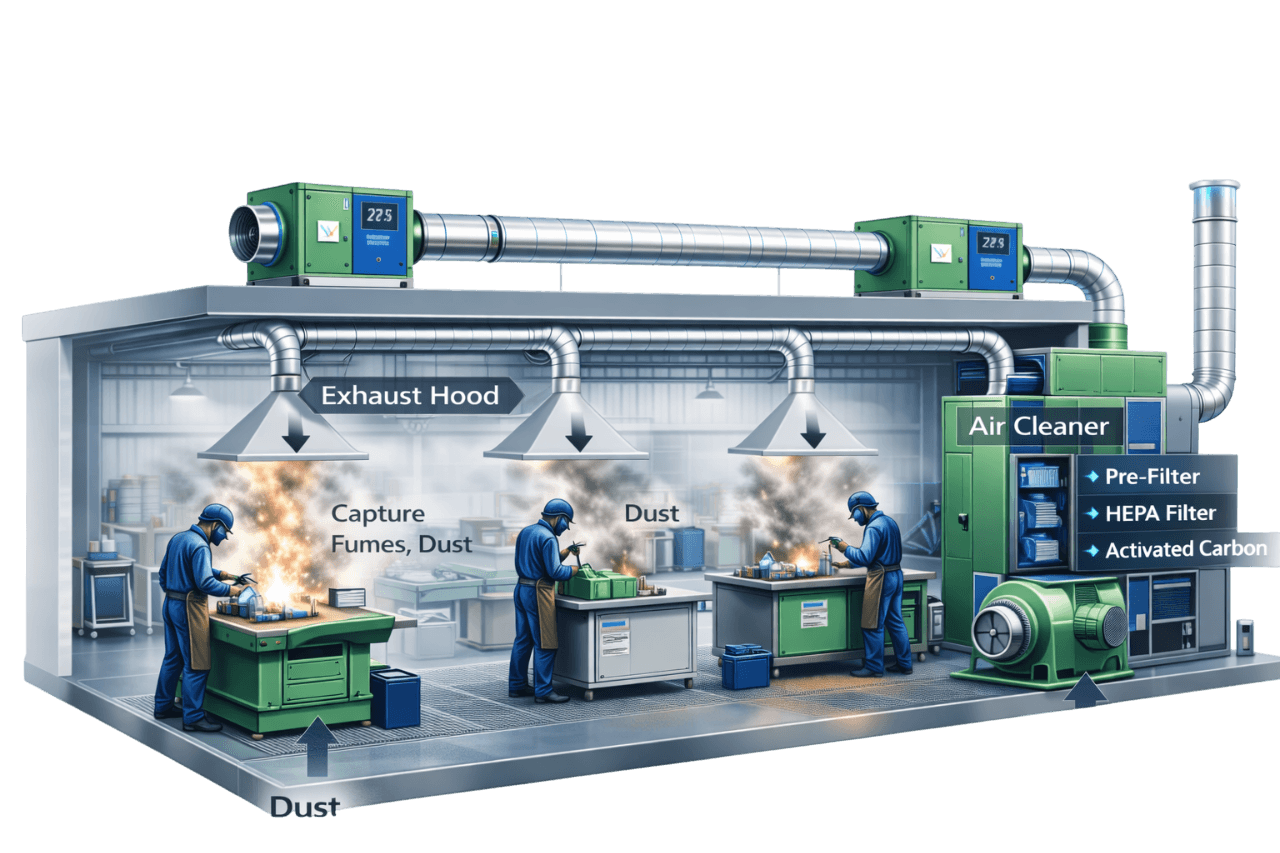
Local Exhaust Ventilation (LEV) Systems
Learn More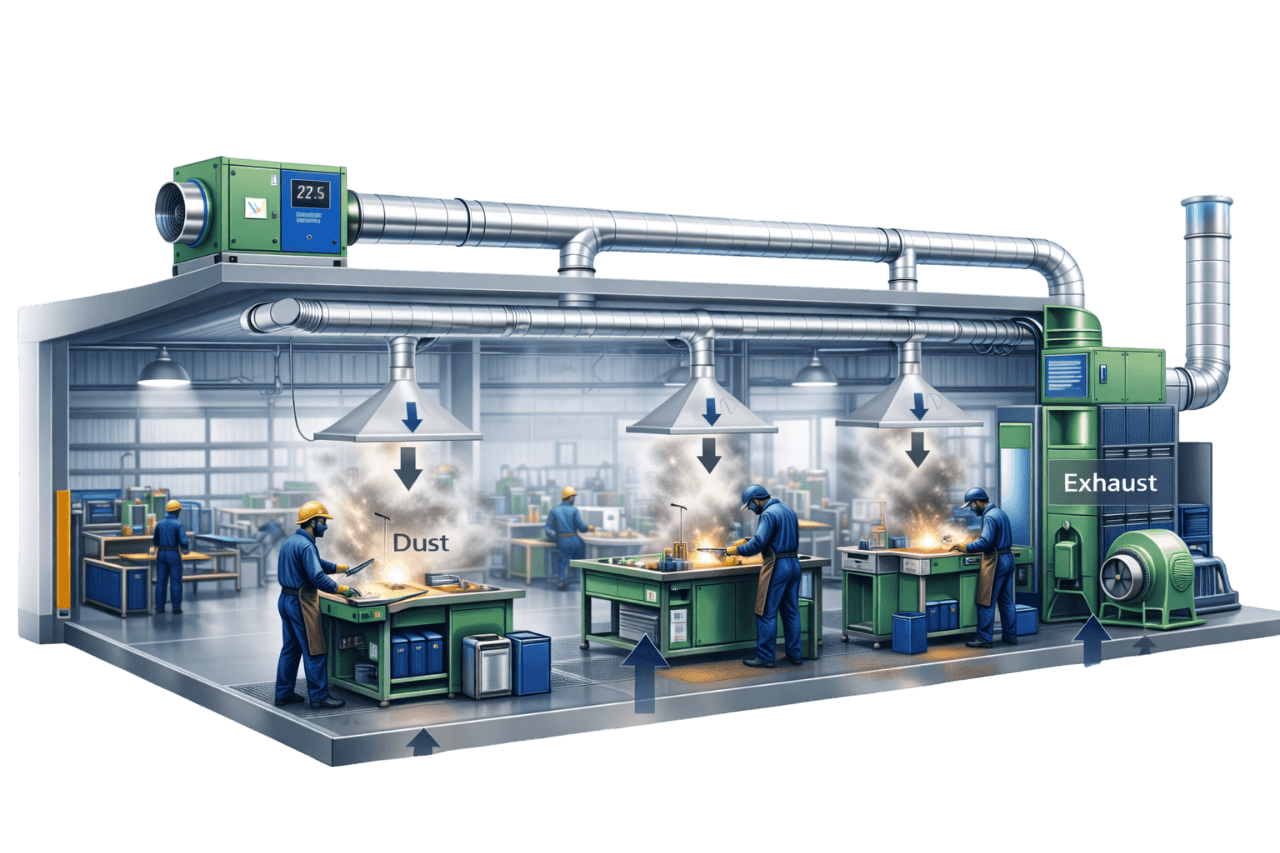
General Dilution Ventilation Systems
Learn More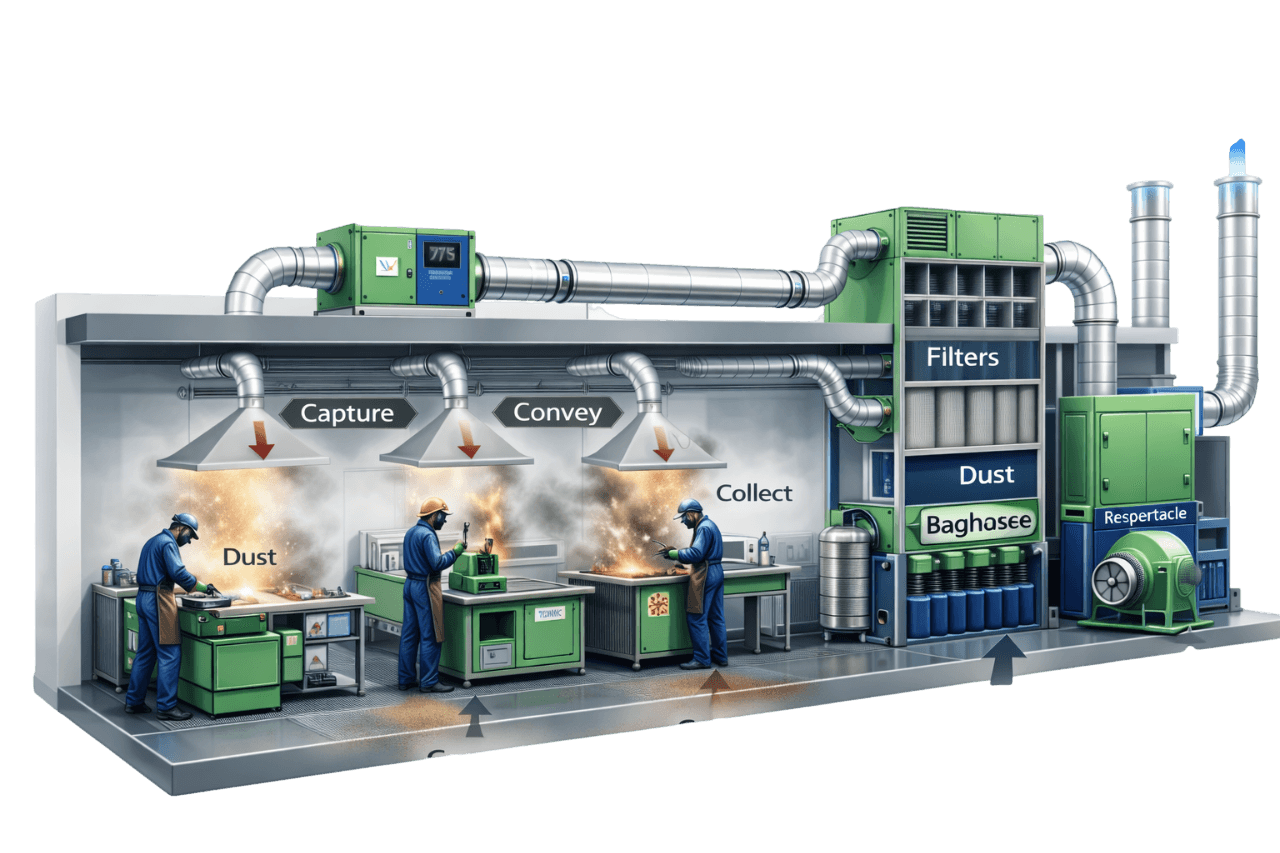
Dust Collection Systems
Learn More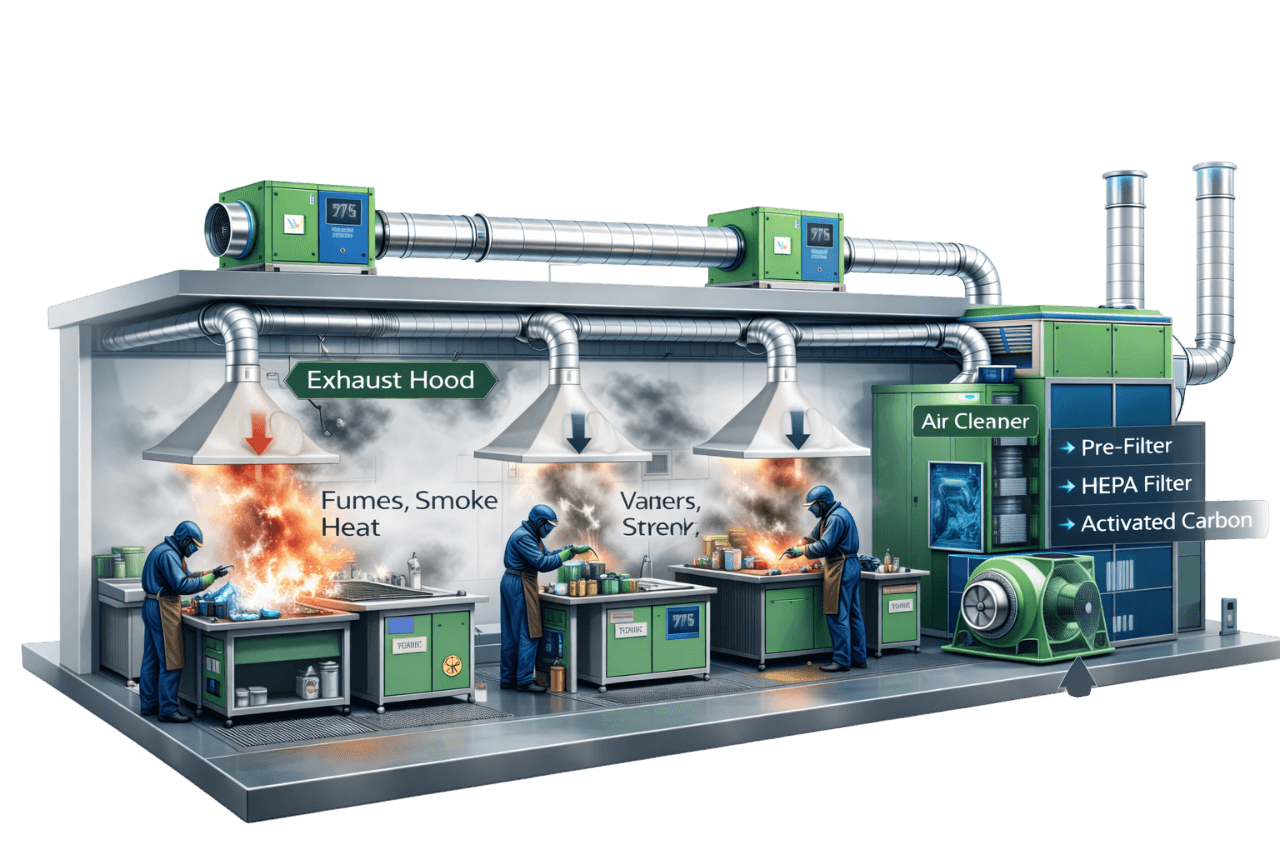
Fume Extraction Systems
Learn More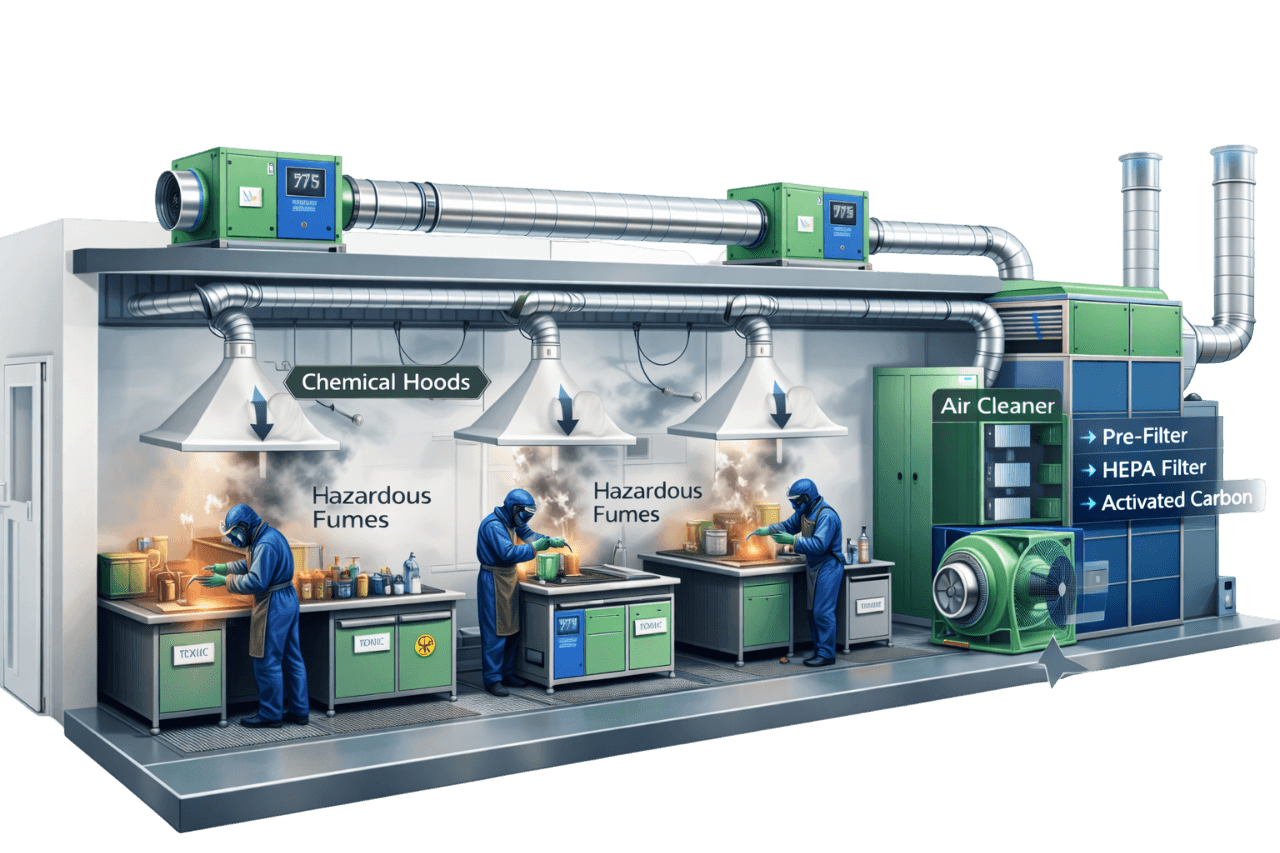
Chemical Exhaust Systems
Learn More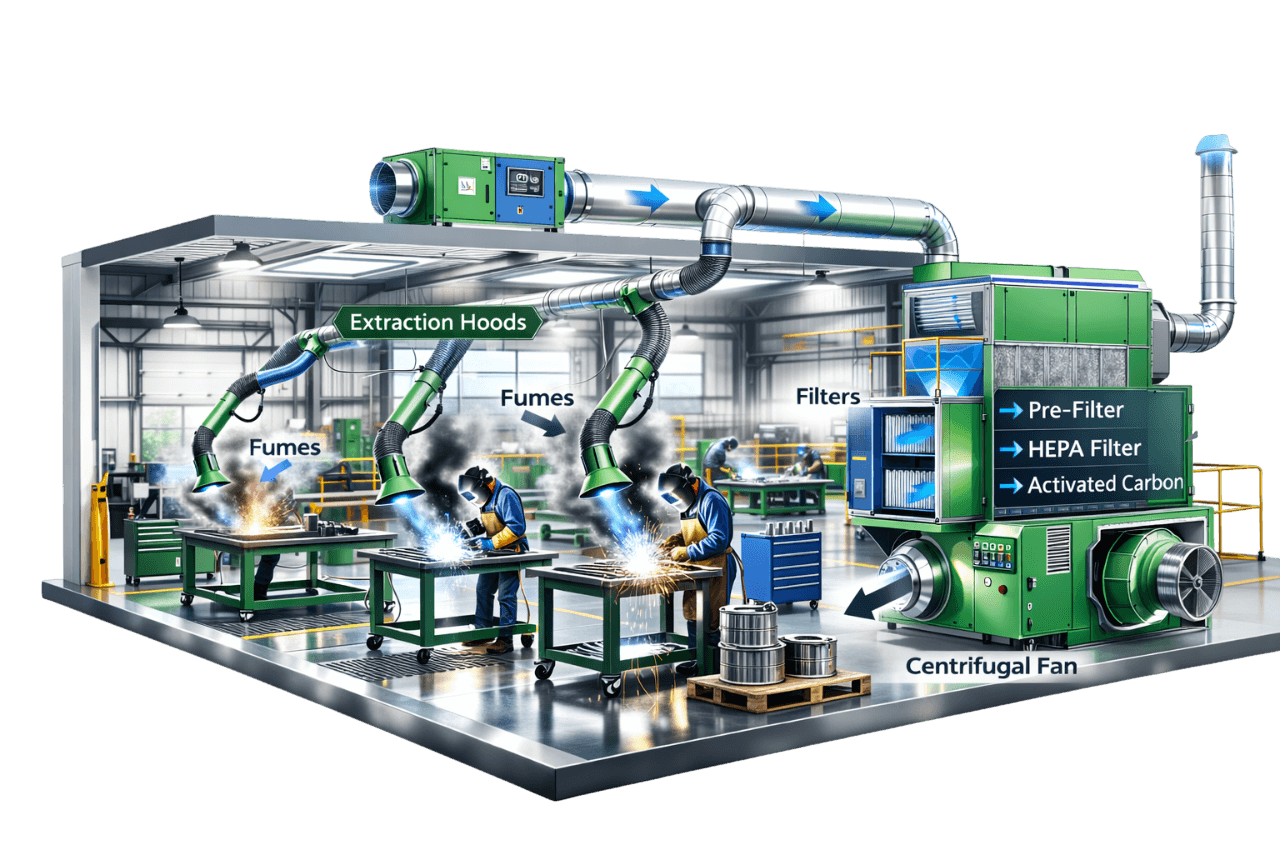
Welding Fume Extraction Systems
Learn More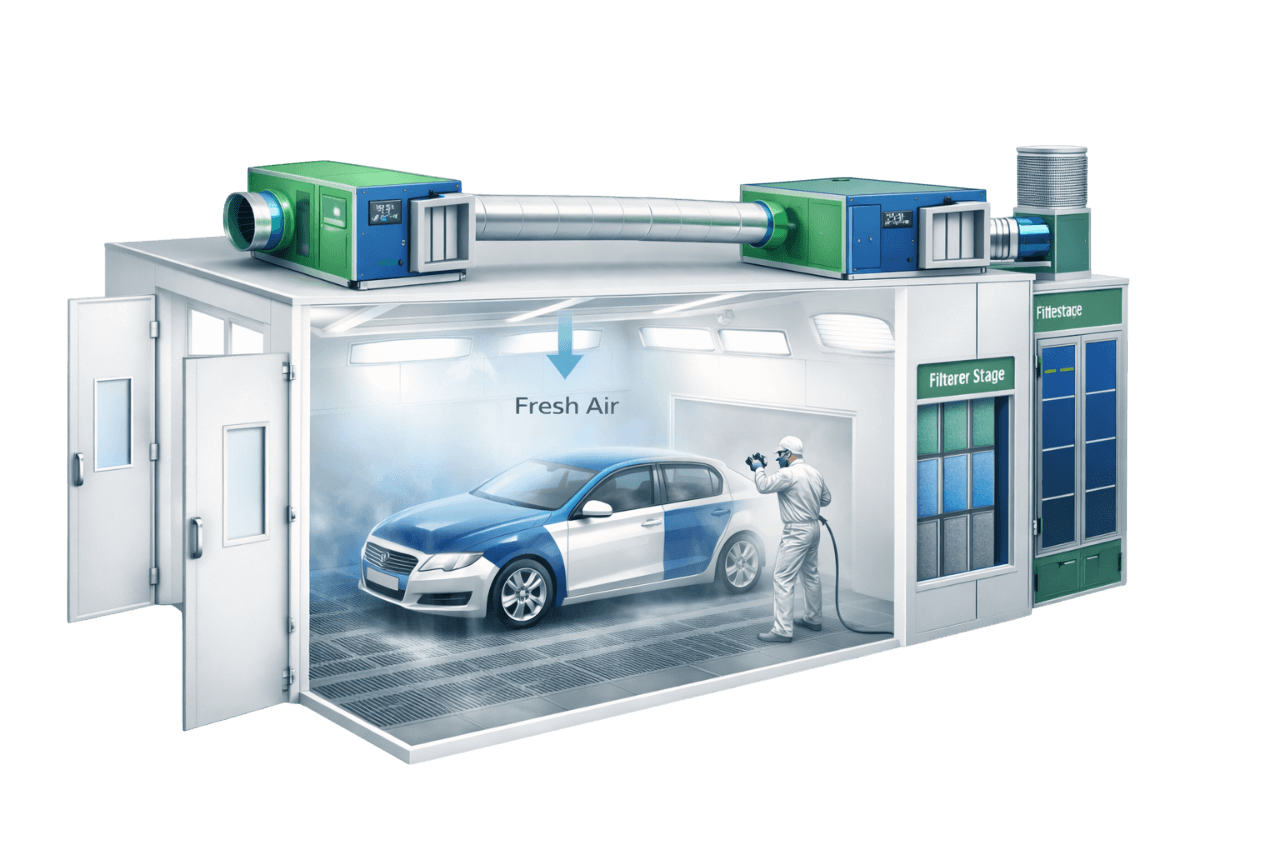
Paint Booth Ventilation Systems
Learn More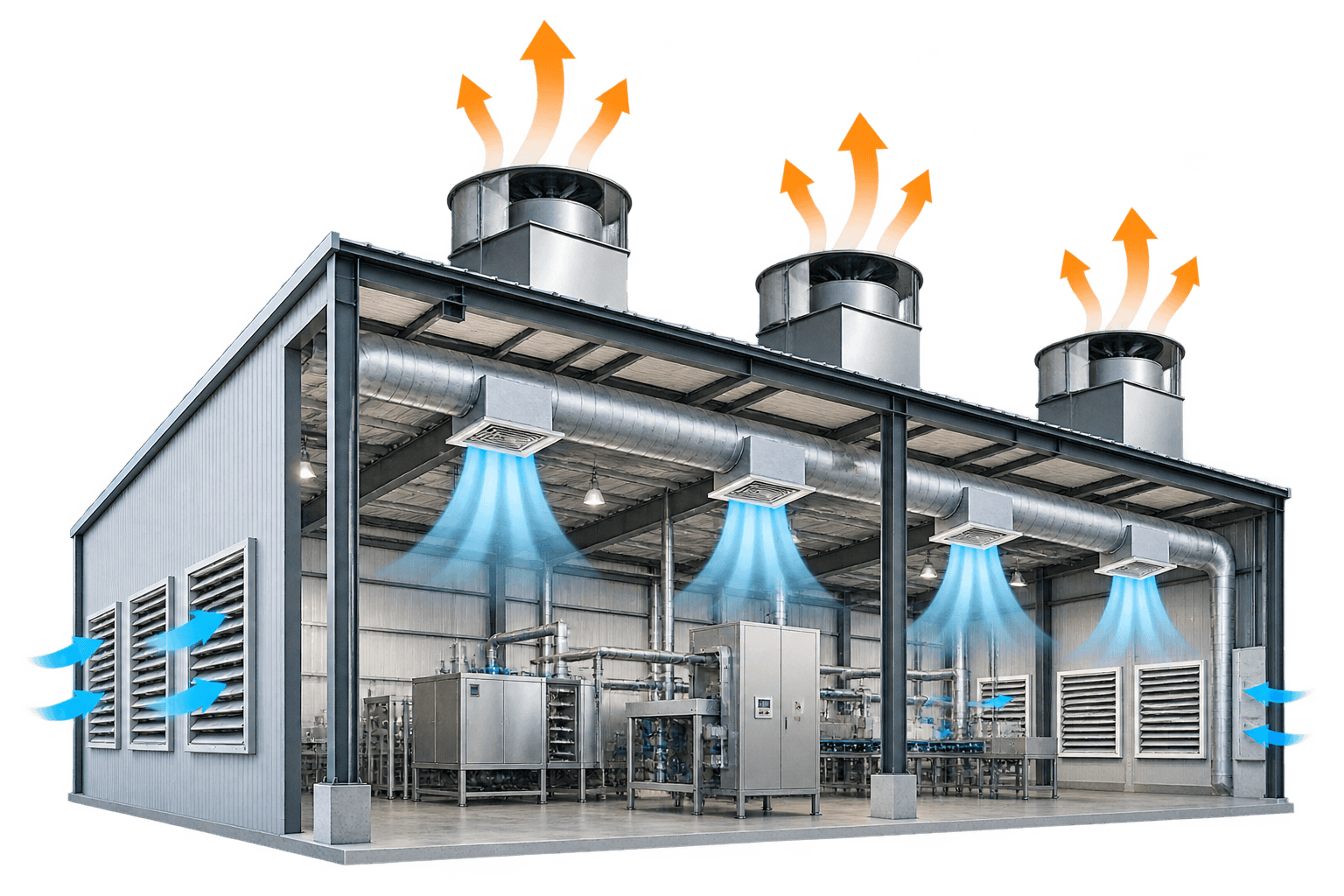
Industrial Dilution Ventilation Systems
Learn MoreFrequently Asked Questions
Q1. What is a heat exhaust ventilation system?
A heat exhaust ventilation system removes excess heat from a building by exhausting hot air, usually from the roof or upper walls, and replacing it with cooler outdoor air at low level. It uses roof exhaust fans, wall fans, turbine ventilators, canopy hoods and fresh air inlets, often with evaporative cooling and automatic controls.
Q2. How does heat exhaust ventilation work?
Hot air rises and collects under the roof. Exhaust fans or roof vents remove this hot layer, while cooler outdoor air enters through low-level louvres or make-up air units. The continuous flow of air carries heat away as fast as it is generated, and thermostats adjust fan operation as temperature changes.
Q3. How much airflow is needed to remove heat from a factory?
It depends on the heat load and the allowable temperature rise. As a working rule, airflow in m³/h is roughly 3,000 × heat load in kW ÷ temperature rise in °C, so removing 100 kW with a 5 °C rise needs about 60,000 m³/h. A proper heat load calculation and site survey give the accurate figure.
Q4. What is the difference between roof exhaust fans and turbine ventilators?
Roof exhaust fans are motor-driven and deliver high, controllable airflow regardless of weather. Turbine ventilators are wind and buoyancy driven, use no electricity and cost less, but each moves much less air and their output varies with wind. Many buildings use both together.
Q5. Can heat exhaust ventilation reduce factory temperature?
Yes. By removing trapped hot air and bringing in outdoor air, heat exhaust ventilation brings indoor temperature much closer to outdoor levels. Adding evaporative make-up air, spot cooling and roof insulation reduces working-level temperatures further.
Q6. Is heat exhaust ventilation cheaper than air conditioning?
Yes, significantly. For large factories and warehouses, heat exhaust ventilation with evaporative cooling costs a fraction of air conditioning to install and uses far less electricity to run, although it cannot cool below outdoor temperature.
Q7. How is heat removed from DG rooms and electrical rooms?
DG rooms use large inlet louvres, exhaust fans or radiator discharge ducts sized for combustion and cooling air. Electrical and transformer rooms use low-level inlets with filtered air and high-level exhaust fans, often with thermostatic control, to keep equipment within its rated temperature.
Q8. What is the stack effect in ventilation?
The stack effect is the natural upward movement of warm air in a building. Warm indoor air rises and escapes through high openings, drawing cooler air in through low openings. Taller buildings and larger temperature differences create a stronger stack effect.
Q9. Should evaporative cooling be combined with heat exhaust ventilation?
In most Indian factories, yes. Evaporative make-up air supplies cooler air at worker level while exhaust fans remove the heat. The combination works best when the exhaust rate is sufficient to prevent humidity build-up, and ventilation-only mode can be used on very humid days.
Q10. How often should heat exhaust fans be serviced?
Most industrial exhaust fans benefit from a quarterly service covering cleaning, bearings, belts and electrical checks, with a thorough pre-summer inspection. Dusty or high-temperature environments may need more frequent attention, and evaporative coolers need regular pad and water system maintenance.
Q11. What is the cost of a heat exhaust ventilation system in India?
Indicative equipment prices range from about ₹1,500 to ₹5,000 per turbine ventilator and ₹25,000 to ₹1,50,000 per powered roof exhaust fan, with evaporative make-up air units from about ₹50,000. The total project cost depends on heat load, airflow, roof work and controls. Contact Compress India for an accurate quotation.
Q12. Does Compress India design and install heat exhaust ventilation systems in Mumbai?
Yes. Compress India designs, supplies, installs, tests, commissions and maintains heat exhaust ventilation systems across Mumbai, Navi Mumbai, Thane and the rest of Maharashtra, and undertakes projects across India. Contact our HVAC team to schedule a site survey.