General Dilution Ventilation Systems
(Design, Supply, Installation, Testing, Commissioning & AMC for Whole-Space Dilution Ventilation)
Design, Supply, Installation, Testing, Commissioning & AMC for Whole-Space Dilution Ventilation
Hot, stuffy work areas, lingering solvent smells and rising gas readings are signs that a space is not getting enough clean air. Compress India designs and installs General Dilution Ventilation Systems that bring fresh outdoor air into factories, warehouses, plant rooms and commercial buildings, dilute airborne contaminants and heat, and exhaust them safely outdoors.
Every system we build starts with numbers, not guesswork. We calculate the dilution airflow your space actually needs from contaminant generation, heat load, occupancy and code requirements, then select the fans, louvres, ductwork, sensors and controls to deliver it at the lowest practical running cost.
Whether you need a new general ventilation system for an industrial building, heat relief for a hot shop floor, or an upgrade to an under-performing exhaust fan installation, our HVAC team can help. Request a site survey and quotation today.
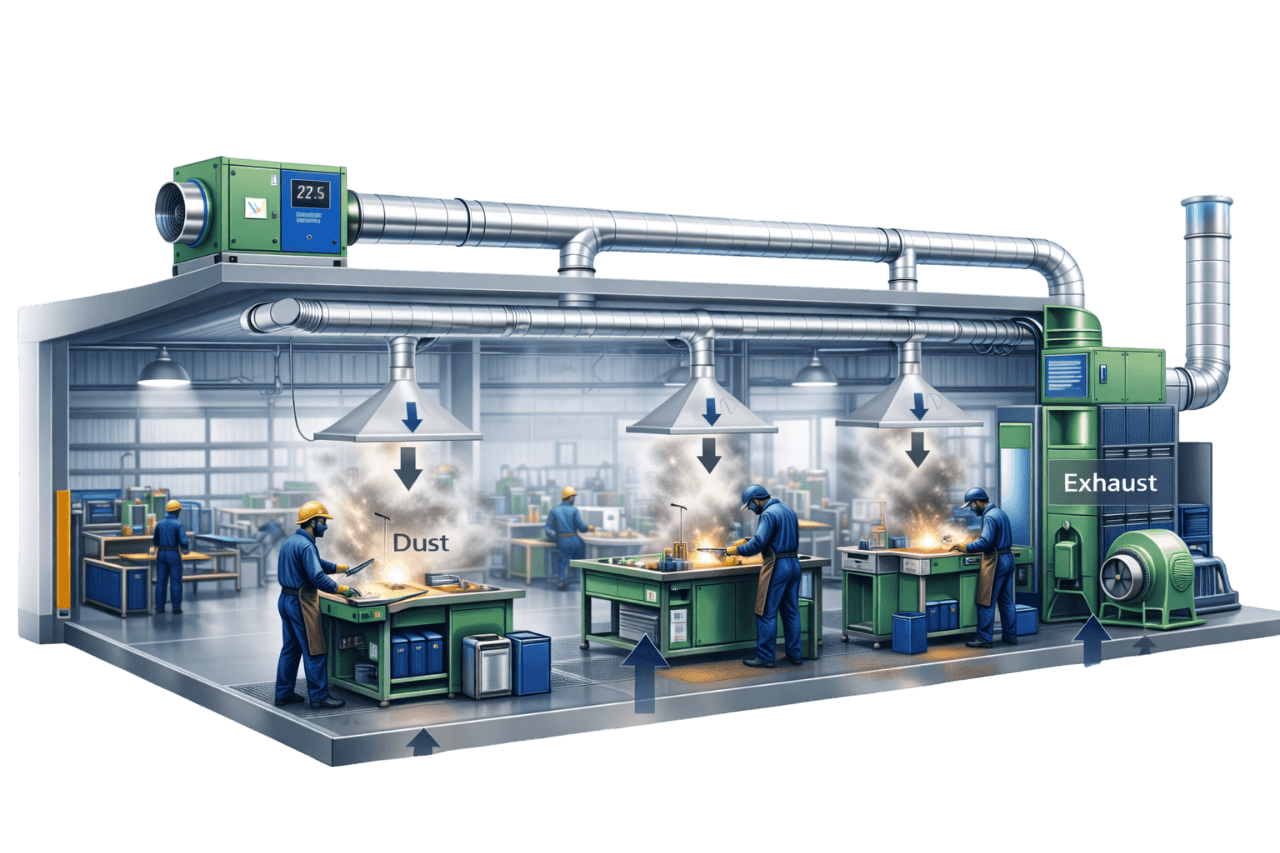
Compress India delivers complete dilution ventilation projects under one contract, so a single team is accountable for performance from the first calculation to the last maintenance visit.
- Design: Contaminant and heat load assessment, dilution airflow calculation, air changes per hour, fan selection and CFD airflow analysis where required.
- Supply: Supply fans, AHUs, make-up air units, industrial exhaust fans, roof extractors, louvres, filters, gas detectors, VFDs and control panels from reputed ventilation brands.
- Installation: In-house fabricated HVAC ductwork, fan mounting with vibration isolation, sensor installation, and electrical and control wiring.
- Testing & Commissioning: Airflow and air change verification, smoke tests, tracer gas testing and air quality monitoring, with a full commissioning report.
- AMC: Planned maintenance, sensor calibration, filter and duct cleaning, and fast breakdown support.
One point of contact, one set of drawings and one team that stands behind the result. That is how a dilution ventilation system should be delivered.
What Is a General Dilution Ventilation System?
A general dilution ventilation system supplies clean outdoor air to an entire room or building and exhausts an equal (or slightly larger) volume of contaminated air. The incoming air mixes with the room air and lowers the concentration of gases, vapours, heat, moisture and odours to safe, comfortable levels.
It is also known as general exhaust ventilation, whole room ventilation, mixing ventilation or general mechanical ventilation. Unlike local exhaust ventilation (LEV), which captures contaminants at the point where they are released, dilution ventilation treats the whole space.
General dilution ventilation examples are all around us:
- A bath exhaust fan clearing steam from a bathroom, or a kitchen exhaust fan removing cooking odours at home
- Wall mount exhaust fans and roof extractors pulling hot air out of a warehouse
- Jet fans and a basement ventilation system diluting vehicle exhaust in a car park
- A spark-proof exhaust fan keeping hydrogen well below its explosive limit in a battery charging room
- Fresh air units and toilet exhaust maintaining indoor air quality in an office
Home ventilation and room ventilation work on the same principle at small scale. Industrial dilution ventilation applies it with engineered airflow rates, make-up air, sensors and controls, so results can be measured and verified.
Why Dilution Ventilation Is Used
Dilution ventilation is the most practical way to control airborne hazards and discomfort that are spread across a space rather than concentrated at one point. Businesses install it for five main reasons.
Diluting Low-Toxicity Contaminants
Many processes release small amounts of low-toxicity vapours, gases or fumes, such as mild solvents, cleaning agents, adhesives or CO₂ from occupants. Contaminant dilution ventilation brings these concentrations down to a fraction of their occupational exposure limits, protecting workers without the cost of capturing every source individually.
Controlling Heat & Humidity
Furnaces, ovens, compressors, motors, steam lines and roof solar gain can push shop-floor temperatures well above outdoor air. A general ventilation system for heat removal replaces hot, humid indoor air with cooler outdoor air, reducing heat stress, condensation and equipment overheating. In humid coastal cities like Mumbai, controlling moisture is just as important as controlling temperature.
Removing Odours & Stale Air
Toilets, canteens, kitchens, printing areas, storage rooms and gyms quickly build up odours and stale air. Continuous air changes flush them out, keeping workplaces pleasant and preventing smells from drifting into offices, customer areas or neighbouring units.
Keeping Flammable Vapours Below Safe Limits
Solvent stores, paint stores, fuel handling areas and battery rooms can accumulate flammable vapours or hydrogen. Properly sized dilution airflow keeps concentrations far below the Lower Explosive Limit (LEL), typically at or below 25% of LEL, reducing fire and explosion risk.
Maintaining Indoor Air Quality
Offices, commercial buildings, training rooms and control rooms need a steady supply of fresh outdoor air to keep CO₂, VOCs and odours under control. General ventilation for indoor air quality improves comfort, concentration and productivity, and helps buildings meet ASHRAE 62.1 and NBC 2016 fresh air requirements.
How a Dilution Ventilation System Works
A dilution ventilation system works on a simple principle: the more clean air you mix into a space, the lower the concentration of whatever is being released into it. Here is how the process runs, step by step.
1. Fresh Air Enters the Space
Clean outdoor air is drawn in through supply fans, air handling units, make-up air units or wall louvres. Where the outdoor air is dusty, it is filtered first. In hot climates it may also be evaporatively cooled before it reaches the work area.
2. Clean Air Mixes with Contaminated Air
Supply air is delivered with enough velocity and at the right locations to mix thoroughly with the room air. Good mixing is what makes dilution work. Poorly placed inlets leave pockets of stale, contaminated air, however many fans are running.
3. Contaminant Concentration Drops to Safe Levels
As clean air mixes in, the concentration of vapours, gases, heat and moisture falls. At steady state, concentration equals the contaminant generation rate divided by the effective airflow, so the airflow is sized to hold concentrations well below exposure limits and LEL.
4. Diluted Air Is Exhausted Outdoors
Industrial exhaust fans, roof extractors or ducted exhaust systems remove the diluted air and discharge it outdoors, away from air intakes, windows and neighbouring buildings.
5. Continuous Air Changes Maintain Air Quality
The cycle repeats continuously, delivering a set number of air changes per hour (ACH). Sensors and variable frequency drives (VFDs) can raise or lower airflow as contaminant levels, heat load or occupancy change, keeping the space safe without wasting energy.
Main Components of a Dilution Ventilation System
Every general ventilation system is built from a few core components. Selecting and sizing each one correctly decides how well the system performs and how much it costs to run.
Supply Fans, AHUs & Make-Up Air Units
Supply fans push fresh air into the space. Axial ventilation fans suit wall and roof openings, while centrifugal ventilation fans handle ducted systems with higher static pressure. Air handling units (AHUs) add filtration, and cooling where required. Make-up air units replace the air removed by exhaust fans, often with evaporative pre-cooling for Indian factory conditions.
Exhaust Fans & Roof Extractors
Exhaust fans remove diluted air from the space. Options include wall mounted industrial exhaust fans, louvered exhaust fans with an exhaust fan shutter, roof exhaust fans and roof ventilation fans, and inline exhaust fans fitted within ductwork. Sizes range from a small exhaust fan of 4 or 6 inches for a toilet to a large, heavy duty exhaust fan of 24 inches and above for factory sheds. Spark-resistant or flameproof fans are used where flammable vapours may be present.
Air Inlets & Louvres
Weather louvres, sand-trap louvres, bird screens and gravity dampers let fresh air in while keeping out rain, dust, birds and insects. In Mumbai's monsoon, inlet design is critical to prevent water ingress. For natural systems, ridge vents and roof air vents provide high-level openings.
Ductwork (Where Required)
Many shed-type systems work without ducts. Where air must be carried to or from specific zones, GI HVAC ductwork, grilles, diffusers and ventilation ducting distribute the air evenly. Stainless steel or coated ducts are used for corrosive or humid exhaust. Compress India fabricates ductwork in-house for quality and speed.
Filters
Pre-filters and fine filters on the supply side keep outdoor dust, pollen and pollution out of the building. Filter selection balances cleanliness against pressure drop, since every additional filter stage adds to fan energy.
Gas, CO₂ & Temperature Sensors
VOC, CO, NO₂, hydrogen and LEL gas detectors, CO₂ sensors, and temperature and humidity sensors measure conditions in real time. They trigger alarms, boost ventilation when needed and let fans slow down when the air is clean.
Controls
Control panels with starters, VFDs, timers and interlocks tie the system together. Controls can link with fire alarm systems, gas detection panels and building management systems (BMS) for automatic operation and remote monitoring.
Types of Dilution Ventilation Systems
The right type of dilution ventilation depends on what you are controlling, where it comes from and how the building is used. Compress India designs all seven common configurations.
Supply-Based Dilution Ventilation
Fans or AHUs push filtered fresh air into the space, and air leaves through relief louvres or openings. This creates positive pressure general ventilation, which keeps dust and unfiltered air out. It suits electrical rooms, control rooms, clean assembly areas and spaces next to dusty zones.
Exhaust-Based Dilution Ventilation
Exhaust fans pull air out, and fresh air enters through louvres or openings. The resulting negative pressure general ventilation stops odours, vapours and hydrogen from escaping into neighbouring areas. It is the preferred choice for toilets, battery charging rooms, paint and solvent stores, and kitchens.
Balanced Mechanical Dilution Ventilation
Supply and exhaust dilution ventilation uses fans on both sides, giving full control over airflow paths, mixing and room pressure. A small offset keeps the space slightly negative or positive as needed. Balanced systems with dedicated make-up air are the most reliable choice for large factories and multi-zone buildings.
Natural Dilution Ventilation
Natural systems rely on wind and the stack effect. Cross ventilation through wall openings, ridge ventilation, roof vents and wind-driven turbo ventilators let hot air escape at high level while fresh air enters low down. Running cost is close to zero, but airflow varies with weather and cannot be guaranteed.
Hybrid (Mixed-Mode) Ventilation
Hybrid systems use natural ventilation whenever conditions allow and switch on mechanical fans when temperature, gas levels or still weather demand it. Roof vent fans, solar-powered roof ventilation fans and thermostat-controlled extractors are common hybrid elements. The result is lower energy use with guaranteed minimum performance.
Heat Relief Ventilation for Factories
Heat relief ventilation moves large volumes of outdoor or evaporatively cooled air through hot work areas. Roof extractors remove heat at high level, while make-up air, cooler exhaust fan combinations and air circulation fans deliver air to worker zones. This is the most effective form of industrial heat stress ventilation for sheds without air conditioning.
Demand-Controlled Dilution Ventilation
Demand controlled general ventilation adjusts fan speed to real-time readings from gas, CO₂ or temperature sensors. Gas sensor controlled ventilation in car parks, for example, runs fans at low speed most of the day and ramps up only when CO or NO₂ rises. It delivers the same protection at a fraction of the fixed-speed running cost.
Dilution Ventilation vs Local Exhaust Ventilation (LEV)
Dilution ventilation cleans the whole room; local exhaust ventilation captures contaminants at the source before they reach the room. Choosing between general exhaust vs local exhaust depends mainly on toxicity, emission rate and how close workers are to the source.
| Factor | General Dilution Ventilation | Local Exhaust Ventilation (LEV) |
|---|---|---|
| Principle | Dilutes contaminants throughout the space | Captures contaminants at the point of release |
| Best for | Low-toxicity vapours, heat, odour, moisture | Toxic dust, fumes, mists and high-emission sources |
| Emission sources | Many, dispersed, low and uniform | Few, fixed, concentrated |
| Airflow required | High | Low to moderate |
| Energy use | Higher, as large air volumes are moved and replaced | Lower per source |
| Worker exposure | Contaminant passes through the breathing zone before dilution | Contaminant removed before reaching the breathing zone |
| Layout flexibility | High, no hoods at each machine | Lower, tied to machine positions |
| Initial cost | Lower for large, open spaces | Higher per source |
In practice, the best designs often combine both. LEV captures major point sources such as welding, grinding or spray painting, while general ventilation handles background heat, residual vapours and fresh air. Compress India designs both and can tell you where each makes sense in your facility.
Dilution Ventilation vs Displacement Ventilation
Dilution ventilation mixes supply air thoroughly with room air, so conditions are nearly uniform throughout. Displacement ventilation supplies cool air slowly at low level; it rises as it warms and carries heat and contaminants up to high-level exhausts without mixing.
| Factor | Dilution (Mixing) Ventilation | Displacement Ventilation |
|---|---|---|
| Air delivery | High velocity, high or side-wall supply | Low velocity, near floor level |
| Room conditions | Uniform temperature and concentration | Stratified, cleaner and cooler at floor level |
| Best for | Most spaces, including those with dispersed or heavier-than-air contaminants | High-ceiling spaces with warm, rising contaminants |
| Supply air temperature | Can be cooler than room air | Only slightly cooler than room air |
| Layout sensitivity | Tolerant of obstructions and layout changes | Sensitive to obstructions near floor diffusers |
Displacement can be more efficient for heat-driven plumes in tall spaces. Dilution is more versatile and easier to retrofit into existing buildings, which is why it remains the most widely used approach.
Mechanical vs Natural Dilution Ventilation
Mechanical dilution ventilation uses fans to guarantee a set airflow whatever the weather. Natural ventilation uses wind and buoyancy through openings, ridge vents and roof vents at little or no running cost.
| Factor | Mechanical Dilution Ventilation | Natural Dilution Ventilation |
|---|---|---|
| Airflow | Guaranteed and controllable | Varies with wind and temperature difference |
| Running cost | Fan energy | Near zero |
| Filtration & cooling | Possible | Not possible |
| Suitability for hazards | Suitable for vapours, gases and LEL control | Not reliable for hazard control |
| Typical use | Factories, plant rooms, car parks, battery rooms | Warehouses, sheds, low-risk storage |
Where hazards or heat stress must be controlled reliably, mechanical ventilation is essential. Hybrid systems combine both to cut energy costs without sacrificing safety.
When Dilution Ventilation Is Suitable
Dilution ventilation is the right solution when the contaminant, the way it is released and the way people work around it all favour whole-space control.
Low-Toxicity Contaminants
The contaminant should have a relatively high exposure limit, meaning it is harmful only at elevated concentrations. Many common solvents, cleaning chemicals, CO₂ and nuisance odours fall into this category.
Low & Uniform Emission Rates
Dilution works best when contaminants are released slowly and steadily. Sudden bursts or large releases are hard to dilute quickly enough, so a predictable generation rate makes the dilution airflow calculation reliable.
Dispersed or Multiple Sources
When emissions come from many small sources spread across a floor, such as drying parts, open containers or occupants, hooding each one is impractical. General ventilation handles all of them together.
Workers Away from the Source
The system works best when workers are far enough from emission points for the contaminant to mix and dilute before it reaches their breathing zone.
Heat, Odour & Moisture Control
For heat relief, odour removal and humidity control, dilution ventilation is usually the most economical choice, because the load is spread throughout the space rather than concentrated in one spot.
When Dilution Ventilation Is Not Suitable
Dilution ventilation is not a universal fix. In the following situations, it should be replaced or supplemented by local exhaust ventilation.
Highly Toxic Contaminants
Substances with very low exposure limits, such as lead fumes, silica dust, isocyanates or carcinogens, would need impractically large airflows to dilute safely. They must be captured at the source.
Large Point Sources of Dust or Fumes
Grinding, cutting, heavy welding, spray painting, mixing of powders and fume-generating processes release too much, too fast. Diluting them spreads the hazard across the whole building instead of removing it.
Workers Close to the Source
If operators work directly over the emission point, they breathe the contaminant before it can mix and dilute. No amount of general ventilation will protect them adequately.
When LEV Is the Better Option
Choose LEV, such as hoods, extraction arms, enclosures, fume cupboards or a paint booth exhaust fan, whenever contaminants are toxic, concentrated, dusty or released close to workers. LEV also saves energy because it moves far less air. Compress India will assess your processes honestly and recommend LEV where it is the safer and more economical solution.
Dilution Ventilation Standards & Guidelines
A well-engineered general dilution ventilation system is designed to recognised standards, so its airflow can be justified to factory inspectors, fire authorities, consultants and insurers. Compress India's designs reference the following guidelines.
ACGIH Industrial Ventilation Guidelines
The ACGIH manual, Industrial Ventilation: A Manual of Recommended Practice for Design, is the leading reference for industrial dilution ventilation. It sets out the dilution airflow equations for health protection and for fire and explosion safety, the use of mixing factors, and good practice for supply and exhaust placement.
ASHRAE 62.1 Ventilation Rates
ASHRAE Standard 62.1 sets minimum outdoor air rates for acceptable indoor air quality in commercial and institutional buildings. Its Ventilation Rate Procedure combines a per-person rate and a per-area rate; for offices, this is 2.5 L/s per person plus 0.3 L/s per m² (5 CFM per person plus 0.06 CFM per ft²). It also gives minimum separation distances between exhaust outlets and fresh air intakes.
NBC 2016 Ventilation Requirements
The National Building Code of India 2016 covers ventilation in Part 8 (Building Services), including natural ventilation and mechanical ventilation requirements for different occupancies. Part 4 (Fire and Life Safety) addresses smoke ventilation for basements and car parks. Compress India designs to NBC 2016 and local fire authority requirements.
Factories Act Ventilation & Temperature Provisions
Section 13 of the Factories Act, 1948 requires adequate ventilation by the circulation of fresh air and a reasonable working temperature in every workroom. Section 14 requires effective measures against dust and fumes, including exhaust close to the point of origin where necessary. State factory rules, such as the Maharashtra Factories Rules, add detailed requirements that we account for in every industrial design.
Occupational Exposure Limits (TLV / PEL)
Occupational exposure limits define the maximum airborne concentration a worker may be exposed to. References include ACGIH Threshold Limit Values (TLVs), OSHA Permissible Exposure Limits (PELs), and the permissible levels in the Second Schedule of the Factories Act. Occupational exposure limit ventilation is designed to keep concentrations well below these values, not just at them.
Lower Explosive Limit (LEL) Safety Margins
For flammable vapours and gases, dilution airflow is sized to keep concentrations at or below 25% of the LEL, and often lower. Hydrogen, for example, has an LEL of 4% by volume, so battery rooms are ventilated to keep hydrogen far below that level. LEL gas detectors typically alarm at 10% LEL and trigger higher-level actions at 20–25% LEL.
Dilution Ventilation Design & Sizing
Correct dilution ventilation system design is what separates a system that works from one that simply runs. Compress India sizes every project from first principles, then checks the result against code minimums and site realities.
Contaminant Generation Rate Assessment
The starting point is how much contaminant enters the air. We review material consumption records, safety data sheets, process temperatures, evaporation rates, occupancy, vehicle movements and battery charging currents. For example, a process that uses 1 kg of solvent per 8-hour shift releases about 35 mg of vapour every second.
Dilution Airflow Calculation
At steady state, the required dilution airflow is:
Q = (G × K) ÷ C
where Q is airflow (m³/s), G is the contaminant generation rate (mg/s), K is the mixing factor, and C is the target concentration (mg/m³). For solvent evaporation, the ACGIH form is Q (CFM) = (403 × 10⁶ × SG × ER × K) ÷ (MW × TLV), with ER in pints per minute and TLV in ppm.
*Worked example:* 35 mg/s of vapour, a target concentration of 100 mg/m³ and K = 3 gives Q = (35 × 3) ÷ 100 ≈ 1.05 m³/s, or about 3,800 m³/h (2,200 CFM). A separate LEL-based calculation is done for flammable vapours, and the higher airflow governs.
Mixing Factor (K) for Incomplete Mixing
Real rooms never mix perfectly, so the calculated airflow is multiplied by a mixing factor (K).
- K = 1: Perfect mixing, a theoretical ideal
- K ≈ 1.5–2: Well-designed supply and exhaust positions with good air throw
- K ≈ 2–3: Average mixing in typical industrial spaces
- K ≈ 3–5 or higher: Poor mixing, obstructions, high racking or risk of short-circuiting; some guidance uses values up to 10
Good air distribution lowers K, which directly reduces fan size and running cost.
Air Changes per Hour
Air changes per hour (ACH) express airflow relative to room volume: ACH = airflow (m³/h) ÷ room volume (m³). A 30 m × 20 m × 8 m shed (4,800 m³) at 10 ACH needs 48,000 m³/h, or about 28,250 CFM. The ranges below are typical starting points; the final design always comes from the contaminant or heat load calculation.
| Space | Typical starting range |
|---|---|
| Warehouses and low-occupancy storage | 3–6 ACH |
| General factories and workshops | 6–10 ACH |
| Toilets and washrooms | 10–15 ACH |
| Laundries | 10–20 ACH |
| Commercial kitchens (in addition to hood exhaust) | 15–30 ACH |
| Hot process areas (heat relief) | 15–30+ ACH, or by heat load |
| Basement car parks | About 6 ACH normal mode; 12 ACH or as specified by NBC and the fire authority for smoke mode |
| Battery charging rooms | By hydrogen generation calculation |
| DG, pump and electrical rooms | By heat load and combustion air calculation |
Heat Load–Based Airflow Calculation
Where heat is the main load, airflow is calculated from the heat to be removed and the allowable temperature rise:
Q (m³/s) = Heat load (kW) ÷ (1.2 × ΔT)
In imperial units, Q (CFM) = BTU/hr ÷ (1.08 × ΔT in °F). Removing 60 kW of machine heat with a 5 °C rise needs 10 m³/s, or 36,000 m³/h (about 21,200 CFM). Because outdoor air in Mumbai often reaches 33–35 °C, ventilation alone cannot bring indoor temperature below outdoor; evaporative pre-cooling or spot cooling is added where lower temperatures are needed.
Supply & Exhaust Location Planning
Fresh air should reach workers first, then pass over emission sources, then leave through exhausts located close to those sources. Heavier-than-air vapours need low-level exhaust, while hydrogen and heat need high-level exhaust. Intakes are kept well away from exhaust outlets, DG stacks and loading bays, using ASHRAE 62.1 separation guidance and prevailing wind direction.
Avoiding Short-Circuiting & Dead Zones
Short-circuiting happens when supply air flows straight to the exhaust without sweeping the room. Dead zones form behind racking, in corners and under mezzanines. We prevent both with correct spacing, adequate air throw, directional louvres, and air circulation fans or jet fans where needed.
Make-Up Air Requirements
Every cubic metre of air exhausted must be replaced. Without planned make-up air, exhaust fans lose performance, doors become hard to open, and air is pulled in from toilets, drains or dusty areas. Dilution ventilation with makeup air is sized so supply is usually 5–10% less than exhaust for negative pressure zones, or slightly more for positive pressure zones.
CFD Airflow Analysis
Computational fluid dynamics (CFD) simulates air velocity, temperature and contaminant concentration throughout the space before anything is built. Dilution ventilation CFD reveals dead zones, short-circuiting and hot spots, so fan positions can be optimised on screen instead of corrected on site.
Energy Efficiency in Dilution Ventilation
Dilution ventilation moves large volumes of air, so fan energy is its biggest running cost. Energy efficient industrial dilution ventilation keeps the same protection while cutting power bills significantly.
VFD Fan Control
Fan power varies with the cube of fan speed. Running a fan at 80% speed uses only about half the power of full speed. Variable frequency drives (VFDs) let fans run at the speed actually needed, rather than full speed all day, and provide soft starting that reduces wear.
Sensor-Based Demand Control
Gas, CO₂ and temperature sensors tell the system how much air is needed at any moment. Fans slow down when the air is clean and ramp up only when readings rise. In car parks, offices and intermittently used plant rooms, this substantially reduces fan running hours and energy.
Heat Recovery Where Contaminants Allow
In air-conditioned offices and clean commercial spaces, an energy recovery ventilator (ERV) or heat recovery wheel pre-cools and dehumidifies incoming fresh air using the outgoing exhaust. An ERV system is not suitable where exhaust carries flammable, corrosive or toxic contaminants; in those cases, run-around coil systems that keep the airstreams fully separate may be considered.
Evaporative Pre-Cooling of Make-Up Air
Direct or indirect evaporative cooling can lower make-up air temperature by several degrees at a fraction of the cost of air conditioning. It is most effective in drier months; during Mumbai's humid monsoon, indirect or two-stage evaporative cooling works better. On some sites, earth-air tunnels, a simple form of geothermal HVAC, can also temper incoming air.
Using Natural & Hybrid Ventilation
Ridge vents, roof ventilation systems, turbo ventilators and cross ventilation can handle base loads for free. Mechanical fans then run only when conditions demand. Choosing high-efficiency EC or BLDC exhaust fan models for smaller duties also lowers exhaust fan wattage across dozens of units.
Controls & Monitoring
Intelligent controls turn a dilution ventilation system from a fixed-speed fan installation into a responsive safety system that proves its performance every day.
VOC, CO & NO₂ Gas Detectors
VOC detectors monitor solvent areas, printing units and chemical stores. CO and NO₂ detectors are standard in basement car parks and loading bays, staging fans up in steps as vehicle exhaust levels rise.
LEL Monitoring for Flammable Vapours
Catalytic or infrared LEL detectors continuously measure flammable vapour and hydrogen levels. At the first alarm, ventilation boosts to high speed; at higher levels, the system can raise alarms, shut down charging or process equipment, and alert the control room.
CO₂ & IAQ Sensors
CO₂ sensors are a reliable indicator of occupancy and fresh air adequacy in offices, meeting rooms, gyms and halls. IAQ sensors that also measure PM2.5, humidity and VOCs give a complete picture of indoor air quality.
Temperature-Based Heat Relief Control
Thermostats and temperature sensors stage roof extractors and supply fans on and off, or modulate VFD speed, as shop-floor, DG room or electrical room temperatures change. This keeps conditions safe without running every fan at full speed through cooler hours.
BMS & SCADA Integration
General ventilation BMS integration over BACnet or Modbus provides remote start and stop, fan status, alarms, sensor trends, filter pressure drop and energy data. Interlocks with fire alarm and gas detection panels ensure the system responds correctly in emergencies.
Benefits of General Dilution Ventilation
For the right applications, general dilution ventilation delivers reliable protection and comfort at a lower cost than any alternative.
Simple Design & Lower Initial Cost
With fewer components than a hood-and-duct network at every machine, dilution systems are quicker to design, install and commission. For large, open buildings, the initial cost per square metre is usually much lower than LEV.
Handles Dispersed Contaminant Sources
One system controls vapours, heat and odours from many small sources at once, including sources that move, change or cannot be hooded.
Heat Relief & Worker Comfort
Continuous air movement and fresh air reduce heat stress, humidity and stuffiness. Comfortable workers are more alert, make fewer errors and are more productive through long shifts.
Flexible for Changing Layouts
Because the system serves the whole space rather than individual machines, you can rearrange production lines, racking or workstations without redesigning the ventilation.
Low Maintenance
Fans, louvres, filters and sensors are straightforward to service. With a planned AMC, a dilution ventilation system runs reliably for many years with minimal downtime.
Limitations of General Dilution Ventilation
Understanding the limitations is part of good design. Compress India will always tell you where dilution alone is not enough.
Not for Highly Toxic Contaminants
Substances with very low exposure limits would need impractically large airflows. These must be controlled at the source with LEV or process enclosure.
High Airflow & Energy Use
Diluting contaminants across a whole space means moving large air volumes, which adds fan energy. VFDs, demand control and efficient fans reduce, but do not eliminate, this cost.
Contaminants Pass Through the Breathing Zone
By design, contaminants mix into the room air before they are exhausted, so workers near sources may still be exposed. Source location and airflow paths must be planned carefully.
Requires Good Air Mixing
Poorly placed supply and exhaust points create dead zones where concentrations stay high. Air distribution design matters as much as fan capacity.
Costly Conditioning of Large Outdoor Air Volumes
If the space is air-conditioned or heated, every cubic metre of outdoor air must be cooled, dehumidified or heated, which significantly raises HVAC energy use. Heat recovery helps where contaminants allow it.
Does Not Control Dust at the Source
Dust and heavy particles settle and re-suspend rather than dilute evenly. Dusty processes need capture at the source, with dilution only handling residual background levels.
Where Dilution Ventilation Systems Are Used
From heavy industry to commercial buildings, Compress India designs dilution ventilation systems for a wide range of applications.
Factories & Warehouses
Factory dilution ventilation removes process heat, low-level vapours and stale air from production halls. Warehouse dilution ventilation uses roof extractors, industrial ventilation fans and make-up air louvres to control heat under metal roofs, protect stored goods and keep pickers and forklift operators comfortable.
Workshops with Low-Toxicity Fumes
Maintenance shops, assembly areas and light fabrication units benefit from workshop dilution ventilation using a shop exhaust fan network and fresh air inlets. Where continuous welding, grinding or soldering takes place, we add LEV at those benches and use dilution for the background.
Offices & Commercial Buildings
Commercial buildings need fresh air supply for occupants, exhaust for toilets and pantries, and coordination with HVAC air conditioning systems. We provide treated fresh air units, bathroom ventilation systems with ceiling ventilation fans, canteen kitchen ventilation and kitchen exhaust systems, and plenum ventilation designs that integrate cleanly with AC ventilation.
Basements & Car Parks
Basement car parks need continuous dilution of CO, NO₂ and vehicle fumes, plus smoke extraction during a fire. We design jet fan and ducted basement ventilation systems with CO and NO₂ sensors and fire-mode operation to NBC 2016 and fire authority requirements.
Battery Charging Rooms
Lead-acid and other vented batteries release hydrogen during charging. Battery room dilution ventilation uses high-level exhaust, low-level fresh air inlets, spark-resistant fans and hydrogen detectors interlocked with the chargers, keeping hydrogen far below its LEL.
Paint & Solvent Stores
Solvent vapour dilution ventilation for paint and chemical stores typically uses low-level and high-level exhaust, flameproof motors and LEL monitoring. Spray painting itself needs a dedicated paint booth exhaust fan system, which we can also provide.
Printing Units
Solvent-based inks, cleaning solvents and press heat make printing units a classic dilution ventilation application. We combine general ventilation with local extraction at presses and ink stations for complete VOC control.
Laundries
Industrial and hotel laundries generate heat, moisture and lint. Dilution ventilation removes heat and humidity from the workspace, while dryer exhaust is ducted separately to prevent lint build-up and fire risk.
Textile Mills
Spinning, weaving and processing departments produce heat and fibre fly and need controlled humidity. Dilution and supply systems in textile mills remove heat, work alongside humidification plants, and use filtration to manage airborne fibres.
DG, Pump & Electrical Rooms
DG rooms need combustion air plus enough airflow to carry away engine and radiator heat. Pump rooms and electrical rooms need heat removal to protect motors, panels and transformers, often with filtered positive-pressure supply to keep dust out.
Gyms & Sports Halls
High occupancy and physical activity raise CO₂, humidity and odours quickly. CO₂-based demand-controlled ventilation keeps gyms and sports halls fresh during peak hours while saving energy when they are quiet.
Top Ventilation Equipment Brands in India
Compress India is brand-neutral. We select fans and components on certified performance data, efficiency, noise, duty suitability, delivery time and after-sales support in India, then recommend the best fit for your budget and application.
Kruger
Kruger is one of the most widely specified fan brands in Indian HVAC projects. Its centrifugal, axial and inline fans are commonly used in AHUs, ducted supply and exhaust systems, and basement ventilation.
Systemair
Swedish ventilation group Systemair offers a broad range of inline duct fans, roof fans, axial fans, car park jet fans and air handling units, with EC motor options for energy-efficient ventilation.
Nicotra Gebhardt
Nicotra Gebhardt is known for centrifugal fans, plug fans and blowers used in air handling units and ducted ventilation systems, with a wide selection of sizes and pressure ranges.
Greenheck
US-based Greenheck manufactures roof exhausters, upblast fans, inline fans, louvres and dampers. Its products are widely used in commercial kitchen exhaust, industrial exhaust and general ventilation.
ebm-papst
German specialist ebm-papst is a leader in EC fans and motors. Its high-efficiency plug fans and axial fans are a popular choice for EC fan dilution ventilation and for retrofits that replace older AC motor fans.
Almonard
Indian manufacturer Almonard produces industrial axial fans, wall and roof exhaust fans, air circulators and man coolers. Its products are widely used for factory heat relief and shed ventilation.
Other Ventilation Brands
Other options include Östberg for compact inline duct fans, Soler & Palau for a wide range of residential and commercial fans, and Indian brands such as Havells and Crompton for small exhaust fans in toilets, pantries and utility rooms. We choose from the full market so your system is never tied to a single brand's limitations.
Dilution Ventilation Installation Guide
Even a perfectly designed system can under-perform if it is installed poorly. Compress India's dilution ventilation installation process follows a clear sequence, managed by our own engineers and fabrication teams.
Site Survey & Airflow Planning
We inspect the building, measure volumes, identify heat and contaminant sources, check existing fans and openings, and note structural, electrical and access constraints. Where useful, we take baseline temperature, gas or CO₂ readings to benchmark improvement.
Supply & Exhaust Fan Placement
Fans are positioned to create a clean sweep of air across the space, from worker zones towards sources and exhausts. Placement accounts for roof structure, wind direction, neighbouring buildings and future expansion.
Louvre & Air Inlet Installation
Louvres and inlets are installed with proper flashing, sealing and bird screens. In Mumbai, rain-resistant or sand-trap louvres and correct orientation are essential to prevent monsoon water ingress.
Ductwork Installation
Where ducts are needed, our in-house team fabricates GI, stainless steel or coated ductwork to SMACNA-style construction standards. Ducts are sealed, supported and fitted with dampers and access doors for balancing and cleaning.
Fan Mounting & Vibration Isolation
Wall, roof and inline fans are mounted on rigid bases or curbs with spring or rubber anti-vibration mounts and flexible connectors. This protects the building structure and keeps noise to acceptable levels.
Sensor & Gas Detector Installation
Sensors are mounted at the correct height for the gas they measure: low for heavier-than-air vapours, high for hydrogen and methane, and at breathing height for CO₂. Placement follows the manufacturer's guidance and the airflow pattern.
Electrical & Control Wiring
We provide power and control wiring, starters, VFD panels, interlocks with fire alarm and gas detection systems, and BMS connectivity. Flameproof wiring and equipment are used in hazardous areas.
Testing & Commissioning
A system is only as good as its proven performance. Our dilution ventilation commissioning process verifies that the installed system meets its design intent before handover.
Airflow & Air Change Verification
We measure airflow at every fan, louvre and grille using anemometers and flow hoods, check fan speed, current and static pressure, and calculate actual air changes per hour. Dampers and VFDs are balanced until airflows match the design.
Smoke Tests for Air Movement
Smoke generators make air movement visible, confirming that fresh air sweeps work areas, that contaminated air moves towards exhausts, and that no dead zones or short-circuiting remain.
Tracer Gas Testing
For critical spaces, tracer gas decay testing measures the actual effective air change rate and mixing, giving a far more accurate result than airflow readings alone.
Air Quality & Exposure Monitoring
We measure temperature, humidity, CO₂ and target gases at worker positions under normal operating conditions, and confirm that concentrations stay within design limits.
Commissioning Reports
You receive a complete commissioning report with measured airflows, test results, sensor calibration certificates, as-built drawings, and operation and maintenance manuals, ready for audits, inspections and insurance reviews.
Dilution Ventilation Service, Maintenance & AMC
Fan performance drops quietly over time as filters clog, belts slip and sensors drift. A Compress India dilution ventilation maintenance AMC keeps your system delivering its design airflow, year after year.
Fan, Motor, Belt & Bearing Checks
We check fan speed, motor current, vibration, belt tension and alignment, bearing condition and lubrication, and tighten electrical terminations. Early detection prevents unexpected breakdowns during production.
Filter Cleaning & Replacement
Supply filters are inspected, cleaned or replaced based on pressure drop and dust load. Clean filters protect airflow and indoor air quality while keeping fan energy in check.
Louvre & Inlet Cleaning
Louvres, bird screens and inlets collect dust, leaves and nests that choke airflow. Regular cleaning, especially before and after the monsoon, keeps fresh air flowing freely.
Gas Detector & Sensor Calibration
Gas detectors and sensors drift and must be bump-tested and calibrated with certified test gas at the intervals recommended by the manufacturer. We maintain calibration records for audits and inspections.
Duct Cleaning
Ducts that carry grease, lint, dust or condensate are inspected and cleaned to restore airflow, reduce fire risk and prevent odours and microbial growth.
Common Dilution Ventilation Problems & Solutions
Most ventilation complaints trace back to a few common causes. Here is how we diagnose and fix them.
Stagnant Air & Dead Zones
Cause: Supply and exhaust points are poorly spaced, or racking, mezzanines and machinery block airflow.
Solution: Relocate or add inlets and exhausts, use directional louvres, or add air circulation fans or jet fans. CFD analysis confirms the fix before work begins.
Air Short-Circuiting
Cause: Supply and exhaust openings are too close together, so fresh air leaves without sweeping the room.
Solution: Separate supply and exhaust across the space, redirect supply air, or reposition exhaust fans.
High Contaminant Levels
Cause: Airflow is too low, fans are under-performing, generation has increased, or a source needs LEV.
Solution: Measure actual airflow, restore fan performance, recalculate dilution airflow, and add LEV for major sources.
Heat Build-Up in Work Areas
Cause: Insufficient airflow, hot air recirculating near the roof, or no make-up air.
Solution: Add roof extractors, provide adequate make-up air, add evaporative pre-cooling, and direct air to worker zones.
Drafts & Worker Discomfort
Cause: High-velocity supply air aimed directly at workers or poorly selected grilles and louvres.
Solution: Change diffusers or louvre angles, reduce outlet velocity, or rebalance airflow with VFDs.
Odours Spreading to Adjacent Areas
Cause: The space is at positive pressure, or doors and openings let contaminated air escape.
Solution: Increase exhaust relative to supply to create negative pressure, and seal openings between zones.
High Energy Bills
Cause: Fixed-speed fans running at full speed all day, inefficient old motors, or over-sized systems.
Solution: Add VFDs and sensor-based demand control, replace old fans with EC fans, and right-size airflow to the actual load.
Dilution Ventilation Retrofit & Upgrades
An existing ventilation system rarely needs to be replaced entirely. Targeted upgrades often fix performance problems and cut energy costs at a fraction of the cost of a new installation.
Adding LEV for Major Sources
If one or two processes dominate contaminant levels, adding local exhaust at those points removes the bulk of the load. The general ventilation can then run at lower airflow, saving energy while improving air quality.
VFD & Sensor-Based Control Upgrades
Retrofitting VFDs and gas, CO₂ or temperature sensors to existing fans converts a fixed-speed system into demand-controlled ventilation. It is one of the quickest-payback upgrades available for car parks, factories and commercial buildings.
Improving Air Distribution with CFD
When a system moves enough air but still leaves hot spots or high readings, the problem is usually distribution. A CFD study identifies where to relocate inlets, add jet fans or redirect supply air to fix dead zones without adding fan capacity.
Adding Evaporative Cooling to Make-Up Air
Converting plain outdoor air intakes to evaporatively cooled make-up air lowers shop-floor temperatures by several degrees in dry weather, improving heat relief without the cost of full air conditioning.
Replacing Old Fans with EC Fans
Old belt-driven fans with standard AC motors lose efficiency over time. Replacing them with direct-drive EC fans, or BLDC exhaust fan models for smaller duties, reduces power consumption, eliminates belt maintenance and adds built-in speed control.
Dilution Ventilation System Cost in India
The cost of a dilution ventilation system in India depends mainly on the airflow required, the type of fans and controls, whether ductwork is needed, and the hazard level of the space. The figures below are indicative 2026 budget ranges for supply and installation, excluding GST. Your final dilution ventilation system price is confirmed after a site survey and design.
Cost by Airflow & Air Changes
Airflow is the biggest cost driver, and it is set by room volume and the required air changes or dilution calculation.
| System scope | Typical airflow | Indicative budget |
|---|---|---|
| Plant room, toilet block or small store exhaust | Up to 5,000 CFM | ₹30,000 – ₹2 lakh |
| Workshop, battery room or solvent store with sensors and spark-resistant or flameproof fans | 5,000 – 20,000 CFM | ₹2 lakh – ₹10 lakh |
| Factory or warehouse heat relief with roof extractors and make-up air louvres | 20,000 – 1,00,000 CFM | ₹5 lakh – ₹30 lakh |
| Ducted balanced system with filtered or evaporatively cooled make-up air, VFDs and BMS | 50,000 CFM and above | ₹25 lakh and above |
Simple exhaust-only systems cost the least per CFM. Ducted, filtered and conditioned systems cost more but deliver far better control.
Fan, Ducting & Controls Cost
- Fans: Wall-mounted industrial exhaust fans of 18–36 inches typically cost about ₹6,000 to ₹30,000 each, with flameproof models costing more. Standard motorised roof extractors are commonly in the ₹15,000 to ₹45,000 range, while branded, high-capacity or centrifugal units cost more.
- Ductwork: GI ductwork is priced by duct surface area, typically around ₹70 to ₹150 per sq ft fabricated and installed. Insulation, stainless steel and coated ducts add to this.
- Controls: Cost depends on the number of gas detectors and sensors, hazardous-area ratings, VFD sizes and whether BMS integration is required.
Factors Affecting Total Project Cost
- Required airflow and number of fans
- Hazard level, including flameproof or spark-resistant equipment
- Ductwork length, material and insulation
- Make-up air treatment, such as filtration or evaporative cooling
- Number and type of sensors, and BMS or SCADA integration
- Structural work, roof openings and access at height
- Electrical supply, cabling distances and panel requirements
- Testing, commissioning and CFD scope
Want an accurate figure for your site? Share your drawings or book a site survey, and we will send a detailed, itemised quotation.
Dilution Ventilation Design & Installation in Mumbai, Navi Mumbai & Thane
Compress India provides general dilution ventilation design, installation, commissioning and AMC across Mumbai, Navi Mumbai and Thane, including industrial belts such as MIDC Andheri, the Thane-Belapur (TTC) industrial area, Taloja, Wagle Estate and the Bhiwandi warehousing hub.
The region's climate shapes every design we deliver. High humidity for much of the year, heavy monsoon rain and salt-laden coastal air call for rain-resistant louvres, corrosion-protected fans and fixings, and make-up air strategies that account for moisture, not just temperature. Dense, high-rise development also means many basement car parks and plant rooms that need reliable, code-compliant ventilation in tight spaces.
Being local means faster site surveys, quicker installation and responsive AMC support when you need it.
Why Choose Compress India for Dilution Ventilation Systems?
Choosing the right general ventilation supplier and installer is the difference between a system that protects your people and one that just makes noise. Here is what you get with Compress India.
Industrial Ventilation Design Expertise
Our engineers understand industrial processes, contaminants and heat loads, not just fans. We design complete heating, cooling and ventilation solutions around how your facility actually works.
Code-Compliant Airflow Calculations
Every design is backed by documented airflow calculations referencing ACGIH, ASHRAE 62.1, NBC 2016, the Factories Act and exposure limits, ready for consultants, inspectors and insurers.
CFD-Based Airflow Planning
For complex or critical spaces, we use CFD analysis to test air distribution before installation, eliminating dead zones and costly on-site corrections.
In-House Ductwork Fabrication
Our own fabrication facility produces GI, stainless steel and coated ductwork to project specifications, giving you better quality control, fit and delivery timelines.
Fan & Sensor Selection
As a brand-neutral designer, we select fans, motors, louvres, gas detectors and controls on performance, efficiency and service support, never on convenience.
Testing & Commissioning
We verify airflow, air changes, air movement and air quality on site, and hand over full commissioning documentation so performance is proven, not assumed.
AMC & Retrofit Support
After handover, our AMC and retrofit teams keep your system efficient and compliant, and upgrade it as your processes grow and change.
Get a Dilution Ventilation Solution from Compress India
Whether you are planning a new facility, fixing a hot or stuffy workspace, or upgrading an ageing exhaust system, Compress India can design and deliver the right dilution ventilation solution for your site and budget.
Connect with Our HVAC Team
Tell us about your space and process, and we will recommend the most effective and economical approach. To help us respond quickly, share:
- Building drawings or approximate dimensions
- Processes, chemicals or safety data sheets involved
- Heat sources and number of occupants or workers
- Current problems, such as heat, odour, gas alarms or high energy bills
Call: [Phone Number] | Email: [Email Address] | Visit: [Office Address]
Request a site survey and quotation today.
Related Industrial HVAC, Ventilation & Ductwork Solutions
General Dilution Ventilation Systems work alongside these solutions to help control dust, fumes, heat and airborne contaminants across industrial spaces.
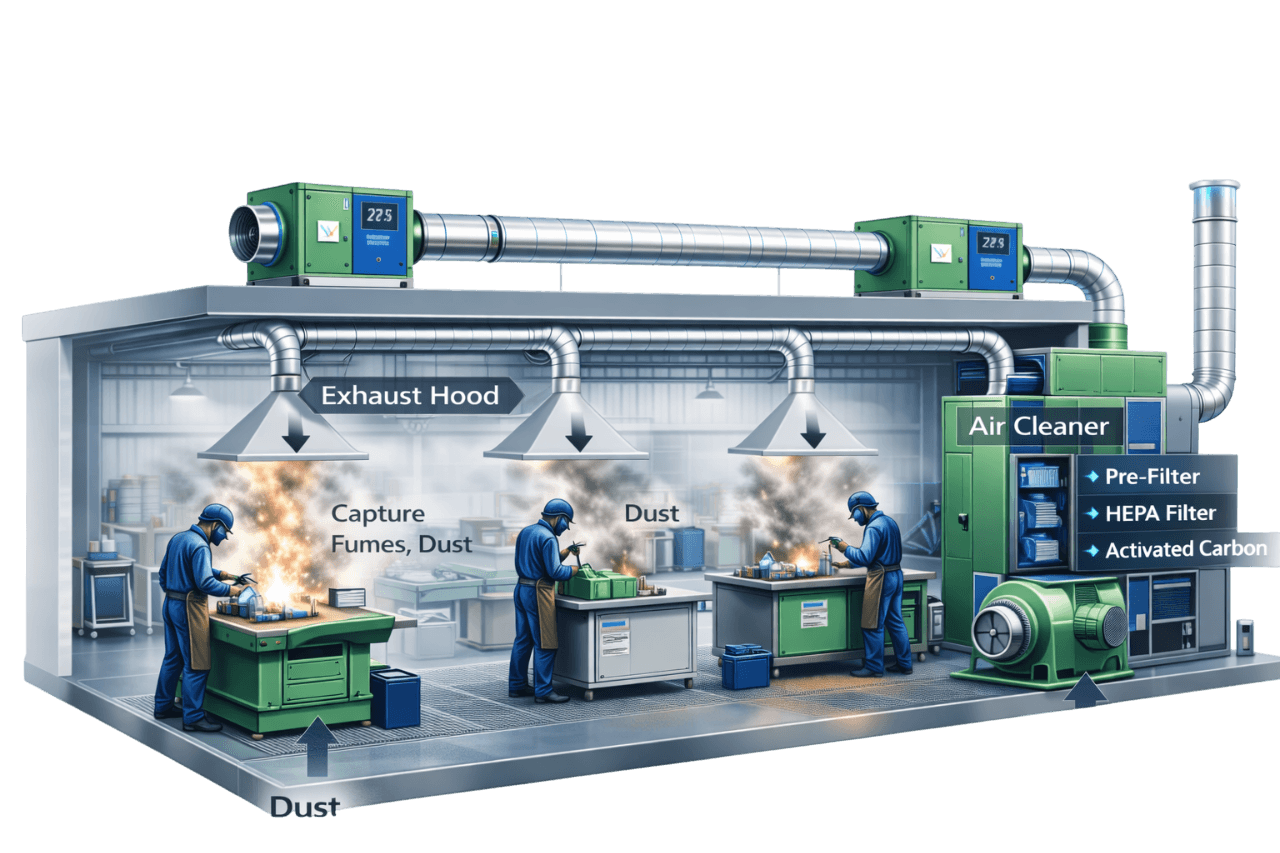
Local Exhaust Ventilation (LEV) Systems
Learn More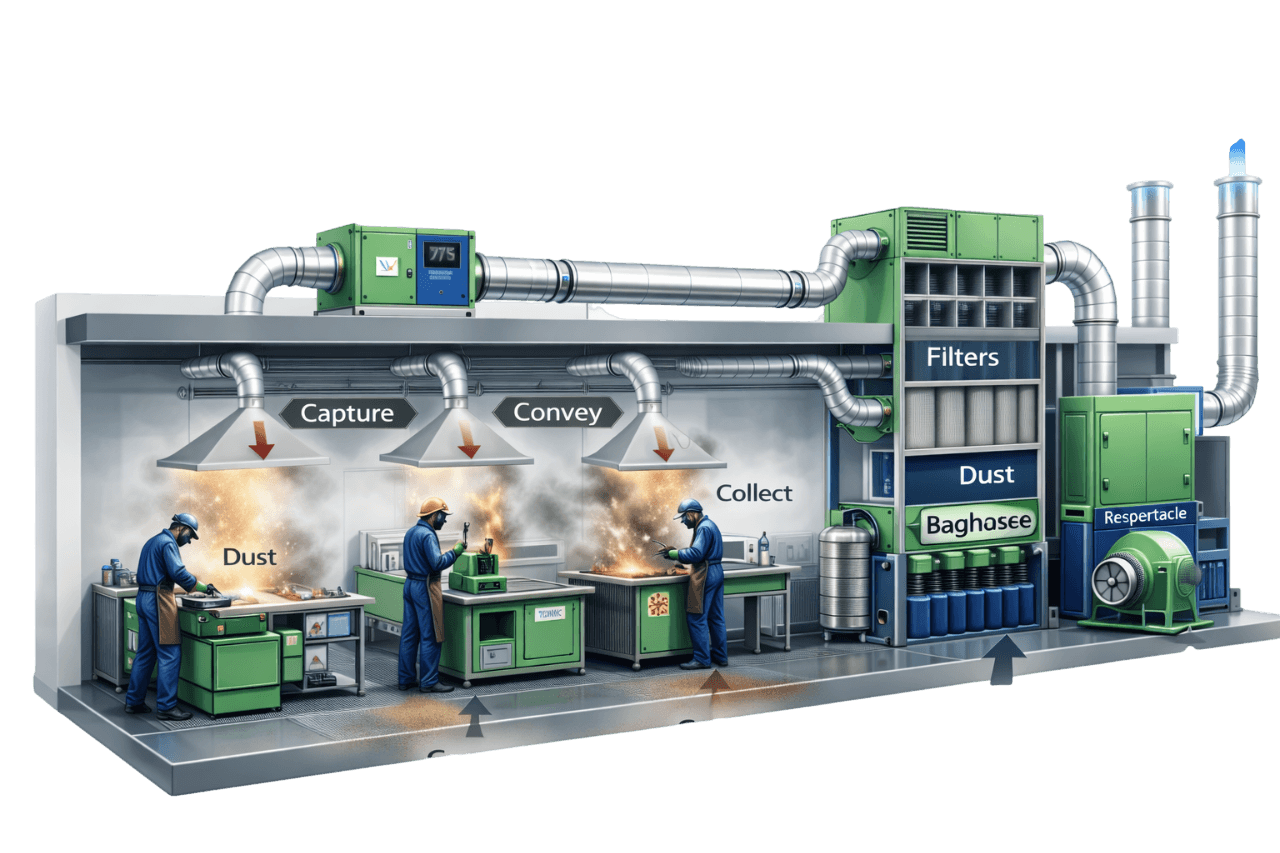
Dust Collection Systems
Learn More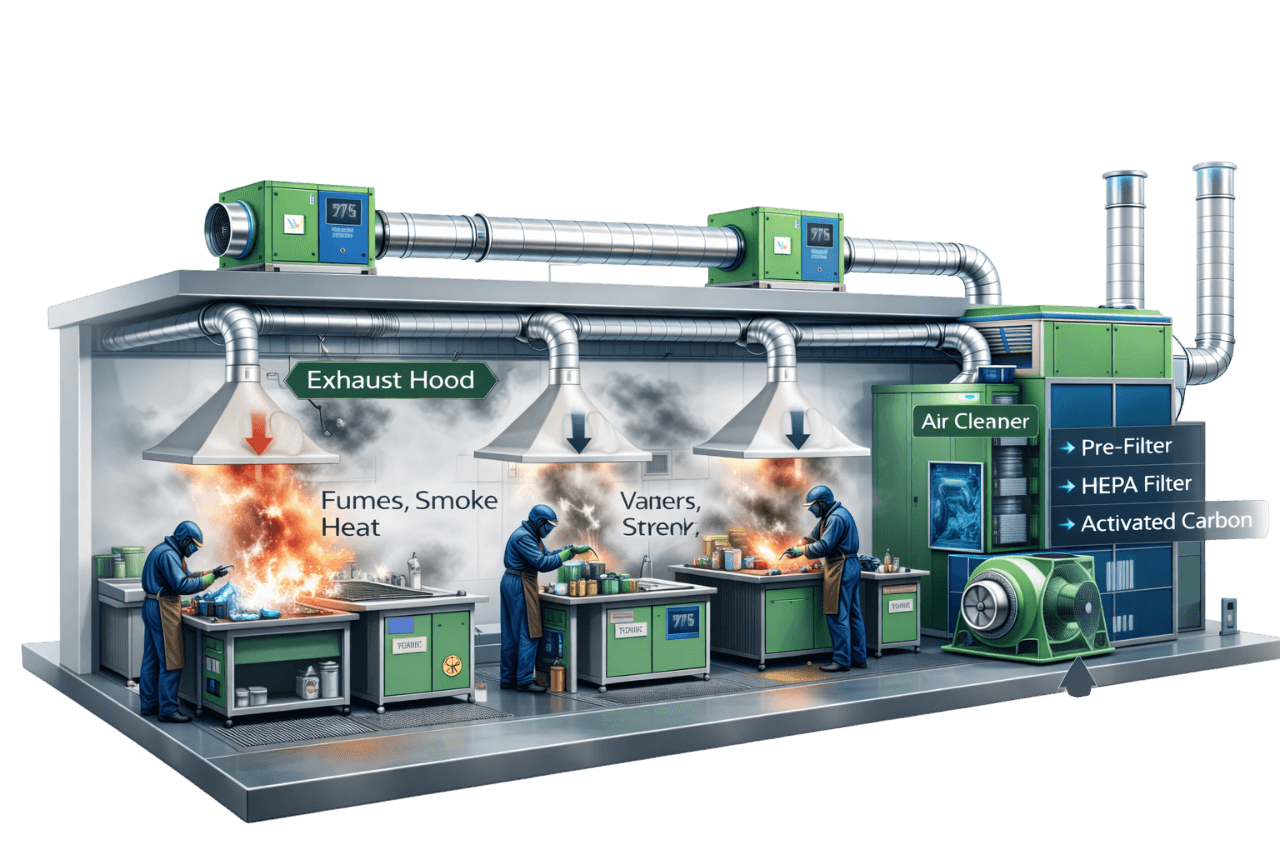
Fume Extraction Systems
Learn More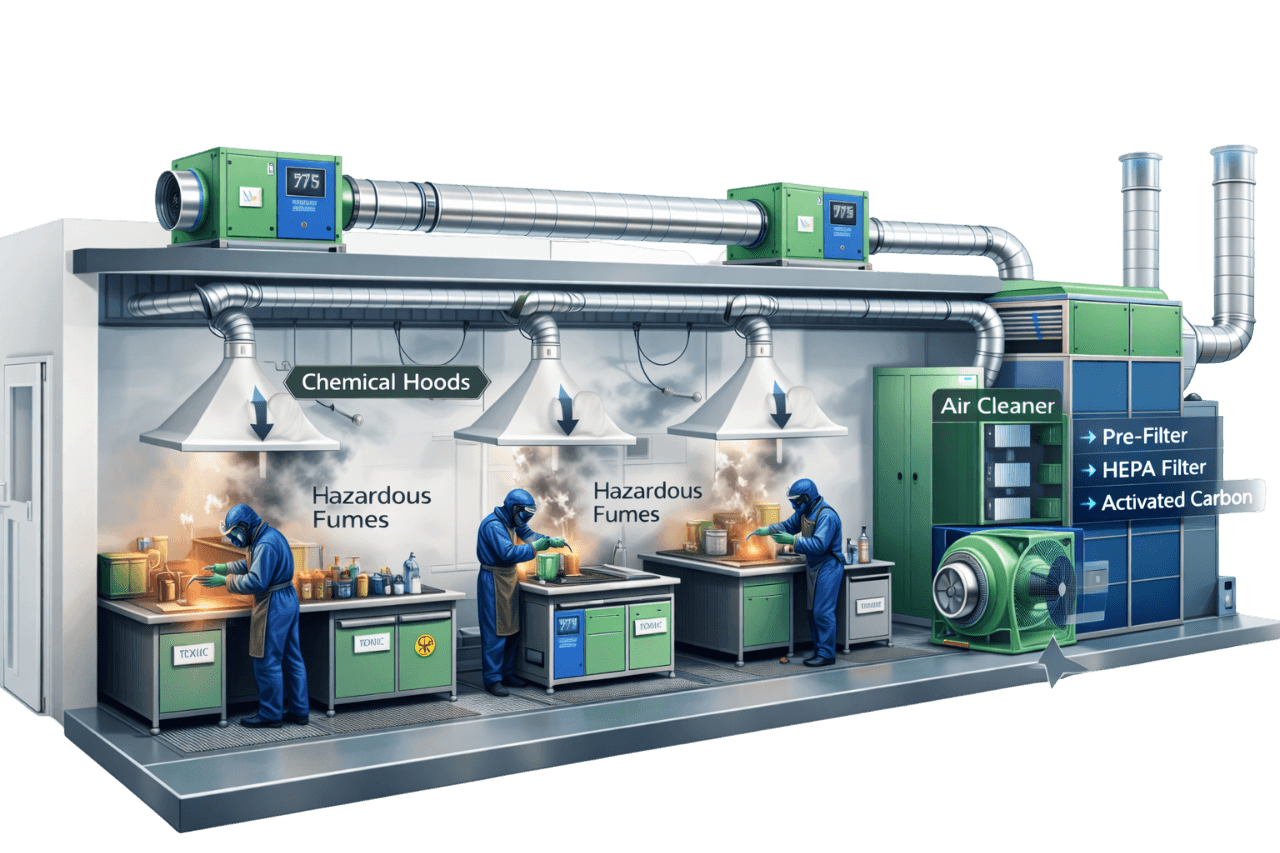
Chemical Exhaust Systems
Learn More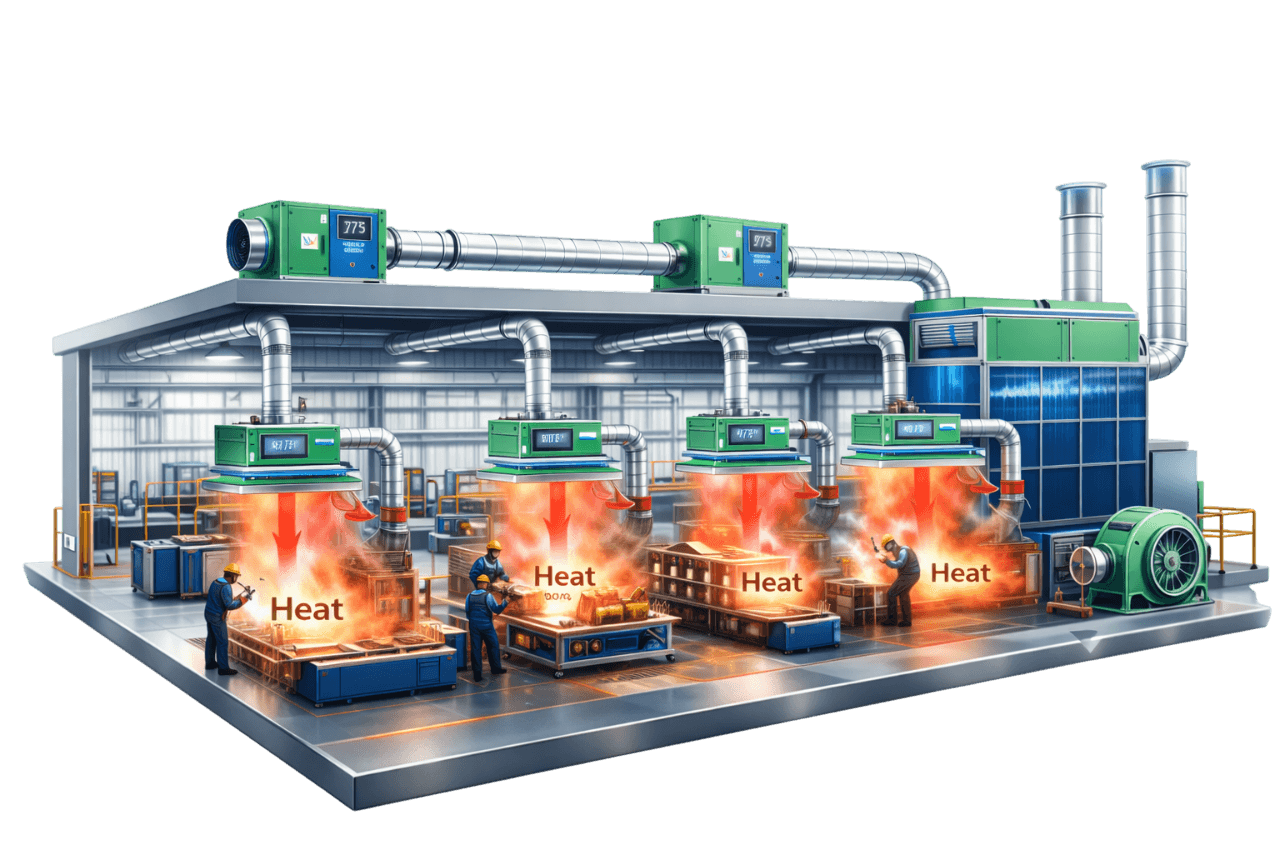
Heat Exhaust Ventilation Systems
Learn More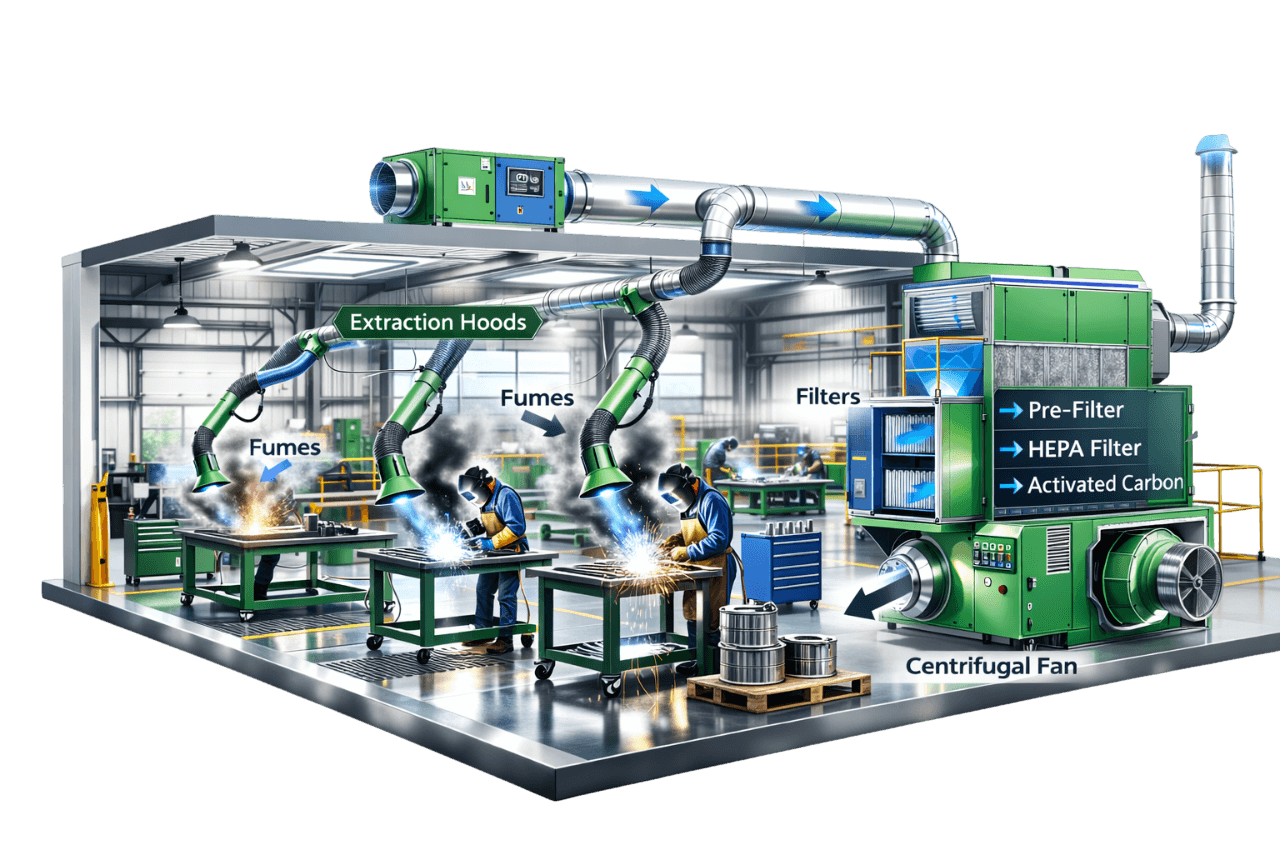
Welding Fume Extraction Systems
Learn More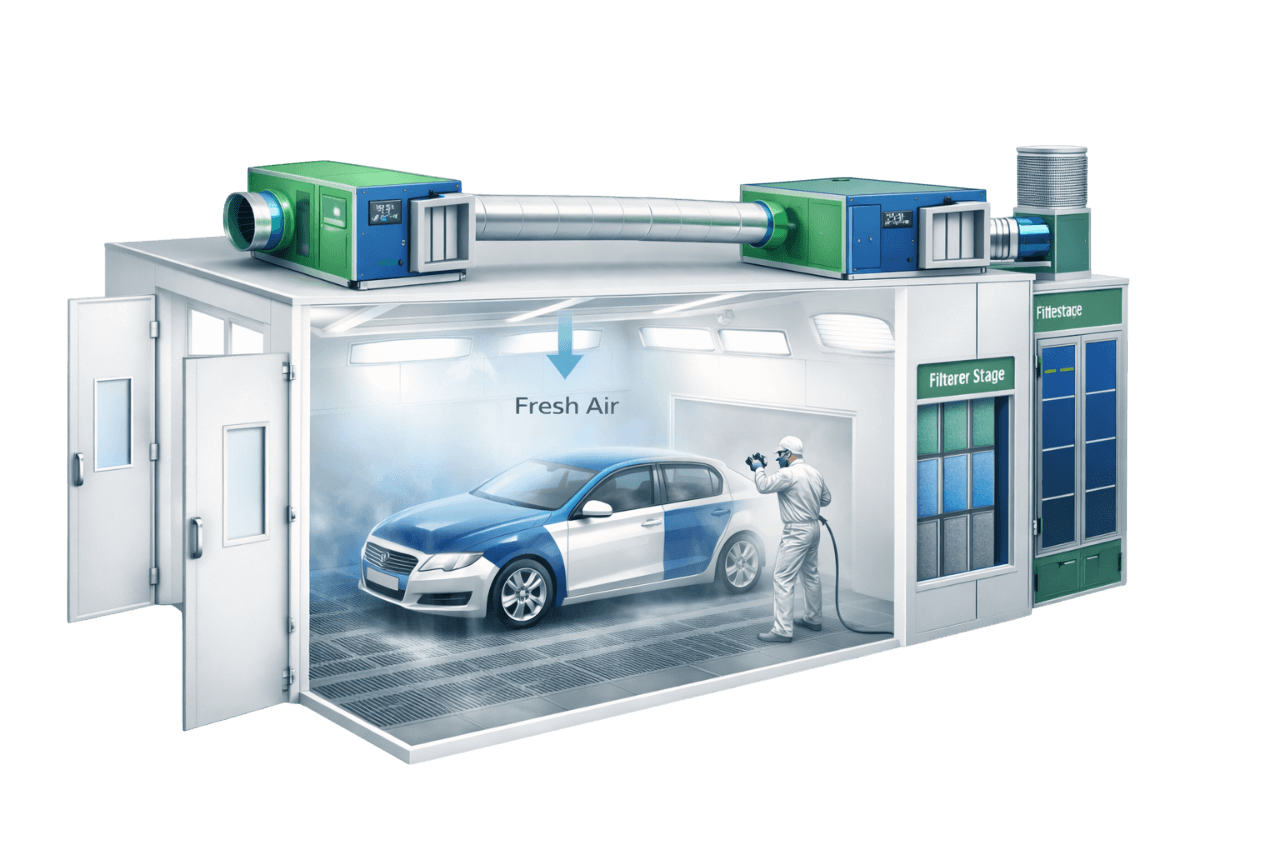
Paint Booth Ventilation Systems
Learn More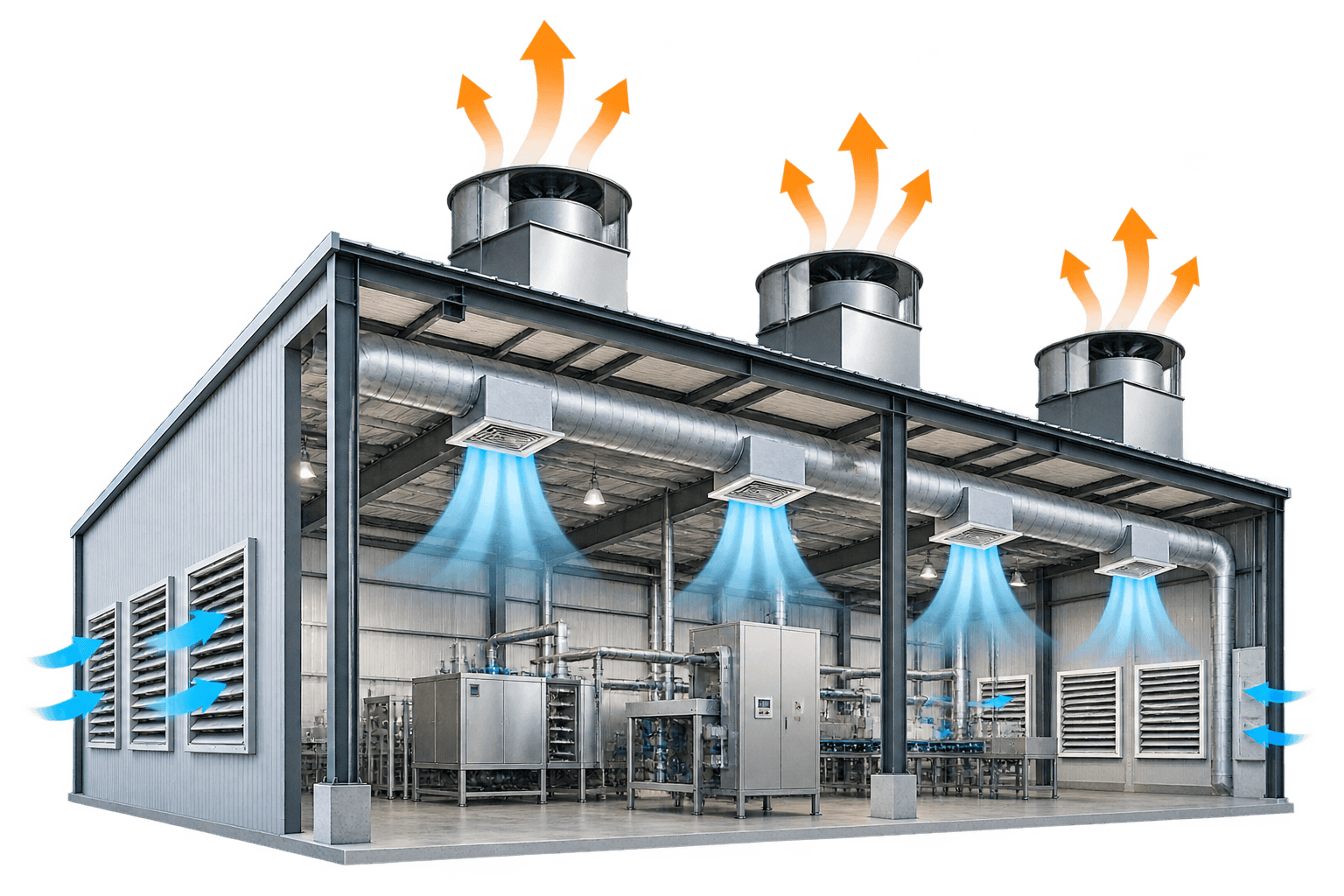
Industrial Dilution Ventilation Systems
Learn MoreFrequently Asked Questions
Q1. What is a general dilution ventilation system?
A general dilution ventilation system supplies clean outdoor air to an entire space and exhausts contaminated air, so gases, vapours, heat, moisture and odours are diluted to safe and comfortable levels. It treats the whole room rather than capturing contaminants at the source.
Q2. How does dilution ventilation work?
Fresh air enters through supply fans or louvres, mixes with the room air, and lowers contaminant concentrations. The diluted air is then removed by exhaust fans or roof extractors, and continuous air changes keep concentrations at safe levels.
Q3. What is the difference between dilution ventilation and local exhaust ventilation (LEV)?
Dilution ventilation reduces contaminant concentration throughout a space by mixing in clean air. LEV captures contaminants at the point of release using hoods, arms or enclosures. Dilution suits low-toxicity, dispersed sources and heat; LEV is needed for toxic, dusty or concentrated sources close to workers.
Q4. When should dilution ventilation be used?
Use it when contaminants have low toxicity, emission rates are low and steady, sources are spread across the space, workers are not right next to the source, or the main goal is controlling heat, odour or humidity.
Q5. When is dilution ventilation not suitable?
It is not suitable for highly toxic contaminants, large point sources of dust or fumes, or situations where workers operate directly over the emission point. In those cases, local exhaust ventilation is the safer and more economical option.
Q6. How is dilution airflow calculated?
The basic steady-state formula is Q = (G × K) ÷ C, where Q is airflow, G is the contaminant generation rate, K is the mixing factor, and C is the target concentration. For heat, airflow is calculated from the heat load and allowable temperature rise. For flammable vapours, a separate LEL-based calculation applies, and the highest result governs.
Q7. What is the mixing factor (K) in dilution ventilation?
The mixing factor accounts for incomplete mixing of supply air with room air. K = 1 represents perfect mixing; practical values are typically around 1.5–3 for well-designed systems and higher where mixing is poor. Better air distribution means a lower K and a smaller, cheaper system.
Q8. How many air changes per hour are needed for dilution ventilation?
It depends on the application. Typical starting ranges are 3–6 ACH for warehouses, 6–10 ACH for general factories, 10–15 ACH for toilets and 15–30 ACH or more for hot process areas. The final rate should always come from a contaminant or heat load calculation.
Q9. Can dilution ventilation reduce heat in factories?
Yes. Heat relief ventilation replaces hot indoor air with outdoor air and can bring indoor temperatures close to outdoor levels. Adding evaporative pre-cooling to make-up air and directing air to worker zones improves comfort further.
Q10. How can the energy cost of dilution ventilation be reduced?
Use VFDs, sensor-based demand control, efficient EC fans, good air distribution to lower the mixing factor, heat recovery where contaminants allow, and natural or hybrid ventilation for base loads. Adding LEV at major sources also reduces the general airflow needed.
Q11. What is the cost of a dilution ventilation system in India?
Indicative budgets range from about ₹30,000 for small plant room or toilet exhaust to ₹5–30 lakh for factory or warehouse heat relief, and more for ducted, balanced systems with conditioned make-up air and BMS. The exact cost depends on airflow, hazard level, ductwork and controls, and is confirmed after a site survey.
Q12. Does Compress India design and install dilution ventilation systems in Mumbai?
Yes. Compress India designs, supplies, installs, commissions and maintains dilution ventilation systems across Mumbai, Navi Mumbai and Thane. Contact our HVAC team to book a site survey and receive a detailed quotation.