Welding Fume Extraction Systems
(Design, Supply, Installation, Testing, Commissioning & AMC for Welding Fume Control)
Design, Supply, Installation, Testing, Commissioning & AMC for Welding Fume Control
Every arc you strike sends a plume of metal fume and gas straight toward the welder's face. Compress India designs and installs welding fume extraction systems that capture that plume at the arc, filter it safely and keep your welding bays clear, compliant and productive.
Whether you run a two-welder maintenance shop or a 50-station fabrication line, we engineer the right mix of portable welding fume extractors, extraction arms, on-torch extraction and centralised filtration for your processes, materials and layout. Share your welding details for a free site survey and a detailed quotation.
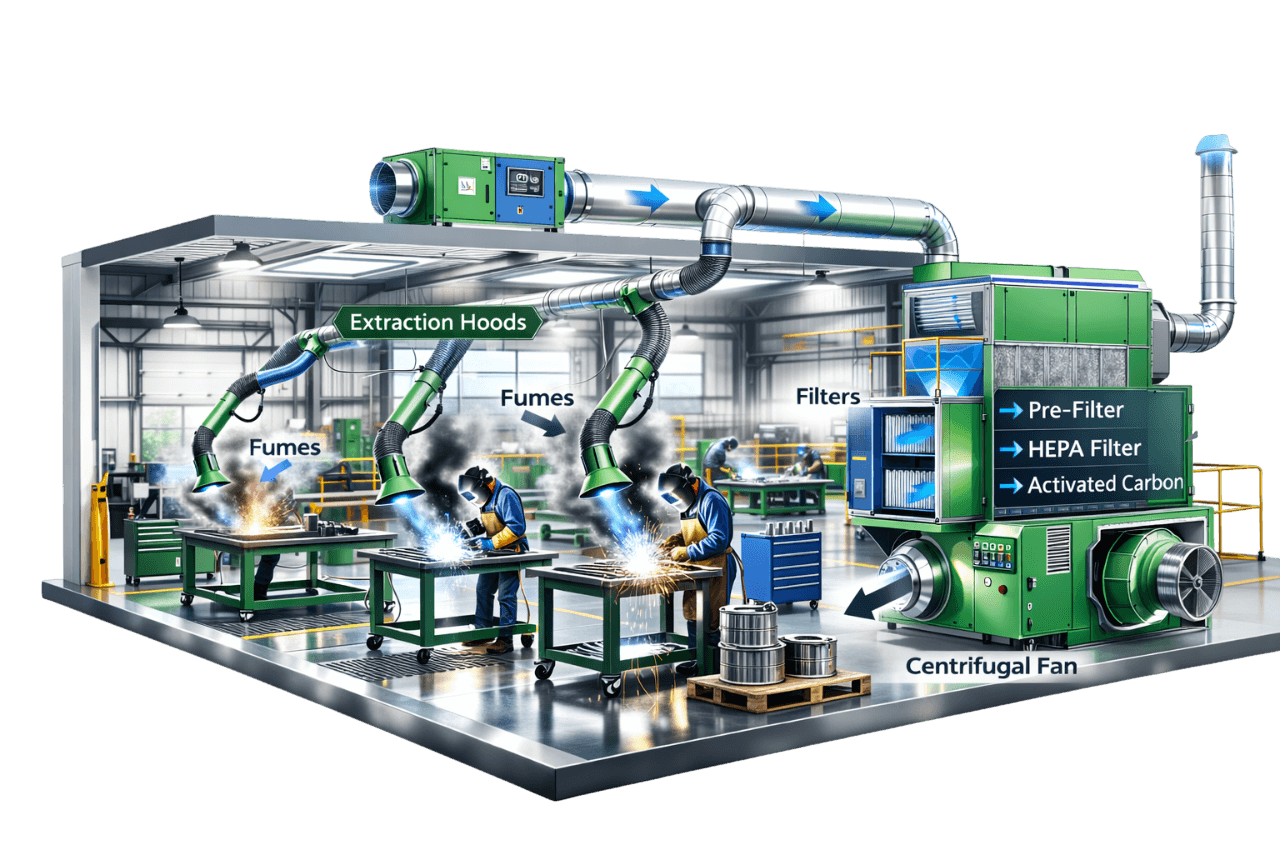
Compress India is a complete welding fume control partner for workshops and plants in Mumbai, Navi Mumbai, Thane and across India. One team takes responsibility from the first survey to years of reliable operation.
- Design: Welding process and material review, welder count and duty cycle analysis, capture method selection, airflow and duct sizing.
- Supply: Portable and mobile fume extraction units, wall-mounted extractors, flexible extraction arms, on-torch systems, welding tables, booths, cartridge collectors and fans.
- Installation: Arm mounting, ductwork fabrication, filter unit and fan erection, arc sensors and electrical work by our own site teams.
- Testing & Commissioning: Airflow and capture velocity measurement, smoke tests and optional welder breathing zone monitoring, with a documented report.
- AMC: Filter replacement, pulse system checks, spark arrestor cleaning, arm maintenance and breakdown support.
From a single portable welding fume extractor with HEPA filter to a centralized welding fume extraction system for a fabrication workshop, we deliver welding fume control that works on the shop floor, not just on paper.
What Is a Welding Fume Extraction System?
A welding fume extraction system is a local exhaust ventilation (LEV) system designed specifically for welding and cutting. It captures fume and smoke at the arc using an extraction arm, on-torch nozzle, table, hood or booth, then draws it through ductwork to a filter unit that removes the metal particles before the air is returned or exhausted.
Because welding fume particles are extremely fine and hot sparks travel with them, a welding extraction system needs features that general ventilation does not: high-efficiency cartridge or HEPA filtration, spark protection, and capture devices that the welder can position within a few hundred millimetres of the arc.
A complete welding fume extraction system typically includes:
- Capture devices: flexible extraction arms, on-torch guns, downdraft tables, hoods or booths
- Welding fume extraction ductwork with dampers
- A spark arrestor or pre-separator
- A welding fume collector with cartridge, HEPA or carbon filters
- A welding fume extraction fan
- Controls such as arc-sensing auto start/stop and filter pressure monitoring
It is also called a welding fume collection system, welding fume filtration system, welding smoke extraction system, welding exhaust system or welding LEV system.
What Are Welding Fumes?
Welding fume forms when the intense heat of the arc vaporises metal from the base material, filler wire, electrode and coatings. The vapour cools almost instantly in the surrounding air and condenses into extremely fine solid particles, mixed with gases produced by the arc.
Metal Oxide Particles
The solid part of welding fume consists mainly of metal oxides, such as iron oxide, manganese oxide, chromium and nickel compounds, zinc oxide or aluminium oxide, depending on what is being welded. Fluorides and silicates from flux and electrode coatings are also common. This is the visible smoke that rises from the weld.
Welding Gases (Ozone, NOx & CO)
The arc's ultraviolet radiation and heat create ozone and nitrogen oxides from the surrounding air, while CO2-shielded processes can produce carbon monoxide. These gases are invisible, and standard particle filters do not remove them. That is why capture at source and adequate general ventilation both matter.
Why Welding Fume Particles Are So Harmful
Most welding fume particles are smaller than one micron, and many are ultrafine particles below 0.1 micron. At this size they bypass the body's natural defences in the nose and throat and penetrate deep into the lungs. Some can even pass into the bloodstream, carrying toxic metals to other organs.
Welding Fume Composition by Base Metal
The hazard of welding fume depends largely on the metals being joined. Compress India designs every welding fume extraction system around the materials you actually weld.
Mild Steel Welding Fumes
Mild steel fume is mostly iron oxide, with manganese from the wire or electrode and silicon compounds. Although often considered the least hazardous, mild steel fume is still classified as carcinogenic, and manganese content makes source capture essential.
Stainless Steel Fumes (Hexavalent Chromium & Nickel)
Stainless steel welding releases chromium and nickel compounds, including hexavalent chromium, a potent human carcinogen. Stick welding of stainless steel tends to produce more hexavalent chromium than MIG or TIG. Stainless steel welding fume extraction calls for high-efficiency filtration and, in most cases, exhaust outdoors rather than recirculation.
Galvanised Steel Fumes (Zinc Oxide)
Welding or cutting galvanised steel vaporises the zinc coating, producing dense white zinc oxide fume. Inhaling it is the most common cause of metal fume fever among welders.
Aluminium Welding Fumes
Aluminium welding produces aluminium oxide fume and, because aluminium reflects so much ultraviolet light, notably higher ozone levels than steel. Effective extraction and good general ventilation are both needed.
Coated & Painted Metal Fumes
Paints, primers, oils, plating and degreaser residues on the workpiece decompose in the arc, releasing a range of irritant and toxic compounds. Chlorinated solvent residues can even form phosgene under arc radiation. Cleaning the joint before welding and capturing fume at the source are essential.
Fume Generation by Welding Process
Different welding processes produce very different amounts of fume. Matching the extraction method to the process is key to effective and economical welding fume control.
MIG / MAG Welding
MIG/MAG welding is the most widely used process in Indian fabrication and produces moderate to high fume volumes, especially at high currents. MIG welding fume extraction works well with both extraction arms and on-torch extraction, which is particularly effective for long continuous welds.
Flux-Cored Arc Welding
Flux-cored arc welding (FCAW) generates some of the highest fume rates of any welding process because the flux inside the wire adds to the plume. FCAW fume extraction needs strong source capture, often combined with on-torch extraction or high-capacity arms.
Stick (MMA) Welding
Stick welding produces substantial fume from the electrode coating, and it is often used in site, repair and structural work where fixed extraction is harder to arrange. Stick welding fume extraction typically relies on portable welding fume extractors with flexible arms.
TIG Welding
TIG welding produces relatively little fume, but ozone levels can be significant, particularly on aluminium and stainless steel. Because TIG welders work very close to the weld, small hoods or compact arms positioned carefully provide effective TIG welding fume extraction without disturbing the shielding gas.
Submerged Arc Welding
In submerged arc welding, the arc is covered by a layer of granular flux, so visible fume is low. However, flux handling and recovery can release dust, and some fume still escapes, so local extraction near the head and flux system is recommended.
Plasma & Laser Cutting
Plasma cutting generates large volumes of metal fume and nitrogen oxides, while laser cutting and welding produce very fine particles. Plasma cutting fume extraction usually uses zoned downdraft cutting tables connected to self-cleaning filter units. Laser welding fume extraction uses enclosed cells with dedicated extraction.
Robotic Welding
Robotic cells weld continuously and at high duty cycles, generating steady, high fume volumes. Robotic welding fume extraction uses hooded enclosures or overhead canopy hoods connected to high-capacity collectors.
Brazing & Soldering
Brazing produces metal fume and flux fumes, sometimes including fluorides and, with older alloys, cadmium. Soldering releases rosin flux smoke, a respiratory sensitiser. Benchtop soldering fume extractors, solder station fume extractors and small arms capture these at the workstation.
Health Risks of Welding Fumes
Welding fume exposure is one of the most significant occupational health risks in metalworking. The effects range from short-term illness to permanent disease, which is why welding fume extraction is a necessity rather than a luxury.
Metal Fume Fever
Inhaling zinc oxide from galvanised steel, or fumes from copper and some other metals, can cause metal fume fever. It brings flu-like symptoms such as fever, chills, aching muscles, nausea and a metallic taste, usually a few hours after exposure. Frequent episodes are a clear signal that extraction at the workstation is inadequate.
Manganese Exposure
Manganese is present in most steel welding wires and electrodes. Long-term overexposure can damage the nervous system, causing symptoms similar to Parkinson's disease, including tremors, slowed movement and mood changes. Manganese welding fume extraction at source is the most effective protection.
Lung Cancer Risk (IARC Group 1 Classification)
The International Agency for Research on Cancer classifies welding fume as carcinogenic to humans (Group 1), based on evidence of increased lung cancer risk. The classification applies to all welding fume, including mild steel, and the risk is higher still where hexavalent chromium and nickel are present from stainless steel welding.
Chronic Respiratory Diseases
Regular exposure to welding fume and gases is linked to bronchitis, asthma-like symptoms, reduced lung function, siderosis from iron oxide deposits and a greater susceptibility to lung infections such as pneumonia.
How a Welding Fume Extraction System Works
A welding fume extractor works on a simple principle: capture the plume before it rises into the welder's face, clean the air and discharge it safely.
1. Fumes Captured at the Arc
An extraction arm hood, on-torch nozzle, downdraft table or booth creates an airflow at the arc strong enough to overcome the rising thermal plume. This is known as the welding fume capture velocity, and it must be achieved at the point where fume is generated.
2. Spark Arrestor Stops Hot Particles
The fume-laden air passes through a spark arrestor or pre-separator that slows, cools and traps glowing particles and spatter, protecting the filters from ignition.
3. Pre-Filter & Main Filter Trap Fume Particles
A pre-filter captures larger particles, and the main filter, typically a pleated cartridge or HEPA filter, traps fine welding fume particles at high efficiency. In self-cleaning units, pulses of compressed air periodically clean the cartridges.
4. Carbon Filter Removes Gases (Optional)
Where odours or certain gases need to be reduced, an activated carbon stage can be added after the particle filter. Carbon has limited capacity for welding gases such as ozone, NOx and CO, so general ventilation remains important.
5. Clean Air Returned or Exhausted Outdoors
The cleaned air is either returned to the workshop, saving heating or cooling energy, or exhausted outdoors. Recirculation is used only where the fume type and filter efficiency make it safe; stainless steel and other high-hazard fumes are usually exhausted outside.
Main Components of a Welding Fume Extraction System
Every component in a welding fume extraction system affects how well it captures fume, how safe it is and how much it costs to run. Compress India specifies each part to suit your welding operations.
Flexible & Telescopic Extraction Arms
A welding fume extraction arm is a self-supporting, articulated arm with a capture hood that welders position close to the arc. Flexible extraction arms come in various reaches, while telescopic arms and boom extensions cover larger work areas. Good arms move easily and stay exactly where they are placed.
On-Torch Fume Extraction Guns
On-torch fume extraction guns have suction nozzles built into the MIG/MAG torch, so capture moves with the arc. Welding torch fume extraction removes fume right at the source, with no hood to reposition, and connects to a high vacuum welding fume extraction unit.
Welding Tables (Downdraft & Backdraft)
A welding downdraft table draws fume down through a perforated worktop, while a backdraft table or welding fume extraction bench pulls it horizontally into a rear hood. They suit small parts, grinding and repetitive bench welding.
Welding Booths & Curtains
A welding fume extraction booth or enclosure contains fume, sparks and arc light within a defined space, with extraction at the back or top. Welding curtains and screens protect nearby workers from arc flash and help control drafts that disturb capture.
Ductwork & Dampers
Welding fume extraction ductwork connects arms, tables and booths to the central filter unit. Ducts are sized to maintain the correct welding fume duct velocity, with balancing dampers and automatic welding fume dampers that open only at active stations.
Spark Arrestors & Pre-Separators
Spark arrestors and pre-separators stop hot particles and spatter from reaching the filters, which is the single most important fire safety measure in any welding extraction unit.
Self-Cleaning Cartridge Filters
A cartridge welding fume collector uses pleated cartridges cleaned automatically by compressed air pulses. This pulse jet welding fume collector design keeps pressure drop stable and extends filter life, making it the standard choice for centralised systems.
HEPA & Activated Carbon Filters
A HEPA welding fume extractor adds a final high-efficiency stage for very fine or hazardous particles, such as stainless steel fume. Activated carbon filters can be added to reduce odours from coated or oily materials.
Fans & Automatic Start/Stop Controls
The welding fume extraction fan provides the airflow and static pressure the system needs. Arc-sensing controls start and stop the fan or open dampers automatically when welding begins, saving energy and ensuring extraction is always on when needed.
Types of Welding Fume Extraction Systems
The best welding fume extractor for your workshop depends on how many welders you have, how often they move and what they weld. Compress India supplies and installs every major type.
Portable & Mobile Welding Fume Extractors
A portable welding fume extractor, or mobile welding fume extraction unit, combines a fan, filter and extraction arm on wheels. It can follow the work around the shop or to site, making it ideal for maintenance teams, small workshops and occasional welding. Small portable fume extractors suit light-duty work, while industrial models with self-cleaning filters handle heavier use.
Wall-Mounted Welding Fume Extractors
A wall mounted welding fume extractor serves a fixed welding bay with one or two arms and a compact filter unit. It keeps the floor clear, avoids trailing hoses and is a cost-effective welding bay extraction system for repetitive work.
Centralised Multi-Station Systems
A centralized welding fume extraction system connects many arms, tables and booths to one large filter unit and fan through ductwork. This central welding fume extraction system offers the lowest running cost per station, a cleaner shop floor and simplified maintenance for larger fabrication workshops.
On-Torch High Vacuum Systems
An on torch welding fume extraction system uses low airflow at high suction to capture fume directly at the MIG torch nozzle. It is highly effective for long welds, large structures and confined spaces where positioning an arm is difficult.
Welding Table Extraction
Downdraft and backdraft welding tables provide built-in extraction for bench welding, grinding and small component work. They can be standalone with their own filter unit or connected to a central system.
Welding Booth Extraction
Welding booths with rear or overhead extraction give excellent capture for repetitive jobs, training bays and small component welding. Enclosure reduces the airflow needed and contains sparks and arc glare.
Robotic Welding Cell Extraction
Robotic welding fume extraction uses enclosed cells or canopy hoods over the robot to capture continuous fume from high duty cycle welding. Systems are sized for sustained operation, often with dedicated collectors.
Ambient Welding Fume Filtration for Large Halls
In large fabrication halls, some fume always escapes local capture and rises to the roof. Ambient welding fume extraction uses ceiling-mounted filter units or push-pull systems to clean the general hall air, complementing source capture rather than replacing it.
On-Torch Extraction vs Extraction Arms
On-torch extraction captures fume right at the nozzle with no repositioning, while extraction arms are more versatile across processes. Many plants use both.
| Factor | On-Torch Extraction | Extraction Arms |
|---|---|---|
| Capture point | At the torch nozzle, moves with the arc | Hood positioned by the welder near the arc |
| Airflow needed | Very low, at high vacuum | Much higher, at low vacuum |
| Repositioning | Not required | Required as the weld progresses |
| Suitable processes | MIG/MAG and flux-cored | MIG, TIG, stick, grinding, cutting |
| Welder comfort | Torch slightly heavier and bulkier | Standard torch; arm must be moved |
| Best for | Long welds, large structures, confined spaces | General fabrication, varied jobs, bench work |
Portable vs Centralised Welding Fume Extraction
Portable units suit a few welders who move around; centralised systems suit fixed welding bays and growing production.
| Factor | Portable / Mobile Extractor | Centralised System |
|---|---|---|
| Number of welders | 1 to 3 | 4 or more fixed stations |
| Upfront cost | Low per unit | Higher initial investment |
| Cost per station | Rises quickly with more units | Falls as more stations are added |
| Maintenance | Many individual filters | One central, self-cleaning filter unit |
| Floor space & noise | Units at each workstation | Unit located away from the work area |
| Flexibility | Moves anywhere, including site | Fixed stations |
Source Capture vs Ambient Filtration
Source capture welding fume extraction removes fume at the arc, before it reaches the welder, and should always come first. Ambient filtration cleans the general hall air and catches what escapes.
| Factor | Source Capture | Ambient Filtration |
|---|---|---|
| Protects welder's breathing zone | Directly | Only indirectly |
| Airflow needed | Low, focused | Very high, whole-hall volume |
| Best use | Primary control at every welding station | Supplement in large halls with many welders |
This is also the key point in welding fume extraction vs general ventilation: roof fans and open doors dilute fume across the building, but cannot stop the plume rising through the welder's breathing zone.
Recirculation vs Exhaust Outdoors for Welding Fumes
Recirculating filtered air saves energy, but it is only appropriate where the fume and filtration make it safe.
| Factor | Recirculation | Exhaust Outdoors |
|---|---|---|
| Energy cost | Lower; conditioned air stays inside | Higher; make-up air required |
| Suitable for | Mild steel and aluminium fume with high-efficiency, monitored filtration | Stainless steel, high-alloy and coated metal fumes |
| Welding gases | Not removed by particle filters | Removed from the building |
| Typical choice | Many mild steel workshops | Stainless steel fabrication and high-hazard work |
Compress India evaluates your materials and processes before recommending recirculation, and specifies outdoor exhaust wherever hexavalent chromium, nickel or significant gases are present.
Welding Fume Standards & Regulations
A compliant welding fume extraction system is designed with recognised equipment standards and Indian safety law in mind. Compress India applies these references throughout design and commissioning.
ISO 21904 Welding Fume Extraction Standards
ISO 21904 sets requirements for equipment used to capture and separate welding fume. Its parts cover general requirements, testing and marking of separation efficiency, capture efficiency of on-torch extraction devices and the minimum airflow for capture devices. Choosing equipment tested to these standards gives confidence that performance claims are genuine.
IS 818 Safety Code for Welding & Cutting
IS 818 is the Indian Standard code of practice for safety and health requirements in electric and gas welding and cutting operations. It includes guidance on ventilation and fume control, making it a key reference for welding shops in India.
Factories Act & State Factory Rules (India)
The Factories Act, 1948 required employers to remove dust and fumes at source and keep workplace air safe. These obligations continue under the Occupational Safety, Health and Working Conditions Code, 2020, operative since 21 November 2025, with State Factory Rules such as the Maharashtra Factories Rules continuing to guide practical compliance.
ACGIH Exposure Limits for Manganese & Chromium
ACGIH Threshold Limit Values are widely used to judge welding fume exposure. The TLV for manganese is 0.02 mg/m³ as respirable particulate, and the TLV for hexavalent chromium is 0.0002 mg/m³ as inhalable particulate, both as eight-hour averages. Limits this low are practically impossible to meet without effective source capture.
Welding Fume Extraction Design & Sizing
The most expensive welding fume extractor is the one that does not capture fume. Compress India's welding fume extraction system design is built on your real processes, materials and working patterns.
Welding Process & Material Assessment
We record which processes you use (MIG, TIG, stick, flux-cored, cutting, grinding), the base metals and consumables, and typical currents and job sizes. This tells us how much fume is produced, how hazardous it is and which filtration and discharge options are appropriate.
Number of Welders & Duty Cycle
The number of welding stations, how many are used at once and the arc-on time per shift determine the total airflow and filter load. A realistic usage factor prevents oversizing, while automatic dampers let a central system serve only active stations.
Choosing the Right Capture Method
We match the capture method to how welders actually work: extraction arms for varied fabrication, on-torch extraction for long MIG and flux-cored welds, tables for bench work and grinding, booths for repetitive jobs and enclosures for robots. Mixed shops often use a combination.
Airflow per Arm, Torch & Table
Welding fume extraction airflow is set by the capture method. A standard extraction arm typically needs around 800 to 1,200 m³/h to achieve an effective capture velocity of about 0.5 to 1.0 m/s at the working distance. On-torch systems need only a small fraction of that airflow, but at much higher suction, while downdraft tables are sized by worktop area. We convert these into total welding fume extraction CFM for the system.
Arm Reach & Positioning
Arm length, mounting height and slewing range are chosen so each welder can place the hood within the effective capture zone, typically within a few hundred millimetres of the arc, across the full work area. Booms and rails extend coverage for large workpieces.
Filter Selection by Fume Type
Mild steel fume is handled well by self-cleaning cartridge filters, while stainless steel and high-alloy work calls for higher-efficiency media, HEPA stages and outdoor exhaust. Oily or coated materials may need pre-coating or carbon stages. Filter area is sized to keep pressure drop and cleaning frequency under control.
Duct Design & Transport Velocity
Welding fume duct velocity is typically kept around 10 to 15 m/s to prevent particles settling in the ducts. Each branch is sized for its airflow, with long-radius bends, angled branch entries and balancing dampers so every station receives its design airflow.
Fan Selection & Static Pressure
The welding fume extraction fan is selected for the total airflow and the welding fume extraction static pressure across arms, ducts, spark arrestor, filters and discharge. We allow for filter loading so suction stays strong as filters age. On-torch systems use dedicated high-vacuum fans or blowers.
Make-Up Air Requirements
Where extracted air is exhausted outdoors, it must be replaced with fresh air. Correctly placed make-up air inlets prevent negative pressure, drafts across welding bays and poor capture performance.
Fire Safety in Welding Fume Extraction
Sparks and hot spatter are an unavoidable part of welding, and filter fires are one of the biggest risks in any welding dust collection system. Compress India builds fire safety into every design.
Spark Arrestors & Pre-Separators
Spark arrestors and pre-separators use baffles, mesh or centrifugal action to slow and cool hot particles before they reach the filter. They are fitted as standard on every welding fume collector we supply.
Flame-Retardant Filter Media
Flame-retardant cartridge media reduce the chance of a spark igniting the filter. Combined with pre-coating for oily fume, they make the filter unit far more resistant to ignition.
Fire Suppression in Filter Units
For high-risk applications, filter units can be fitted with temperature sensors, fire dampers and automatic suppression systems that isolate and extinguish a fire before it spreads.
Keeping Grinding Dust & Oily Fumes Separate
Grinding produces hot sparks and combustible dust, and oily fumes can coat filters with flammable residue. Where possible, we separate welding and grinding fume extraction or add dedicated pre-separation and pre-coating to prevent a dangerous mix in one filter.
Energy Efficiency & Controls
An energy efficient welding fume extraction system runs only when welding is happening and only at the airflow it needs.
Automatic Start/Stop with Arc Sensing
Arc sensors on the welding cable detect when welding starts and automatically switch on the extractor or open the station damper, then stop after a short delay. Welders never forget to turn extraction on, and fans do not run idle.
VFD Fans & On-Demand Dampers
In central systems, a welding fume extraction VFD adjusts fan speed to match the number of active stations, while automatic welding fume dampers open only where welding is in progress. Together, they can dramatically reduce fan energy.
Filter Differential Pressure Monitoring
A welding fume collector differential pressure gauge shows filter loading, triggers pulse cleaning only when needed and warns before filters restrict airflow. A welding fume airflow monitor can also alert the team if suction at the arms drops.
Energy Savings from Safe Recirculation
Where mild steel fume is filtered to a high efficiency and monitored, returning the cleaned air to the workshop avoids exhausting heated or cooled air, saving energy. We only recommend this where it is safe for the materials welded.
Benefits of Welding Fume Extraction Systems
A properly engineered welding fume extraction system pays back through healthier welders, better welds and smoother operations.
Protects Welders' Health
Capturing fume at the arc dramatically reduces exposure to carcinogenic fume, manganese, hexavalent chromium and irritant gases, protecting your most skilled people.
Better Visibility & Weld Quality
With the smoke cleared from the weld zone, welders see the pool clearly, leading to more consistent welds, fewer defects and less rework.
Cleaner Workshop & Equipment
Less fume settles on machines, cranes, lights, panels and finished products, reducing cleaning time and electrical problems.
Compliance with Safety Norms
A well-designed, documented system supports compliance with occupational safety law and customer or export audit requirements.
Higher Productivity & Fewer Sick Days
Welders who are not breathing smoke work more comfortably, take fewer breaks and lose fewer days to fume-related illness.
Limitations of Welding Fume Extraction Systems
Every welding fume control method has trade-offs. Knowing them helps you choose the right system and use it well.
Extraction Arms Need Frequent Repositioning
Arms only capture effectively when kept close to the arc, so welders must move them as the weld progresses. Training, lightweight arms and on-torch extraction reduce this dependence.
On-Torch Guns Are Heavier
On-torch guns are slightly heavier and bulkier than standard torches, which some welders notice over a long shift. Modern designs and correct hose management minimise the difference.
Filter Replacement Costs
Cartridges, HEPA and carbon filters are consumables. Self-cleaning systems, pre-separators and correctly sized filter areas extend their life, and an AMC makes costs predictable.
Recirculation Limits for Stainless Steel Fumes
Because of hexavalent chromium and nickel, stainless steel fume is usually exhausted outdoors rather than recirculated, which increases make-up air requirements.
Fan Noise
Fans and high-vacuum units can be noisy near welding bays. Locating central units outside, using silencers and running fans at lower VFD speeds keeps noise at comfortable levels.
Where Welding Fume Extraction Systems Are Used
Compress India designs welding fume extraction systems for workshops and plants across a wide range of industries.
Fabrication & Structural Steel Shops
Metal fabrication fume extraction for structural steel, sheet metal and general fabrication combines extraction arms, on-torch extraction and centralised filter units, sized for the number of welders and the size of the work.
Automotive & Auto Component Plants
Automotive welding fume extraction covers robotic welding cells, spot and MIG welding lines, brazing and repair bays, with enclosed cells, canopy hoods and high-capacity collectors.
Shipbuilding & Ship Repair Yards
Shipbuilding welding fume extraction must handle large structures, confined spaces and long welds. High vacuum on-torch systems, mobile extractors with long hoses and confined space ventilation are commonly combined.
Heavy Engineering & Pressure Vessel Units
Large weldments, long seams and heavy flux-cored and submerged arc welding call for high-capacity arms, booms, on-torch extraction and ambient filtration in tall fabrication bays.
Railway Workshops
Railway coach, wagon and locomotive workshops weld large bodies and frames, needing mobile extractors, long-reach arms and hall-level fume control.
Construction Equipment Manufacturing
Excavator, loader and crane manufacturers weld heavy structural components, often with robots and manual welders side by side, requiring a mix of cell extraction and manual station capture.
Pipeline & Oil & Gas Fabrication
Pipe spool fabrication, pressure piping and oil and gas structures involve stick, TIG and flux-cored welding. Portable welding exhaust systems and mobile extractors follow the work across yards and bays.
Welding Training Institutes & ITIs
Training bays with many learners welding at once need booth extraction and central systems that protect students and instructors throughout long practical sessions.
Stainless Steel Kitchen Equipment Manufacturing
Commercial kitchen equipment makers weld stainless steel all day, making hexavalent chromium welding fume extraction with high-efficiency filtration and outdoor exhaust a priority.
Maintenance Workshops
Plant maintenance and repair workshops weld occasionally and at different locations. Portable fume extractors for welding and small portable fume extraction systems provide flexible, cost-effective protection.
Top Welding Fume Extraction Brands in India
Indian workshops can choose from a strong range of international and domestic welding fume extraction brands. Compress India works on a multi-brand, application-first basis: we compare extractors on capture performance, filter efficiency, spares availability and running cost, then design and install the complete system around the equipment that fits your workshop best.
Nederman
Nederman is a Swedish industrial air filtration company known for extraction arms and welding fume extraction. Its range includes Nederman portable fume extractors, wall-mounted units and centralised systems for larger workshops.
Kemper
Kemper is a German specialist in welding fume extraction. Kemper fume extraction products cover mobile extractors, on-torch extraction, centralised filter systems and extraction welding tables.
Plymovent
Plymovent is a Dutch brand offering extraction arms, mobile and stationary welding fume extractors and centralised filtration. A Plymovent fume extractor is a common choice in fabrication and maintenance workshops.
Lincoln Electric
Lincoln Electric is a global welding equipment manufacturer that also offers welding fume control, including portable and mobile extractors, centralised systems and fume extraction welding guns.
ESAB
ESAB is a well-known welding and cutting brand offering fume extraction units and fume extraction torches designed to work alongside its welding and cutting equipment.
Donaldson
Donaldson is a global filtration company whose Torit brand includes cartridge dust and fume collectors widely used for welding, thermal cutting and other heavy fume loads.
Other Welding Fume Extraction Brands
Miller offers fume extraction solutions to complement its welding equipment. Indian manufacturers such as Coimbatore-based Cleantek produce portable and industrial welding fume extractors, and several other domestic makers offer cost-effective extractors, arms and collectors suited to local conditions.
*Brand names are trademarks of their respective owners and are mentioned for reference only.*
Welding Fume Extraction Installation Guide
Good welding fume extraction installation turns a well-designed system into one welders actually use. Compress India's teams plan every detail around how your workshop operates.
Welding Bay Layout Planning
We map every welding station, crane path, material flow route and work envelope before fixing arm positions. Arms, tables and booths are placed so they reach the work easily without obstructing cranes, forklifts or material handling.
Arm Mounting on Walls, Columns or Rails
Extraction arms are mounted on walls, building columns, free-standing posts or overhead rails at heights that give full reach and easy movement. Slewing brackets and booms extend coverage for large workpieces.
Ductwork & Damper Installation
Welding fume extraction ductwork is routed along the shortest practical path, clear of cranes and lighting, supported at correct spacing and sealed at every joint. Balancing dampers and automatic dampers are installed at each branch, with access doors for cleaning.
Filter Unit & Fan Placement
Central filter units and fans are placed where they are easy to service, away from welding bays for noise control and, where possible, outside the building to save floor space. Dust bins are positioned for safe, easy emptying.
Spark Arrestor Installation
Spark arrestors and pre-separators are installed ahead of the filter unit, with access for inspection and cleaning. For grinding-heavy applications, additional pre-separation is included.
Electrical Wiring & Arc Sensors
We install control panels, starters, VFDs, pressure sensors and arc sensors on welding cables, and link them to automatic dampers and fans so extraction starts and stops with welding.
Make-Up Air Provision
Where air is exhausted outdoors, we provide fresh air inlets or make-up air units positioned to avoid drafts across welding bays that could disturb capture or shielding gas.
Testing & Commissioning
Welding fume extraction commissioning proves that your system captures fume where it matters: at the arc and in the welder's breathing zone.
Airflow & Capture Velocity Measurement
We measure airflow at every arm, torch, table and booth and check capture velocity at the working distance. Dampers are balanced until every station meets its design airflow.
Smoke Visualisation Tests
Smoke tests at each station show how well fume is drawn into the hood, revealing the effect of cross-drafts and hood position. They are also an effective way to train welders on correct arm positioning.
Welder Breathing Zone Exposure Monitoring
On request, we arrange personal air sampling in the welder's breathing zone to measure actual exposure to fume, manganese or chromium, confirming that the system brings exposure within permissible limits.
Filter Pressure Drop Checks
Clean filter pressure drop is recorded at handover, and pulse cleaning settings are adjusted, giving your maintenance team a clear baseline for future filter changes.
Commissioning Reports
You receive a commissioning report with measured airflows, velocities, pressures, control settings and test results, along with as-built drawings and operation and maintenance manuals.
Welding Fume Extractor Service, Maintenance & AMC
Welding fume extraction maintenance keeps suction strong, filters efficient and fire risk low. Compress India's AMC covers every part of the system.
Cartridge Filter Replacement
We monitor filter pressure drop and replace cartridges and welding fume extractor filters before they restrict airflow, using the correct specification for your fume type.
Pulse Cleaning System Checks
Solenoid valves, diaphragms, timers and the compressed air supply are checked so pulse cleaning keeps filters clear and extends their life.
Spark Arrestor Cleaning
Spark arrestors and pre-separators are cleaned regularly to maintain airflow and remove debris that could become a fire hazard.
Arm Joint & Hose Maintenance
Friction joints, support springs or struts, hoses and hood dampers are adjusted and replaced so arms move freely and stay exactly where welders place them.
Dust Bin Emptying
Collected dust is removed safely and on schedule, with bins inspected for seal integrity and correct fitting.
Duct Leak Checks
Ducts and joints are inspected for leaks, damage and dust build-up that reduce suction at the arms, and repaired or cleaned as needed.
Fan & Motor Checks
Fans and motors are checked for vibration, bearing condition, impeller build-up and current draw to prevent unexpected breakdowns.
Common Welding Fume Extraction Problems & Solutions
If your welding bays still look hazy, one of these common issues is usually the cause. Compress India troubleshoots systems of any make.
Fumes Escaping Past the Hood
Cause: Hood too far from the arc, cross-drafts from fans or doors, or insufficient airflow. Solution: Train welders on positioning, add screens to control drafts, rebalance airflow or upgrade to on-torch extraction.
Welders Not Repositioning Arms
Cause: Stiff or heavy arms, short reach or inconvenient mounting positions. Solution: Service or replace arm joints, fit longer or lighter arms, reposition mountings or add on-torch extraction so capture moves automatically with the torch.
Low Suction at Arms
Cause: Loaded filters, leaking or blocked ducts, closed dampers or an undersized fan. Solution: Measure airflow and pressure, clean or replace filters, repair leaks, rebalance dampers and correct the fan duty.
Clogged Filters & High Pressure Drop
Cause: Undersized filter area, failed pulse cleaning, wet compressed air or oily fume. Solution: Increase filter area, repair the pulse system, dry the air supply and add pre-coating or pre-filtration.
Filter Fires from Sparks
Cause: Missing or blocked spark arrestors, or grinding sparks drawn directly into the filter. Solution: Install or clean spark arrestors and pre-separators, separate grinding extraction and add fire detection or suppression.
Arms Sagging or Drifting
Cause: Worn friction joints, weakened springs or struts, or a hood heavier than the arm is designed for. Solution: Adjust or replace joint assemblies and support components, or upgrade to a heavier-duty arm.
Visible Haze in the Workshop
Cause: Too few capture points, poor capture at existing stations or recirculated air from inadequate filters. Solution: Add capture points, improve positioning, upgrade filtration and add ambient filtration for large halls.
Excessive Noise
Cause: Fans running at full speed, unbalanced impellers or units located close to welding bays. Solution: Add VFDs, balance impellers, fit silencers and relocate central units outside the workspace.
Welding Fume Extraction Retrofit & Upgrades
An existing system can often be upgraded to improve capture, safety and efficiency without starting again from scratch.
Upgrading from Portable to Centralised Systems
As your workshop grows, we can design a central system that replaces multiple portable units, reusing arms where practical and freeing floor space.
Adding On-Torch Extraction
Adding on-torch extraction with a high vacuum unit delivers reliable capture for long MIG and flux-cored welds, working alongside existing arms.
Adding Ambient Filtration for Large Halls
Ceiling-mounted or push-pull ambient filtration clears residual haze in large fabrication halls and complements existing source capture.
Auto Start/Stop & VFD Upgrades
Retrofitting arc sensing, automatic dampers and VFDs reduces running hours, energy use and filter wear, often with a fast payback.
HEPA Filter Upgrades for Stainless Steel Welding
If you have moved into stainless steel work, adding HEPA stages and reviewing recirculation versus exhaust helps control hexavalent chromium exposure.
Welding Fume Extraction System Cost in India
Welding fume extractor price in India depends on capacity, filter type, capture method and the number of welding stations. The ranges below are indicative, excluding GST, and help you plan before a site survey.
| System Type | Typical Indicative Price Range (INR) | Main Price Drivers |
|---|---|---|
| Portable / mobile welding fume extractor | ₹40,000 to ₹2,00,000 | Airflow, arm length, filter type, self-cleaning, HEPA stage |
| Wall-mounted welding fume extractor | ₹1,00,000 to ₹3,00,000 | Number of arms, filter area, controls |
| Centralised system, small workshop (4 to 8 stations) | ₹7,50,000 to ₹20,00,000 | Total airflow, arms or tables, ductwork, filter unit |
| Large centralised or on-torch multi-station systems | ₹20,00,000 and above | Stations, airflow, high vacuum units, controls, fire protection |
*Indicative ranges only. Your exact welding fume extraction system price depends on the survey, processes and specification. Request a free quotation from Compress India for an accurate figure.*
Portable Welding Fume Extractor Cost
A small portable fume extractor with a disposable filter and a single arm sits at the lower end of the range. Industrial welding fume extractors with larger filter areas, longer arms, spark protection, HEPA stages and automatic filter cleaning cost more, but deliver longer filter life and lower running costs.
Extraction Arm Cost per Station
In a central system, the cost per station includes the arm, its mounting, the automatic damper and a share of the ductwork, filter unit and fan. Arm cost varies with reach, diameter, construction and features such as built-in lighting or dampers.
Centralised System Cost
Centralised system cost is driven by total airflow, which depends on the number of stations, the capture method and usage diversity. Because the filter unit and fan are shared, the cost per station falls as more stations are connected.
Filter Replacement Cost
Replacement cartridges and HEPA filters typically cost from a few thousand to a few tens of thousands of rupees each, depending on size and media. Self-cleaning systems, pre-separators and correct filter sizing reduce how often they need changing.
Factors Affecting Total Project Cost
- Number of welders, stations and duty cycle
- Welding processes and materials, especially stainless steel
- Capture method: arms, on-torch, tables, booths or robot enclosures
- Filter type: cartridge, HEPA, carbon and self-cleaning features
- Ductwork length, routing and installation height
- Recirculation vs exhaust outdoors and make-up air needs
- Controls: arc sensing, automatic dampers, VFD and monitoring
- Fire protection and spark arrestors
- AMC and filter consumables over the system's life
The cheapest extractor is rarely the best value. A correctly designed system captures fume effectively, lasts longer and costs less to run.
Welding Fume Extraction Design & Installation in Mumbai, Navi Mumbai & Thane
Compress India supplies and installs welding fume extraction systems across Mumbai, Navi Mumbai, Thane and the wider Maharashtra industrial belt. Our local teams provide quick workshop surveys, efficient installation and responsive service when you need it.
The region's fabrication shops, auto component plants, heavy engineering units, ship repair yards and stainless steel equipment makers weld every day, and we understand the space, budget and production constraints they work within. Whether you need a single portable welding fume extractor or a complete centralized system for a new plant, we can survey your workshop at short notice.
For clients outside the Mumbai region, we undertake welding fume extraction projects across India with the same design, installation and commissioning standards.
Why Choose Compress India for Welding Fume Extraction?
As a welding fume extraction system supplier and installation partner, Compress India combines fume control engineering with hands-on workshop experience and long-term support.
Industrial Fume Control Expertise
Our team specialises in industrial ventilation, local exhaust ventilation and fume control. We understand how capture, filtration, ductwork, fans and make-up air work together in real welding environments.
Workshop-Specific System Design
We design around your welders, processes, materials, crane paths and layout, so the system fits how your team actually works and gets used every shift.
Multi-Brand Extractor Supply
We supply portable, wall-mounted, on-torch and centralised extractors from multiple brands, recommending the best fit for your application and budget rather than a single product line.
In-House Ductwork Fabrication
Our in-house ductwork fabrication ensures correct sizing, quality joints and faster installation for central welding fume extraction systems.
Fire Safety & Compliance Focus
Spark arrestors, flame-retardant filters, fire protection and correct discharge decisions are built into every design, supporting your safety audits and compliance.
Testing & Commissioning
Every system is tested for airflow, capture velocity and filter pressure drop, with smoke tests and optional breathing zone monitoring, and handed over with a clear commissioning report.
AMC & Filter Replacement Support
Our AMC covers filter replacement, pulse system checks, spark arrestor cleaning, arm maintenance and fan servicing, keeping your system performing at design level.
Get a Welding Fume Extraction Solution from Compress India
Clear air in your welding bays starts with the right design. Tell us about your welding processes, materials and number of welders, and we will recommend the most effective and economical solution.
Connect with Our HVAC Team
Share your requirement with Compress India's HVAC team today. Send us your workshop layout, welding processes, materials and number of stations, and we will arrange a site survey and provide a detailed proposal and quotation.
Call us, email us or fill out the enquiry form to request a free site survey and quotation for your welding fume extraction system.
Related Fume Extraction, LEV & Dust Collection Solutions
Welding fume control often works best alongside other air quality systems. Compress India also designs and installs:
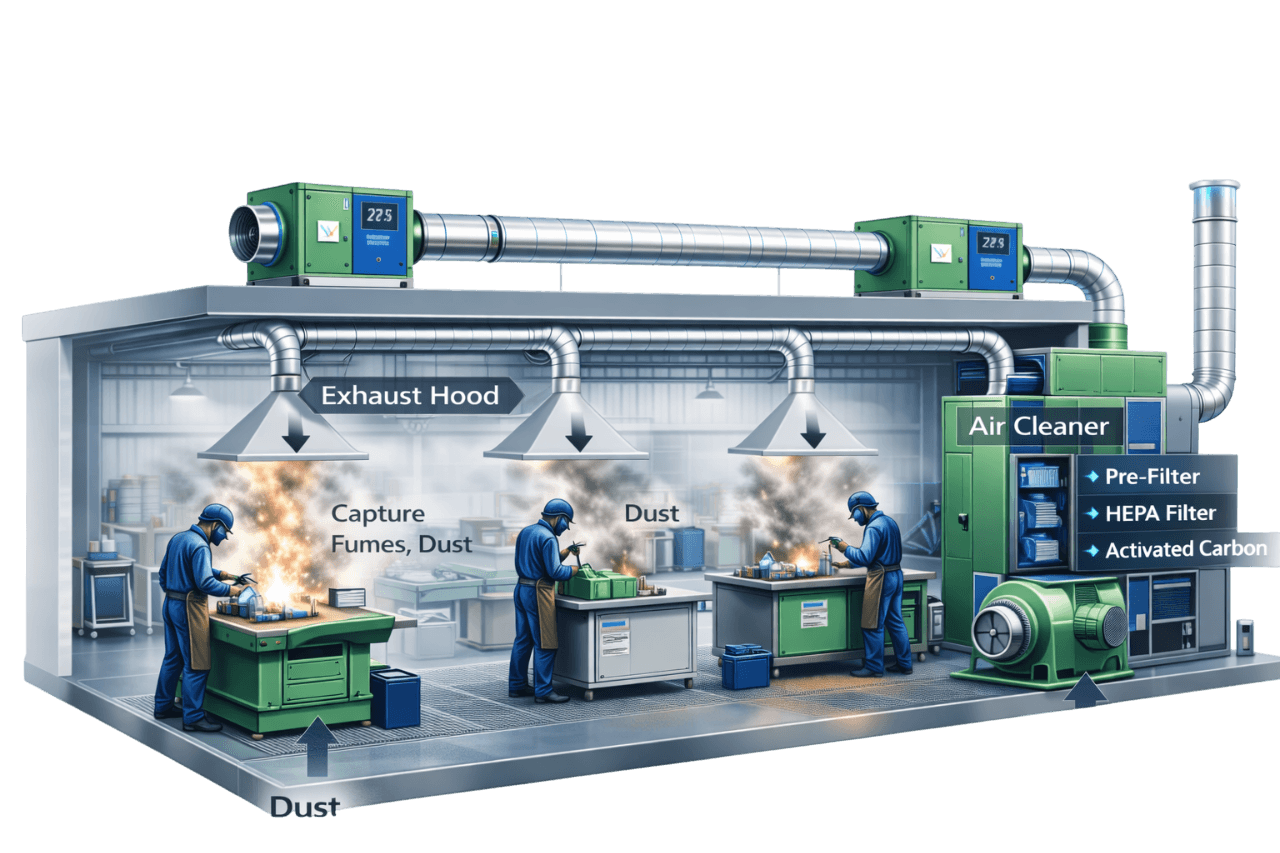
Local Exhaust Ventilation (LEV) Systems
Learn More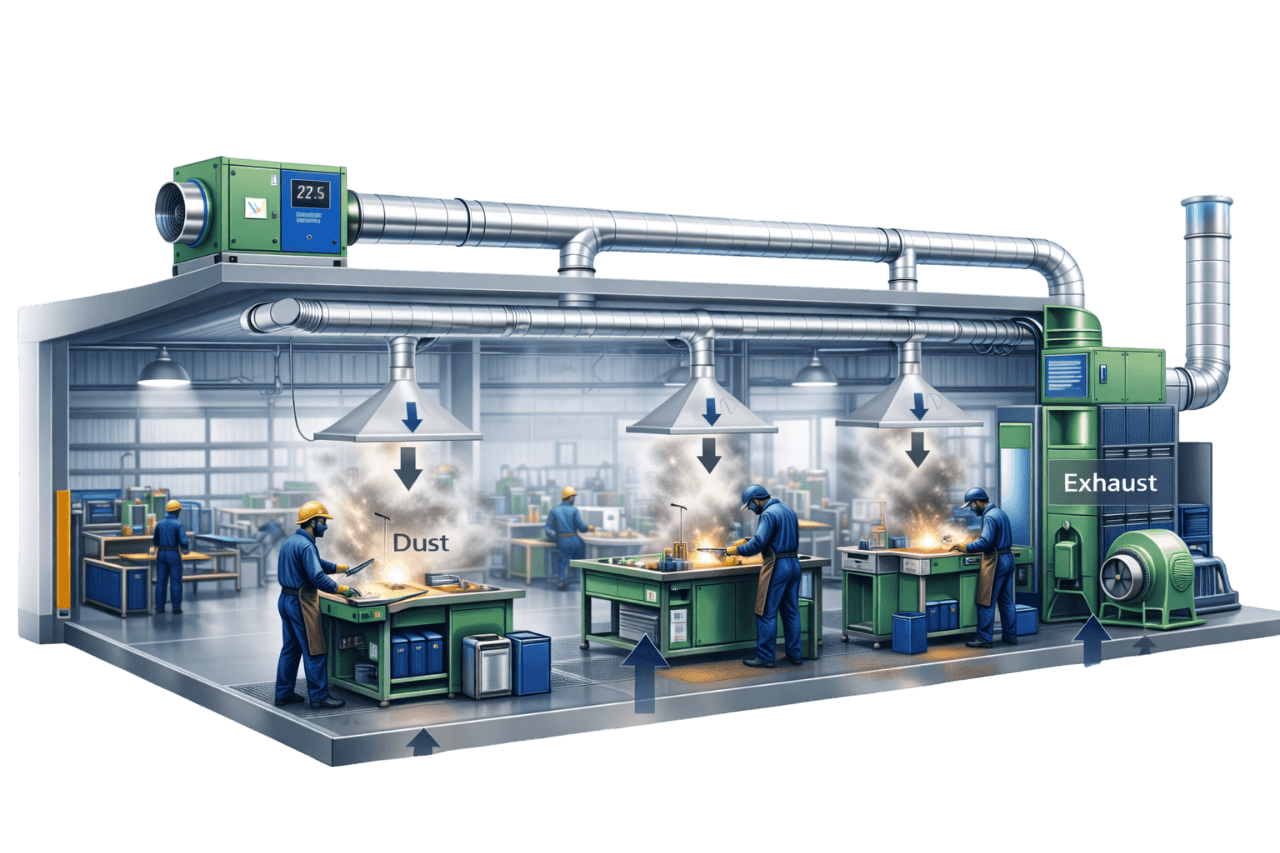
General Dilution Ventilation Systems
Learn More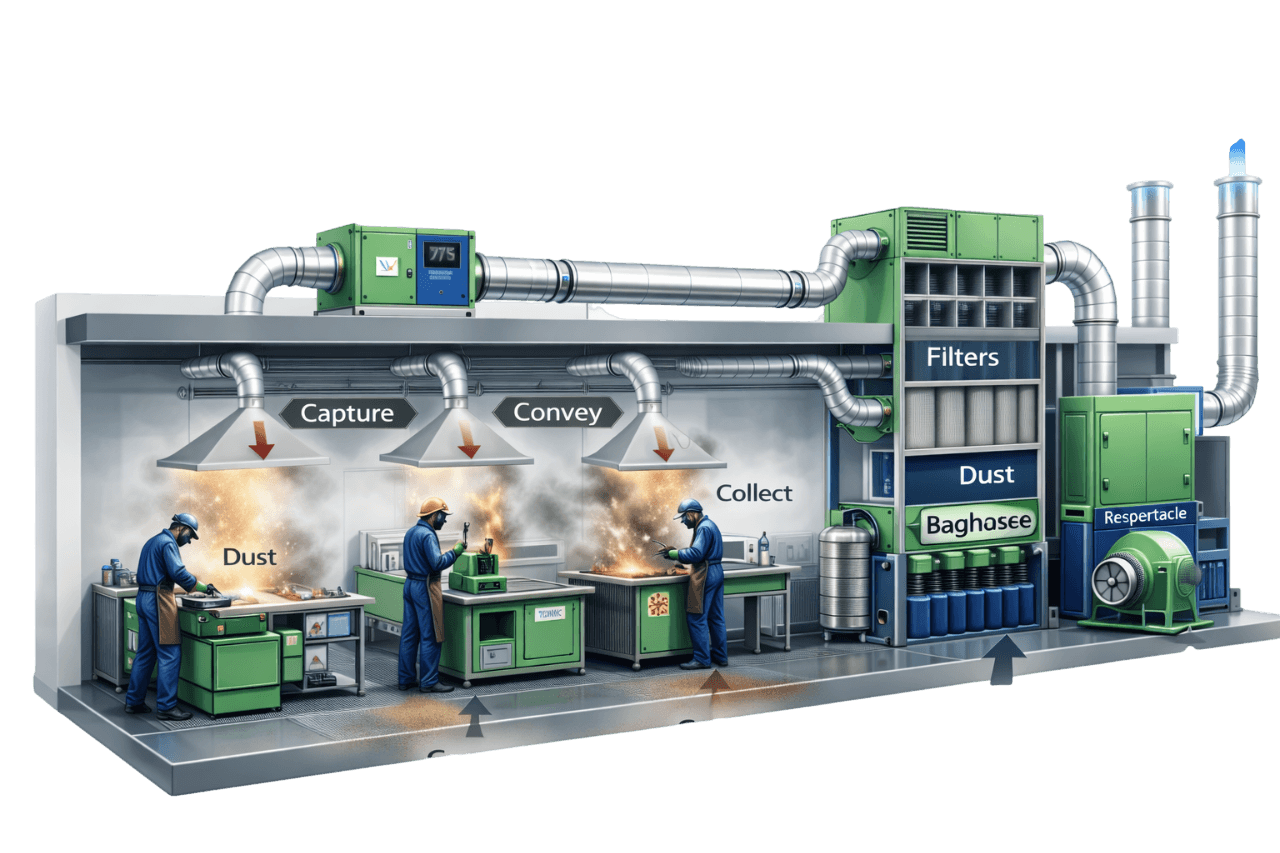
Dust Collection Systems
Learn More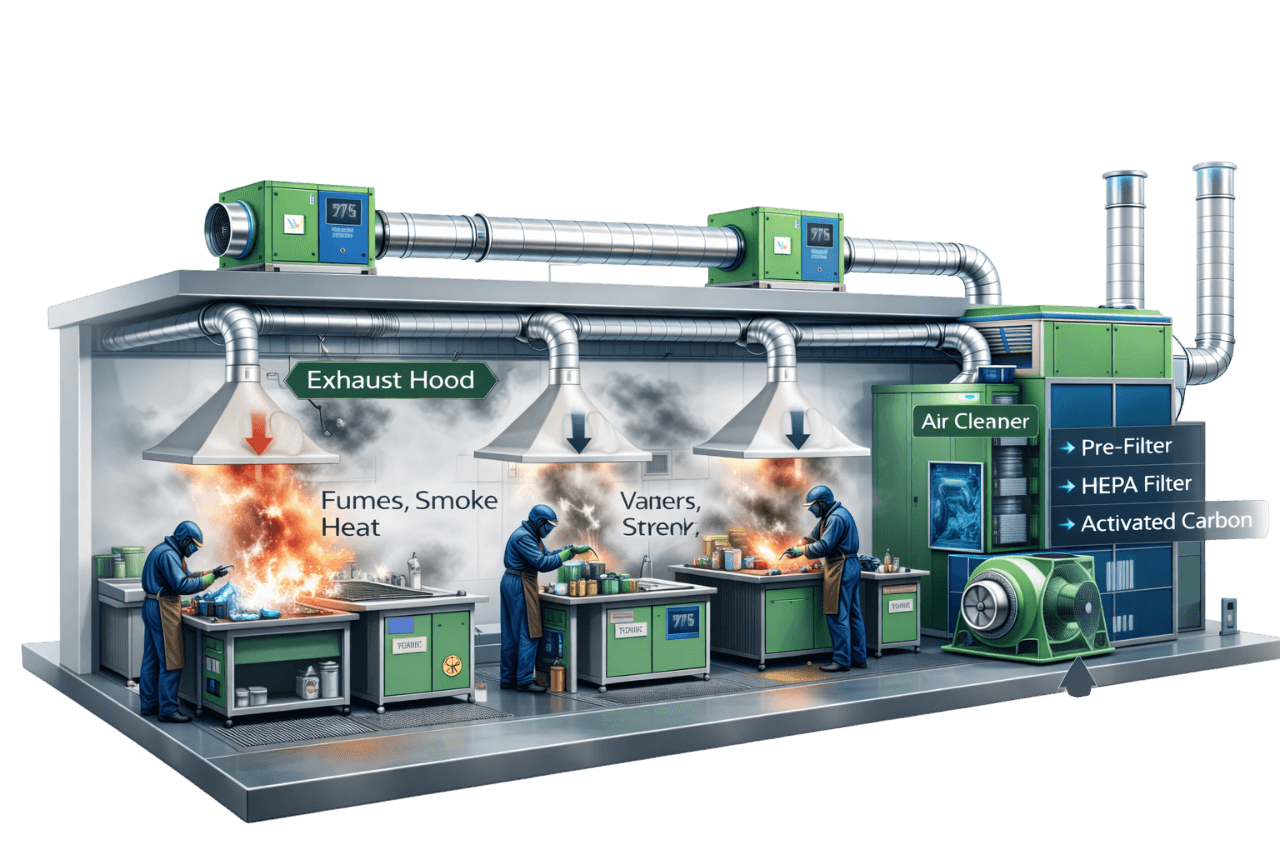
Fume Extraction Systems
Learn More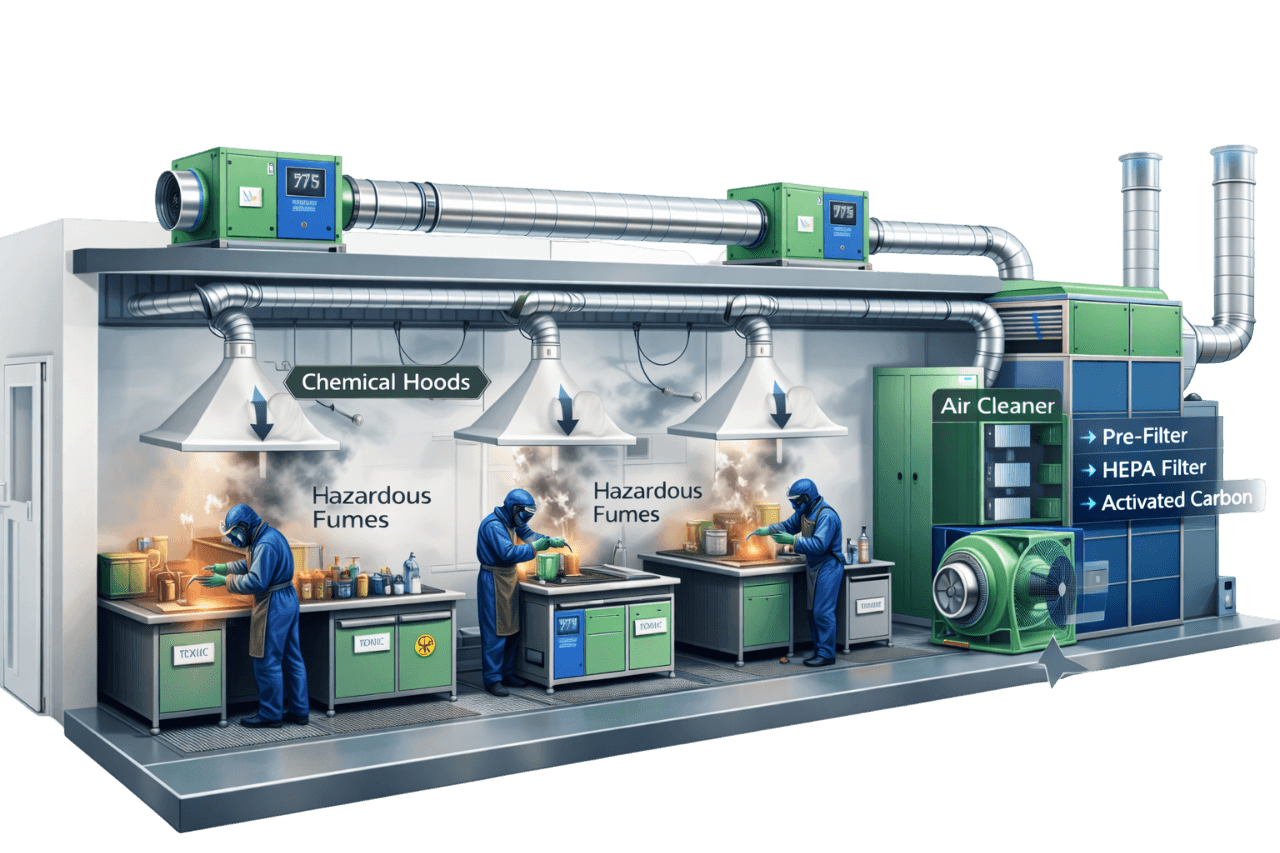
Chemical Exhaust Systems
Learn More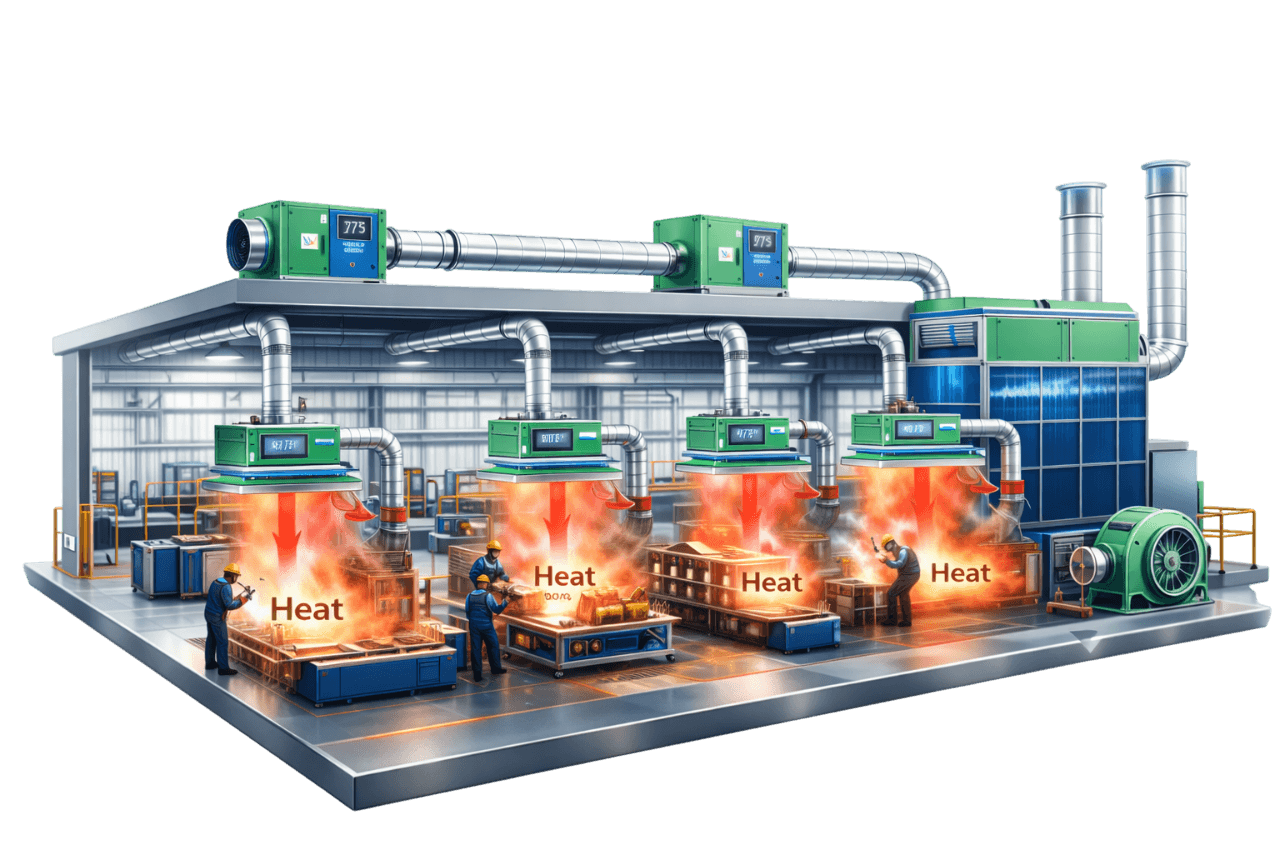
Heat Exhaust Ventilation Systems
Learn More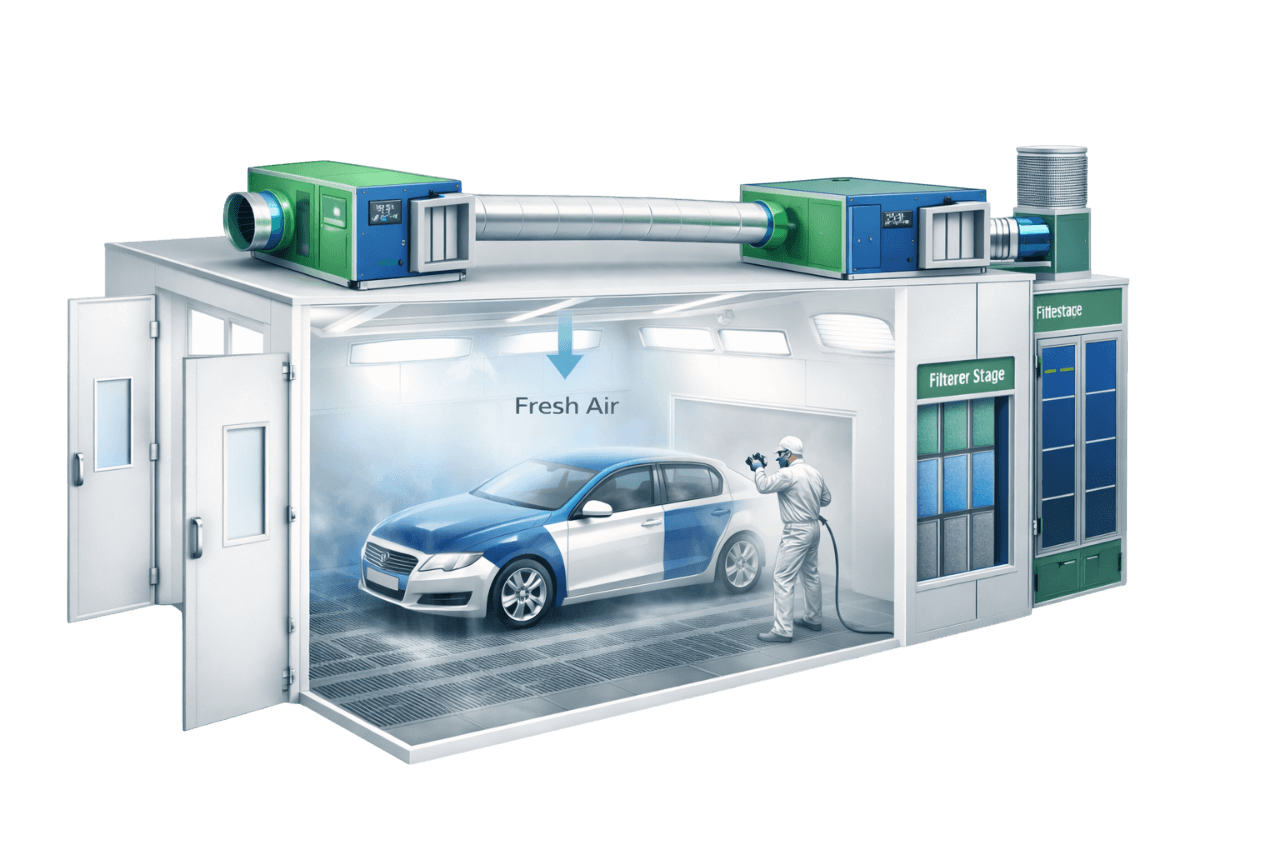
Paint Booth Ventilation Systems
Learn More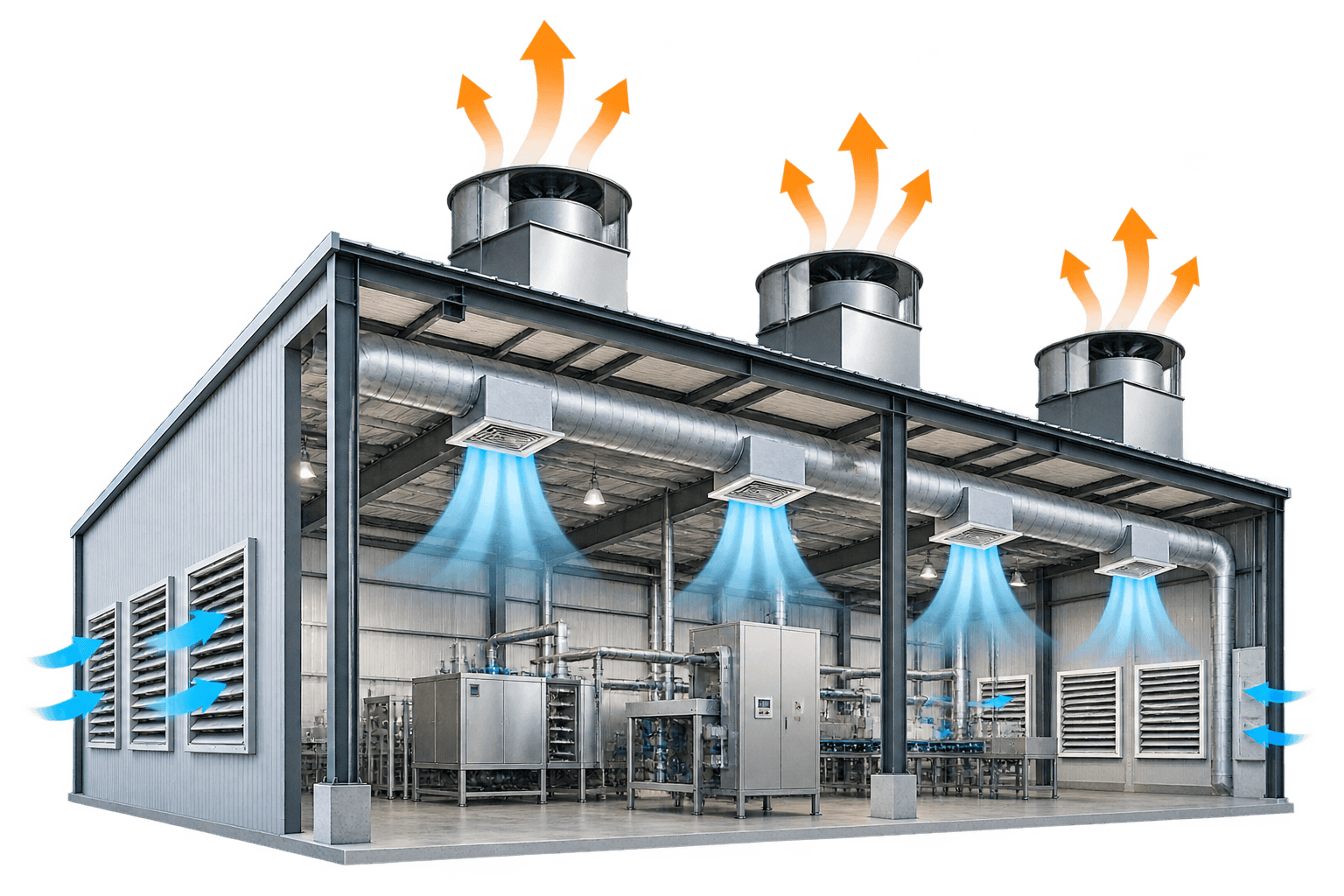
Industrial Dilution Ventilation Systems
Learn MoreFrequently Asked Questions
Q1. What is a welding fume extraction system?
A welding fume extraction system is a local exhaust ventilation system that captures fume and smoke at the welding arc using arms, on-torch nozzles, tables or booths, filters out the metal particles and returns clean air to the workshop or exhausts it outdoors.
Q2. Why are welding fumes dangerous?
Welding fumes contain ultrafine metal particles and gases that penetrate deep into the lungs. They are classified as carcinogenic to humans, can cause metal fume fever and chronic lung disease, and may contain manganese, hexavalent chromium and nickel, which carry additional health risks.
Q3. How does a welding fume extractor work?
A fan creates suction at a hood or torch nozzle close to the arc. The fume passes through a spark arrestor and pre-filter, then a cartridge or HEPA filter traps the fine particles. An optional carbon stage reduces odours, and the clean air is returned or exhausted.
Q4. Which welding processes produce the most fumes?
Flux-cored arc welding and stick welding generally produce the most fume, followed by MIG/MAG welding at higher currents. TIG welding and submerged arc welding produce the least visible fume, although TIG can generate significant ozone.
Q5. What is the difference between on-torch extraction and extraction arms?
On-torch extraction captures fume directly at the MIG torch nozzle using low airflow at high vacuum, with no repositioning needed. Extraction arms use higher airflow through a hood the welder positions near the arc and work with almost any welding or cutting process.
Q6. Is a portable or centralised welding fume extraction system better?
Portable extractors are better for one to three welders who move around or work on site. Centralised systems are better for four or more fixed welding stations, offering lower cost per station, easier maintenance and a cleaner shop floor.
Q7. What filters are used in welding fume extractors?
Most welding fume extractors use a spark arrestor, a pre-filter and a main pleated cartridge filter, often self-cleaning. HEPA filters are added for very fine or hazardous fumes such as stainless steel, and activated carbon can be added for odours.
Q8. Can air from a welding fume extractor be recirculated in the workshop?
For mild steel and aluminium welding, air can often be recirculated if the filtration is high-efficiency and properly maintained. For stainless steel, high-alloy and coated metals, exhausting outdoors is usually recommended because of hexavalent chromium, nickel and welding gases.
Q9. How much airflow is needed per welding station?
A standard extraction arm typically needs around 800 to 1,200 m³/h to achieve a capture velocity of about 0.5 to 1.0 m/s at the arc. On-torch extraction needs only a fraction of that airflow at much higher suction. The exact figure depends on process, arm size and working distance.
Q10. How often should welding fume extractor filters be replaced?
It depends on fume load, arc-on time and filter type. Disposable filters in portable units may need replacing within months, while self-cleaning cartridges in central systems commonly last one to two years. A differential pressure gauge is the most reliable guide.
Q11. What is the cost of a welding fume extraction system in India?
Indicative prices range from about ₹40,000 to ₹2,00,000 for a portable welding fume extractor and from about ₹7,50,000 for a small centralised multi-station system. The final cost depends on stations, airflow, filters, ductwork and controls. Contact Compress India for an accurate quotation.
Q12. Does Compress India supply and install welding fume extraction systems in Mumbai?
Yes. Compress India designs, supplies, installs, tests, commissions and maintains welding fume extraction systems across Mumbai, Navi Mumbai, Thane and the rest of Maharashtra, and undertakes projects across India. Contact our HVAC team to schedule a site survey.