Local Exhaust Ventilation (LEV) Systems
(Design, Supply, Installation, Testing, Commissioning & AMC for Industrial LEV & Fume Extraction)
Design, Supply, Installation, Testing, Commissioning & AMC for Industrial LEV & Fume Extraction
Welding fumes, grinding dust, solvent vapours and powder emissions do not stay where they are made. Left uncontrolled, they drift into the breathing zone of your workers, settle on equipment and products, and put your plant at risk during inspections.
Compress India designs and installs Local Exhaust Ventilation (LEV) Systems that capture these contaminants right at the point of release, before they spread. From a single welding bay to a multi-hood dust extraction system serving an entire production floor, we handle the complete project: process study, hood design, LEV ducting, fan and dust collector selection, installation, testing, commissioning and annual maintenance.
Whether you need an industrial LEV system for a fabrication shop, a pharmaceutical LEV system for dispensing booths, or a chemical vapour extraction system with a scrubber, our engineering team builds it around your process, not a catalogue.
Request a site survey and quotation for your LEV project today.
What Is a Local Exhaust Ventilation (LEV) System?
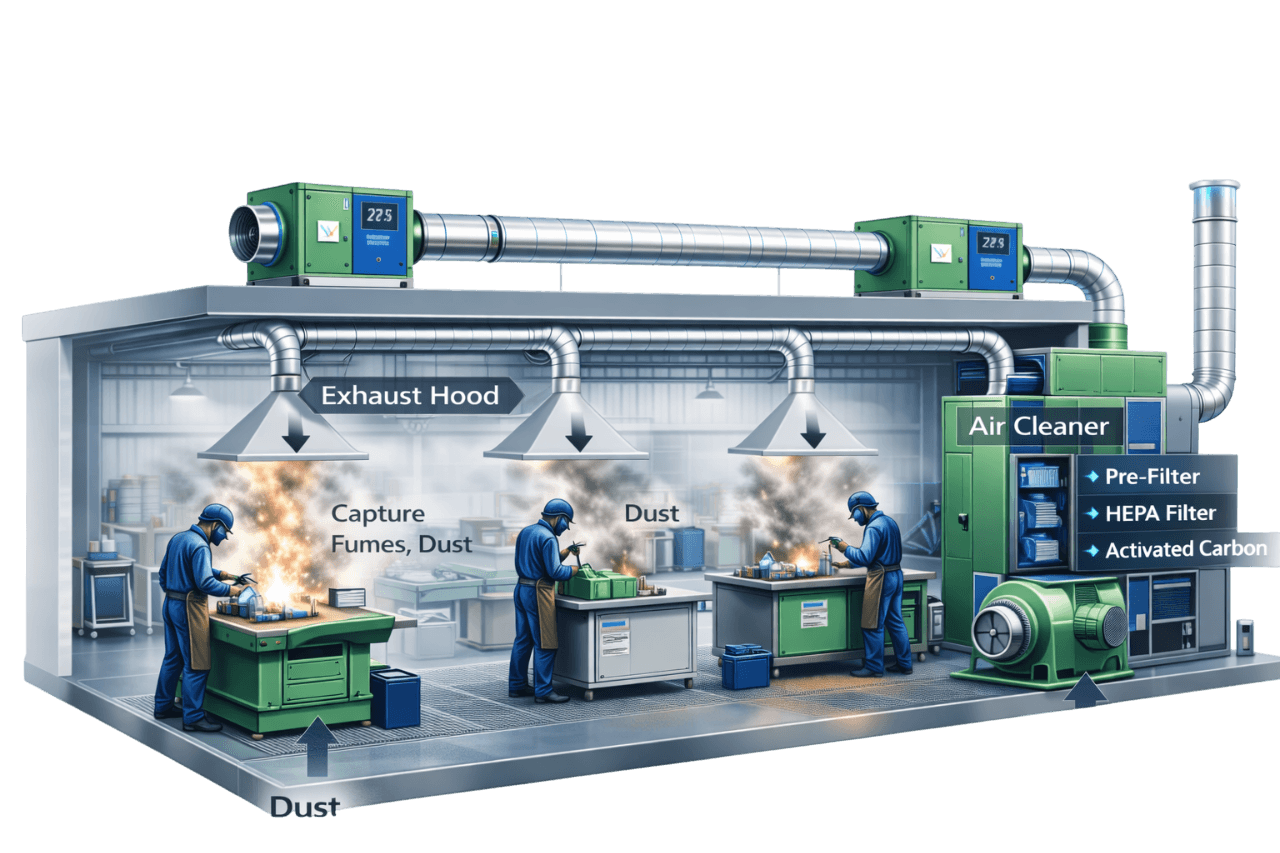
A local exhaust ventilation system is an engineered extraction system that captures airborne contaminants at their source and carries them away before they reach workers or the surrounding workspace. It is also known as local extract ventilation, source capture ventilation, point source ventilation or simply an LEV system.
Unlike general exhaust ventilation, which dilutes contaminated air across a whole room using wall-mounted or roof exhaust fans, an LEV system works at the point of generation. A hood, booth or extraction arm is placed at the process, and a fan draws contaminated air through LEV ductwork to an air cleaner such as a dust collector, filter or scrubber. The cleaned air is then discharged safely through a stack.
A well-designed LEV ventilation system typically includes:
- A hood or enclosure that captures dust, fumes, mist or vapour at the source
- Ductwork sized to transport the contaminant without settling
- An air cleaning device such as a cartridge dust collector, baghouse, HEPA filter, activated carbon unit or wet scrubber
- An extraction fan that provides the required airflow and static pressure
- A discharge stack that releases cleaned air away from building openings
- Airflow indicators and pressure gauges that confirm the system is performing
LEV fume extraction is the most effective engineering control for welding, grinding, cutting, painting, powder handling, chemical processing and laboratory work, because it removes the hazard instead of spreading it around.
Why LEV Is Essential in Industrial Workplaces
Every process that releases dust, fume, mist or vapour creates two problems: a health risk for the people nearby and a contamination risk for the plant. Local exhaust ventilation solves both at once.
Protecting Worker Health from Dust, Fumes & Vapours
Fine particles and fumes from welding, grinding, cutting and chemical handling can cause respiratory irritation, occupational asthma, metal fume fever, silicosis and long-term lung damage. Solvent vapours can affect the nervous system and liver. An LEV system keeps these contaminants out of the worker's breathing zone, reducing exposure far more reliably than masks alone. Personal protective equipment then becomes a backup, not the only line of defence.
Capturing Contaminants at the Source
The closer the capture point is to the source, the less air you need to move and the better the protection. Source capture ventilation removes contaminants within centimetres of where they are generated, so they never have a chance to mix with room air. This is why LEV is ranked above general ventilation in the hierarchy of engineering controls.
Legal & Safety Compliance
Indian factory law requires employers to remove dust and fumes at the point of origin where they are likely to be injurious. Pollution control boards also regulate what leaves your stack. A properly designed, tested and documented LEV system helps you meet factory inspection requirements, audit checklists from global clients, and consent conditions for air emissions.
Cleaner Workplace & Product Protection
Dust that escapes a process settles on machines, electrical panels, finished goods and other batches. In pharma, food and electronics plants, this means cross-contamination and rejected product. LEV keeps the shop floor, equipment and products cleaner, reduces housekeeping time and protects sensitive machinery from abrasive or conductive dust.
How an LEV System Works
Every LEV extraction system, from a single fume extraction arm to a plant-wide centralised network, follows the same five-stage path.
1. Hood Captures Contaminants at the Source
The hood is where capture happens. It may be an enclosure, a booth, a slot along a tank edge, a canopy above hot work or a flexible arm positioned over a weld. The hood creates enough air velocity at the source to overcome room draughts and the contaminant's own motion, drawing it into the system.
2. Ductwork Transports Contaminated Air
LEV ducting carries the captured air to the air cleaner. Ducts must be sized to maintain a transport velocity high enough to keep dust in suspension, typically 15 to 23 m/s for dust, while keeping bends, branches and length to a minimum to reduce pressure loss.
3. Air Cleaner Removes Dust, Fumes or Vapours
Before air is released, an air cleaning device removes the contaminant. Dust collectors, cartridge filters, HEPA filters, cyclones, wet scrubbers and activated carbon units are selected based on particle size, chemistry, moisture, temperature and emission limits.
4. Fan Creates the Required Suction
The LEV exhaust fan, usually a centrifugal extraction fan, generates the airflow and static pressure needed to overcome resistance from the hoods, ducts and air cleaner. Placing the fan after the air cleaner protects it from abrasion and build-up.
5. Clean Air Discharged Through the Stack
Cleaned air leaves through a discharge stack at adequate height and velocity, well away from air intakes, doors and windows. This prevents exhaust from re-entering the building and helps meet stack emission norms.
Main Components of an LEV System
The performance of local exhaust ventilation equipment depends on every component working together. A weak link anywhere, a poorly placed hood or an undersized fan, reduces protection for the entire system.
Hoods & Enclosures
The LEV hood is the most important part of the system. Its shape, size and position decide how much contaminant is captured and how much airflow is needed. We design each fume extraction hood and dust extraction hood around the actual process, the direction of contaminant release and the way operators work.
Ductwork & Blast Gates
The extraction duct system is fabricated in GI, MS, stainless steel, PP or FRP depending on the contaminant. Blast gates and balancing dampers let each branch draw its design airflow, and allow unused hoods to be closed off to save energy.
Air Cleaning Devices
The LEV air cleaner removes dust, fume, mist or vapour before discharge. Options include pulse-jet bag filters, cartridge dust collectors, cyclones, wet scrubbers, activated carbon filters, electrostatic precipitators, oil mist collectors and HEPA filters.
Exhaust Fans
The LEV centrifugal fan provides the suction for the whole system. Fan type, blade design, material and motor rating are chosen for the required airflow, static pressure and the nature of the air being handled, including flameproof or ATEX extraction fans for hazardous areas.
Discharge Stack
The LEV discharge stack releases cleaned air at a safe height and velocity. It includes sampling ports for emission monitoring and, where needed, a weather cap design that does not deflect exhaust back down towards the roof.
Airflow Indicators & Pressure Gauges
An LEV airflow indicator at each hood and an LEV pressure gauge across each filter show operators, at a glance, whether the system is working. Differential pressure gauges also tell maintenance teams when filters need cleaning or replacement.
Types of LEV Hoods
Choosing the right local exhaust ventilation hood is the single biggest factor in system performance. The general rule: enclose as much as possible, and capture as close to the source as possible.
Enclosing Hoods (Booths, Fume Hoods & Glove Boxes)
An enclosing hood surrounds the process fully or partially, so the contaminant is contained inside. Spray booths, laboratory fume hoods, powder dispensing booths and glove boxes are all enclosing hoods. They offer the best protection with the lowest airflow and are the first choice wherever the process allows.
Capturing Hoods (Slot Hoods & Flanged Hoods)
A capturing hood sits outside the source and creates enough air velocity to pull contaminants in. Slot hood ventilation along tank edges, flanged hoods at workbenches and rectangular hoods at machines fall into this category. Adding a flange can reduce the airflow needed for the same capture by roughly 25%.
Receiving Hoods (Canopy Hoods & Grinding Guards)
A receiving hood uses the natural movement of the contaminant. Canopy hoods catch rising hot fumes from furnaces and melting pots, while grinding wheel guards receive the particles thrown off the wheel. They only work when the contaminant actually travels towards the hood.
Flexible Fume Extraction Arms
A fume extraction arm is a flexible, self-supporting arm with a capture hood that operators position close to the work. It is widely used for welding fume extraction, soldering and laboratory work, where the source position changes from job to job.
Downdraft & Extraction Tables
Downdraft extraction tables pull air down through a perforated or grilled worktop, drawing fumes and dust away from the operator's face. Backdraft extraction tables pull air horizontally from the rear. Both suit grinding, sanding, welding of small parts and plasma cutting.
On-Tool Extraction
On-tool extraction uses a small shroud built into a hand tool, such as a grinder, sander or saw, connected to a high-vacuum extraction unit. Because capture happens millimetres from the source, very little airflow is needed.
Types of LEV Systems
Compress India designs every type of LEV system for dust and fume extraction, from compact portable units to fully centralised industrial extraction systems.
Centralised LEV Systems
A centralised LEV system connects multiple hoods to a common duct network, air cleaner and fan. It suits production lines and workshops with many fixed extraction points, offering lower running costs per point, a single maintenance location and outdoor discharge.
Portable & Mobile Fume Extractors
Portable fume extractors combine a small fan, filter and extraction arm on a mobile unit. They are ideal for maintenance work, occasional welding and sites where installing ductwork is not practical. Most recirculate filtered air, so they must be matched carefully to the contaminant.
Welding Fume Extraction Systems
A local exhaust ventilation system for welding captures fine metal fume from MIG, TIG, stick and flux-cored welding using extraction arms, hoods, fume guns or welding tables. Welding fume is very fine, so these systems use cartridge filters with pulse cleaning and, where needed, spark arrestors.
Dust Collection Systems
Industrial dust extraction systems serve grinding, cutting, powder handling, sanding, bagging and conveying. They combine LEV hoods and ducting with a pulse-jet bag filter, cartridge dust collector or cyclone to capture dust and return it for disposal or reuse.
Chemical Fume & Vapour Extraction Systems
Chemical vapor extraction systems handle acid fumes, alkali mists and solvent vapours from reactors, tanks, charging points and plating lines. They use corrosion-resistant PP or FRP ducting and fans, and a wet scrubber or activated carbon unit to treat the exhaust.
Laboratory Fume Hood Exhaust Systems
Laboratory fume hood exhaust systems connect each fume cupboard to dedicated exhaust fans with the right face velocity, often with variable air volume control. We design the ducting, fans, scrubbers and stacks for R&D, QC and teaching labs.
Paint Booth & Spray Extraction Systems
Paint fume extraction systems combine spray booths, paint booth exhaust fans, dry filters or water-wash sections and stacks. They control overspray and solvent vapour, protect painters and improve finish quality.
Pharma Dispensing & Sampling Booths
Pharmaceutical LEV systems include downflow dispensing booths, sampling booths and point extraction at granulators, blenders and compression machines. They protect operators from potent APIs and prevent cross-contamination between batches, with HEPA filtration at the exhaust.
Air Cleaning Devices for LEV
The right air cleaner protects the environment, meets emission limits and, in many cases, lets you recover valuable material. Compress India selects the device based on your contaminant, not a default choice.
Bag Filters & Pulse-Jet Dust Collectors
A baghouse dust collector uses fabric filter bags cleaned automatically by compressed-air pulses. It handles high dust loads and large airflows, making it the workhorse for cement, powder, foundry, grinding and bulk-handling applications. Bag material is chosen for temperature, moisture and chemical resistance.
Cartridge Filter Dust Collectors
A cartridge dust collector packs a large pleated filter area into a compact housing. It is ideal for fine, dry particles such as welding fume, laser and plasma cutting fume, and light powders, with high efficiency and easy filter changes.
Cyclone Separators
Cyclones use centrifugal force to separate coarse and heavy particles. They have no filters to replace and are often used as a pre-separator before a bag filter, reducing load on the filters and recovering reusable material such as metal chips or wood dust.
Wet Scrubbers
An LEV scrubber system washes contaminated air with water or a chemical solution. Packed-bed and venturi scrubbers remove acid fumes, alkali mists, soluble gases and sticky or hot dust. Built in PP or FRP, they are standard for chemical, pharma, plating and pickling processes.
Activated Carbon Filters
Activated carbon fume extraction adsorbs organic solvent vapours and odours. It suits low-concentration VOC applications such as small paint areas, laboratories, printing and adhesive work. Carbon life depends on the load, so we size the bed for realistic change intervals.
Electrostatic Precipitators & Oil Mist Collectors
Oil mist extraction systems capture coolant and oil mist from CNC machines, grinding and forging using coalescing filters or electrostatic precipitators. These systems recover oil, keep machines and floors clean, and prevent slippery, contaminated work areas.
HEPA Filtration for Hazardous Dust
An LEV HEPA filter provides final-stage filtration for toxic, potent or carcinogenic dust, including APIs, silica and heavy metals. HEPA stages are often installed in safe-change housings so maintenance staff are not exposed when filters are replaced.
LEV vs General (Dilution) Ventilation
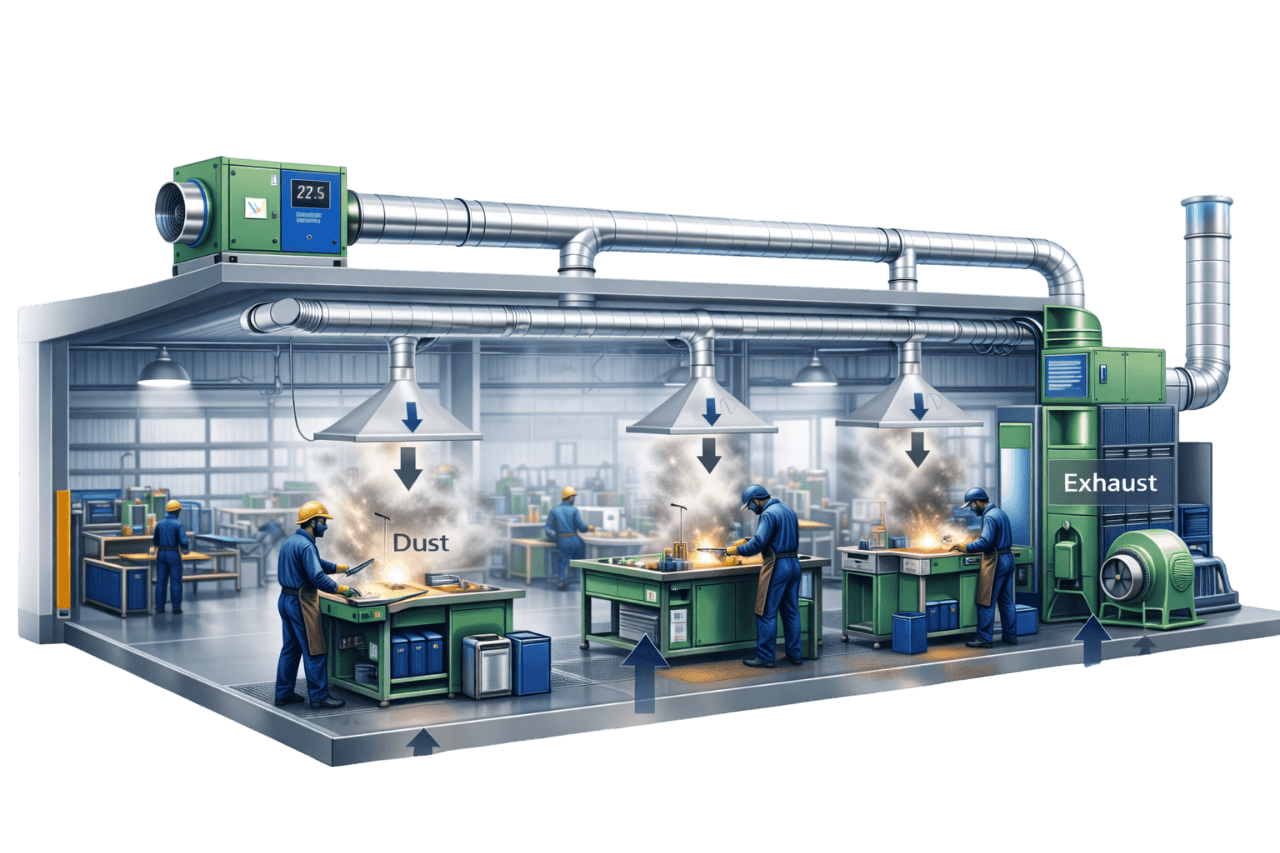
General exhaust ventilation, also called dilution ventilation, uses industrial exhaust fans, roof ventilation fans or wall mount exhaust fans with fresh-air inlets to change the air in a whole room. Local exhaust ventilation captures the contaminant at the source instead. For toxic, dusty or high-volume emissions, LEV is almost always the better choice.
| Factor | Local Exhaust Ventilation (LEV) | General (Dilution) Ventilation |
|---|---|---|
| How it works | Captures contaminant at the source | Dilutes contaminant across the whole room |
| Worker protection | High, contaminant kept out of the breathing zone | Moderate, worker still breathes diluted air |
| Airflow needed | Low to moderate | High |
| Energy and make-up air cost | Lower | Higher |
| Suitable for | Dust, welding fume, toxic vapours, point sources | Heat, odours, low-toxicity vapours, many small sources |
| Emission treatment | Easy, air is concentrated | Difficult, large volume of dilute air |
| Typical equipment | Hoods, extraction arms, dust collectors, scrubbers | Roof exhaust fans, wall exhaust fans, inline fans, louvres |
In practice, many plants use both: LEV at the process and general ventilation for heat and residual contaminants. Our team designs the two together so they do not work against each other.
Centralised LEV vs Portable Fume Extractors
Both options have their place. The right choice depends on the number of extraction points, how often they are used and whether filtered air can be recirculated.
| Factor | Centralised LEV System | Portable Fume Extractor |
|---|---|---|
| Best for | Many fixed extraction points | 1 to 2 points, changing locations |
| Discharge | Outdoors through a stack | Usually recirculated into the room |
| Upfront cost | Higher | Lower |
| Running cost per point | Lower | Higher |
| Maintenance | One location, easier to manage | Each unit serviced separately |
| Suitable contaminants | Wide range, including toxic and heavy loads | Light, occasional fume and dust loads |
| Flexibility | Fixed layout, expandable by design | Can move between work areas |
For a fabrication shop with 10 welding bays, a centralised welding exhaust ventilation system usually costs less over its life. For a maintenance workshop with occasional welding, portable units are often enough. We recommend the option that fits your process and budget.
LEV Standards & Regulations
Compress India designs and tests local exhaust ventilation systems in line with recognised international practice and Indian regulations, so your system stands up to factory inspections, client audits and pollution control board checks.
ACGIH Industrial Ventilation Guidelines
The ACGIH Industrial Ventilation manual is the most widely used engineering reference for LEV system design. It provides recommended capture velocities, hood design data, duct transport velocities and calculation methods for airflow and static pressure. Our LEV airflow calculation and duct sizing follow these methods.
ANSI/AIHA Z9.2 LEV Standard
ANSI/AIHA Z9.2 sets out the fundamentals for design, construction, operation and testing of local exhaust ventilation systems. It emphasises documented design criteria, commissioning, baseline performance records and periodic testing, practices we build into every project handover.
HSE HSG258 LEV Guidance
HSE local exhaust ventilation guidance, HSG258, is a practical reference on hood selection, commissioning, user manuals, log books and thorough examination and testing, typically at least every 14 months. Many multinational plants in India follow it as best practice, alongside OSHA and DOSH local exhaust ventilation guidance used by global groups.
Factories Act & State Factory Rules (India)
The Factories Act, 1948 requires effective measures to prevent the inhalation and accumulation of injurious dust and fumes, including exhaust appliances placed as near as possible to the point of origin. Provisions on ventilation and dangerous fumes are carried forward under the Occupational Safety, Health and Working Conditions Code, 2020 and applicable state rules, including the Maharashtra Factories Rules. Our documentation supports inspections under these requirements.
Pollution Control Board Stack Emission Norms
The Central and State Pollution Control Boards, including MPCB in Maharashtra, set limits on particulate and gaseous emissions and stack height through consent conditions. We select air cleaners to meet your consent limits and provide stacks with sampling ports and platforms for third-party emission monitoring.
LEV System Design & Sizing
Good local exhaust ventilation design is the difference between a system that protects workers and one that just makes noise. Our LEV system design process is methodical and fully documented.
Process & Contaminant Assessment
We start by studying the process: what is released, in what form, how fast, how hot and for how long. We note particle size, toxicity, flammability, moisture, corrosiveness and operator movements. This assessment drives every design decision that follows.
Hood Selection & Placement
We choose the hood type that gives the best control with the least airflow, preferring enclosures, then receiving hoods, then capturing hoods. Placement accounts for operator access, material handling, cross-draughts from doors and fans, and the direction the contaminant travels.
Capture Velocity & Face Velocity
LEV capture velocity is the air speed needed at the source to draw the contaminant into the hood. Face velocity is the air speed across an enclosure opening, such as a booth or fume hood. Typical design ranges, based on ACGIH guidance:
| How the contaminant is released | Example processes | Capture velocity (m/s) |
|---|---|---|
| With almost no velocity into quiet air | Evaporation from tanks, degreasing | 0.25 to 0.5 |
| At low velocity into moderately still air | Welding, spray booths, low-speed conveyor transfers | 0.5 to 1.0 |
| Actively into rapid air motion | Spray painting, barrel filling, crushers | 1.0 to 2.5 |
| At high velocity into very rapid air motion | Grinding, abrasive blasting, tumbling | 2.5 to 10 |
For a simple plain hood, the LEV capture velocity calculation uses the relationship below, where Q is airflow, V is capture velocity, X is the distance from the hood face and A is the hood face area. A flanged hood needs about 75% of this airflow.
Q = V \left(10X^{2} + A\right)
The key takeaway: capture velocity falls very quickly with distance. Doubling the distance from hood to source can need around four times the airflow, which is why hood position matters so much.
Duct Transport Velocity to Prevent Settling
LEV conveying velocity must keep particles airborne all the way to the collector. Too low and dust settles and blocks ducts; too high and energy use, noise and abrasion rise.
| Contaminant | Typical duct velocity (m/s) |
|---|---|
| Gases, vapours, smoke | 5 to 10 |
| Welding fume, fine light dust | 10 to 15 |
| Dry dusts and powders | 15 to 20 |
| Average industrial dust (grinding, wood, sanding) | 18 to 20 |
| Heavy dust (metal turnings, foundry sand) | 20 to 23 |
| Heavy or moist dust | above 23 |
Duct Sizing & System Balancing
LEV duct sizing sets each branch diameter to achieve the target duct velocity at its design airflow. Branches are balanced by design, using calculated duct sizes, or with balancing dampers, so every hood receives its share of air. We favour gradual transitions, long-radius bends and branch entries at 30 to 45 degrees.
Fan Selection & Static Pressure
LEV static pressure calculation adds up losses from hood entry, ducts, bends, branches, the air cleaner and the stack. LEV fan sizing then matches airflow and total pressure to a fan curve with margin for filter loading. We choose backward-curved, radial or paddle-blade centrifugal fans based on the dust load, and specify motors and VFDs for efficient operation.
Air Cleaner Selection
The air cleaner is chosen for the contaminant type, concentration, particle size, temperature, moisture, explosibility and the emission limit you must meet. For some processes, two stages, such as a cyclone plus bag filter, or a scrubber plus mist eliminator, give the best result.
Stack Height & Discharge Velocity
The stack must release air high enough, and fast enough, to clear the roof and nearby buildings. We typically design for a discharge velocity of around 15 m/s or more, avoid rain caps that deflect exhaust downwards, and keep stacks away from fresh air intakes. Stack height also follows pollution control board requirements.
Make-Up Air Requirements
Every cubic metre extracted must be replaced. Without make-up air, the building runs under negative pressure, hood performance drops, doors slam and fumes back-draft from other sources. We design LEV make up air through louvres, fresh air units or tempered air systems, located so incoming air does not disturb capture at the hoods.
Safety in LEV Systems
An extraction system concentrates dust and vapour in one place. Without the right safeguards, that concentration can create a fire or explosion hazard. Compress India builds safety into every industrial LEV system from the design stage.
Dust Explosion Protection & Venting
Many dusts, including pharma powders, flour, sugar, wood, aluminium and plastics, are combustible. For these applications we provide explosion vent panels, flameless venting for indoor collectors, isolation valves and rotary airlocks to stop a flame travelling back through the ductwork to the workplace.
Flameproof & ATEX-Rated Fans and Motors
Where flammable vapours or combustible dusts are present, we specify explosion proof LEV equipment: flameproof motors, spark-resistant fan construction and ATEX extraction fans suited to the hazardous area classification of your plant.
Spark Arrestors
Grinding, cutting and welding throw hot sparks that can ignite filter media. Spark arrestors and drop-out boxes upstream of the dust collector cool and trap sparks before they reach the filters, a simple addition that prevents costly filter fires.
Corrosion-Resistant Materials (SS, PP & FRP)
Acid fumes and corrosive vapours destroy mild steel ducts quickly. We fabricate hoods, ducts, fans and scrubbers in stainless steel, polypropylene or FRP to suit the chemistry, temperature and fire rating needed for the application.
Fire Dampers & Fire Protection
Where ducts pass through fire-rated walls, we provide fire dampers where they are appropriate for the exhaust stream, along with temperature sensors, sprinkler or suppression connections in collectors, and fire-alarm interlocks that shut down fans safely.
Energy Efficiency & Controls
Extraction fans often run all day, whether or not the process is active. An energy efficient LEV system can cut fan power significantly while improving protection.
VFD Fan Control
LEV VFD control lets the fan run at the speed actually needed. Because fan power drops sharply with speed, even a modest speed reduction gives large energy savings. VFDs also allow soft starting and constant-pressure control as filters load.
On-Demand Extraction with Automatic Dampers
Motorised dampers open only at workstations in use, triggered by sensors, switches or machine signals. The fan then slows down to match the active hoods, so you only pay for the extraction you need.
Machine Interlocks
Interlocks prevent a machine from starting unless its extraction is running, and can keep the fan running for a set time after work stops to clear residual fume. This removes reliance on operators remembering to switch on extraction.
Filter Differential Pressure Monitoring
LEV differential pressure monitoring across filters triggers pulse cleaning only when needed, saves compressed air, and alerts maintenance teams before filter loading starts to reduce hood airflow.
PLC, SCADA & BMS Integration
An LEV monitoring system with PLC control can log airflow, pressure, fan status and alarms, and connect to your SCADA or building management system. LEV BMS integration gives your facility team real-time visibility and a digital record for audits.
Benefits of LEV Systems
Protects Worker Health & Safety
LEV keeps dust, fumes and vapours out of the breathing zone, reducing occupational illness, absenteeism and dependence on respirators. A healthier workforce is a more productive one.
Removes Contaminants Before They Spread
By capturing at the source, LEV stops contamination spreading to neighbouring work areas, offices and stores, protecting people who are not even working on the process.
Lower Airflow & Energy Than Dilution Ventilation
Because LEV only handles concentrated air near the source, it needs far less airflow than diluting a whole building, which means smaller fans, less make-up air and lower cooling or heating loads.
Helps Meet Regulatory Requirements
A well-documented local exhaust ventilation LEV system supports compliance with factory rules, pollution control consent conditions and client audit requirements.
Reduces Cross-Contamination in Pharma & Food Plants
In pharma and food manufacturing, LEV at dispensing, sampling, blending and packing points prevents powders from migrating between rooms and batches, supporting GMP compliance.
Material Recovery from Dust Collectors
Many dust collectors return clean, dry material that can be reused or sold, such as metal powder, pharma ingredients, food powders and wood dust, offsetting part of the running cost.
Cleaner Equipment & Less Housekeeping
Less dust settling on machines, electrical panels and floors means lower cleaning effort, fewer breakdowns and a more professional plant for client visits.
Limitations of LEV Systems
We believe in being upfront. Understanding these limitations is exactly why professional design and maintenance matter.
Must Be Designed for Each Process
There is no universal LEV system. A hood that works well for one process can fail on another. Each system must be engineered for the specific contaminant, process and layout.
Effectiveness Depends on Hood Position & Operator Use
A fume extraction arm left 60 cm away from the weld provides little protection. Operator training, sensible hood design and airflow indicators are essential to make LEV work in daily practice.
Regular Testing & Maintenance Required
Filters load, ducts clog, belts wear and dampers get moved. Without regular inspection, performance can drop without anyone noticing. Scheduled testing and maintenance are part of owning an LEV system.
Fan & Make-Up Air Energy Use
Extraction fans and the conditioning of make-up air consume energy. Good design, VFDs and on-demand controls keep this under control.
Noise from Fans & Air Cleaners
Fans, pulse-jet cleaning and high duct velocities generate noise. We address this with correct fan selection, acoustic enclosures, silencers and outdoor fan placement where possible.
Where LEV Systems Are Used
Compress India delivers local exhaust ventilation systems for industrial workplaces across manufacturing, process and research sectors.
Welding & Fabrication Shops
LEV for welding uses extraction arms, fume hoods, welding tables and centralised cartridge collectors to control MIG, TIG and arc welding fume. We also design LEV for cutting, including plasma and laser cutting tables with downdraft extraction.
Pharmaceutical & API Plants
Pharmaceutical LEV systems serve dispensing, sampling, granulation, blending, compression, coating and packing, with HEPA filtration, SS construction and containment to protect operators and product.
Chemical Plants
Chemical industry LEV captures vapours and fumes at reactor manholes, charging points, drum filling, centrifuges and storage tanks, treated through scrubbers or carbon units.
Laboratories
We design fume hood exhaust, snorkel extraction and scrubber systems for QC, R&D and academic laboratories, balancing safety with energy use.
Paint Shops & Spray Booths
Spray booths, paint booth exhaust fans and overspray filtration for industrial, automotive and furniture finishing, including solvent vapour control.
Grinding, Polishing & Buffing Areas
LEV for grinding uses receiving hoods, wheel guards, backdraft benches and dust collectors to capture metal dust, abrasive particles and buffing lint.
Woodworking Units
Woodworking LEV connects saws, planers, routers and sanders to dust collectors with explosion protection, keeping fine wood dust out of the air.
Foundries & Metal Processing
Canopy hoods over furnaces, extraction at shake-out, fettling and sand plants, and high-temperature ducting and bag filters for foundry fumes and dust.
Food Processing Plants
Dust extraction at flour, sugar, spice and powder handling points, plus oil mist and steam extraction, with hygienic design and material recovery.
Electronics & Soldering Areas
Compact extraction arms and bench-level fume extractors for soldering, PCB assembly and rework stations, with filtration for flux fumes.
Battery Charging Rooms
Local and general exhaust for battery charging rooms to remove hydrogen and acid mist, with flameproof exhaust fans and appropriate air change rates.
Plastic, Rubber & Printing Industries
Extraction for moulding, extrusion, mixing, compounding and printing presses to control fumes, VOCs, carbon black and ink solvents. We also handle automotive LEV systems and vehicle exhaust extraction for service workshops and test bays.
Top LEV & Dust Collection Brands in India
Many plants have a preferred equipment brand, or already have one installed. Compress India designs systems around your preferred make where specified, and integrates equipment from established manufacturers into a properly engineered LEV system. The brand is only one part of the result; hood design, ductwork, balancing and commissioning decide how well the system performs.
Nederman
A Swedish manufacturer known for fume extraction arms, welding fume extraction, vehicle exhaust extraction and industrial dust collection systems.
Donaldson
A global filtration company whose industrial dust collectors, including cartridge and bag-type units, are widely used for dust and fume collection.
Camfil
A Swedish air filtration specialist offering HEPA and HVAC filters, along with cartridge dust collectors for industrial applications.
Kemper
A German company specialising in welding fume extraction, including mobile fume extractors, extraction arms and central filtration systems.
Plymovent
A Dutch manufacturer of welding fume extraction, extraction arms, filtration units and vehicle exhaust extraction systems.
Thermax
An Indian engineering company with offerings in energy and environment, including air pollution control equipment such as bag filters, scrubbers and electrostatic precipitators.
Other LEV & Dust Collection Brands
Several reputable Indian and international manufacturers supply centrifugal fans, extraction arms, cartridge collectors, scrubbers and filters. We evaluate equipment on performance data, spare availability, service support and total cost of ownership, and recommend what fits your process and budget best.
LEV Installation Guide
A well-designed system can still fail if it is installed poorly. Our local exhaust ventilation construction and installation teams follow a proven sequence on every project.
Site Survey & Process Study
Our engineers visit your plant to study the process, measure the layout, note obstructions, check roof and wall access, confirm power availability and identify where the fan, collector and stack can go.
Hood Fabrication & Positioning
Hoods are fabricated to the design drawing and positioned as close to the source as practical, without blocking operator access or material flow. Final positions are confirmed with operators before fixing.
Duct Routing – Short Runs & Minimal Bends
LEV ductwork is routed along the shortest practical path, with long-radius bends, smooth transitions and angled branch entries. Duct supports are spaced to carry the weight of the duct plus possible dust build-up.
Cleanout Doors & Access Points
We provide cleanout doors at bends, branches and long horizontal runs, and test ports for airflow measurement, so the system can be inspected and cleaned without dismantling.
Blast Gates & Balancing Dampers
Blast gates and balancing dampers are installed on branches and locked in their commissioned positions, so airflow distribution is not disturbed by casual adjustment.
Air Cleaner & Fan Foundation
Dust collectors, scrubbers and fans are installed on level foundations or structural frames with anti-vibration mounts and flexible connections, and with safe access for filter changes and dust bin removal.
Stack Installation
Stacks are erected with guy ropes or structural support, sampling ports, ladders and platforms as required, and positioned away from air intakes and neighbouring buildings.
Electrical, Controls & Machine Interlocks
We supply and install starters, VFDs, control panels, pressure switches, airflow indicators and machine interlocks, with wiring to hazardous-area standards where needed.
Make-Up Air Provision
Fresh air louvres, supply fans or treated air units are installed to replace the extracted air, positioned so incoming air does not create cross-draughts at the hoods.
LEV Testing, Commissioning & Periodic Inspection
An LEV system is only as good as its measured performance. We use calibrated LEV test equipment, including anemometers, pitot tubes, manometers and smoke generators, to prove performance at handover and throughout the system's life.
Commissioning & Baseline Performance Report
LEV commissioning confirms that every hood achieves its design capture or face velocity and airflow. We record hood airflows, static pressures, fan speed, motor current and filter pressure drop in a baseline report that becomes the benchmark for all future tests.
Capture & Face Velocity Measurement
We measure capture velocity at the working position and face velocity across booth and fume hood openings on a grid, comparing results with design values and correcting any shortfall before handover.
Hood Static Pressure Checks
Hood static pressure is a quick, reliable indicator of airflow. We record it for each hood at commissioning, so operators and maintenance teams can later check performance with a simple gauge reading.
Smoke Visualisation Tests
Smoke tests show how air moves around each hood, revealing escape, cross-draught effects and dead zones that numbers alone can miss. They are also a powerful training tool for operators.
Fume Hood Testing (ASHRAE 110)
For laboratory fume hoods, we carry out performance testing based on the ASHRAE 110 method, which includes face velocity measurement, smoke visualisation and tracer gas containment testing.
Periodic Thorough Examination & Testing
LEV performance testing should be repeated at regular intervals. Good practice, including HSE guidance, calls for a thorough examination and test at least every 14 months, and more often for high-risk processes such as abrasive blasting or hazardous dust. We provide scheduled LEV inspection with a written report and recommendations.
LEV Log Book & Records
We provide a system manual, drawings, commissioning report and an LEV log book for routine weekly and monthly checks. These records show inspectors and auditors that your system is maintained and effective.
LEV Service, Maintenance & AMC
Local exhaust ventilation maintenance keeps your system performing at its commissioned level. Our Annual Maintenance Contracts include scheduled visits, preventive checks and priority breakdown support.
Filter Replacement & Pulse-Jet Cleaning Checks
We monitor filter differential pressure, check solenoid valves, diaphragms, timers and compressed air supply, and replace bags or cartridges before they restrict airflow.
Dust Bin Emptying
We check hoppers, rotary valves and dust bins, and help set emptying routines so collected dust never backs up into the filters.
Duct Cleaning & Leak Checks
Ducts are inspected through cleanout doors for build-up, and joints, flexible connectors and access doors are checked for leaks that reduce suction at the hoods.
Fan, Motor, Belt & Bearing Checks
We inspect impellers for wear and build-up, check belt tension and alignment, lubricate bearings, measure vibration and motor current, and confirm fan speed matches commissioning values.
Scrubber Water & Chemical Dosing Checks
For scrubbers, we check pump performance, spray nozzles, packing condition, water level, blowdown, pH and chemical dosing, keeping removal efficiency within design limits.
Hood & Extraction Arm Inspection
We inspect hoods for damage and modifications, check extraction arm joints, hoses and friction settings, and verify airflow indicators are working and visible to operators.
Common LEV Problems & Solutions
If your existing extraction system is not doing its job, you are not alone. These are the problems we see most often in plant audits, and how we fix them.
Poor Capture at the Source
Problem: Fumes or dust visibly escape the hood. Solution: Move the hood closer, add flanges or side baffles, convert to a partial enclosure, and shield the source from cross-draughts caused by doors, pedestal fans or make-up air.
Low Hood Face Velocity
Problem: Booths or fume hoods fall below design face velocity. Solution: Check for blocked filters, closed dampers, slipping belts or duct leaks, then rebalance the system or increase fan capacity if the design was undersized.
Dust Settling & Duct Blockage
Problem: Ducts fill with dust and suction drops at the far hoods. Solution: Resize ducts to achieve the correct conveying velocity, remove flat horizontal runs where possible, and add cleanout doors for inspection.
High Filter Pressure Drop
Problem: The filter gauge reads high and airflow falls. Solution: Check pulse cleaning and compressed air quality, empty hoppers, replace blinded filters, and review the air-to-cloth ratio if filters load too quickly.
Fan Wear, Imbalance & Vibration
Problem: Noisy, vibrating fans with worn impellers. Solution: Clean or replace the impeller, balance the rotor, check bearings and alignment, and if the fan handles dusty air, relocate it downstream of the collector.
Leaks in Ducts & Joints
Problem: Air enters through damaged joints and open doors, reducing suction at hoods. Solution: Seal joints, replace damaged flexible connectors and gaskets, and close unused openings.
Fire or Explosion Risk
Problem: Combustible dust or sparks in an unprotected system. Solution: Add spark arrestors, explosion vents, isolation valves, temperature monitoring and correct earthing of ducts and filters.
Fumes Re-Entering the Building
Problem: Exhaust is drawn back in through air intakes or windows. Solution: Raise the stack, increase discharge velocity, replace deflecting rain caps and relocate intakes away from the exhaust plume.
LEV Retrofit & Upgrades
You do not always need a new system. Many existing installations can be brought up to standard with targeted upgrades at a fraction of the cost.
Redesigning Ineffective Hoods
We replace poorly performing hoods with enclosures, flanged or slot hoods, or extraction arms designed for the actual process, often improving capture while reducing airflow.
Adding Air Cleaners for Emission Compliance
If your system discharges untreated air, we add dust collectors, scrubbers or carbon filters to meet pollution control board limits and consent conditions.
VFD & On-Demand Extraction Upgrades
Retrofitting VFDs, automatic dampers and machine interlocks turns a fixed-speed system into an energy efficient LEV system with a short payback period.
Replacing Worn Fans & Ducts
We replace corroded ducts, worn impellers and inefficient fans with correctly sized, corrosion-resistant equipment.
Adding Explosion Protection
For systems handling combustible dust, we add explosion venting, isolation, spark detection and ATEX-rated components to bring the installation up to a safer standard.
LEV System Cost in India
LEV system price in India depends on the process, the number of hoods, total airflow, the type of air cleaner and the materials used. The figures below are indicative ranges for planning only; your actual cost is confirmed after a site survey and design.
Cost by Airflow & Number of Hoods
| Project scope | Typical airflow | Indicative cost (INR) |
|---|---|---|
| Single portable fume extractor | 1 to 2 hoods | ₹75,000 to ₹2.5 lakh |
| Small centralised system (workshop, lab, small booth) | 2,000 to 5,000 m³/h | ₹4 lakh to ₹15 lakh |
| Medium multi-hood system with dust collector | 5,000 to 20,000 m³/h | ₹15 lakh to ₹50 lakh |
| Large plant-wide LEV with collector or scrubber | above 20,000 m³/h | ₹50 lakh and above |
Dust Collector & Scrubber Cost
The air cleaner is often the largest single cost item. Cartridge collectors, pulse-jet bag filters, cyclones and PP/FRP wet scrubbers vary widely in price depending on airflow, filter area, material of construction, explosion protection and automation level.
Ductwork, Fan & Stack Cost
Duct cost depends on diameter, length, material (GI, MS, SS, PP or FRP), number of fittings and installation height. Fan cost depends on airflow, static pressure, construction and motor type, including flameproof motors. Stack cost depends on height, material and access platforms.
Factors Affecting Total Project Cost
- Type and toxicity of contaminant
- Number, type and spread of extraction points
- Required airflow and static pressure
- Air cleaner type and emission limits
- Material of construction (GI, SS, PP, FRP)
- Explosion protection and hazardous-area requirements
- Controls, VFDs, monitoring and BMS integration
- Make-up air requirements
- Site access, working height and shutdown constraints
- Testing, documentation and AMC scope
The lowest price is rarely the lowest cost. An undersized fan or poorly designed hood can make the whole investment ineffective. Share your process details with us for an accurate, itemised LEV quotation.
LEV System Design & Installation in Mumbai, Navi Mumbai & Thane
Compress India provides LEV system design, supply, installation, testing and AMC for factories, laboratories and workshops across Mumbai, Navi Mumbai and Thane. We work with units in industrial belts such as the Thane-Belapur (TTC) industrial area, Taloja, Rabale, Mahape, Turbhe, Wagle Estate, Andheri, Bhiwandi, Dombivli, Ambernath and Palghar.
Being close to your site means faster surveys, quicker installation schedules and responsive support after handover. Whether you run a pharma plant in Navi Mumbai, a fabrication unit in Thane or a laboratory in Mumbai, our team can assess your process and propose a practical local exhaust ventilation solution. We also take up LEV projects across Maharashtra and other parts of India.
Why Choose Compress India for LEV Systems?
As an experienced LEV contractor and system supplier, Compress India brings engineering, fabrication and service under one roof. You get one accountable partner from the first survey to the last inspection report.
Industrial Ventilation Design Expertise
Our engineers design using established industrial ventilation methods, with documented airflow, capture velocity, duct velocity and static pressure calculations for every system.
Process-Specific Hood Design
We design every hood around your process and operators, not a standard catalogue item, because the hood decides whether the system actually protects your people.
In-House Ductwork Fabrication
We fabricate LEV ductwork, hoods and fittings in GI, MS, SS, PP and FRP, giving us control over quality, fit and delivery schedules.
Fan, Dust Collector & Scrubber Selection
We select LEV exhaust fans, dust collectors, cartridge filters, scrubbers and carbon units based on your contaminant and emission limits, and can design around your preferred equipment brand.
Safety & Compliance Focus
Explosion protection, flameproof equipment, corrosion-resistant materials and compliance with factory and pollution control requirements are built into our designs from day one.
Testing, Commissioning & Documentation
Every project is handed over with measured airflows, a baseline performance report, drawings, an operation manual and an LEV log book, ready for inspections and audits.
AMC & Periodic Inspection Support
Our AMC plans cover preventive maintenance, filter management, periodic thorough examination and testing, and priority breakdown response, keeping your system performing year after year.
Get an LEV Solution from Compress India
If your workers are exposed to dust, fumes or vapours, or your existing extraction is not performing, now is the time to act. Tell us about your process, and our engineers will recommend a practical, compliant and energy efficient LEV system for your plant.
Connect with Our HVAC Team
- Call us: [Phone Number]
- Email: [Email Address]
- Visit us: [Office Address]
Share your process details, number of work points and layout drawings if available, and we will arrange a site survey and a detailed LEV quotation. Request your free site assessment today.
Related Industrial HVAC, Ventilation & Ductwork Solutions
Local Exhaust Ventilation (LEV) Systems work alongside these solutions for cleaner air, effective contaminant control and safer industrial workplaces.
General Dilution Ventilation Systems
Learn More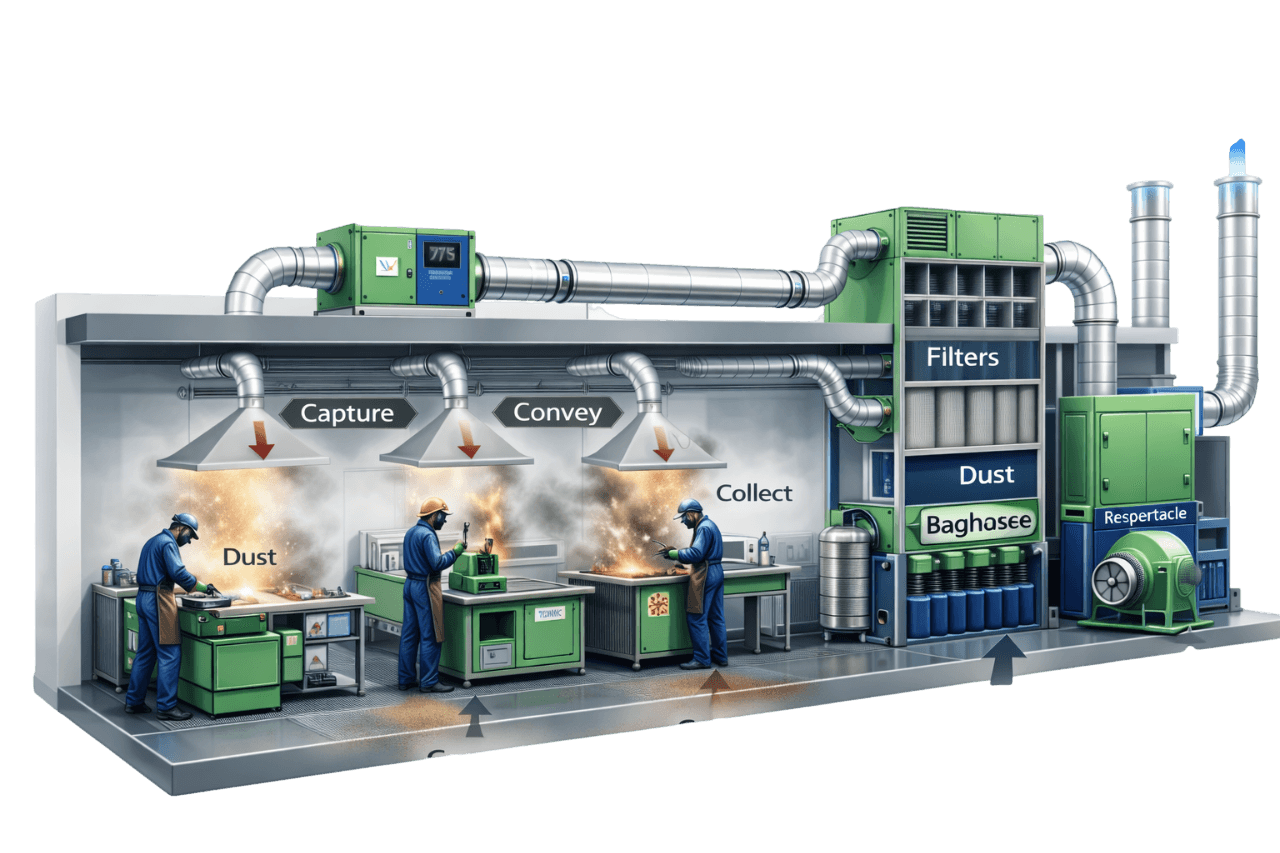
Dust Collection Systems
Learn More
Fume Extraction Systems
Learn More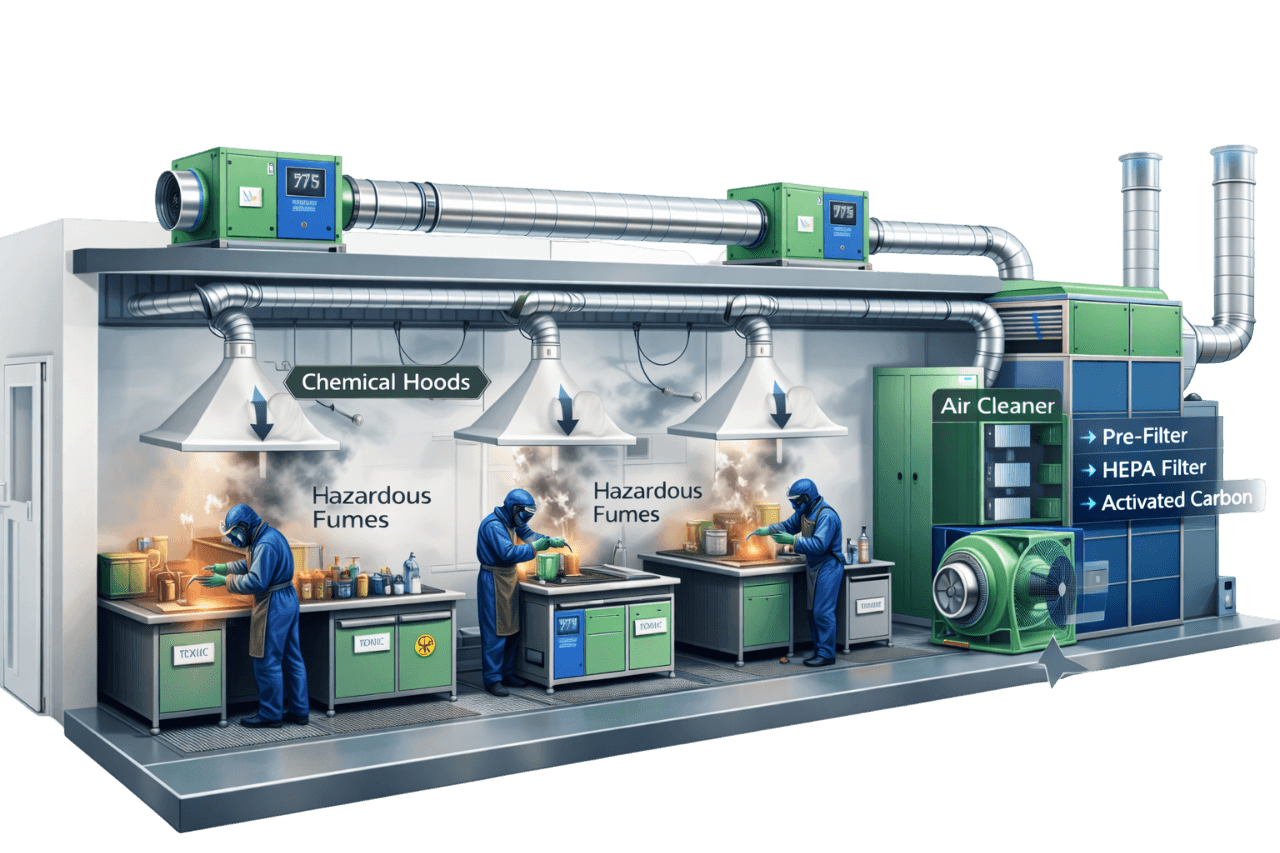
Chemical Exhaust Systems
Learn More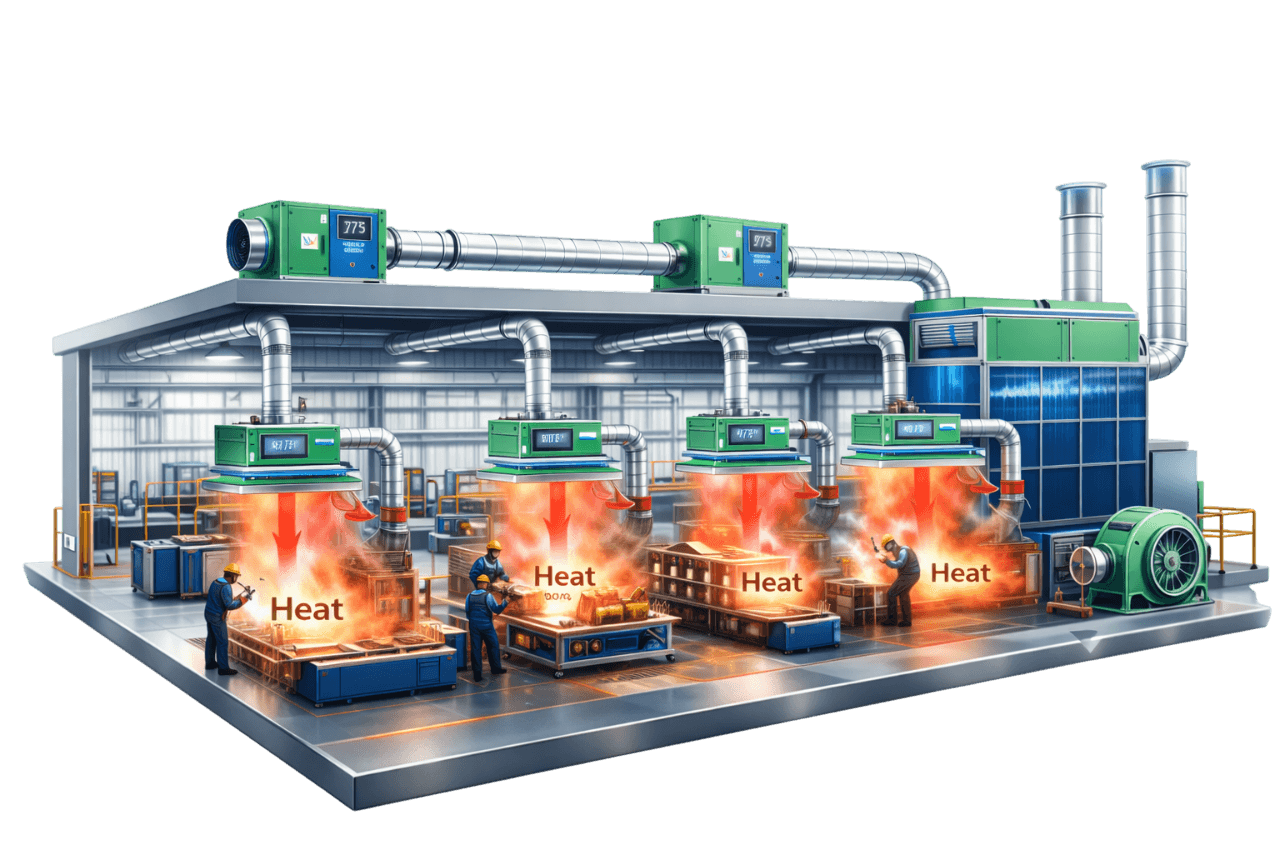
Heat Exhaust Ventilation Systems
Learn More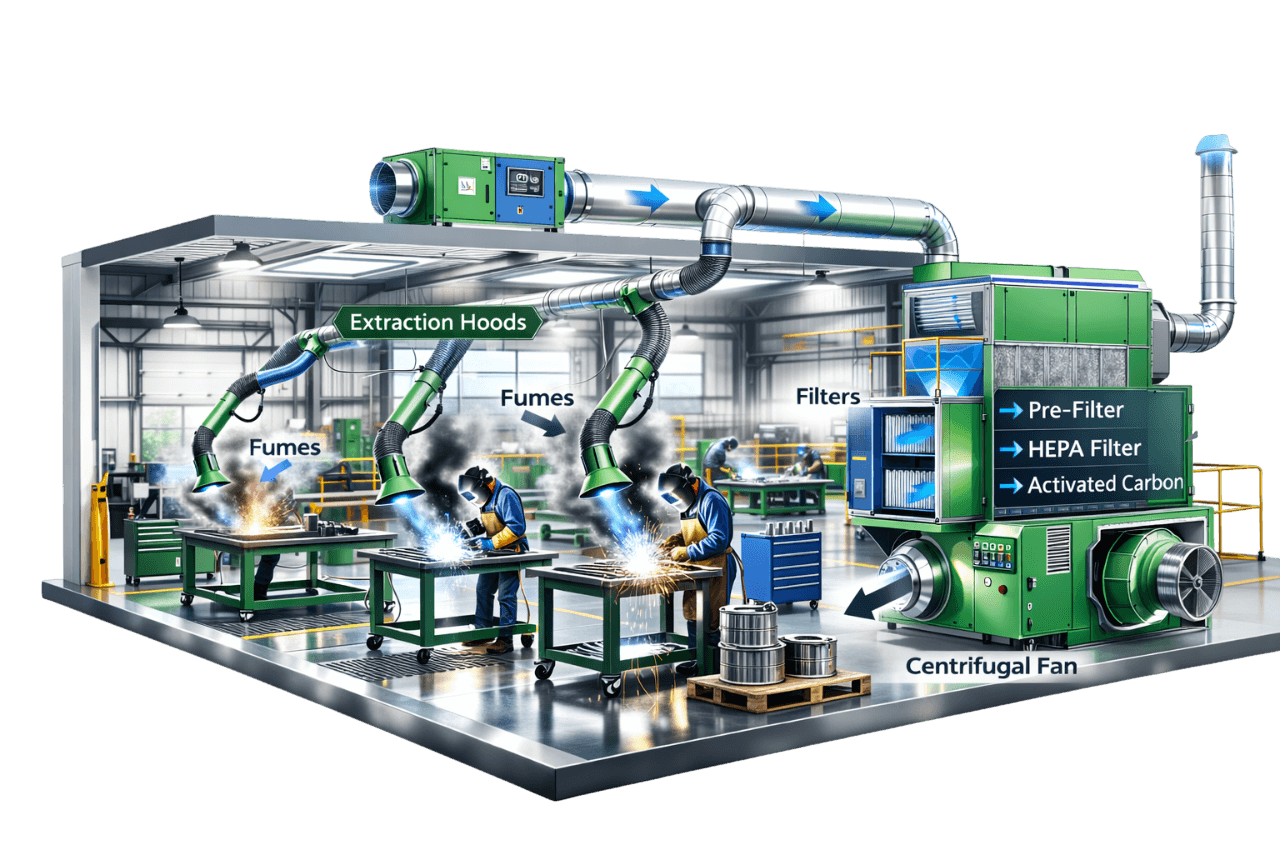
Welding Fume Extraction Systems
Learn More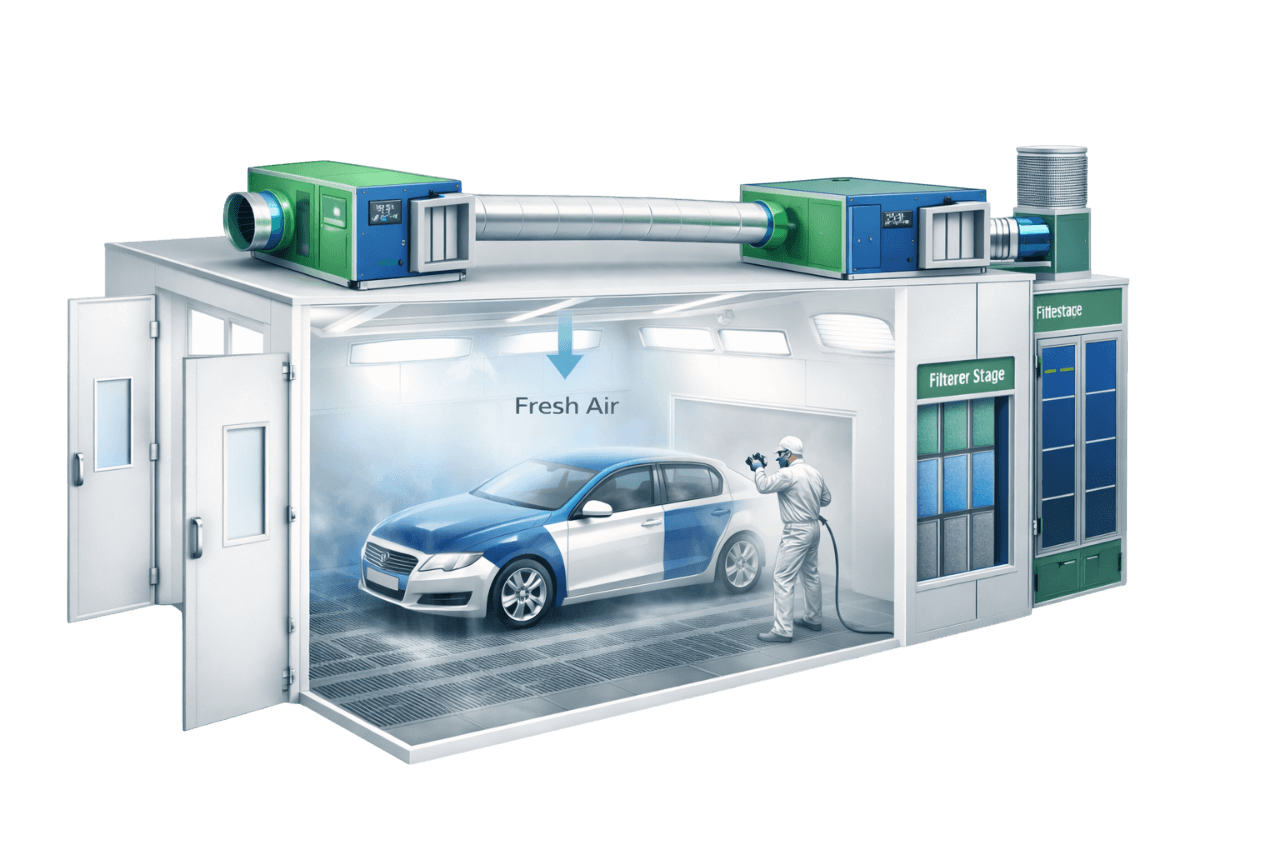
Paint Booth Ventilation Systems
Learn More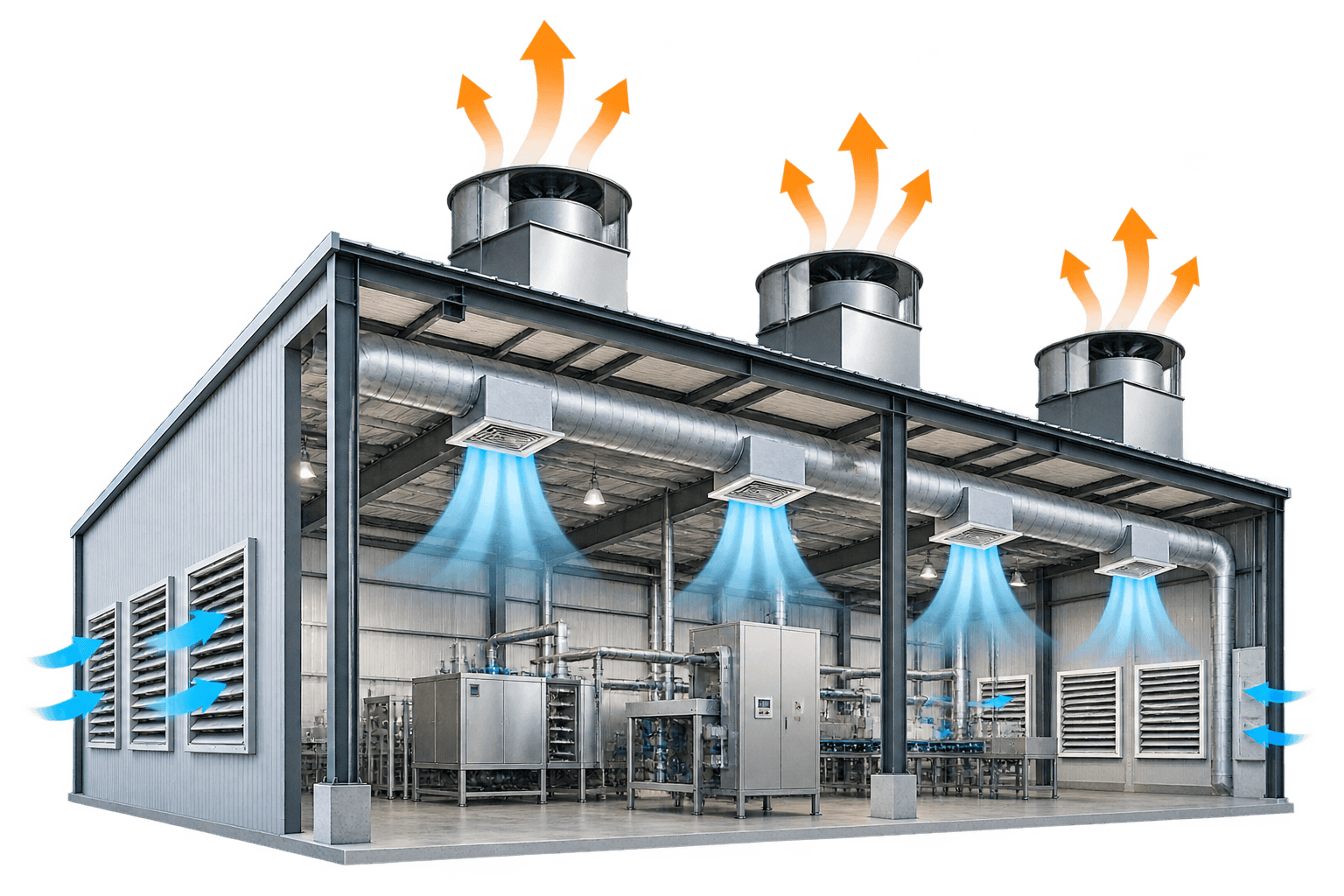
Industrial Dilution Ventilation Systems
Learn MoreFrequently Asked Questions
Q1: What is a local exhaust ventilation (LEV) system?
A local exhaust ventilation system is an engineered extraction system that captures dust, fumes, mists or vapours at the point where they are released, using a hood, ductwork, an air cleaner, a fan and a discharge stack. It prevents contaminants from reaching the worker's breathing zone and spreading through the workplace.
Q2: How does an LEV system work?
A hood captures the contaminant at the source, ductwork carries it at a set transport velocity to an air cleaner such as a dust collector or scrubber, and a fan provides the suction. Cleaned air is then released through a stack, away from building openings.
Q3: What is the difference between LEV and general ventilation?
LEV captures contaminants at the source before they spread. General or dilution ventilation mixes contaminated air with fresh air across the whole room. LEV gives better protection with less airflow and is preferred for dust, welding fume and toxic vapours.
Q4: What are the main components of an LEV system?
The main components are the hood or enclosure, ductwork with blast gates, an air cleaning device, an exhaust fan, a discharge stack, and airflow indicators or pressure gauges to monitor performance.
Q5: What types of hoods are used in LEV systems?
LEV systems use enclosing hoods such as booths and fume hoods, capturing hoods such as slot and flanged hoods, receiving hoods such as canopies and grinding guards, flexible extraction arms, downdraft tables and on-tool extraction.
Q6: What is capture velocity in LEV design?
Capture velocity is the air speed needed at the point of release to draw the contaminant into the hood. It ranges from about 0.25 m/s for vapours released into still air to 2.5 m/s or more for high-energy processes such as grinding.
Q7: Which industries need LEV systems?
LEV is used in welding and fabrication, pharma and API plants, chemical plants, laboratories, paint shops, grinding and polishing, woodworking, foundries, food processing, electronics, battery charging rooms and plastic, rubber and printing industries.
Q8: How are welding fumes extracted with LEV?
Welding fume is captured using extraction arms, fume hoods, fume extraction guns or downdraft welding tables, and filtered through cartridge collectors with pulse cleaning and spark arrestors. For multiple bays, a centralised welding fume extraction system is usually the most economical option.
Q9: Which dust collector or scrubber is used with an LEV system?
It depends on the contaminant. Cartridge collectors suit fine dry dust and welding fume, pulse-jet bag filters suit heavy dust loads, cyclones suit coarse particles, wet scrubbers suit acid fumes and soluble gases, carbon filters suit solvent vapours, and HEPA filters suit hazardous or potent dust.
Q10: How often should LEV systems be tested and inspected?
Operators should carry out simple visual and gauge checks weekly. A thorough examination and performance test by a competent engineer is recommended at least every 14 months, and more often for high-risk processes, with results recorded in the LEV log book.
Q11: What is the cost of an LEV system in India?
A portable fume extractor may cost ₹75,000 to ₹2.5 lakh, while centralised systems range from about ₹4 lakh for small setups to ₹50 lakh or more for large plants with dust collectors or scrubbers. The final cost depends on airflow, number of hoods, air cleaner type and materials.
Q12: Does Compress India design and install LEV systems in Mumbai?
Yes. Compress India designs, supplies, installs, tests and maintains LEV systems across Mumbai, Navi Mumbai and Thane, as well as other locations in Maharashtra and India. Contact our team to arrange a site survey and quotation.