Industrial Dilution Ventilation Systems
(Design, Supply, Installation, Testing, Commissioning & AMC for Factory & Plant Dilution Ventilation)
Design, Supply, Installation, Testing, Commissioning & AMC for Factory & Plant Dilution Ventilation
Not every contaminant in a factory comes from a single point you can put a hood over. Solvent vapours drift from open containers, forklifts move emissions around the warehouse, batteries release hydrogen while charging and production heat builds across an entire hall. Compress India designs and installs industrial dilution ventilation systems that bring in enough fresh air, mix it effectively and exhaust it in a controlled way to keep contaminants, heat and flammable vapours at safe levels throughout the workspace.
From a single battery charging room to whole-plant general ventilation for a large manufacturing facility, our systems are engineered around your processes, contaminant loads and building layout. Share your requirement for a free site survey and a detailed quotation.
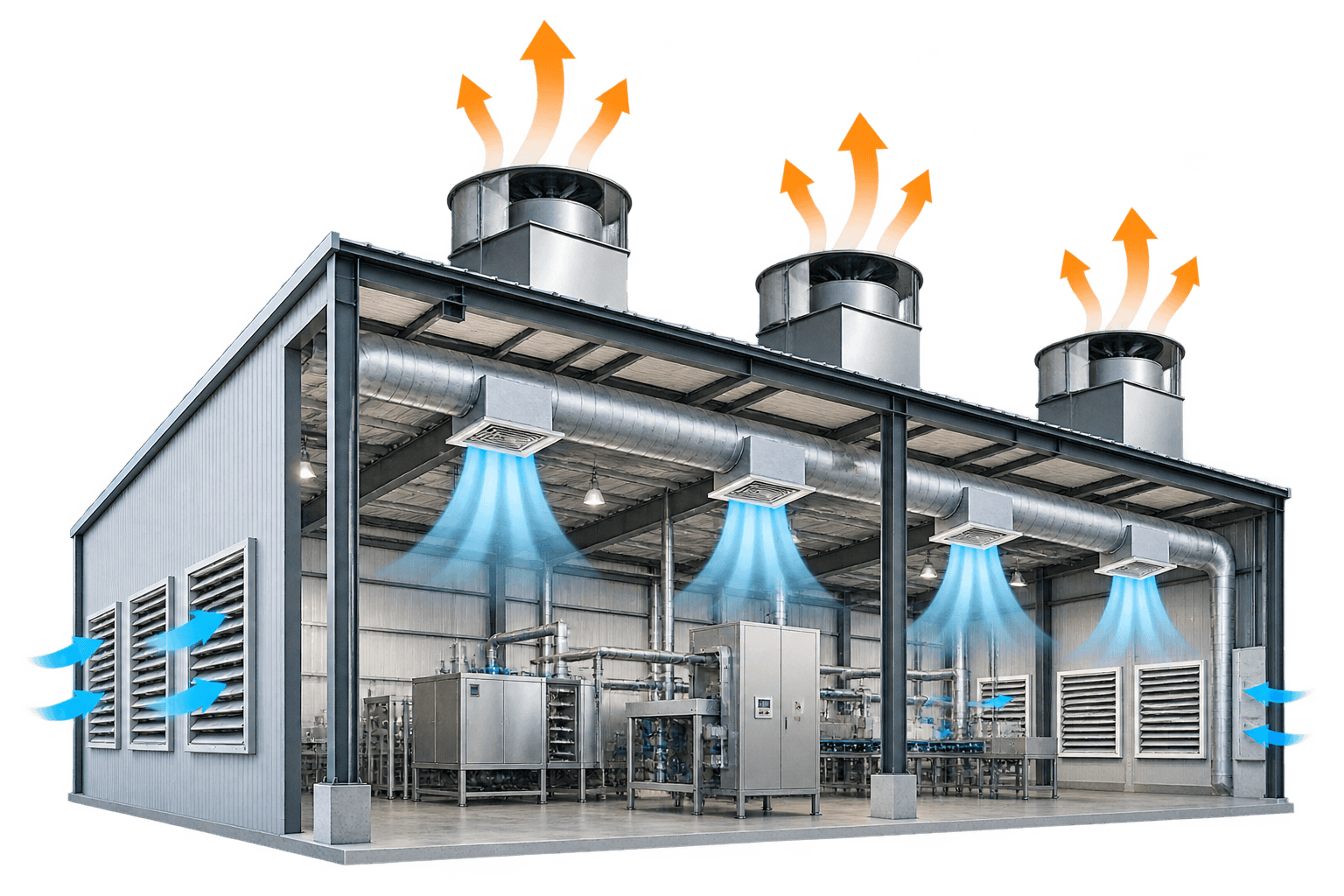
Compress India is an industrial ventilation contractor serving factories and plants in Mumbai, Thane, Navi Mumbai, the MIDC industrial areas and across India. We provide complete project delivery from assessment to long-term maintenance.
- Design: Process and contaminant inventory, generation rate estimation, dilution and LEL-based airflow calculation, heat load assessment, air change planning and CFD modelling where needed.
- Supply: Industrial roof exhaust fans, axial and centrifugal ventilation fans, make-up air units, evaporative air washers, louvres, dampers, gas detectors and controls.
- Installation: Fan and louvre installation, ductwork where required, gas detection, hazardous area electrical wiring and interlocks.
- Testing & Commissioning: Airflow and air change verification, smoke and tracer tests, gas detector calibration and alarm testing, with a documented performance report.
- AMC: Fan, louvre, gas detector, evaporative cooler and controls maintenance.
Whether you need an industrial dilution ventilation system for a manufacturing plant, industrial general ventilation for heat removal or industrial dilution ventilation with make-up air for a solvent area, we deliver a safe and efficient solution.
What Is an Industrial Dilution Ventilation System?
An industrial dilution ventilation system, also called industrial general ventilation or general exhaust ventilation, controls airborne contaminants by supplying clean outdoor air and exhausting contaminated air so that concentrations throughout the space stay below safe limits. Instead of capturing contaminants at the source, it dilutes them by mixing them with large volumes of fresh air.
Dilution ventilation is the right choice for low-toxicity contaminants released from many small or moving sources, such as solvent vapours from multiple workstations, forklift exhaust in warehouses or hydrogen in battery charging areas. It is also widely used for industrial heat removal ventilation, keeping large production halls within comfortable and safe temperatures.
A typical industrial dilution ventilation system includes:
- Industrial roof exhaust fans or wall-mounted axial fans
- Make-up air units, evaporative air washers or intake louvres for fresh air
- Dampers and, where needed, ductwork for air distribution
- Gas detectors and LEL sensors for demand control and safety
- Control panels, VFDs and interlocks
These systems may also be described as industrial air exchange systems, whole space industrial ventilation, industrial supply exhaust ventilation or industrial mechanical ventilation.
Why Factories & Plants Need Dilution Ventilation
Even with good process design, factories release vapours, gases, heat and moisture into the general workspace. Industrial dilution ventilation keeps these under control across the entire building.
Diluting Process Vapours & Gases
Solvent-based processes, cleaning, coating, curing and chemical handling release vapours that spread through the work area. Industrial vapor dilution ventilation keeps concentrations below occupational exposure limits where local capture of every source is impractical.
Controlling Heat & Humidity from Production
Machines, ovens, furnaces, dryers and steam processes raise temperature and humidity across production halls. Industrial heat dilution ventilation removes this heat and moisture, reducing heat stress and protecting equipment and products.
Keeping Flammable Vapours Below LEL
Where flammable vapours or hydrogen can accumulate, dilution ventilation keeps concentrations well below the lower explosive limit (LEL), a fundamental fire and explosion safety measure in solvent stores, mixing rooms and battery charging areas.
Removing Forklift & Engine Emissions
Diesel and LPG forklifts, trucks at loading docks and engine test areas release carbon monoxide, nitrogen dioxide and diesel exhaust. Dilution ventilation, often controlled by gas sensors, keeps these emissions at safe levels in warehouses and factories.
Meeting Factory Safety Requirements
Indian occupational safety law requires adequate ventilation by the circulation of fresh air and protection from harmful vapours, gases and heat. A properly engineered and commissioned dilution ventilation system provides clear evidence of compliance during inspections and audits.
Industrial Contaminants Controlled by Dilution Ventilation
Industrial contaminant dilution works best for contaminants that are low in toxicity, released at a steady and predictable rate, and spread across the workspace rather than concentrated at one point.
Solvent & VOC Vapours
Solvent vapor dilution ventilation handles vapours from cleaning, degreasing, coating, printing, adhesive application and open containers. It keeps concentrations below exposure limits and flammable levels where many small sources make local capture impractical.
Hydrogen from Battery Charging
Lead-acid and other vented batteries release hydrogen during charging, particularly towards the end of the charge. Hydrogen dilution ventilation removes it from ceiling level before it can accumulate toward its lower explosive limit.
CO & NO₂ from Forklifts & Engines
Diesel and LPG forklifts, vehicles at loading bays and engine testing release carbon monoxide and nitrogen dioxide. Industrial gas dilution ventilation, controlled by CO and NO₂ sensors, keeps these gases within safe limits in warehouses and plants.
Process Heat & Moisture
Ovens, dryers, kettles, washers and steam processes release heat and moisture that make work areas uncomfortable and can damage products and buildings. Dilution ventilation removes the excess heat and humidity with the exhaust air.
Odours from Food & Chemical Processing
Cooking, frying, fermentation, rendering and chemical processing can produce strong odours that spread through the plant. General ventilation dilutes and removes these odours, improving comfort for workers and neighbours.
Low-Toxicity Process Gases
Gases such as carbon dioxide from fermentation and low-toxicity process gases can be controlled by dilution where their release rate is predictable and exposure limits are not extremely low. Highly toxic gases, however, need local exhaust or enclosure.
How Industrial Dilution Ventilation Works
Effective dilution ventilation depends on moving the right amount of air along the right path through the building.
1. Make-Up Air Enters at Low Level
Fresh outdoor air enters through low-level louvres, openings or make-up air units, preferably on the side of the building away from contaminant sources and exhaust discharges.
2. Air Sweeps Through the Work Zone
The fresh air moves across the work area, passing workers first and then the contaminant sources, so that people are in clean air and contaminants are carried away from them.
3. Contaminants Mix & Dilute to Safe Levels
As the air passes the sources, vapours, gases and heat mix into it and are diluted to concentrations below occupational exposure limits and well below flammable limits.
4. Roof or Wall Fans Exhaust Diluted Air
Industrial roof exhaust fans or wall-mounted fans near the sources remove the diluted air from the building, discharging it where it cannot re-enter through intakes.
5. Sensors Adjust Ventilation to Actual Conditions
Gas detectors, LEL sensors and temperature sensors adjust fan speed or stage fans on and off, delivering more airflow when contaminant levels or temperatures rise and saving energy when they fall.
Main Components of an Industrial Dilution Ventilation System
Compress India selects every component for the airflow, contaminants, hazards and environment of your plant.
Roof Exhaust Fans & Powered Ventilators
Industrial roof exhaust fans and powered roof ventilators remove contaminated and hot air from the highest point of the building, where warm vapours and heat collect. They are available as axial, mixed-flow and centrifugal designs, including flameproof versions for hazardous areas.
Wall-Mounted Axial Exhaust Fans
Industrial axial ventilation fans mounted on walls, with louvres or exhaust fan shutters, provide cost-effective exhaust in workshops, warehouses and production sheds. Heavy duty industrial exhaust fans in larger sizes handle high airflows efficiently.
Make-Up Air Units & Evaporative Air Washers
Make-up air units supply filtered fresh air to replace exhausted air, while evaporative air washers cool the incoming air in hot conditions. Industrial make up air ensures the building does not go into excessive negative pressure and that fresh air reaches the work zone.
Intake Louvres & Dampers
Weather and sand trap louvres admit fresh air while keeping out rain and dust. Motorised dampers open with fans and close when the system is off.
Industrial Ductwork (Where Required)
Ducted industrial dilution ventilation is used where fresh air must be delivered to specific zones, or exhaust must be drawn from low-level points such as heavier-than-air vapour areas. Ductwork is sized for correct air distribution and static pressure.
Gas Detectors & LEL Sensors
Gas detectors for VOCs, CO, NO₂, hydrogen or ammonia, and LEL sensors for flammable vapours, provide both demand control and safety alarms. They can start or speed up fans automatically when levels rise.
Control Panels & VFDs
Control panels manage fan staging, interlocks and alarms. An industrial ventilation VFD adjusts fan speed to demand, saving energy and allowing precise airflow control.
Types of Industrial Dilution Ventilation Systems
The right configuration depends on building size, contaminants, climate and the need for pressure control. Compress India designs every type.
Exhaust-Based Dilution with Natural Make-Up Air
Exhaust fans remove air mechanically while fresh air enters naturally through louvres, doors and openings. This simple, economical approach keeps the building under slight negative pressure and suits many workshops and warehouses.
Supply-Based Dilution with Make-Up Air Units
Make-up air units push filtered, and often cooled, fresh air into the building, with exhaust through relief openings or fans. This creates slight positive pressure, keeps dust out and delivers conditioned air directly to the work zone.
Balanced Push-Pull Dilution Ventilation
Balanced systems combine mechanical supply and mechanical exhaust, with supply introduced on one side and exhaust drawn from the other. This gives the best control of air paths and pressure in large production halls.
Hybrid Dilution + Local Exhaust Systems
Many plants use local exhaust ventilation for high-emission or high-toxicity sources and dilution ventilation for the remaining background contamination and heat. This hybrid approach gives effective protection at the lowest total airflow.
Emergency Dilution Ventilation for Gas Leaks
Emergency ventilation systems start automatically when gas detectors sense a leak of ammonia, solvent vapour or other hazardous gas, rapidly increasing airflow to dilute and remove it.
Heat Relief Dilution Ventilation
Heat relief ventilation uses high airflows, often with evaporative make-up air, to remove process and roof heat from production halls, improving comfort and reducing heat stress.
Industrial Dilution Ventilation vs Local Exhaust Ventilation (LEV)
LEV captures contaminants at the source before they reach workers; dilution ventilation lowers concentrations after contaminants have mixed into the room air. The two are complementary, and choosing correctly is central to effective industrial ventilation.
| Factor | Industrial Dilution Ventilation | Local Exhaust Ventilation (LEV) |
|---|---|---|
| Principle | Dilute contaminants with large volumes of fresh air | Capture contaminants at the point of release |
| Best for | Low-toxicity vapours and gases, heat, many or mobile sources | Toxic dusts, fumes, mists and high-emission point sources |
| Worker protection | Depends on mixing and air path | Direct protection of the breathing zone |
| Airflow needed | High | Low, focused |
| Energy cost | Higher, especially with conditioned make-up air | Lower for the same protection level |
| Treatment before discharge | Rarely practical due to high air volume | Easy to filter or scrub |
In short, general exhaust vs local exhaust is not an either-or decision. Compress India designs source capture where it is needed and dilution ventilation for the rest.
Industrial vs Commercial Dilution Ventilation
Industrial and commercial dilution ventilation use similar fans and principles, but they are designed around very different loads and risks.
| Factor | Industrial Dilution Ventilation | Commercial Dilution Ventilation |
|---|---|---|
| Design basis | Contaminant generation, exposure limits, LEL, heat load | Occupancy, odour and comfort |
| Typical spaces | Factories, warehouses, battery rooms, solvent stores | Offices, malls, car parks, toilets, kitchens |
| Hazards | Flammable vapours, toxic gases, high heat | Mainly CO in car parks, odours and CO₂ |
| Equipment | Heavy duty industrial fans, flameproof motors, gas detectors | Commercial exhaust fans, inline fans, CO sensors |
| Airflow levels | Often very high | Moderate |
When Industrial Dilution Ventilation Works Best
Dilution ventilation is the right choice when specific conditions are met. Where they are not, local exhaust ventilation is usually needed.
Low-Toxicity Contaminants from Many Sources
Dilution works best for contaminants with relatively high exposure limits, released in small amounts from many points across the work area, where fitting a hood to each source would be impractical.
Large Open Production Halls
Large halls with high roofs and open layouts suit whole space industrial ventilation, as long as air can move freely from inlets to exhaust points without dead zones.
Mobile Sources like Forklifts
Forklifts, vehicles and portable equipment move around, so their emissions cannot be captured locally. Sensor-controlled dilution ventilation handles these mobile sources effectively.
When to Combine Dilution with LEV
Where some sources release toxic dust, fume or high vapour volumes, those should be captured with LEV, while dilution ventilation handles background contamination, heat and minor sources. This combination gives the best protection at the lowest airflow.
Special Industrial Applications
Some areas need dilution ventilation designed specifically for their hazards. Compress India has the experience to engineer these critical systems.
Battery Charging Areas (Hydrogen Dilution)
Battery charging areas need battery room dilution ventilation that removes hydrogen from ceiling level and keeps it well below its lower explosive limit. Airflow is calculated from the number of cells and charging current, using methods such as those in the IEC 62485 series, with spark-resistant fans and hydrogen detection where required.
Solvent Stores & Paint Mixing Rooms
Solvent stores and paint mixing rooms need continuous exhaust, often from low level, because most solvent vapours are heavier than air. Flameproof fans, LEL monitoring and interlocks keep these areas safe.
Ammonia Refrigeration Machinery Rooms
Ammonia machinery rooms need continuous ventilation and emergency ventilation that starts automatically on ammonia detection. Design follows recognised refrigeration safety standards, with exhaust discharged safely away from occupied areas.
Warehouses with Forklift Traffic
Warehouse dilution ventilation controlled by CO and NO₂ sensors keeps forklift emissions within safe limits while minimising energy use during low-traffic periods.
Printing & Coating Halls
Printing presses, laminators and coating machines release solvent vapours across large areas. Dilution ventilation, combined with local capture at the highest-emission points, keeps vapour levels and odours under control.
Textile Mills (Heat & Humidity Control)
Textile mills need high air change rates to remove machine heat while maintaining the humidity levels that spinning and weaving require. Dilution ventilation is designed alongside humidification and air washer systems.
Industrial Ventilation Standards & Regulations
Industrial dilution ventilation design draws on Indian law and recognised international guidance. Compress India applies these references throughout design and commissioning.
Factories Act Ventilation Provisions
The Factories Act, 1948 required every workroom to have adequate ventilation by the circulation of fresh air, reasonable temperatures and measures against harmful dust, fumes and gases. These duties continue under the Occupational Safety, Health and Working Conditions Code, 2020, operative since 21 November 2025, with State Factory Rules such as the Maharashtra Factories Rules guiding practical compliance.
ACGIH Industrial Ventilation Guidelines
The ACGIH manual Industrial Ventilation: A Manual of Recommended Practice for Design is the most widely used engineering reference for industrial ventilation. It sets out dilution ventilation equations, mixing factors, LEL-based calculations and guidance on when dilution is appropriate.
Occupational Exposure Limits (TLV / PEL)
Dilution ventilation is designed to keep contaminant concentrations below occupational exposure limits, such as ACGIH Threshold Limit Values and permissible exposure limits set by regulators. For example, the ACGIH TLVs for carbon monoxide and nitrogen dioxide, key forklift pollutants, are 25 ppm and 0.2 ppm respectively as eight-hour averages.
LEL Safety Margins for Flammable Vapours
For flammable vapours, ventilation is designed to keep concentrations at a safe fraction of the lower explosive limit, commonly no more than 25% of LEL, with gas detection alarms set well below that level. Hydrogen, for example, has an LEL of about 4% by volume in air.
Hazardous Area Classification (IS/IEC 60079)
The IS/IEC 60079 series governs hazardous area classification and equipment for explosive atmospheres in India. The degree and availability of ventilation directly influence the zone classification, which in turn determines the fans, motors and electrical equipment that can be used.
Ammonia Machinery Room Standards (IIAR & ASHRAE 15)
IIAR standards and ASHRAE 15 set requirements for ammonia refrigeration machinery rooms, including continuous and emergency ventilation, ammonia detection, alarm levels and safe discharge. They are the leading references for cold storage and food processing plants.
Industrial Dilution Ventilation Design & Sizing
Industrial dilution ventilation design must be calculated, not guessed. Too little air leaves workers exposed; too much wastes energy. Compress India's industrial dilution ventilation calculation follows recognised engineering methods.
Process & Contaminant Inventory
We list every process, chemical, fuel-burning vehicle and heat source in the space, along with quantities used, operating hours and exposure limits. This identifies which contaminants can be diluted and which need local capture.
Contaminant Generation Rate Estimation
The rate at which each contaminant enters the air is estimated from solvent consumption, evaporation rates, engine data, battery charging currents or process data. An accurate generation rate is the foundation of a reliable design.
Dilution Airflow & Mixing Factor (K)
The basic dilution airflow is the contaminant generation rate divided by the acceptable concentration, multiplied by a mixing factor (K) that accounts for imperfect mixing and uneven release. K typically ranges from about 3 to 10 depending on air distribution quality and contaminant toxicity. For a liquid solvent, industrial dilution ventilation CFM, expressed in m³/h, is:
Q = (24.45 × 10⁶ × SG × ER × K) ÷ (MW × C)
where SG is the solvent's specific gravity, ER the evaporation rate in litres per hour, MW its molecular weight and C the acceptable concentration in ppm.
LEL-Based Airflow Calculation
For flammable vapours, a separate calculation determines the airflow needed to keep concentrations at a safe fraction of the LEL, usually 25% or less. Temperature and process conditions are factored in, and the design uses whichever is higher: the exposure-based or LEL-based airflow.
Heat & Moisture Removal Airflow
Where heat is the main concern, airflow is calculated from the sensible heat load and allowable temperature rise, and from moisture generation for humid processes. Heat often governs total airflow in hot production halls.
Air Changes per Hour for Industrial Buildings
Industrial ventilation ACH provides a useful cross-check. Low-load storage areas may need only a few air changes per hour, while hot process areas can need 15 to 30 or more. We always confirm ACH against calculated contaminant and heat airflows rather than using it alone.
Fan & Inlet Placement for Effective Air Sweep
Inlets are placed so fresh air reaches workers before passing contaminant sources, and exhaust fans are placed close to sources and high where heat and light vapours collect, or low where heavy vapours settle. Good placement reduces the airflow needed.
Make-Up Air Planning
Industrial dilution ventilation with make-up air ensures exhausted air is replaced in a controlled way. Make-up air is filtered, and cooled where beneficial, and delivered where it supports the intended air path.
CFD Modelling for Large Halls
Industrial dilution ventilation CFD simulations predict airflow patterns, contaminant concentrations and temperatures across large or complex halls, revealing dead zones and short-circuiting before installation.
Safety in Industrial Dilution Ventilation
Where dilution ventilation protects against flammable or toxic gases, the ventilation system itself becomes a safety-critical system. Compress India designs it accordingly.
Flameproof & Spark-Resistant Fans
Fans handling flammable vapours or hydrogen are selected with flameproof motors certified for the hazardous area and spark-resistant construction, removing the fan as a potential ignition source.
Emergency Ventilation Activation
Emergency ventilation starts automatically when gas detectors sense a release, rapidly increasing airflow to dilute and remove the gas. Manual emergency switches are also provided at safe locations.
Gas Detection Interlocks & Alarms
Gas detectors are interlocked with fans, alarms, beacons and, where appropriate, process shutdowns, so that a gas release triggers a coordinated safety response.
Fail-Safe Fan Monitoring
Airflow switches or current monitoring confirm that fans are actually running. If a critical fan fails, alarms sound and standby fans or process interlocks take over.
Energy Efficiency in Industrial Dilution Ventilation
Because dilution ventilation moves large volumes of air, energy efficiency makes a major difference to running costs. An energy efficient industrial dilution ventilation system delivers safety without wasting power.
Sensor-Based Demand Control
Gas sensor controlled industrial ventilation and demand controlled industrial ventilation adjust airflow to actual contaminant levels, running fans harder only when needed.
VFD & EC Fans
VFDs and industrial EC ventilation fans vary speed smoothly with demand. Because fan power falls sharply with speed, reducing airflow during low-emission periods saves significant energy.
Evaporative Cooling of Make-Up Air
Evaporative air washers cool incoming air at a fraction of the energy of refrigerated cooling, improving comfort in hot production halls without large air conditioning loads.
Natural & Hybrid Ventilation
Natural ventilation through louvres, ridge vents and turbine ventilators provides base airflow at zero energy cost, with mechanical fans added for peak conditions or hazardous areas.
Reducing Airflow Through Source Control
Capturing the highest-emission sources with LEV, covering containers and substituting less volatile materials can dramatically reduce the dilution airflow required, cutting both capital and running costs.
Controls & Monitoring
Modern controls make industrial dilution ventilation safer, smarter and easier to manage.
VOC, CO, NO₂, H₂ & NH₃ Gas Detectors
We select and position gas detectors for the specific contaminants in each area: VOC sensors for solvent areas, CO and NO₂ for forklift zones, hydrogen for battery rooms and ammonia for refrigeration plants.
LEL Monitoring
Catalytic or infrared LEL sensors monitor flammable vapour concentrations as a percentage of the lower explosive limit, triggering increased ventilation and alarms at preset levels.
Temperature & Humidity Control
Temperature and humidity sensors stage fans and evaporative coolers to maintain comfortable, stable conditions in production areas.
PLC, SCADA & BMS Integration
Industrial ventilation BMS integration brings fan status, gas levels, alarms and energy data onto your PLC, SCADA or building management system for central monitoring and control.
Worker Exposure Monitoring
Periodic personal air sampling confirms that workers' actual exposures remain below occupational exposure limits and validates the ventilation design.
Benefits of Industrial Dilution Ventilation
A properly engineered dilution ventilation system protects people and property across your entire facility.
Safer Air Across Large Work Areas
Dilution ventilation lowers contaminant concentrations throughout the workspace, not just at individual workstations, protecting everyone in the area.
Handles Multiple & Mobile Sources
It controls emissions from many small, scattered or moving sources, such as forklifts and open containers, that would be impractical to capture individually.
Lower Fire & Explosion Risk
Keeping flammable vapours and hydrogen well below explosive limits significantly reduces fire and explosion risk in stores, mixing rooms and battery areas.
Heat Relief & Better Productivity
Removing process heat and humidity improves comfort, reduces heat stress and helps workers stay productive through hot seasons.
Lower Cost Than Full LEV for Low-Hazard Areas
For low-toxicity contaminants from diffuse sources, dilution ventilation is often simpler and cheaper to install than fitting local exhaust to every source.
Limitations of Industrial Dilution Ventilation
Dilution ventilation is powerful but not universal. Understanding its limits ensures it is used where it works best.
Not Suitable for Toxic Dusts & Fumes
Highly toxic contaminants, dusts, welding fume and heavy mists need local exhaust ventilation. Dilution cannot reliably protect workers who are close to high-emission or high-toxicity sources.
High Airflow in Large Buildings
Diluting contaminants in large buildings requires high airflows, which increase fan energy and, where make-up air is conditioned, heating or cooling costs.
Contaminants Pass Through Work Zones
Contaminants mix into room air before being removed, so workers near sources can still be exposed to higher concentrations than the room average.
Performance Depends on Air Distribution
Poorly placed inlets and fans can create dead zones and short-circuiting, leaving parts of the building under-ventilated even when total airflow is adequate.
Industries Using Dilution Ventilation Systems
Compress India designs industrial dilution ventilation for a wide range of sectors.
Manufacturing Plants
Manufacturing dilution ventilation removes heat, vapours and background contaminants from production halls, assembly areas and process zones.
Warehouses & Logistics Hubs
Warehouses and logistics hubs use sensor-controlled dilution ventilation to control forklift emissions and roof heat.
Chemical & Solvent Handling Areas
Chemical process general ventilation dilutes vapours in drum stores, dispensing areas and process buildings, with flameproof equipment where required.
Pharmaceutical Warehouses & Production Areas
Pharmaceutical warehouses and solvent-handling production areas use dilution ventilation for vapour control, heat removal and safe storage conditions.
Printing & Packaging Units
Printing presses, laminators and coating lines release solvent vapours and heat that dilution ventilation keeps under control.
Plastics & Rubber Processing
Moulding, extrusion and vulcanising areas generate heat, odours and low-level vapours that are effectively managed with general ventilation.
Food & Beverage Plants
Food processing plants use dilution ventilation to remove heat, moisture and odours from cooking, frying, baking and fermentation areas.
Textile Mills
Textile mills need high air change rates for heat removal, combined with humidity control for fibre processing.
Foundries & Metal Workshops
Foundries and metal workshops use dilution ventilation for heat relief and background fume control, alongside local exhaust at major sources.
Battery Charging & Forklift Maintenance Areas
Battery charging rooms and forklift maintenance areas need hydrogen dilution ventilation and exhaust for vehicle emissions.
Cold Storage & Ammonia Plants
Cold storage and ammonia refrigeration plants need machinery room ventilation and emergency exhaust linked to ammonia detection.
Top Industrial Ventilation Brands in India
Industrial ventilation projects in India can draw on strong international and domestic fan brands. As an industrial ventilation supplier and contractor, Compress India takes a multi-brand, application-first approach, comparing fans on airflow, efficiency, hazardous area certification, noise and service support before designing and installing the complete system.
Kruger
Kruger is a Singapore-headquartered fan manufacturer with a strong presence in India, known for centrifugal, inline and axial fans used in HVAC and industrial ventilation.
Systemair
Systemair is a Swedish ventilation company offering a broad range of axial, roof, inline and centrifugal fans, along with air handling and air distribution products.
Nicotra Gebhardt
Nicotra Gebhardt is a fan brand with Italian and German roots, known for centrifugal fans, plug fans and fan modules for air handling and industrial applications.
Greenheck
Greenheck is a US-based manufacturer of air movement and control equipment, including roof exhaust fans, industrial fans, louvres and dampers.
Almonard
Almonard is an Indian manufacturer of industrial fans, including exhaust fans, air circulators and ventilation fans for factories and commercial spaces.
Other Industrial Ventilation Brands
Leading Indian electrical brands offer heavy duty industrial exhaust fans, while specialist manufacturers supply flameproof fans, evaporative air washers, turbine ventilators and gas detection systems. We help you choose the right combination for performance and value.
*Brand names are trademarks of their respective owners and are mentioned for reference only.*
Industrial Dilution Ventilation Installation Guide
Industrial dilution ventilation installation must deliver the designed air path, not just the designed airflow. Compress India's teams install every system with that goal in mind.
Site Survey & Process Mapping
We map processes, contaminant sources, heat sources, forklift routes, existing openings, roof structure and nearby air intakes, and take baseline temperature and gas readings where useful.
Roof & Wall Fan Installation
Roof exhaust fans are mounted on curbs with weatherproof flashing, and wall fans are installed in framed openings with louvres or shutters, all positioned to create the intended air sweep.
Make-Up Air & Louvre Installation
Make-up air units, evaporative air washers and intake louvres are installed at low level, away from exhaust discharges and contaminated outdoor air.
Ductwork Installation
Where ducted distribution or low-level exhaust is required, industrial ductwork is fabricated, supported and sealed to deliver balanced airflow.
Gas Detector Installation
Gas detectors are mounted at the correct height for each gas: high for hydrogen and other light gases, low for heavier solvent vapours, and at breathing height for CO and NO₂.
Hazardous Area Electrical Wiring
Electrical work in classified areas uses certified flameproof motors, junction boxes, cable glands and fittings installed to the relevant IS/IEC 60079 requirements.
Control Panel & Interlocks
Control panels, VFDs, gas detection controllers and interlocks are installed and wired so fans respond automatically to gas levels, temperature and alarms.
Testing & Commissioning
Industrial dilution ventilation commissioning confirms that the system delivers safe conditions across the whole space.
Airflow & Air Change Verification
We measure airflow at fans, louvres and make-up air units, and calculate achieved air changes per hour against design values.
Smoke & Tracer Gas Tests
Smoke tests reveal air paths, dead zones and short-circuiting, while tracer gas tests can quantify ventilation effectiveness in critical areas.
Gas Detector Calibration & Alarm Testing
Gas detectors are calibrated with certified test gases, and alarms, fan responses and interlocks are tested at each set point.
Worker Exposure Monitoring
On request, personal air sampling measures actual worker exposure to confirm that concentrations remain below occupational exposure limits.
Performance Report
You receive a performance report covering airflows, air change rates, test results, gas detector settings and recommendations, along with operation and maintenance manuals.
Industrial Dilution Ventilation Service, Maintenance & AMC
Industrial dilution ventilation maintenance keeps airflow, safety systems and energy efficiency at design levels. Compress India's AMC covers the complete system.
Fan, Motor, Belt & Bearing Checks
Fans and motors are checked for vibration, bearing wear, belt condition, blade build-up and current draw to prevent unexpected failures.
Louvre, Damper & Filter Cleaning
Louvres, bird screens, dampers and make-up air filters are cleaned so fresh air can enter freely and dampers operate correctly.
Gas Detector Calibration
Gas detectors are bump-tested and calibrated at recommended intervals, and sensors are replaced at the end of their service life.
Evaporative Cooler Maintenance
Evaporative pads, water tanks, pumps and distribution systems are cleaned and serviced to prevent scaling, odours and bacterial growth.
Controls & Interlock Checks
Control sequences, VFD settings, alarms and interlocks are tested to confirm that the system responds correctly to gas levels and temperatures.
Common Industrial Dilution Ventilation Problems & Solutions
Most dilution ventilation problems come from air distribution rather than fan capacity alone. Compress India diagnoses and fixes issues in existing systems.
Dead Zones in Large Halls
Cause: Inlets and exhaust fans placed so that air bypasses parts of the building. Solution: Relocate or add fans and inlets, add supply air distribution or HVLS fans, and use CFD to plan the corrected air path.
Vapour Build-Up Near Sources
Cause: Emission rates too high for dilution or exhaust points far from sources. Solution: Add local exhaust at high-emission points, move exhaust closer to sources or increase airflow in that zone.
Air Short-Circuiting
Cause: Inlets placed next to exhaust fans, so fresh air leaves without sweeping the work area. Solution: Separate inlets and exhausts across the space and redirect air paths through the occupied zone.
Gas Detector False Alarms
Cause: Uncalibrated or poisoned sensors, wrong sensor type or detectors placed near vents and doors. Solution: Recalibrate or replace sensors, select the right technology and reposition detectors correctly.
Heat & Humidity Build-Up
Cause: Insufficient airflow for the heat load, blocked louvres or too little exhaust relative to evaporative supply. Solution: Increase exhaust, clean louvres, rebalance supply and exhaust and add humidity-based controls.
Fan Failures in Harsh Environments
Cause: Standard fans exposed to corrosive vapours, heat, dust or moisture. Solution: Upgrade to corrosion-resistant, high temperature or flameproof fans with motors outside the airstream, supported by regular AMC checks.
High Energy Consumption
Cause: Fans running at full speed around the clock regardless of conditions. Solution: Add VFDs, gas sensor demand control, temperature staging and source control to cut unnecessary airflow.
Industrial Dilution Ventilation Retrofit & Upgrades
Existing general ventilation systems can often be made safer and more efficient with targeted upgrades.
Adding LEV for High-Emission Sources
Capturing the largest emission sources with local exhaust ventilation reduces the load on dilution ventilation and improves protection for nearby workers.
Gas Detection & Demand Control Upgrades
Adding gas detectors and demand control lets fans respond to actual contaminant levels, improving safety while reducing energy use.
Flameproof Fan Upgrades
Replacing standard fans with certified flameproof fans in solvent stores, mixing rooms and battery areas brings older installations up to current safety expectations.
CFD-Based Redesign of Air Distribution
CFD analysis of an existing building identifies dead zones and short-circuiting, guiding cost-effective changes to fan and inlet positions.
Evaporative Make-Up Air Retrofit
Adding evaporative make-up air units to exhaust-only systems improves fresh air delivery and cools the work zone in hot seasons.
Industrial Dilution Ventilation System Cost in India
The cost of an industrial dilution ventilation system depends on building size, required airflow, hazard level and controls. Because every plant is different, we price each project after a site survey, but the guide below helps you plan.
| Equipment | Typical Indicative Price per Unit (INR) | Main Price Drivers |
|---|---|---|
| Heavy duty wall exhaust fan, 18 to 24 inch | ₹5,000 to ₹25,000 | Size, motor rating, construction |
| Industrial roof exhaust fan, 600 mm and above | ₹25,000 to ₹1,50,000 | Size, airflow, drive type |
| Evaporative air washer or make-up air unit | ₹50,000 to ₹3,00,000 | Airflow, pad type, construction, controls |
*Indicative supply prices only, excluding GST and installation. Flameproof and corrosion-resistant fans cost more than standard units. Request a free quotation from Compress India for an accurate project figure.*
Cost by Building Size & Airflow
Total airflow, set by contaminant generation, LEL requirements and heat load, determines the number and size of fans and make-up air units. Larger buildings and higher hazard levels need more airflow and therefore larger systems.
Fans, Make-Up Air & Controls Cost
Fans are usually the largest single cost, followed by make-up air units and evaporative washers. VFDs, control panels and BMS integration add to capital cost but reduce running costs significantly.
Gas Detection & Safety Systems Cost
Gas detection costs depend on the number of detection points, the gases monitored, sensor technology and controller features. Flameproof equipment, emergency fans and backup power add further cost in hazardous areas.
Factors Affecting Total Project Cost
- Building size, height and layout
- Contaminant types, generation rates and hazard level
- Required airflow and air change rates
- Flameproof, spark-resistant or corrosion-resistant equipment
- Make-up air units and evaporative cooling
- Ductwork for air distribution or low-level exhaust
- Gas detection, LEL monitoring and alarm systems
- Controls: VFDs, PLC, SCADA or BMS integration
- CFD modelling for complex buildings
- AMC and sensor calibration over the system's life
A correctly engineered system avoids both unsafe under-ventilation and costly over-ventilation, giving you the best long-term value.
Industrial Dilution Ventilation in Mumbai, Thane, Navi Mumbai & MIDC Industrial Areas
Compress India provides industrial dilution ventilation design and installation across Mumbai, Thane, Navi Mumbai and the region's MIDC industrial areas, including the Thane-Belapur belt, Taloja, Dombivli, Ambernath and Tarapur, as well as the Bhiwandi warehousing hub. Our local teams offer quick site surveys, coordinated installation and responsive after-sales support.
The region's chemical, pharmaceutical, engineering, plastics, printing, food and logistics facilities face hot, humid summers, heavy monsoons and dense surroundings. We design ventilation that handles these conditions, keeping rain and dust out while moving enough air to control contaminants and heat.
For clients beyond the Mumbai region, we undertake industrial dilution ventilation projects across India with the same engineering and commissioning standards.
Why Choose Compress India for Industrial Dilution Ventilation?
As an industrial ventilation contractor, Compress India combines engineering-led design with hands-on installation and long-term support.
Industrial Ventilation Engineering Expertise
Our team specialises in industrial HVAC, dilution ventilation, local exhaust ventilation and fume control, so we choose the right mix of methods for every area of your plant.
Process & Hazard-Based Design
We design from your actual processes, chemicals, emission rates and hazards, calculating exposure-based, LEL-based and heat-based airflows rather than relying on rules of thumb.
CFD Airflow Planning
For large or complex halls, CFD modelling lets us optimise fan and inlet positions before installation, avoiding dead zones and costly rework.
Flameproof & Industrial Fan Selection
We select heavy duty, flameproof, spark-resistant and corrosion-resistant fans from multiple brands to match each area's duty and hazard classification.
Gas Detection & Safety Integration
We integrate gas detectors, LEL monitoring, alarms, emergency ventilation and interlocks into one coordinated safety system.
Testing & Commissioning
Every system is tested for airflow, air changes, air paths and gas detection response, and handed over with a clear performance report.
AMC & Retrofit Support
Our AMC keeps fans, louvres, gas detectors and controls performing reliably, and our retrofit team can upgrade existing systems as your plant grows.
Get an Industrial Dilution Ventilation Solution from Compress India
Safe air across your entire facility starts with the right assessment. Tell us about your processes, contaminants and building, and we will recommend the most effective and economical ventilation strategy.
Connect with Our HVAC Team
Share your requirement with Compress India's HVAC team today. Send us your building size, processes, chemicals used, forklift activity and current problems, and we will arrange a site survey and provide a detailed proposal and quotation.
Call us, email us or fill out the enquiry form to request a free site survey and quotation for your industrial dilution ventilation system.
Related Industrial HVAC, LEV & Ventilation Solutions
Dilution ventilation works best as part of a complete ventilation plan. Compress India also designs and installs:
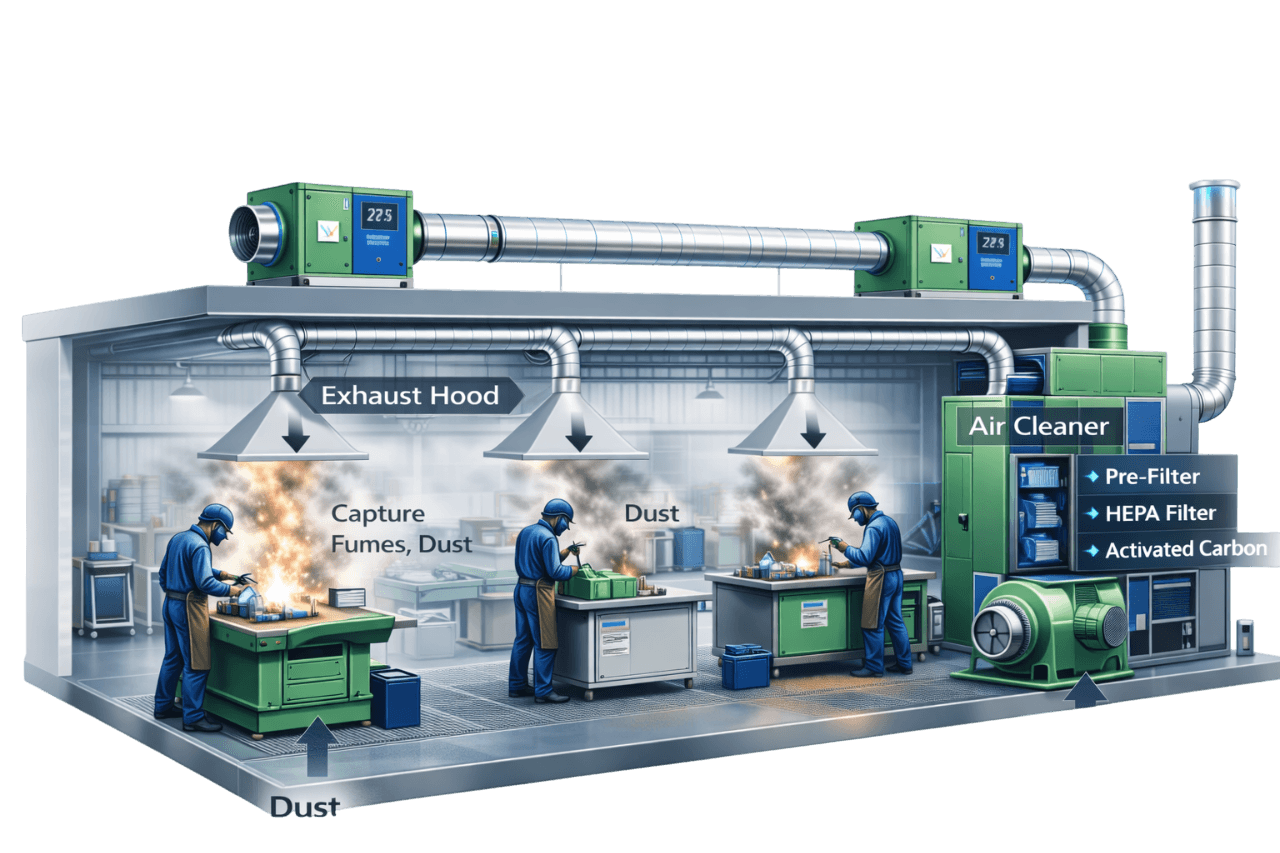
Local Exhaust Ventilation (LEV) Systems
Learn More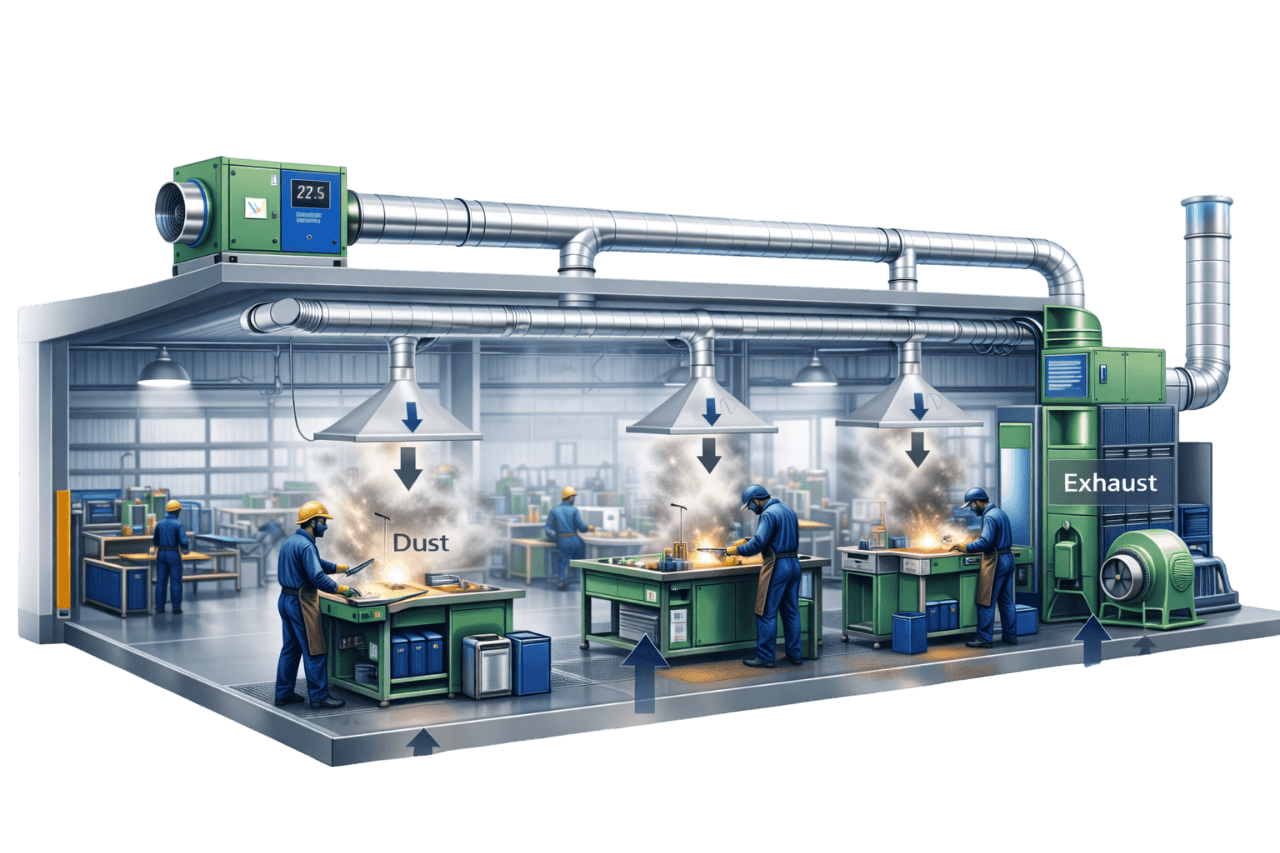
General Dilution Ventilation Systems
Learn More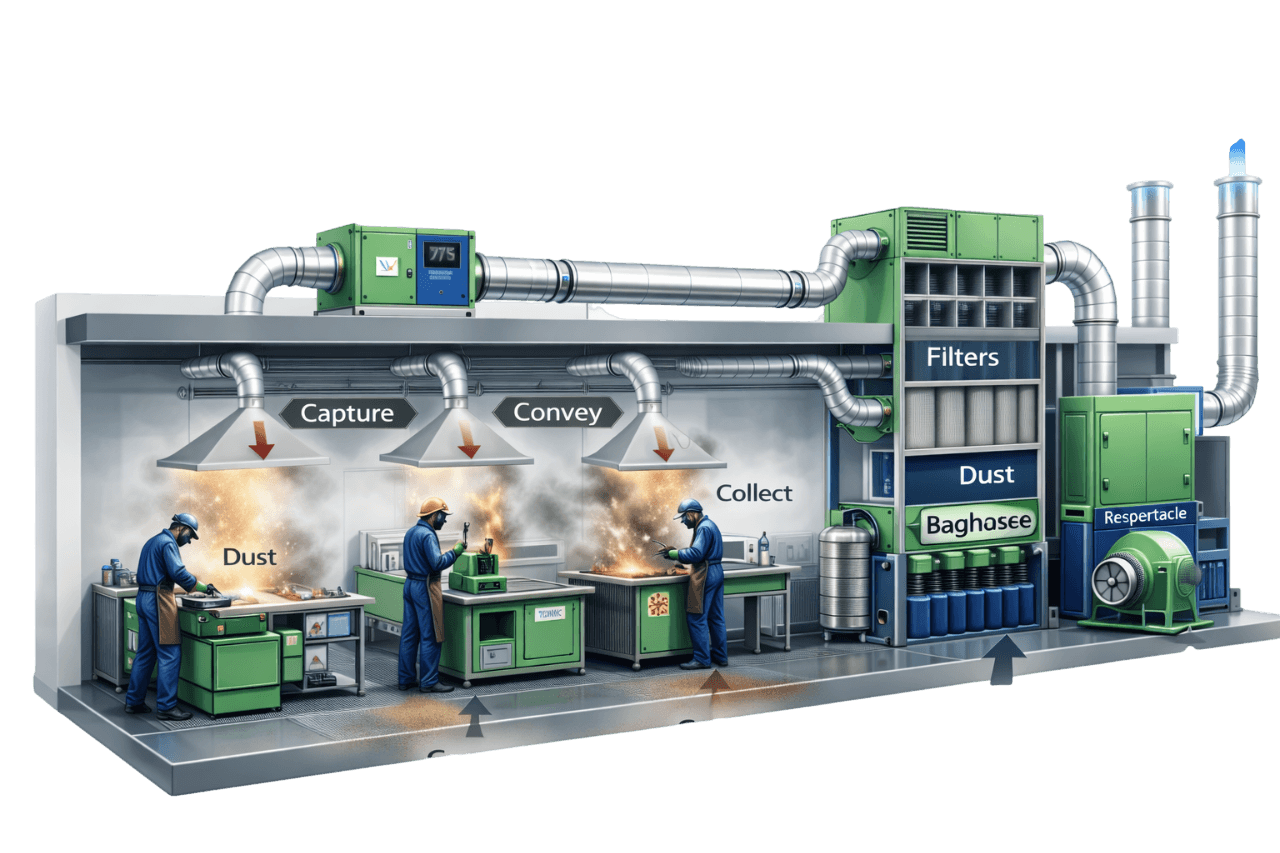
Dust Collection Systems
Learn More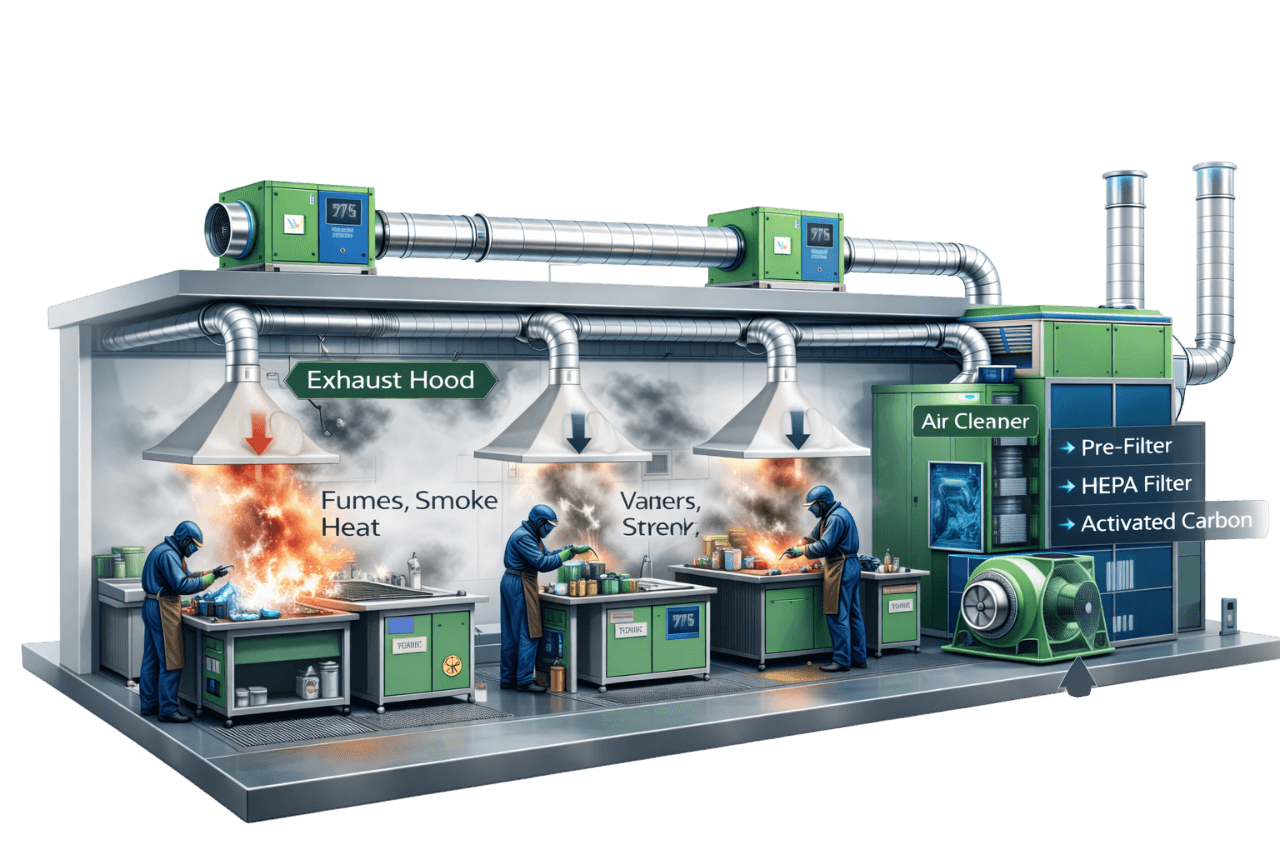
Fume Extraction Systems
Learn More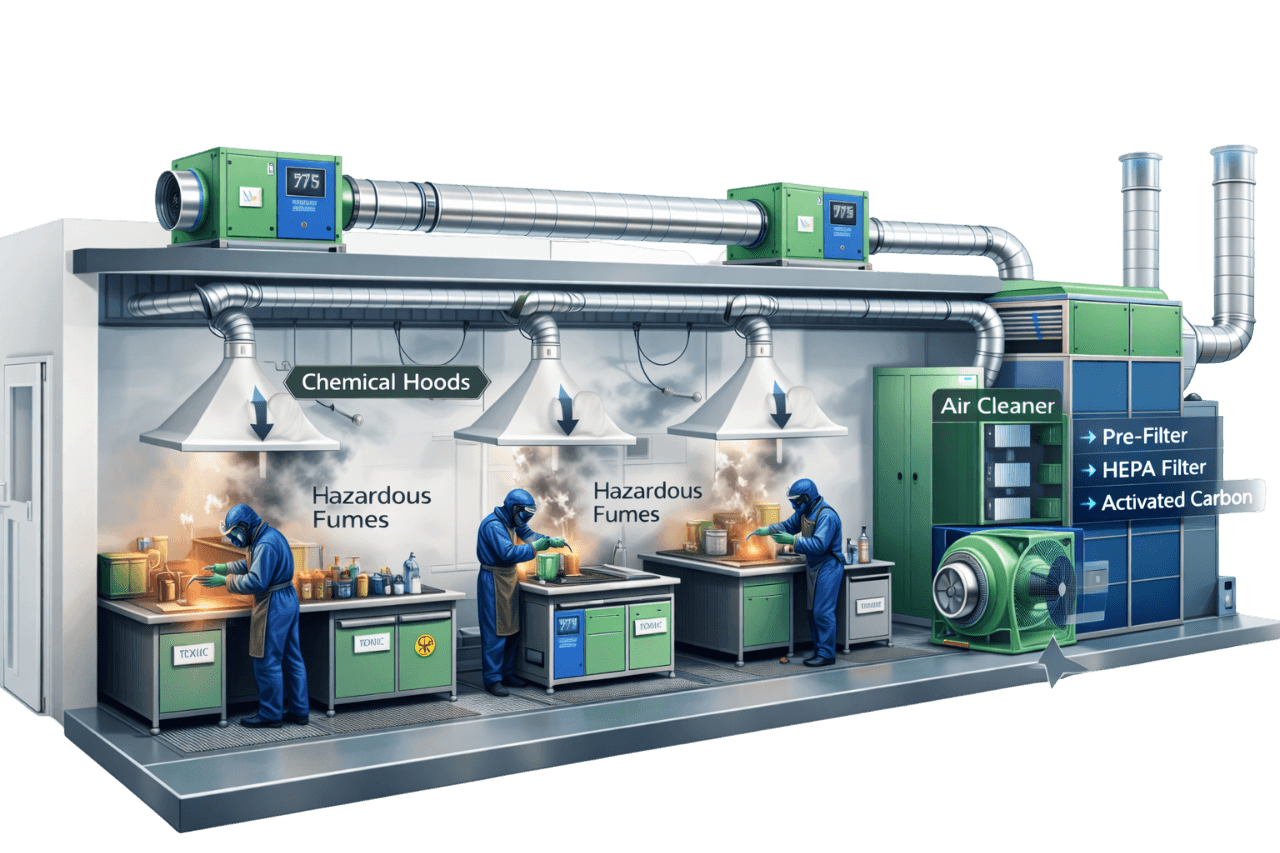
Chemical Exhaust Systems
Learn More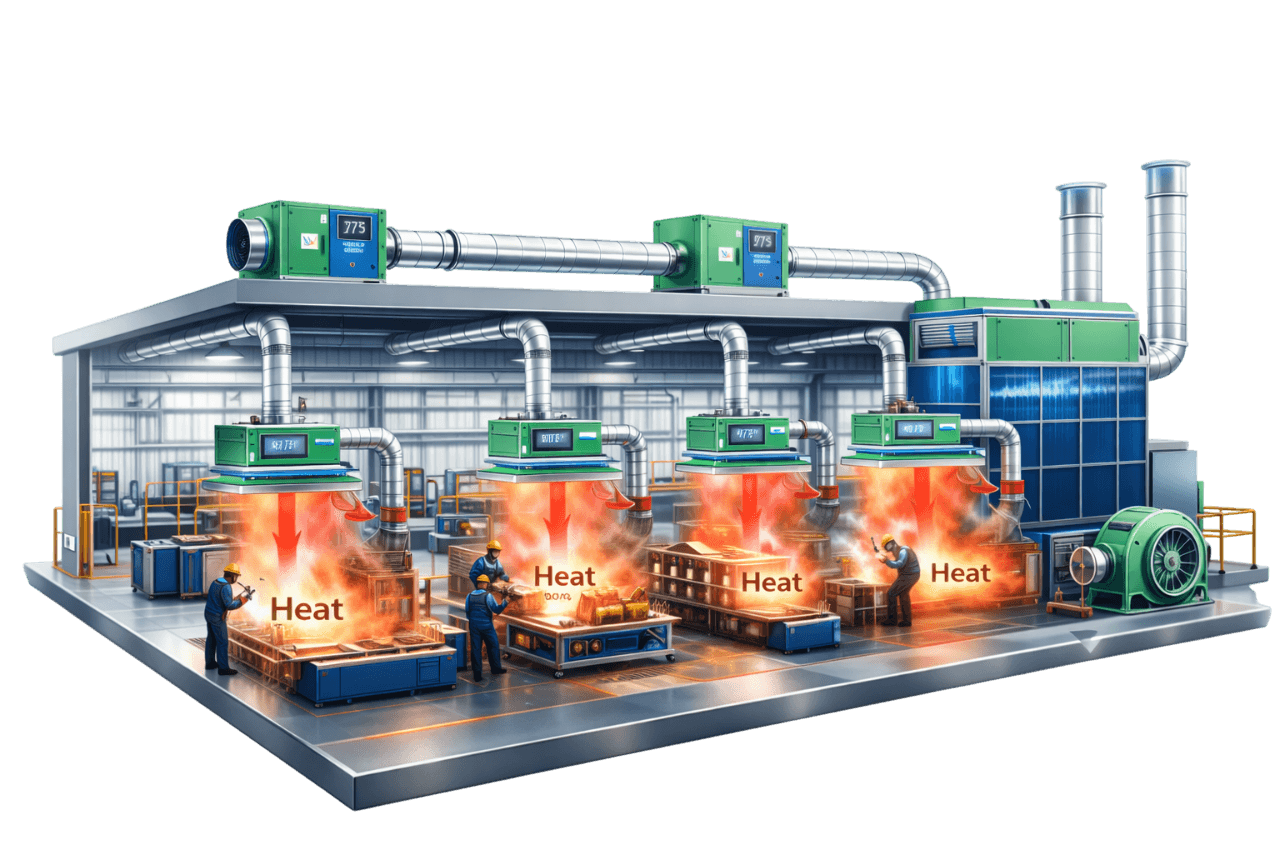
Heat Exhaust Ventilation Systems
Learn More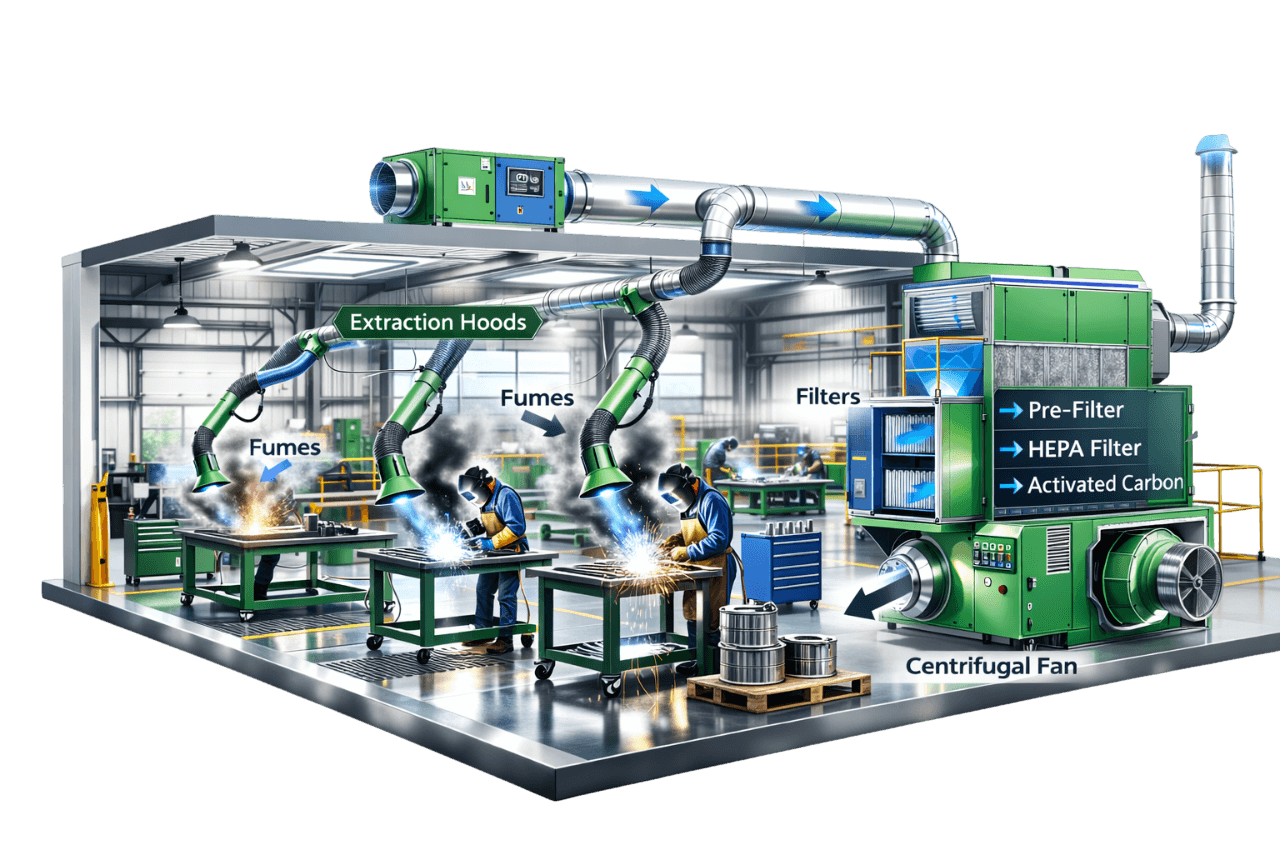
Welding Fume Extraction Systems
Learn More
Paint Booth Ventilation Systems
Learn MoreFrequently Asked Questions
Q1. What is an industrial dilution ventilation system?
An industrial dilution ventilation system supplies fresh outdoor air and exhausts contaminated air to keep vapours, gases, heat and moisture below safe levels throughout a factory or plant. It dilutes contaminants rather than capturing them at the source.
Q2. How does dilution ventilation work in factories?
Fresh air enters at low level, sweeps through the work zone, mixes with contaminants released by processes and vehicles, and is exhausted by roof or wall fans. Sensors can adjust airflow to actual contaminant levels and temperatures.
Q3. What is the difference between industrial and general dilution ventilation?
General dilution ventilation is the broad principle of diluting contaminants with fresh air in any building, from offices to car parks. Industrial dilution ventilation applies that principle to factories and plants, where it is designed around process contaminants, exposure limits, flammable vapour limits and high heat loads, often with flameproof equipment and gas detection.
Q4. What is the difference between dilution ventilation and LEV in industries?
LEV captures contaminants at the source before they reach workers, using hoods and ducts at low airflow. Dilution ventilation lowers concentrations after contaminants mix into room air, using much higher airflow. LEV is needed for toxic dusts and fumes, while dilution suits low-toxicity vapours, gases and heat from many sources.
Q5. Which industrial contaminants can be controlled with dilution ventilation?
Dilution ventilation suits solvent and VOC vapours from diffuse sources, hydrogen from battery charging, CO and NO₂ from forklifts, process heat and moisture, odours and low-toxicity process gases. It is not suitable for toxic dusts, welding fume or high-toxicity gases.
Q6. How is dilution airflow calculated for flammable vapours (LEL)?
The airflow is calculated from the solvent evaporation rate, the vapour's lower explosive limit, its molecular weight and specific gravity, and a safety factor. The design typically keeps vapour concentrations at 25% of the LEL or lower, with temperature corrections for hot processes.
Q7. How much ventilation is required for battery charging areas?
It depends on the number of cells, battery type and charging current. Airflow is calculated to keep hydrogen well below its lower explosive limit of about 4% in air, using methods such as those in the IEC 62485 series, with exhaust from ceiling level and spark-resistant fans.
Q8. How are forklift emissions controlled in warehouses?
Forklift emissions are controlled with dilution ventilation using roof or wall exhaust fans and fresh air inlets, controlled by CO and NO₂ sensors. Regular engine maintenance, and switching to electric forklifts where possible, also reduce emissions at the source.
Q9. When should dilution ventilation be combined with LEV?
Dilution ventilation should be combined with LEV whenever some sources release toxic contaminants, large vapour volumes or dust and fume. LEV captures those sources directly, while dilution handles background contamination, heat and minor sources.
Q10. Which gas detectors are used in industrial dilution ventilation systems?
Common detectors include VOC and LEL sensors for solvent vapours, CO and NO₂ sensors for forklift and engine emissions, hydrogen sensors for battery charging areas and ammonia sensors for refrigeration plants. The right technology and mounting height depend on the gas and the application.
Q11. What is the cost of an industrial dilution ventilation system in India?
Indicative supply prices start from around ₹5,000 to ₹25,000 for a heavy duty wall exhaust fan and ₹25,000 to ₹1,50,000 for an industrial roof exhaust fan, with make-up air, gas detection and controls adding to the total. The final cost depends on building size, airflow and hazard level. Contact Compress India for an accurate quotation.
Q12. Does Compress India design and install industrial dilution ventilation systems in Mumbai?
Yes. Compress India designs, supplies, installs, tests, commissions and maintains industrial dilution ventilation systems across Mumbai, Thane, Navi Mumbai and MIDC industrial areas, and undertakes projects across India. Contact our HVAC team to schedule a site survey.