Paint Booth Ventilation Systems
(Design, Supply, Installation, Testing, Commissioning & AMC for Spray Paint Booth Ventilation)
Design, Supply, Installation, Testing, Commissioning & AMC for Spray Paint Booth Ventilation
A great paint finish depends on the air around it. Too little airflow and overspray settles back on the surface; dusty intake air leaves specks in the clear coat; poor exhaust lets solvent vapour build up toward dangerous levels. Compress India designs and installs paint booth ventilation systems that deliver clean, controlled airflow for a flawless finish, a safe painter and a compliant shop.
From a compact open-face spray booth to a full downdraft spray-bake booth for an automotive workshop or a large booth for buses and rail coaches, we engineer the air make-up, filtration, exhaust and controls around your booth, paint and production. Share your booth details for a free site survey and detailed quotation.
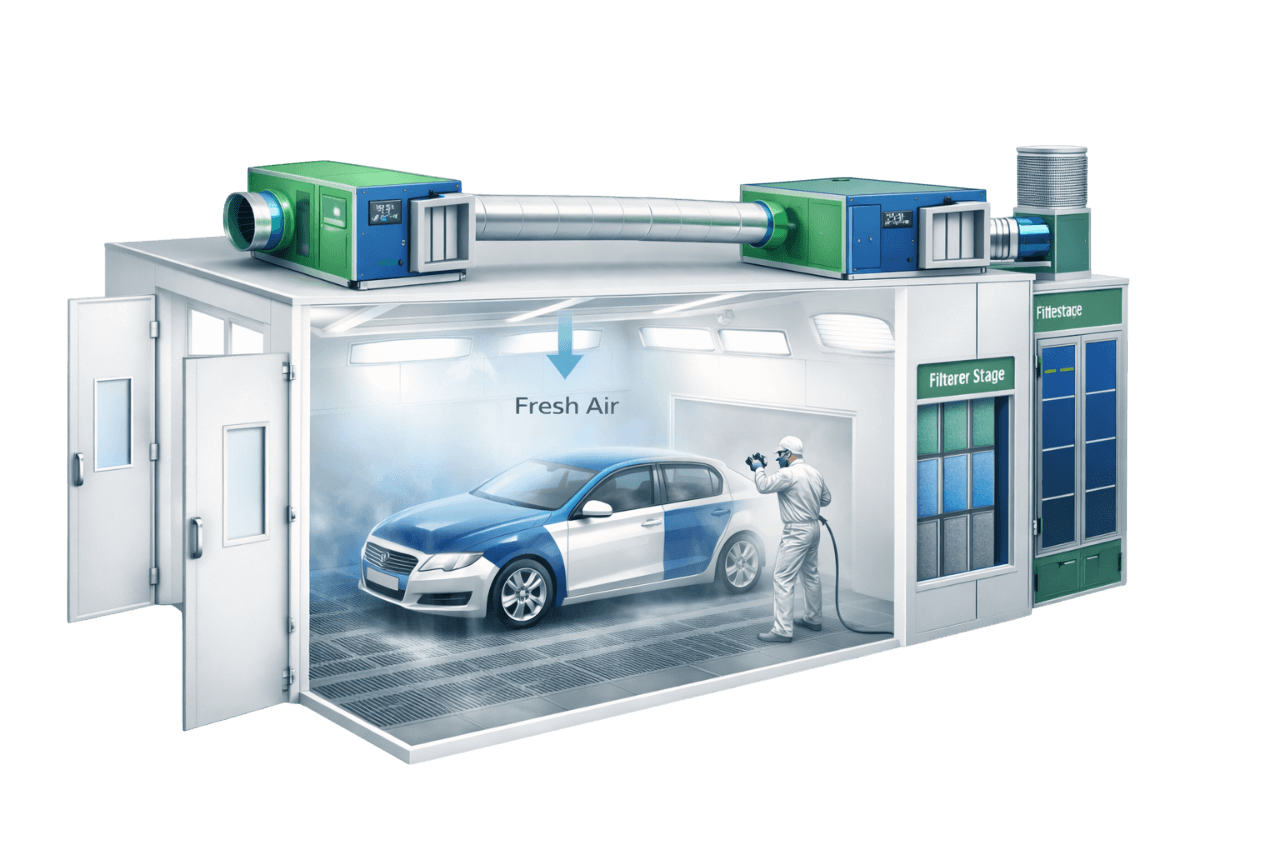
Compress India is a single-point partner for spray booth ventilation in Mumbai, Navi Mumbai, Thane and across India, taking responsibility from design to long-term maintenance.
- Design: Booth type and airflow selection, exhaust CFM calculation, air make-up and heating capacity, filter sizing, duct and stack design, and hazardous area considerations.
- Supply: Intake and ceiling filters, exhaust overspray filters, spark-resistant and explosion-proof exhaust fans, air make-up units, burners and heaters, explosion-proof lighting and control panels.
- Installation: Booth ventilation equipment, ductwork and stacks fabricated and installed by our teams, with electrical and control integration.
- Testing & Commissioning: Air velocity, pressure balance, LEL, bake temperature and interlock testing, with a documented report.
- AMC: Filter replacement, fan and burner servicing, duct cleaning and controls calibration.
Whether you need a paint booth ventilation system for an automotive workshop, a paint booth exhaust system with make-up air for an industrial line or paint booth ventilation with an explosion proof exhaust fan for a solvent-based process, we deliver a complete, compliant solution.
What Is a Paint Booth Ventilation System?
A paint booth ventilation system is the combination of fresh air supply, filtration, airflow control and exhaust that makes a spray booth work. It brings filtered air into the booth, moves it across or down past the object being painted, captures overspray in filters or a water curtain, and exhausts the solvent-laden air safely through a stack.
The ventilation system does three jobs at once: it protects the painter from overspray and solvent vapour, keeps flammable vapour concentrations well below explosive levels and provides clean, dust-free air so the paint finish is smooth and defect-free. In spray-bake booths, the same system also heats and recirculates air to cure the paint.
A typical paint booth ventilation system includes:
- An air make-up unit (AMU) with intake filters and, where needed, a heater
- Ceiling or intake plenum filters that deliver clean, evenly distributed air
- Exhaust overspray filters or a water wash system
- A spark-resistant or explosion-proof paint booth exhaust fan
- Paint booth exhaust ductwork and a stack
- Controls, interlocks, pressure monitoring and explosion-proof lighting
It is also called a spray booth ventilation system, paint booth exhaust system, paint booth airflow system or spray paint booth ventilation.
Why Paint Booth Ventilation Is Essential
Spray painting releases a fine mist of paint particles and a large volume of solvent vapour. Without proper ventilation, both quality and safety suffer.
Removing Overspray & Solvent Vapours
Only part of the paint sprayed reaches the surface; the rest becomes overspray. Paint overspray extraction and paint vapor extraction keep this mist and the evaporating solvents moving away from the painter and the workpiece and into the exhaust filters.
Keeping Vapours Below Explosive Limits
Solvent vapours are flammable. Paint booth LEL ventilation provides enough airflow to keep vapour concentrations far below the lower explosive limit, which is the foundation of paint booth fire and explosion safety.
Dust-Free Air for a Flawless Finish
Dust, fibres and insects in the air end up in the paint film as defects that need sanding and polishing. Multi-stage intake and ceiling filtration supplies clean air, while controlled airflow carries overspray away before it can settle.
Protecting Painters' Health
Paint mist and solvents can cause respiratory irritation, headaches, dizziness and long-term health effects, and some coatings contain isocyanates, which are strong respiratory sensitisers. Good ventilation, combined with appropriate respiratory protection, keeps painter exposure under control.
Emission Control & Regulatory Compliance
Paint shops must control overspray and VOC emissions, store solvents safely and meet fire safety requirements. A properly engineered spray booth ventilation system with filtration, a correctly designed stack and VOC control where required supports compliance with pollution control and safety authorities.
How a Paint Booth Ventilation System Works
Every spray booth ventilation system follows the same path: clean air in, controlled flow past the work, overspray captured, contaminated air out.
1. Filtered Fresh Air Enters the Booth
The air make-up unit draws outdoor air through intake pre-filters and supplies it to the booth, usually through a ceiling plenum fitted with fine diffusion filters. In spray-bake booths, the air can be heated before entering.
2. Controlled Airflow Moves Across or Down Through the Booth
The air moves through the booth at a controlled velocity, either horizontally in a crossdraft booth or vertically downward in a downdraft booth. This paint booth airflow pattern carries overspray away from the painter's breathing zone and the painted surface.
3. Overspray Is Captured by Exhaust Filters or Water Curtain
The overspray-laden air passes through paint arrestor filters in dry filter booths, or a curtain of water in water wash booths, which capture the paint particles before the air leaves the booth.
4. Exhaust Fan Removes Contaminated Air
A spark-resistant paint booth exhaust fan draws the air through the filters and ductwork, maintaining the airflow and keeping solvent vapours well below explosive limits.
5. Air Is Discharged Through the Stack or Treated for VOCs
The exhaust air is discharged through a paint booth exhaust stack high enough to disperse vapours safely. Where emission norms require it, the exhaust passes through activated carbon or an oxidiser to reduce VOC emissions before discharge.
Paint Booth Airflow Configurations
The direction of airflow through the booth has a major effect on finish quality, painter exposure and cost. Compress India helps you choose the right configuration for your work.
Crossdraft Paint Booths
In a crossdraft paint booth, air enters through filtered doors or an intake wall at one end and flows horizontally along the booth to exhaust filters at the opposite end. Crossdraft booths are the most economical option and suit industrial, fabrication and general finishing work, but overspray is drawn along the length of the workpiece.
Full Downdraft Paint Booths
In a downdraft paint booth, air enters through a full ceiling filter and flows vertically down past the vehicle or part into a floor pit with exhaust filters. This gives the cleanest finish and the best overspray control, making it the preferred choice for automotive refinishing and high-quality work.
Semi-Downdraft Paint Booths
A semi downdraft paint booth supplies air through a partial ceiling plenum near the front of the booth and exhausts it at the rear wall. It offers much of the benefit of a downdraft booth without the cost of a floor pit.
Side Downdraft Paint Booths
In a side downdraft paint booth, air enters through the ceiling and is exhausted through filters low on the side walls. It gives downdraft-style airflow without a pit, making it popular where civil work is difficult.
Open-Face Paint Booths
An open face paint booth has an open front and exhausts through filters at the back wall, drawing room air through the open face. It is ideal for small parts, bench work, touch-up and airbrush work, and needs good room make-up air to perform well.
Types of Paint Booths
Paint booths vary widely by overspray capture method, heating, size and level of automation. Compress India designs ventilation for every type.
Dry Filter Paint Booths
Dry filter booths capture overspray on replaceable paint arrestor filters made of fibreglass, paper or synthetic media. They are clean, simple and low-maintenance, and are the most common choice for automotive refinishing, furniture and general industrial painting.
Water Wash (Water Curtain) Paint Booths
Water wash booths use a curtain or spray of water at the back wall to capture overspray, which settles as sludge in a water tank. They handle high paint volumes well and are often used on production lines, but need pumps, water treatment and regular sludge removal.
Spray-Bake Paint Booths
Spray-bake booths combine painting and curing in one enclosure. After spraying, the air make-up unit heats and recirculates air to bake the paint at elevated temperature, shortening curing time and improving finish hardness. They are standard in automotive body shops.
Powder Coating Booths
Powder coating booths capture and often recover oversprayed powder using cartridge filters or cyclones. Powder coating booth ventilation keeps powder concentrations safely low and returns clean air to the room or exhausts it, depending on the design.
Large Industrial Booths for Trucks, Buses & Rail Coaches
Large booths for commercial vehicles, rail coaches and heavy equipment need very high airflows, multiple air make-up units and exhaust fans, and often platforms for painters working at height. Industrial paint booth ventilation for these booths demands careful airflow distribution along the full length.
Bench & Small Open-Face Booths
Small bench and open-face booths serve touch-up, small components, airbrush work, models and laboratories. A small paint booth exhaust fan with filters and a short duct to outside is usually all that is required.
Automatic & Robotic Paint Lines
Automatic and robotic paint lines use conveyorised booths, flash-off zones and ovens. They require precisely balanced air supply and exhaust for each zone, often with water wash or dry scrubber overspray capture and VOC abatement.
Main Components of a Paint Booth Ventilation System
Each component of the paint booth ventilation system affects finish quality, safety and running cost. Compress India selects and integrates every part to suit your booth.
Booth Enclosure & Cabin
The booth cabin, typically made of insulated or single-skin panels, contains the spraying operation, guides airflow and keeps dust out. Door seals, panel joints and windows must be airtight for the ventilation system to work properly.
Intake & Ceiling Plenum Filters
Intake pre-filters on the air make-up unit remove coarse dust, while fine ceiling filters in the plenum diffuse the air evenly across the booth. Paint booth intake filters and paint booth ceiling filters are the key to a dust-free finish.
Exhaust Overspray Filters
Paint arrestor filters in the floor pit or rear wall capture overspray before it reaches the fan and ducts. A paint booth exhaust filter that is loaded with paint must be replaced on time to maintain airflow and reduce fire risk.
Water Wash System (Pump, Tank & Sludge Removal)
Water wash booths include a water tank, recirculation pumps, a water curtain or spray, eliminators and a sludge removal system. Chemical treatment detackifies the paint so it can be removed easily.
Spark-Resistant Exhaust Fans
The paint booth exhaust fan must be spark-resistant, with the motor rated for the hazardous area or located outside the airstream. Explosion proof exhaust fans for paint booths, whether axial or centrifugal, are a critical safety component.
Air Make-Up Unit (AMU)
The air make-up unit supplies filtered fresh air equal to or slightly more than the exhaust volume, often with a heater. A heated make-up air paint booth maintains comfortable temperatures and correct paint application conditions.
Heating System for Bake Cycle
In spray-bake booths, a burner or heater raises air temperature for the bake cycle. Diesel, gas and electric heating options are available, with heat exchangers keeping combustion products out of the booth.
Explosion-Proof Lighting
Booth lighting must not create an ignition source. Light fittings are usually mounted outside the booth behind sealed glass panels or are explosion-proof rated, providing bright, even light for accurate colour matching.
Ductwork & Exhaust Stack
Paint booth exhaust ductwork carries exhaust air to the stack. Ducts are dedicated to the booth, made of non-combustible material, fitted with access for cleaning and routed to a stack that discharges well above the roofline.
Control Panel & Interlocks
The control panel manages spray, flash-off and bake modes, fan speeds, heating and alarms. Paint booth fan interlocks prevent spraying unless the exhaust fan is running and link the booth to fire suppression systems.
Crossdraft vs Downdraft Paint Booths
Downdraft booths give the cleanest finish and best overspray control; crossdraft booths cost less and need no floor pit.
| Factor | Crossdraft Paint Booth | Downdraft Paint Booth |
|---|---|---|
| Airflow direction | Horizontal, end to end | Vertical, ceiling to floor |
| Finish quality | Good | Excellent, lowest dust and overspray re-deposit |
| Painter exposure | Overspray can pass the painter if positioned downstream | Overspray drawn down, away from the breathing zone |
| Civil work | None | Floor pit or raised base required |
| Capital cost | Lower | Higher |
| Best for | Industrial parts, fabrication, general finishing | Automotive refinishing, premium finishes |
Semi-downdraft and side downdraft booths sit between the two, offering improved airflow without a full pit.
Dry Filter vs Water Wash Paint Booths
Dry filter booths are simpler and cleaner to run; water wash booths handle higher paint volumes with fewer filter changes.
| Factor | Dry Filter Booth | Water Wash Booth |
|---|---|---|
| Overspray capture | Replaceable arrestor filters | Water curtain or spray |
| Best for | Low to moderate paint volumes, refinishing, furniture | High-volume production painting |
| Consumables | Filter media | Water, treatment chemicals, pump power |
| Waste | Paint-loaded filters | Paint sludge and wastewater |
| Maintenance | Regular filter changes | Sludge removal, water treatment, pump upkeep |
| Capital cost | Lower | Higher |
Air Make-Up & Booth Pressure Balance
The balance between air supplied and air exhausted determines whether the booth pulls in dust, pushes out overspray or performs exactly as designed.
Air Make-Up Unit Sizing
The air make-up unit is sized to supply at least the full exhaust volume, with enough fan pressure to overcome intake and ceiling filters. In spray-bake booths, the heater is sized for the air volume and the required temperature rise for both spray and bake modes.
Positive vs Negative Booth Pressure
Most automotive spray-bake booths operate at a slight positive pressure, so any leakage is outward and dust cannot be drawn in through door gaps. Some industrial and open-face booths run at slight negative pressure to prevent vapour escape into the building. The right choice depends on the booth type, location and surroundings.
Balancing Supply & Exhaust Airflow
Paint booth air balancing adjusts supply and exhaust fans, often with VFDs and a paint booth differential pressure sensor, to hold the target pressure as filters load. This keeps the finish clean, the painter protected and the doors easy to open.
Spray-Bake Heating & Curing
Spray-bake booths use the ventilation system to cure paint as well as apply it. Correct heating design speeds up throughput and delivers a harder, glossier finish.
Heating Options (Diesel, Gas & Electric)
Diesel-fired burners are widely used in Indian body shops, while LPG and piped natural gas burners offer cleaner combustion where supply is available. Electric heaters suit smaller booths or sites without fuel supply. Indirect heat exchangers keep combustion products out of the booth air.
Bake Cycle Air Recirculation
During the bake cycle, most of the booth air is recirculated through the heater, with a small proportion of fresh air to purge remaining vapours. Recirculation reaches bake temperature quickly and reduces fuel consumption significantly compared with heating 100% fresh air.
Infrared Curing Systems
Short-wave and medium-wave infrared lamps cure small repairs and panels quickly by heating the paint film directly. They can be used alone for spot repairs or alongside convection baking to reduce cycle times.
Temperature Uniformity
Even airflow and heat distribution across the booth ensure consistent curing on every panel. Poor uniformity leads to soft spots, gloss variation and rework, so we design air distribution and control for stable, even temperatures.
Paint Booth Filtration & VOC Control
Multi-stage filtration keeps dust off the paint and overspray out of the atmosphere, while VOC control reduces solvent emissions where regulations or neighbours demand it.
Intake Pre-Filters
Intake pre-filters on the air make-up unit capture coarse dust, insects and debris from outdoor air, protecting the heater, fan and ceiling filters.
Ceiling Diffusion Filters
Fine ceiling diffusion filters remove small particles and spread the incoming air evenly across the booth, creating a smooth, laminar downflow that is essential for a clean finish.
Overspray Exhaust Filters
Paint arrestor filters capture paint overspray at the booth floor or rear wall. Paint overspray filtration efficiency and holding capacity determine how often filters need changing and how clean the exhaust ducts stay.
Secondary Pocket Filters
Secondary pocket or bag filters after the arrestor stage capture fine overspray particles that pass the primary filters, reducing emissions and protecting the fan and ducts from paint build-up.
Activated Carbon for VOC Removal
Activated carbon adsorbers remove solvent vapours from exhaust air in booths with moderate VOC loads. Paint booth VOC extraction through carbon is useful where odour complaints or local emission norms require treatment.
Regenerative Thermal Oxidisers (RTO)
For large paint lines with high solvent consumption, regenerative thermal oxidisers destroy VOCs at high temperature and recover most of the heat. Concentrator systems can reduce the air volume that needs treating, making RTOs more economical.
Fire & Explosion Safety in Paint Booths
Paint booths handle flammable solvents, combustible overspray and, in spray-bake booths, burners. Explosion proof paint booth ventilation and layered safety measures are non-negotiable in every Compress India design.
LEL-Based Ventilation Rates
The exhaust rate is designed to keep solvent vapour concentrations well below the lower explosive limit, with recognised standards such as NFPA 33 requiring concentrations not to exceed 25% of that limit. We calculate paint booth flammable vapor control airflows from your paint and solvent consumption, not just booth size.
Hazardous Area Classification
The booth interior, exhaust plenum and ducts, and zones around openings are classified as hazardous areas where flammable atmospheres may occur. India follows the IS/IEC 60079 series for area classification. Hazardous area paint booth ventilation equipment is then selected to suit each zone.
Explosion-Proof Motors, Lights & Electricals
Motors, lights, switches and sensors within classified zones must be certified explosion-protected, or located outside the hazardous area. Lighting is typically installed outside the booth behind sealed glass panels.
Spark-Resistant Fans
Non sparking paint booth fans use spark-resistant materials such as aluminium impellers or rub rings, with motors outside the airstream or rated for the zone. An explosion proof exhaust fan for spray booth duty is a key safety component, not an optional upgrade.
Automatic Fire Suppression
Automatic sprinklers or dry chemical and gas suppression systems protect the booth interior, exhaust plenum and ducts. On activation, the system shuts down spray equipment, heating and fans as required by the fire strategy.
Spray Gun & Exhaust Interlocks
Interlocks prevent spray equipment from operating unless the exhaust fan is running and airflow is proven. The heater is interlocked so it cannot fire without airflow, and bake mode cannot start while painting is under way.
Grounding & Static Control
Paint booth grounding bonds the booth, ducts, fans, spray equipment and workpieces to earth, preventing static discharge that could ignite solvent vapour. Conductive flooring and grounded containers add further protection.
Paint Booth Standards & Regulations
Paint booth ventilation must satisfy fire safety, occupational safety and environmental requirements. Compress India designs with these references in mind.
NFPA 33 Spray Application Standard
NFPA 33 is the leading international standard for spray application using flammable or combustible materials. It covers booth construction, ventilation, electrical classification, interlocks, fire protection and housekeeping, and is widely used as a benchmark by multinational and OEM facilities in India.
EN 16985 Spray Booth Safety Standard
EN 16985 is the European safety standard for spray booths for organic coating materials. It sets requirements for booth design, ventilation, explosion and fire protection, and is referenced by many European booth manufacturers supplying the Indian market.
Factories Act & State Factory Rules (India)
The Factories Act, 1948 required employers to control dust and fumes, prevent fire hazards and protect workers from hazardous substances. These duties continue under the Occupational Safety, Health and Working Conditions Code, 2020, operative since 21 November 2025, with State Factory Rules such as the Maharashtra Factories Rules guiding practical compliance in paint shops.
PESO Requirements for Paint & Solvent Storage
The Petroleum and Explosives Safety Organisation (PESO) licenses the storage of petroleum products and flammable liquids above specified quantities. Paint mixing rooms and solvent stores must meet these requirements, including the use of approved flameproof electrical equipment in hazardous areas.
CPCB & SPCB VOC & Emission Norms
Paint shop emissions fall under the Air (Prevention and Control of Pollution) Act, 1981. State Pollution Control Boards, such as the Maharashtra Pollution Control Board, may set conditions on particulate and VOC emissions, stack height and monitoring through your Consent to Establish and Consent to Operate. Overspray filtration, VOC abatement and correctly designed stacks help you meet them.
Paint Booth Ventilation Design & Sizing
Good paint booth ventilation design balances finish quality, safety and running cost. Compress India sizes every component from your actual booth dimensions, paint consumption and production pattern.
Booth Size & Type Selection
The booth must fit the largest item you paint, with enough working space around it for the painter and equipment. We then choose the airflow configuration, overspray capture method and heating based on your finish quality, paint volume and budget.
Required Air Velocity Through the Booth
Paint booth air velocity must be high enough to carry overspray away but not so high that it disturbs the spray pattern or wastes energy. Downdraft booths are commonly designed at around 0.3 to 0.5 m/s across the floor area, and crossdraft booths at around 0.5 m/s across the booth cross-section.
Exhaust Airflow Calculation
Paint booth CFM calculation multiplies the design air velocity by the area the air passes through. For example, a 7 m × 4 m downdraft car booth at 0.3 m/s needs about 30,000 m³/h, while a crossdraft booth with a 4 m × 3 m cross-section at 0.5 m/s needs about 21,600 m³/h. We then check that this airflow keeps solvent vapours well below the LEL for your paint consumption.
Air Make-Up & Heating Capacity
The air make-up unit is sized to match or slightly exceed the paint booth exhaust CFM. Heating capacity is calculated from the airflow and required temperature rise for spray mode, and from the recirculation rate and bake temperature for the bake cycle.
Filter Area & Face Velocity
Ceiling, intake and exhaust filter areas are sized to keep air velocity through the media within the manufacturer's rating. Correct face velocity maximises capture efficiency, holding capacity and filter life while keeping pressure drop low.
Pit & Grating Design for Downdraft Booths
Downdraft booths need a pit or raised base with grating, filter holders and exhaust channels designed for uniform airflow along the full length of the booth. Pit depth, grating open area and channel layout are all engineered to avoid dead zones.
Duct Design & Stack Height
Paint booth exhaust ducts are sized for the design airflow with smooth transitions and cleaning access, and are dedicated to the booth rather than shared with other exhausts. The stack is designed to discharge well above the roofline and away from air intakes to prevent re-entry.
Fan Selection & Static Pressure
The paint booth exhaust fan is sized for the design airflow and the paint booth static pressure, including exhaust filters at their loaded condition, ducts and stack. Fans are selected for spark-resistant, hazardous area duty, and supply and exhaust fans are matched for pressure balance.
Lighting Requirements
Painters need bright, uniform, shadow-free light with good colour rendering for accurate colour matching and defect detection. We plan the number and position of explosion-proof or outside-mounted light fittings along the booth walls and ceiling.
Energy Efficiency in Paint Booths
Paint booths move and heat large volumes of air, so ventilation is often the biggest energy cost in a paint shop. An energy efficient paint booth ventilation system can cut both electricity and fuel bills significantly.
VFD Fan Control for Spray, Flash-Off & Bake Modes
A paint booth exhaust fan VFD runs fans at full speed only while spraying, then reduces speed for flash-off, bake and standby modes. Because fan power falls sharply as speed reduces, the savings are substantial.
Air Recirculation During Bake Cycle
Recirculating most of the air during the bake cycle, with only a small fresh air purge, reaches bake temperature faster and uses far less fuel than heating fresh air continuously.
Heat Recovery from Exhaust Air
Paint booth heat recovery units transfer heat from warm exhaust air to incoming make-up air, reducing heating demand in bake and cooler-weather operation. Heat exchangers are selected to handle paint-laden air safely.
Efficient Burners & Heating Systems
Modern modulating burners and well-sized heat exchangers deliver the heat needed without over-firing. Regular servicing keeps combustion efficiency high.
Explosion-Proof LED Lighting
Explosion-proof and outside-mounted LED lighting uses much less power than older fittings, gives better colour rendering and lasts far longer, reducing maintenance inside the booth.
Controls & Automation
Smart controls make paint booths easier to operate, safer and more consistent from job to job.
PLC Control Panels
PLC-based control panels manage fans, burners, dampers, lighting and safety interlocks from a single touch screen, with preset programmes for different paint systems.
Spray & Bake Cycle Automation
Automatic sequencing moves the booth from spray to flash-off, bake and cool-down with the right airflow, temperature and time for each stage, reducing operator error.
Filter Pressure Drop Monitoring
Differential pressure gauges or sensors across intake, ceiling and exhaust filters show filter loading and alert operators when changes are due, protecting airflow and finish quality.
Temperature Control
Paint booth temperature control holds stable conditions during spraying and precise bake temperatures during curing. Paint booth humidity control can also be added where coatings are sensitive to moisture.
Alarms, Interlocks & Fire System Interface
Alarms warn of low airflow, filter loading, burner faults or high temperature. Interlocks and fire system interfaces shut down spraying, heating and fans safely in an emergency, and paint booth BMS integration makes status visible to facility teams.
Benefits of Paint Booth Ventilation Systems
A properly engineered paint booth ventilation system improves quality, safety and productivity at the same time.
Superior, Dust-Free Paint Finish
Filtered, evenly distributed air and effective overspray removal produce cleaner, smoother finishes with less sanding, polishing and rework.
Safe Working Environment for Painters
Controlled airflow moves overspray and solvent vapour away from the painter's breathing zone, reducing exposure and improving comfort.
Reduced Fire & Explosion Risk
LEL-based ventilation, spark-resistant fans, explosion-proof electricals, interlocks and suppression systems greatly reduce the risk of fire or explosion.
Faster Curing & Higher Throughput
Spray-bake heating and optimised air cycles cure paint faster, letting you complete more jobs per day in the same booth.
Compliance with Emission Norms
Overspray filtration, VOC abatement where needed and correctly designed stacks help you meet pollution control consent conditions and avoid complaints.
Cleaner Workshop
Containing overspray in the booth keeps paint dust off tools, vehicles, equipment and walls in the rest of the workshop.
Limitations of Paint Booth Ventilation Systems
Understanding the trade-offs helps you plan the right system and budget.
High Airflow & Heating Energy Use
Booths move large air volumes and may heat them for baking. VFDs, bake recirculation, heat recovery and efficient burners reduce, but do not eliminate, this energy use.
Filter Consumables & Hazardous Waste Disposal
Paint-loaded filters and water wash sludge are consumables that must be replaced and disposed of as hazardous waste through authorised channels.
Space & Civil Work for Pits
Full downdraft booths require a floor pit or raised base, plus space for air make-up units, exhaust fans and ducting. Semi-downdraft and side downdraft designs reduce civil work.
Permits & Compliance Requirements
Paint booths may need fire safety approvals, pollution control consents and solvent storage licences. We design and document systems to support these approvals.
Regular Maintenance Needed
Filters, burners, fans, water wash systems and controls need routine maintenance to maintain finish quality and safety. An AMC makes this predictable.
Where Paint Booth Ventilation Systems Are Used
Compress India designs paint booth ventilation for a wide range of automotive, industrial and specialist applications.
Automobile Body Shops & Refinishing Centres
Automotive paint booth ventilation for body shops and dealer workshops uses downdraft or semi-downdraft spray-bake booths with heated air make-up for fast, high-quality refinishing. This is where a paint booth ventilation system for an automotive workshop delivers the biggest quality gains.
Automotive OEM Paint Lines
OEM paint shops use automated, multi-zone booths, flash-off tunnels and ovens with precisely balanced supply and exhaust, overspray capture and VOC abatement.
Two-Wheeler Manufacturing
Two-wheeler manufacturers paint tanks, panels and frames on conveyorised lines with water wash or dry filter booths, robotic application and baking ovens.
Bus & Truck Body Builders
Bus and truck body builders need large booths with high airflows, multiple air make-up units and painter platforms to finish long vehicles evenly.
Railway Coach Workshops
Railway coach painting requires very large booths with carefully distributed airflow along the full coach length, and heating for curing.
Furniture & Woodworking Units
Furniture paint booth ventilation handles lacquers, PU and melamine finishes with dry filter booths, good lighting and solvent control, often in open-face or crossdraft configurations.
Appliance & Metal Fabrication Units
Appliance, cabinet, enclosure and fabrication shops use crossdraft and water wash booths for liquid painting and powder coating booths for durable finishes.
Aerospace Maintenance Facilities
Aerospace paint booth ventilation for aircraft parts and hangars demands very high cleanliness, precise airflow control and robust fire protection.
Powder Coating Shops
Powder coating booth ventilation captures and recovers powder, keeps concentrations safely low and integrates with curing ovens and conveyor lines.
Industrial Equipment Manufacturing
Pumps, compressors, gensets, tractors and machinery are painted in industrial booths sized for large, heavy parts, often with overhead conveyors or rail-mounted trolleys.
Top Paint Booth Brands in India
Paint shops in India can choose from established international booth brands and capable domestic manufacturers. Compress India takes an application-first approach: whether you choose an imported booth, an Indian-made booth or need ventilation for an existing booth, we design, supply and install the air make-up, exhaust, ductwork, stacks and controls that make it perform.
Blowtherm
Blowtherm is an Italian manufacturer of spray booths and industrial heating equipment, well known in automotive refinishing for spray-bake booths and air make-up units.
USI Italia
USI Italia is an Italian spray booth manufacturer offering booths and preparation areas for automotive refinishing and industrial applications.
Junair
Junair is a New Zealand-based spray booth manufacturer known for automotive refinish booths and energy-efficient airflow and curing technologies.
Global Finishing Solutions (GFS)
Global Finishing Solutions is a US-based manufacturer of paint booths and finishing systems for automotive, industrial and aerospace applications.
Other Paint Booth Manufacturers
A number of Indian manufacturers produce cost-effective crossdraft, downdraft, water wash and powder coating booths for body shops and industry. We help you evaluate these options and ensure the ventilation system meets your quality and safety requirements.
*Brand names are trademarks of their respective owners and are mentioned for reference only.*
Paint Booth Installation Guide
Correct paint booth ventilation installation is essential for airflow performance, safety and a flawless finish. Compress India's teams follow a structured sequence coordinated with your civil and electrical works.
Site Survey & Layout Planning
We survey the building, floor space, height, roof structure, access routes, power and fuel availability, and the location of air intakes and neighbours. The booth, air make-up unit, exhaust fans and stack are then positioned for efficient workflow and safe discharge.
Civil Pit Construction for Downdraft Booths
For full downdraft booths, we provide pit drawings with dimensions, depth, grating supports and exhaust channel details, and coordinate with your civil contractor to ensure the pit is built accurately.
Booth Panel Erection
Booth panels, doors, windows and plenum sections are erected, aligned and sealed to create an airtight enclosure that supports correct airflow and pressure balance.
Air Make-Up & Exhaust Unit Installation
Air make-up units and exhaust fan units are installed on the roof, beside the booth or on structural frames, with anti-vibration mounts, flexible connectors and access for maintenance.
Ductwork & Stack Installation
Supply and paint booth exhaust ductwork is fabricated and installed with sealed joints, cleaning access and proper supports. The exhaust stack is erected to the designed height, with weather protection that does not deflect air back down.
Burner, Heater & Fuel Line Installation
Burners, heat exchangers and fuel lines for diesel, gas or electric heating are installed with safety valves, flue connections and controls, following manufacturer and safety requirements.
Explosion-Proof Electrical & Lighting
Electrical work in classified areas uses certified explosion-protected equipment, sealed conduits and correct cable glands. Lighting is installed outside the booth behind sealed panels or as explosion-proof fittings, and the booth is bonded and grounded.
Fire Suppression Integration
We coordinate with the fire protection contractor to integrate sprinklers or suppression systems in the booth, plenum and ducts, and interlock them with spray equipment, heating and fans.
Testing & Commissioning
Paint booth ventilation commissioning verifies that the booth delivers the airflow, pressure, temperature and safety performance it was designed for.
Air Velocity Measurement Across the Booth
We measure air velocity at a grid of points across the booth floor or cross-section to confirm average velocity and uniformity, and adjust fans and dampers to eliminate dead zones.
Booth Pressure Balance Check
Booth pressure is measured in spray and bake modes and supply and exhaust fans are adjusted to hold the target positive or negative pressure.
Vapour & LEL Monitoring
Where required, vapour concentrations are monitored during spraying to confirm that ventilation keeps levels well below the lower explosive limit.
Bake Temperature Uniformity Test
Temperature sensors placed around the booth record heat-up time and temperature uniformity during the bake cycle, confirming even curing across the vehicle or part.
Interlock & Alarm Testing
Spray gun interlocks, burner airflow interlocks, filter alarms, fire system interfaces and emergency stops are tested to confirm safe operation.
Stack Emission Testing
Where required by consent conditions, stack emission testing can be arranged through accredited laboratories to confirm particulate and VOC levels.
Paint Booth Service, Maintenance & AMC
Paint booth ventilation maintenance protects finish quality, safety and energy efficiency. Compress India's AMC keeps your booth performing like new.
Intake, Ceiling & Exhaust Filter Replacement
Intake, ceiling and exhaust filters are inspected and replaced based on pressure drop and paint throughput, maintaining airflow and a dust-free finish.
Water Wash Sludge Removal & Chemical Treatment
For water wash booths, sludge is removed, water treatment chemicals are dosed and pumps and nozzles are checked to keep overspray capture effective.
Fan & Motor Checks
Fans are inspected for paint build-up, vibration, bearing wear and belt condition, and motors for current draw and insulation health.
Burner Servicing
Burners are cleaned, tuned and checked for safe ignition and efficient combustion, and heat exchangers are inspected for leaks.
Duct & Stack Cleaning
Paint residue in ducts and stacks restricts airflow and increases fire risk. Regular cleaning keeps the paint booth exhaust duct clear and safe.
Lighting & Door Seal Checks
Light fittings and glass panels are cleaned and checked, and door seals and panel joints are inspected to maintain airtightness and pressure balance.
Controls Calibration
Temperature sensors, pressure gauges, timers and interlocks are calibrated and tested so the booth runs accurately and safely.
Common Paint Booth Problems & Solutions
Most paint finish and booth performance problems trace back to ventilation. Compress India diagnoses and corrects issues in booths of any make.
Dust & Dirt in the Paint Finish
Cause: Loaded or damaged intake and ceiling filters, negative booth pressure drawing in dust, or poor door seals. Solution: Replace filters, restore slight positive pressure, repair seals and improve pre-booth cleaning.
Overspray Drifting & Poor Capture
Cause: Low or uneven air velocity, blocked exhaust filters or turbulence around the workpiece. Solution: Measure and correct airflow, replace exhaust filters and rebalance supply and exhaust.
Paint Fumes Escaping the Booth
Cause: Booth running at excessive positive pressure, leaking doors or panels, or an undersized exhaust fan. Solution: Rebalance fans, seal leaks and upgrade exhaust capacity where needed.
Uneven Airflow
Cause: Poor plenum design, uneven filter loading or unbalanced pit exhaust channels. Solution: Redistribute ceiling filters, add baffles or dampers and correct pit exhaust design.
Clogged Filters & Low Airflow
Cause: Filters left beyond their life or undersized for the paint volume. Solution: Set replacement schedules based on pressure drop, increase filter area and add secondary filtration.
Booth Pressure Imbalance
Cause: Changing filter resistance, fixed-speed fans or unbalanced supply and exhaust. Solution: Add VFDs with differential pressure control to maintain balance automatically.
Uneven Baking Temperature
Cause: Poor air distribution, burner problems or incorrect recirculation settings. Solution: Service burners, correct airflow distribution and adjust bake controls.
Paint Build-Up in Ducts & Fire Risk
Cause: Inadequate exhaust filtration or infrequent duct cleaning. Solution: Upgrade to multi-stage filtration, clean ducts regularly and review fire protection.
High Energy Bills
Cause: Fans running at full speed in all modes, heating fresh air during bake and inefficient lighting. Solution: Add VFDs, bake recirculation, heat recovery and LED lighting.
Paint Booth Retrofit & Upgrades
Existing booths can often be upgraded for better finish quality, compliance and efficiency without full replacement.
Converting Crossdraft to Downdraft
Converting a crossdraft booth to semi-downdraft or side downdraft airflow, or to full downdraft with a pit, significantly improves finish quality and painter protection.
Adding Spray-Bake Heating
Adding a heated air make-up unit and bake recirculation turns a spray-only booth into a spray-bake booth, speeding up curing and increasing daily throughput.
VFD & LED Lighting Upgrades
Retrofitting VFDs to fans and replacing old fittings with explosion-proof LED lighting reduces energy use and maintenance with a quick payback.
Adding VOC Abatement for Compliance
Where emission norms tighten or neighbours complain, we add activated carbon or oxidiser systems to reduce VOC emissions from existing booths.
Converting Water Wash to Dry Filter Booths
Converting water wash booths to dry filter systems eliminates sludge handling, water treatment and pump maintenance for many lower-volume operations.
Paint Booth Ventilation System Cost in India
Paint booth ventilation price in India depends on booth type and size, airflow configuration, heating, filtration and safety requirements. The ranges below are indicative for complete booths with ventilation, excluding GST, to help you plan a budget before a site survey.
| Booth Type | Typical Indicative Range (INR) | Main Price Drivers |
|---|---|---|
| Small open-face or bench booth | ₹3.5 lakh to ₹8 lakh | Size, exhaust fan, filter type |
| Medium crossdraft / dry filter booth | ₹8 lakh to ₹20 lakh | Size, air make-up, lighting, controls |
| Automotive body shop spray-bake booth | ₹18 lakh to ₹35 lakh | Downdraft or semi-downdraft, heating type, AMU capacity |
| Water wash production booth | ₹6 lakh to ₹25 lakh | Size, pumps, water treatment, sludge system |
| Large bus, truck, rail or OEM booths | ₹45 lakh to ₹1.5 crore | Size, airflow, multiple AMUs, automation, VOC control |
*Indicative ranges only. Your exact paint booth ventilation price depends on the survey, booth specification and site conditions. Request a free quotation from Compress India for an accurate figure.*
Cost by Booth Type & Size
Booth size sets the airflow, which in turn sets the size of fans, air make-up units, filters and ducts. Downdraft configurations cost more than crossdraft because of ceiling plenums, pit filters and civil work, while water wash booths add pumps and water treatment.
Air Make-Up & Heating System Cost
The air make-up unit and heating system are among the largest cost items in a spray-bake booth. Heating can add roughly ₹2 lakh to ₹18 lakh depending on capacity and fuel type, with indirect-fired and gas systems generally costing more than basic diesel or electric options.
Ductwork & Installation Cost
Ductwork, stacks, erection, explosion-proof electrical work, fire suppression integration and civil work for pits add to the equipment cost. For complete turnkey projects, these can add a significant share to the booth equipment price.
Filter & Consumable Costs
Intake, ceiling and exhaust filters are recurring costs that depend on paint throughput and booth size. Water wash booths replace filter costs with water treatment chemicals, sludge disposal and pump maintenance.
Factors Affecting Total Project Cost
- Booth size, type and airflow configuration
- Air make-up capacity and heating fuel
- Filtration stages and VOC abatement requirements
- Explosion-proof fans, lighting and electricals
- Pit construction and other civil work
- Ductwork length and stack height
- Controls: PLC, VFDs, pressure balance and BMS integration
- Fire suppression and safety interlocks
- AMC, filters and consumables over the booth's life
A correctly engineered booth ventilation system costs less over its life through better finish quality, fewer reworks, lower energy bills and fewer compliance issues.
Paint Booth Ventilation Design & Installation in Mumbai, Navi Mumbai & Thane
Compress India provides complete paint booth ventilation design and installation across Mumbai, Navi Mumbai, Thane and the wider Maharashtra industrial belt. Our local teams offer quick site surveys, coordinated installation and responsive after-sales support.
The region's body shops, dealer workshops, auto component makers, furniture units, fabrication shops and industrial manufacturers all depend on clean, safe paint finishing. Our designs account for the region's humidity and monsoon conditions, which affect filtration, heating and curing performance.
For clients outside the Mumbai region, we undertake paint booth ventilation projects across India with the same design, installation and commissioning standards.
Why Choose Compress India for Paint Booth Ventilation?
As a paint booth ventilation supplier and installation partner, Compress India brings airflow engineering, safety expertise and long-term support to every project.
Industrial Ventilation & Airflow Design Expertise
We calculate air velocities, exhaust CFM, air make-up and heating capacity, filter areas and static pressure for your booth, so it delivers a clean finish and a safe working environment from day one.
Booth, AMU & Exhaust Integration
We integrate the booth, air make-up unit, heating, filters, exhaust fans and controls into one balanced system, with correct pressure control across spray, flash-off and bake modes.
In-House Ductwork & Stack Fabrication
Our in-house fabrication of supply and exhaust ductwork, plenums and stacks ensures correct fit, quality joints and faster installation.
Fire Safety & Compliance Focus
LEL-based ventilation, spark-resistant and explosion-proof equipment, interlocks, grounding and fire suppression integration are built into every design, supporting your safety and pollution control approvals.
Energy-Efficient System Design
VFD fan control, bake recirculation, heat recovery and LED lighting reduce running costs without compromising finish quality or safety.
Testing & Commissioning
Every booth is tested for air velocity, pressure balance, bake temperature uniformity and interlocks, then handed over with a complete commissioning report.
AMC & Filter Replacement Support
Our AMC covers filter replacement, fan and burner servicing, duct cleaning, lighting and seal checks and controls calibration, keeping your booth performing reliably.
Get a Paint Booth Ventilation Solution from Compress India
A flawless finish and a safe paint shop start with the right ventilation design. Tell us about your booth, paints and production, and we will recommend the most effective and economical solution.
Connect with Our HVAC Team
Share your requirement with Compress India's HVAC team today. Send us your booth size, type, paint system, production volume and site details, and we will arrange a site survey and provide a detailed proposal and quotation.
Call us, email us or fill out the enquiry form to request a free site survey and quotation for your paint booth ventilation system.
Related Fume Extraction, Chemical Exhaust & LEV Solutions
Paint booth ventilation often works alongside other ventilation and air quality systems. Compress India also designs and installs:
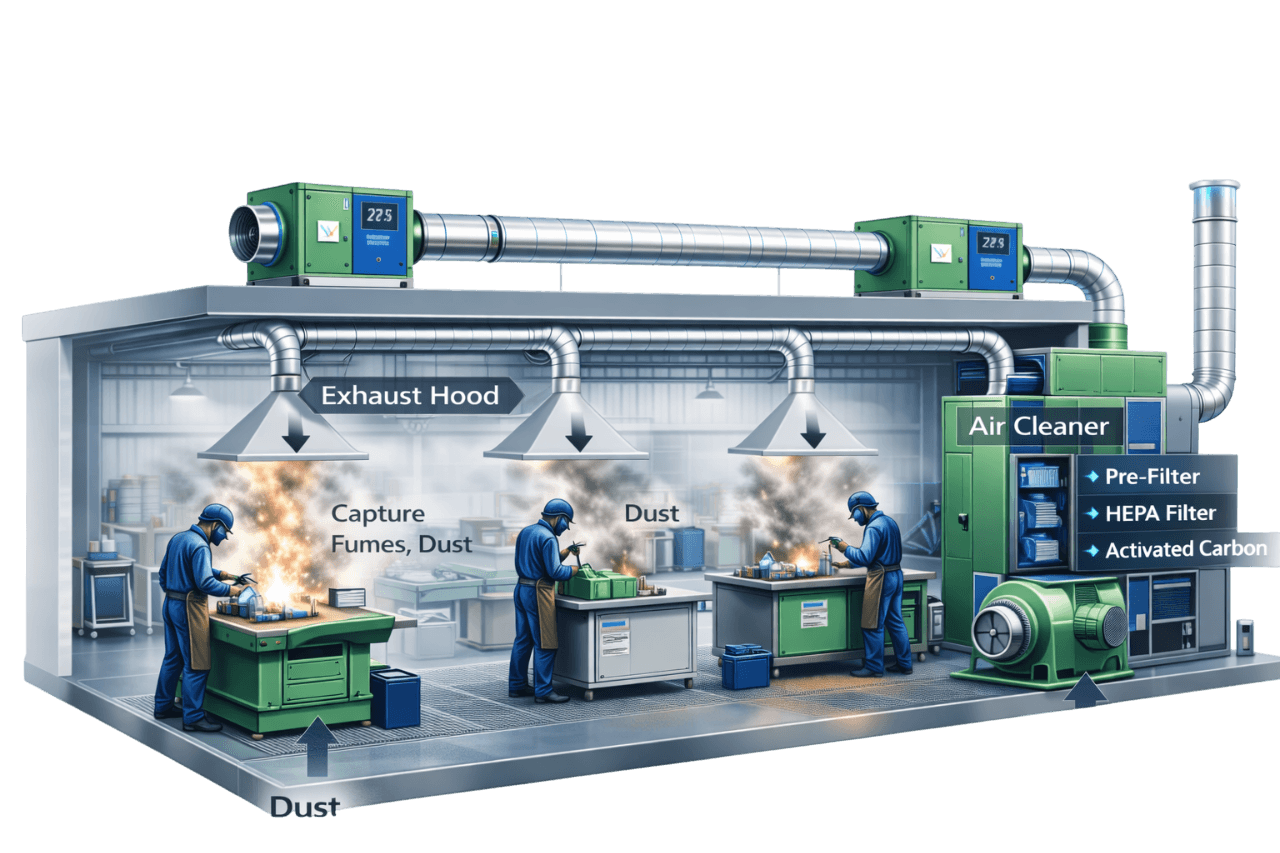
Local Exhaust Ventilation (LEV) Systems
Learn More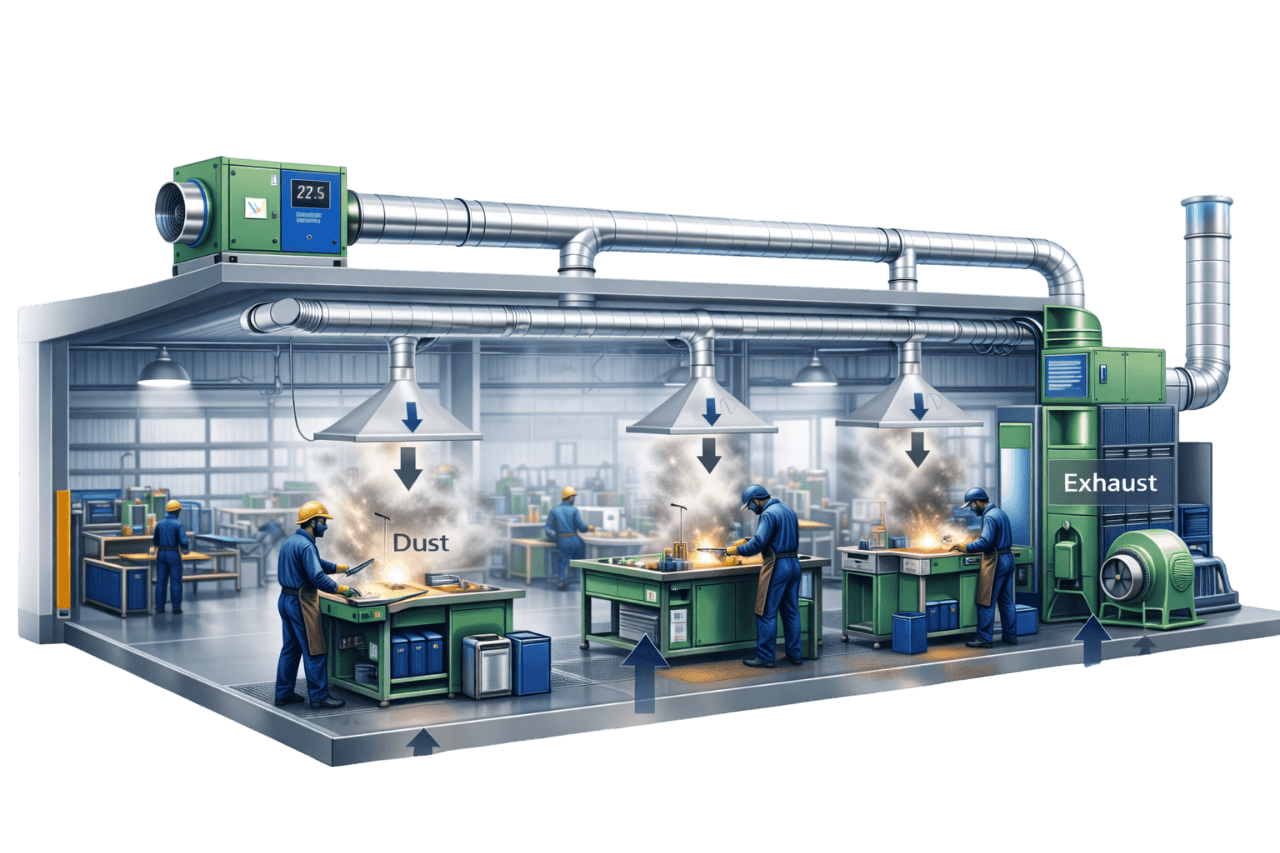
General Dilution Ventilation Systems
Learn More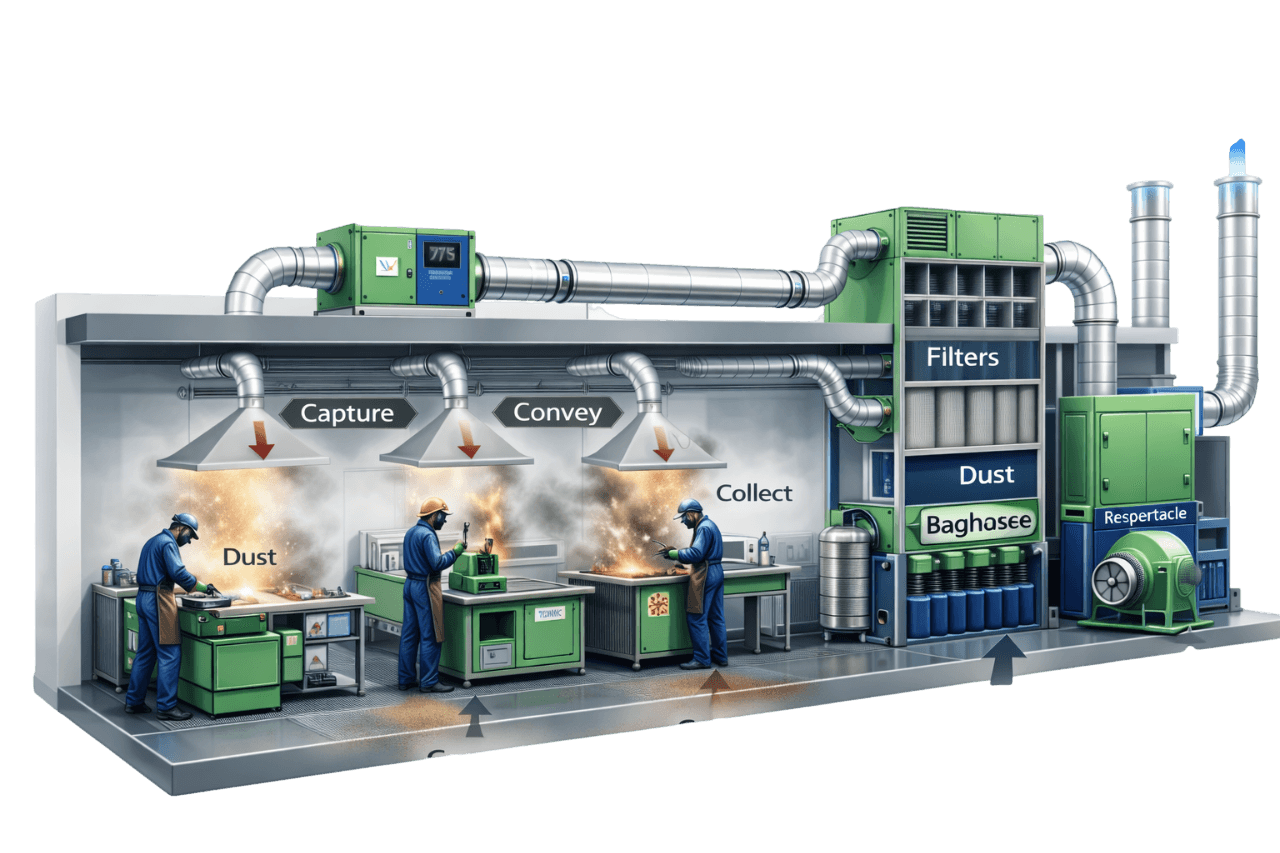
Dust Collection Systems
Learn More
Fume Extraction Systems
Learn More
Chemical Exhaust Systems
Learn More
Heat Exhaust Ventilation Systems
Learn More
Welding Fume Extraction Systems
Learn More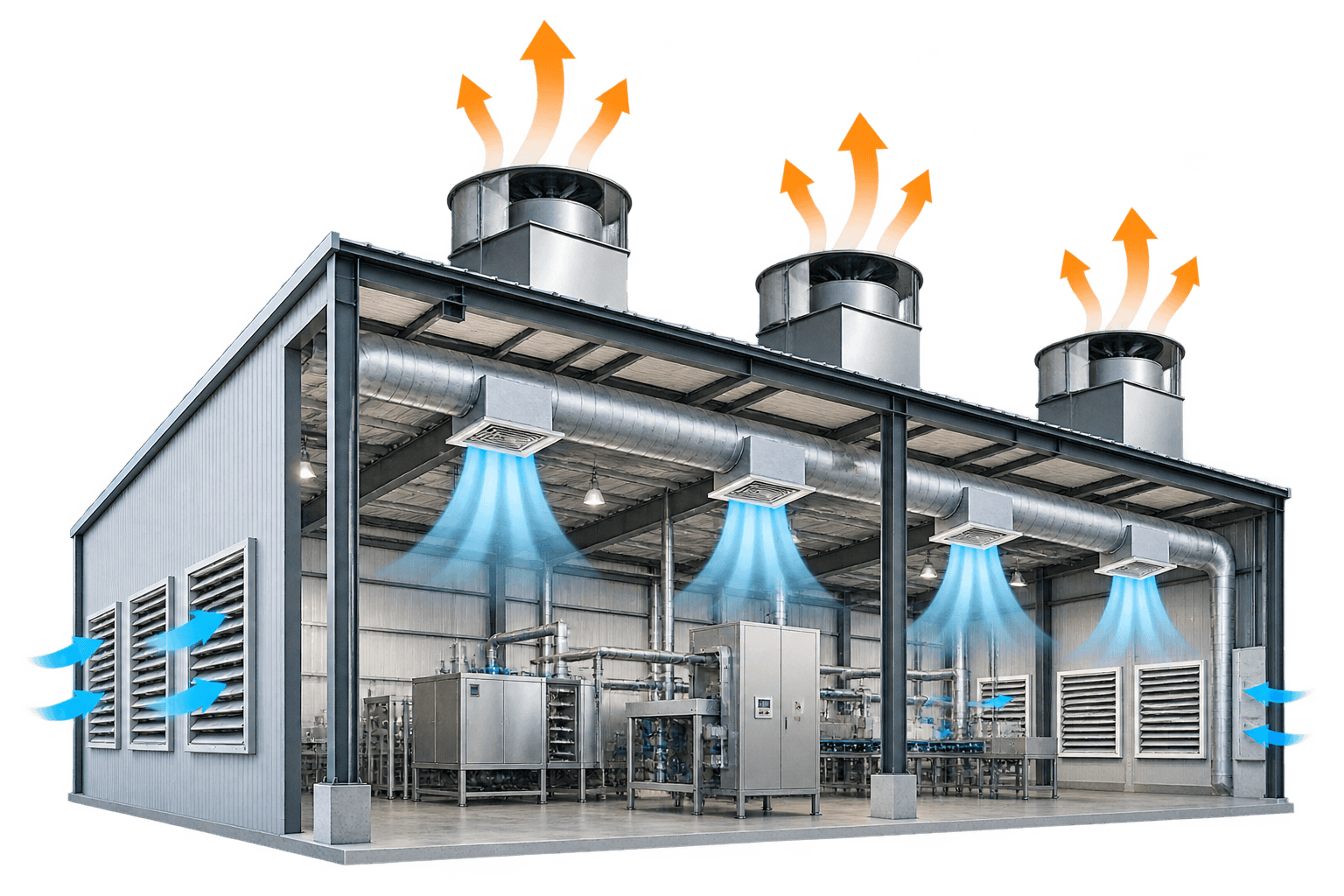
Industrial Dilution Ventilation Systems
Learn MoreFrequently Asked Questions
Q1. What is a paint booth ventilation system?
A paint booth ventilation system supplies filtered fresh air to a spray booth, moves it across or down past the object being painted, captures overspray in filters or a water curtain and exhausts solvent-laden air safely through a stack. It protects the painter, keeps vapours below explosive limits and gives a dust-free finish.
Q2. How does paint booth ventilation work?
An air make-up unit draws outdoor air through intake filters and supplies it through ceiling or wall filters. The air flows through the booth at a controlled velocity, overspray is captured by exhaust filters or water, and a spark-resistant exhaust fan discharges the air through a stack.
Q3. What is the difference between crossdraft and downdraft paint booths?
In a crossdraft booth, air flows horizontally from one end to the other. In a downdraft booth, air flows vertically from the ceiling to a floor pit. Downdraft booths give a cleaner finish and better painter protection, while crossdraft booths cost less and need no pit.
Q4. What is a spray-bake paint booth?
A spray-bake booth is used for both painting and curing. After spraying, the air make-up unit heats and recirculates the air to bake the paint at elevated temperature, reducing curing time and improving finish durability.
Q5. What is the difference between dry filter and water wash paint booths?
Dry filter booths capture overspray on replaceable filters and are simple to run. Water wash booths capture overspray in a water curtain and suit high-volume production, but need pumps, water treatment and sludge removal.
Q6. How much airflow is required in a paint booth?
Airflow is the design air velocity multiplied by the booth area the air passes through. Downdraft booths are commonly designed at about 0.3 to 0.5 m/s and crossdraft booths at about 0.5 m/s. For example, a 7 m × 4 m downdraft car booth at 0.3 m/s needs about 30,000 m³/h.
Q7. Why is paint booth pressure balance important?
Pressure balance controls where leakage goes. Slight positive pressure keeps dust out of the booth for a clean finish, while correct balance prevents overspray and vapour escaping into the workshop and keeps doors easy to open.
Q8. What filters are used in paint booths?
Paint booths use intake pre-filters on the air make-up unit, fine ceiling diffusion filters, paint arrestor exhaust filters and, often, secondary pocket filters. Activated carbon or oxidisers are added where VOC control is needed.
Q9. How is fire and explosion risk controlled in paint booths?
Ventilation keeps solvent vapours well below the lower explosive limit, while spark-resistant fans, explosion-proof electricals, grounding, spray gun and heater interlocks and automatic fire suppression remove ignition sources and control any fire quickly.
Q10. How often should paint booth filters be replaced?
It depends on paint throughput and booth design. Exhaust filters may need changing weekly or even daily in busy shops, while intake and ceiling filters typically last longer. Pressure drop gauges are the most reliable guide.
Q11. What is the cost of a paint booth ventilation system in India?
Indicative costs range from about ₹3.5 lakh for a small open-face booth and ₹18 lakh to ₹35 lakh for an automotive spray-bake booth, to ₹45 lakh and above for large bus, truck or OEM booths. The final cost depends on size, heating, filtration and controls. Contact Compress India for an accurate quotation.
Q12. Does Compress India design and install paint booth ventilation systems in Mumbai?
Yes. Compress India designs, supplies, installs, tests, commissions and maintains paint booth ventilation systems across Mumbai, Navi Mumbai, Thane and the rest of Maharashtra, and undertakes projects across India. Contact our HVAC team to schedule a site survey.